Saturday, April 27, 2024

A new (old) book in the former native speaker's library

I got back last Saturday from Yokohama, where I had a great experience talking to a small but very interested audience about George H. Kerr, his process(es) of writing what eventually became Formosa Betrayed, how Taiwanese students at Kansas State University used Kerr's book in their "battle of the pens" with pro-KMT students, and the translations of the book into Chinese. (Some of this is discussed in my 2014 conference paper, "Formosa Translated.") 

While I was there, I also got a chance to talk with my friends Su Yao-tsung, Hidekazu Sensui, and Yukari Yoshihara about a project we're working on related to Kerr. (More details forthcoming.) I also had a lot of conversations with Su about Kerr, the writing of Formosa Betrayed and his other works, the February 28 Incident, the Taiwan independence movement in Japan and the United States, and the Cold War context of Kerr's teaching and writing about Taiwan. 

He also suggested a topic that I might work on researching related to that last point, so I decided to look up some books written about Taiwan during the 1950s. I just got one of them in the mail, Geraldine Fitch's (infamous) Formosa Beachhead (which is also available online). 


Fitch, who died in 1976 at the age of 84, was described in the New York Times obituary as "a consultant editor to The Free China Review and other English‐language publications in Taipei, Taiwan." 

Judging from a quick skim of the book, Formosa Beachhead is less about Taiwan than it is about China and the United States' policies towards China (and Nationalist China in particular). It'll be interesting to read in more detail.

There are a couple of contemporaneous reviews of the book, including the following:
I need to go home to find George H. Kerr's review of the book, but he was not as kind as these two were.

Saturday, April 13, 2024

台灣演義 episode about the World United Formosans for Independence

I came across this video in my search for more information about WUFI, the World United Formosans for Independence organization. Unlike some other 台灣演義 videos that I've posted, this one has English subtitles! Enjoy!

Thursday, April 04, 2024

Preparing for a presentation in Japan

I've been invited to talk at the Center for Asian Studies at Kanagawa University in Yokohama about my research on George H. Kerr. My lecture is entitled, "Formosa's "Borrowed Voice": George H. Kerr's Struggle to Chronicle Taiwan's Postwar Trauma," playing on the title of Linda Arrigo and Lynn Miles' book, A Borrowed Voice: Taiwan Human Rights through International Networks, 1960-1980 (a book you should get if you haven't yet!). Like the "foreigners" Arrigo and Miles describe who lent their voices to speak for Taiwanese who, at the time, would be in danger if they spoke out themselves, Kerr tried to use his voice to tell Americans about what was happening in Taiwan as soon as he left the island after the February 28 Incident. But he struggled to write and publish a complete account of what happened, for reasons I'll describe in my talk.

My lecture is on April 19--if you happen to be in the Yokohama area, here's where you can get more information to register!

I'm also working on an article manuscript about this topic, which has been accepted with revisions required. (That might take a little while because I'm also speaking at the North American Taiwan Studies Association conference in June. Yikes!)

Wednesday, March 20, 2024

This blog is 20 years old!

A lot has happened since I typed out these words.  

A Pennsylvania Dutch proverb that I often heard as a child goes, "Ve git too soon oldt und too late schmart." I think that about sums things up. I don't have any words of wisdom to share after 20 years of off-and-on blogging. I sort of do this for my own entertainment, I guess, so I don't have high expectations for it. (Though I have at times referred to it in my annual self-criticisms merit reviews as an example of the writing that I do.)

If anyone is curious, though, here's a list of what are currently the top three posts on this thing, according to Blogger stats:

Odd that the top 3 are all from the summer of 2016. I have my own favorites from before that. Like this 2005 review of 走出白色恐怖 (Farewell to the White Terror) by 孫康宜 (Sun Kang-i). 

And this 2006 post on the Freshman Chinese curriculum reform at Tunghai and its 2013 follow-up on how the course was going. (Yikes! I can't believe the follow-up itself is over 10 years old!!) 

And, of course, this 2005 posting of a FICTIONAL love story that I wrote with the help of the former native Chinese speaker back in 1996. Always liked this story. I can still recite some of it, which always impresses my wife! 

Any other posts I should add to this list?

Sunday, March 10, 2024

Need to watch: Fareed Zakaria's CNN special about "Taiwan: Unfinished Business"

I saw an ad for this Fareed Zakaria special on Taiwan, but I wasn't able to see it when it was on CNN, so I'm recording it and will watch it later.


I saw that some people on Twitter criticized the title, wondering whose "unfinished business" it was--the CCP's? One poster (Isla Island) wrote, "'Unfinished business' parrots Beijing's propaganda that its planned invasion & annexation of Taiwan is part of a 'unfinished Chinese civil war'."

I thought the title was interesting in light of the fact that one of the early titles for George H. Kerr's Formosa Betrayed was The Formosan Affair: Unfinished Business on the Pacific Frontier--and then just The Formosan Affair: Unfinished Business. Evidently that title was considered by Houghton Mifflin to be a bit too dry, which is why we ended up with Formosa Betrayed (I really think an exclamation point would go well at the end of that: Formosa Betrayed!). 

Anyway, I'm curious to see what Zakaria has to say. Will it be better than John Oliver's masterful piece on Taiwan, in which he compares it to the "Stanley Cup": "different people keep passing it around and and carving their names on it"? We'll see...


[Update, 3/14: I liked John Oliver's version better.]

Thursday, February 29, 2024

Two new books in the former native speaker's library

University of Hawai'i Press has a clearance sale going, so I bought two books--I think they were a dollar each:

I have to admit, though, that I haven't had time to read anything except for student writing since the beginning of the semester, so I don't know when I'll get around to reading these. Ah, for those long lost days of my "sabbatical"...

Saturday, February 03, 2024

Three new books in the former native speaker's library

Not much to say about these yet because I'm still buried in reading student work, last semester's "sabbatical" a distant bittersweet memory...

This last book is outdated, and the reviews I've seen (here and here) have been mixed at best, but I wanted it to see how the author deals with Taiwan's postwar history in the context of communication studies (though he is a political scientist). 

Saturday, January 20, 2024

A video about the history of trains in Taiwan

Think I'll watch this when I get a chance. I tried to get my son the train fanatic to watch this with me, but he lost interest because I couldn't translate it fast enough...

Friday, January 05, 2024

Taiwan Film & Audiovisual Institute website

Despite everything, this is why I stay on Twitter (or whatever they're calling it these days). I saw a link to this 1936 short film: 台中州高砂族內地觀光.

It looks like the Taiwan Film & Audiovisual Institute website is a great resource. But I'm not sure whether I would have come across it if someone hadn't tweeted about it. 

"Sabbatical" review

Books read since the end of last spring semester (links are to my posts on the books--I didn't post on everything I read):

I also read a bunch of articles for the Rhetoric Society of America Summer Institute session that I attended. And also articles, book chapters, etc., for the papers I worked on during my leave and for the course I'm planning to teach on "rhetorics in contact." 

I didn't manage to read everything on my overly ambitious preliminary reading list, but I did make some headway into it. I suppose I'll go back to that list and read more of it as I find the time to do so. I need to finish up the two papers that I have been working on, too. But first, I need to finish getting my courses prepared before Monday (*gulp!*)...

Monday, January 01, 2024

First "new book in the former native speaker's library" post of 2024!

This afternoon, I went to the neighborhood 7-Eleven and picked up a book I ordered yesterday from the 博客來 website: it's called 《島國知音:台灣問題專家葛超智其人其事》(An Island Nation's Close Friend: Taiwan Expert George H. Kerr's Life and Experiences). It's a translation of 《沖縄と台湾を愛した ジョージ・H・カー先生の思い出》, which was published in 2018. I have a copy of the Japanese book, but I can't read it, so I was excited when I found out a Chinese translation had been published. 

The book is a collection of essays about George H. Kerr by people who knew him (like Kabira Tomokiyo 川平朝清 and Higa Mikio 比嘉幹郎) and people who have studied his life and work (like Su Yao-tsung 蘇瑤崇 and Yoshihara Yukari 吉原ゆかり). It looks like it'll be a good book to read on the flight home! 

Sunday, December 31, 2023

Some new books in the former native speaker's library

We took a short trip to Taiwan during winter break, and though most of our time was spent visiting family and friends after not having been here in five years (!), I did manage to pop into a couple of bookstores. Unfortunately, I didn't really plan well for my book shopping--I went to Southern Materials Center (南天書局) when we were in Taipei, and I was overwhelmed! I spend a few hours just looking for books, but nothing was clicking for some reason (or perhaps everything was clicking). When they were nearing closing time, I finally chose five of the books that I had been looking at, almost at random:

  • Taiwan's 400 Year History, anniversary edition, by Su Beng. I had seen this on the Amazon website, but it was about $90. This cost NT$544 after the discount (about US$18!). This is the condensed English translation of 《台灣人四百年史》 by 史明.
  • 簡吉獄中日記Chien Chi's Prison Diaries. I had read about Chien Chi in Shih-shan Henry Tsai's The Peasant Movement and Land Reform in Taiwan, 1924-1951, and I'm also interested in reading diaries, letters, etc., so this seemed like a good choice. This book covers the period from Dec. 20, 1929-Dec. 24, 1930. It has the Japanese original, a Chinese translation (fortunately for me!), and a reading guide by Chen Tz'u-yu (陳慈玉). 
  • 走出閨房上學校Leaving the Boudoir and Going to School, by Ts'ai Yuen-lung and Huang Ya-fang (蔡元隆、黃雅芳). As the subtitle indicates, this book is about girls' education in the Yunlin-Chia-I area during the Japanese colonial period.
  • 三代臺灣人Three Generations of Taiwanese People, ed. by the Taiwan Research Fund (台灣研究基金會). This is a collection of scholarly papers from three conferences sponsored by the Research Fund, covering what they call the Chiang Wei-shui period, the Lee Teng-hui period, and the Tang-wai (黨外) period of Taiwan's history.
  • 臺灣民眾黨特刊,第一冊The Taiwan People's Party Special Issue, Volume One. I'm not sure why I bought this little (tiny!) boxed collection of two books (a facsimile of the first volume and an appendix explaining the history of the (ahem) *original* Taiwan People's Party. 
In the end, I could have bought more books there, but the way I was feeling, I might have bought fewer as well. This trip has taught me to really think ahead about what I'm looking for when I am going to a bookstore. 

I also bought two books at Eslite:
Have to pack my bags to go home now, though, so on that note, Happy New Year!

Tuesday, December 12, 2023

Mark Mancall oral history recording

I was about to email Mark Mancall to ask him a question about George Kerr, but I was saddened to find out that he passed away in 2020. Dr. Mancall was a brilliant and thoughtful man--I had a chance to talk to him once back in 2017.

Linked to the obituary is an oral history interview of Mancall. I'm listening to it now where he's talking about his experience studying with John King Fairbank. At around 10 minutes, he talks about how when he was student teaching at Harvard, Fairbank would stand in the back of the classroom and imitate him! Fairbank also made Mancall chop wood. (Beginning to sound like Mr. Miyagi...)

Monday, November 27, 2023

Notes on Hsin-i Sydney Yueh, Identity Politics and Popular Culture in Taiwan

Hsin-i Sydney Yueh, Identity Politics and Popular Culture in Taiwan: A Sajiao Generation. Lexington Books, 2017.

A while back (OK, it was over three years ago--how the time flies!), I was asking some questions about sajiao (撒嬌) and Taike (台客) in response to an article on Taiwanese communication modes by Todd Sandel. This book by Hsin-i Sydney Yueh goes a long way towards answering those questions (and questions I didn't even know I had) about the these two Taiwanese concepts. As usual, here I'm not so much giving a formal review of the book as I am noting down some thoughts and questions that I have after reading it. (I'll link to some reviews below.)

Here are the two questions I had: 

Is sajiao, which Sandel characterizes as a practice "associated with 'Mainlanders,'" not practiced as much by non-Mainlander Taiwanese? Is it practiced much in China? 

Have the concepts of hen Tai (很台) and Taike (台客) become points of pride for Taiwanese? 

From what I got from Yueh's book, sajiao, which she describes as "embod[ying] a set of communicative acts that express the vulnerability and helplessness of the actor through imitating a child's immature behavior" (2), is not so much a Mainlander-vs.-Taiwanese (or waishengren vs. benshengren) phenomenon as it is a Northern Taiwan (specifically Taipei) vs. Southern Taiwan (south of Taipei, I guess) phenomenon. That is to say, sajiao seems to be most successfully performed by Taipei residents and appears to be connected to what Yueh characterizes as "Taipei Chic." Taipei Chic represents a form of cultural capital characteristic of how people in Taipei are represented in the media (especially talk shows)--as "urban, fashionable, and middle-class" people with "standard" Mandarin accents (144-145). This is placed in opposition to Taike and Taimei, which present a "local, rural, and working-class ... image" (144). Taike and Taimei (Yueh focuses on Taimei because she's interested in Taipei Chic vs. Taimei when it comes to women performing sajiao) appear to be from southern Taiwan and usually speak Mandarin with a Taiwanese accent. According to the media representations of Northerners and Southerners that Yueh cites, being able to sajiao is not part of Southern Taiwanese women's repertoire. 

It should be noted, as Yueh points out, that not all people who embody "Taipei Chic" are originally from Taipei, but that it's more of a style of behavior and speaking that one has to learn in order to "pass" as a Taipei person. It should also be noted that not all Taipei people (women) can be "Taipei Chic." as Yueh puts it, 

The Taipei Chic female's uniqueness lies in a constructed scarcity, in comparison to other Taiwanese (such as taike, and taimei). According to these talk shows, people who live in Taipei are not automatically Taipei Chic. In other words, the geographic location is not sufficient to fulfill the Taipei Chic image. The Taipei Chic identity is a collective standard, aiming to discern the non-Taipei Chic and expel any such people from the group. Many people who have not obtained the ticket ot enter the group strive to become more similar to Taipei Chic. (155)

In answer to my second question, Yueh's book suggests that while the idea of identifying as Taike can be a point of pride for men, women identified as Taimei--at least ones who show up on talk shows--don't necessarily appreciate that appellation, though this appears to be true mainly in contexts where the concept or term is used by Taipei people to judge people from the south. 

Something that Yueh doesn't mention (at least not that I remember) is that, as I understand it, Taipei's population is more "mainlander-dense" than the southern parts of Taiwan. In that sense, it seems to me that the adulation of Taipei Chic and the deprecation of Taike and Taimei might have some of its roots in the historical waishengren perspective on benshengren that the martial law government encouraged (or perhaps instigated). Sandel suggests this in the article I mentioned above, when he associates sajiao with Mainlanders. (At some point I need to read this review of Yueh's book by 莊佳穎, who brings up the Taiwanese concept of sai-nai [司奶] and compares it to Yueh's discussion of sajiao--h/t to Shao-wei Huang for sending me a copy of that article!)

Another point that interested me about Yueh's book was her last chapter, which moves the discussion of sajiao, Taipei Chic, and Taimei from a more interpersonal and mediatized domestic context to the larger context of what these phenomena have to say about Taiwanese identity in relation to Asia. She extends the interpersonal to the political, arguing that elements of sajiao practice have become part of domestic democratic politics in Taiwan. For instance, "Taiwan's political campaigns are full of cute marketing" (173). We see examples of this now, with vice-presidential candidate Hsiao Bi-khim calling herself a "cat warrior" and arguably even former presidential candidate Terry Gou using a "cute" English slogan "Good Timeing," which sounds similar to his Chinese name, Guo Taiming 郭台銘, (not sure why he kept the "e" in "Timeing"--maybe that makes it cuter?). 

Yueh also casts Taiwan's role in world politics in terms of a sajiao position, suggesting that Taiwan's relative weakness in comparison to China could lead to a a re-situating of Taiwan "as a small entity in terms of the global civic society" rather than a part of a "cultural China framework" (174). She suggests that Taiwan could be treated and studied in a transnational Asian context, which would remove the historical burden that Taiwan had during the Cold War to represent "Chinese culture" to the world. 

There's a lot more going on in this book than my notes here might suggest, so I'd of course recommend reading it to see what I've missed!

I didn't find many reviews of the book, but here are a couple of links in addition to the review I mentioned above:

  • Thoughts on Sajiao (by Kerim Friedman)
  • A review in the International Journal of Taiwan Studies (by Amélie Keyser-Verreault) (will download directly)

Friday, November 24, 2023

Another new book in the former native speaker's library

I mentioned this book in a previous post as a "future book" in my library, and now it has arrived. 

Wendy Cheng, Island X: Taiwanese Student Migrants, Campus Spies, and Cold War Activism (University of Washington Press, 2023)

Here's the summary of the book from the website:
Island X delves into the compelling political lives of Taiwanese migrants who came to the United States as students from the 1960s through the 1980s. Often depicted as compliant model minorities, many were in fact deeply political, shaped by Taiwan's colonial history and influenced by the global social movements of their times. As activists, they fought to make Taiwanese people visible as subjects of injustice and deserving of self-determination. 
Under the distorting shadows of Cold War geopolitics, the Kuomintang regime and collaborators across US campuses attempted to control Taiwanese in the diaspora through extralegal surveillance and violence, including harassment, blacklisting, imprisonment, and even murder. Drawing on interviews with student activists and extensive archival research, Wendy Cheng documents how Taiwanese Americans developed tight-knit social networks as infrastructures for identity formation, consciousness development, and anticolonial activism. They fought for Taiwanese independence, opposed state persecution and oppression, and participated in global political movements. Raising questions about historical memory and Cold War circuits of power, Island X is a testament to the lives and advocacy of a generation of Taiwanese American activists.

As Cheng points out at the beginning, the book takes its name from the way that Taiwan was identified by US Navy Intelligence during World War Two, when, as George Kerr describes in Formosa Betrayed, there were plans to "island-hop" from Taiwan to invade Japan. (As I recall, Kerr says that those plans were scuttled mainly because MacArthur wanted to keep his promise to the Philippines that "I shall return.") I'll be interested to see what connections Cheng makes between the "Island X" plans and "Taiwanese student migrants, campus spies, and Cold War activism." 

I want to see how this book supplements some of what I've already read about Taiwanese independence activists in American universities in books like 《一門留美學生的建國故事》, edited by 張炎憲 and 曾秋美, and parts of 《一個家族·三個時代:吳拜和他的子女們》by 吳宏仁. I see that Cheng hasn't used either of those books, though she does cite Wang Chih-ming's Transpacific Articulations, which I've read parts of.

Not sure when I'll get to reading this, though, since I have a lot of reading and writing to do before the end of my "sabbatical" and courses to prepare for next semester...

 [Update, 11/25: I noticed that although Cheng doesn't cite Wu Hung-jen's book, she does cite an essay written by Suy-ming Chou (周烒明), the husband of Grace Wu Chou (吳秀慧), who is Wu Hung-jen's aunt. The Chous were part of the Formosan independence movement at the University of Wisconsin and lost their Taiwanese (ROC) passports as a result.] 

Wednesday, November 22, 2023

To watch: Sayaka Chatani on "Ideology and Emotions: Rural Youth Mobilization in Colonial Taiwan"

This is another video I want to watch. Prof. Chatani has done some really interesting historical work on youth and emotions in modern East Asia. (I used to enjoy reading her blog, "Prison Notebooks," but it looks like it is no longer around...)


Here's the summary/abstract for the talk:
By the end of World War II, hundreds of thousands of young men in colonial Taiwan had expressed their loyalty to the empire by volunteering to join the army. Why and how did so many colonial youth become passionate supporters of Japanese imperial nationalism? This talk will discuss shifting socioeconomic conditions, aspirations, and emotions experienced by village youth in Xinzhu Province to examine the process of mobilization. Through carefully reading and interpreting village and personal sources and oral interviews, it shows how the global rise of youth and agrarian ideals, Japan's imperial drive for assimilation, and local social tensions shaped these youth's worldviews and experiences. This process reveals Japan's ambition to build an empire-wide nation (or what I call nation-empire), and the local receptions of that imperial endeavor. 

Saturday, November 18, 2023

To watch: Allen Chun lecture on YouTube

As I mourn the waning days of my "sabbatical" and the feeling that I haven't achieved as much as I should, I'm distracting myself by reading up on some things that might help me figure out the conclusion of the paper I'm working on. (So technically, that's probably not a distraction.) I came across notes on a 2018 lecture by Allen Chun, author of a book I'm finding useful--Forget Chineseness: On the Geopolitics of Cultural Identification. I tried to find the lecture, whimsically entitled "Forget Allen Chun," on YouTube, but it's evidently not available. 

I did come across this 2023 lecture by Chun at ANU, which I intend to watch when I get a chance.

Here's the abstract of the lecture:

Social Visibility and Political Invisibility: The Ethnography of a School in Nationalist Taiwan

Beginning as a year-long ethnography of a school in Taiwan in 1990, it provides a concrete point of departure and framework of political-cultural practice for understanding the historical evolution of a system of socialization that resides at the basis of an ongoing process of national identification. This process of national identification has roots in cultural ideology as shaped by changing Nationalist policy and practice to the present. 1990 is also a crucial juncture for viewing a transition from a sinocentric politicizing regime to a Taiwanizing one. My analysis of the school in time and practice, both in the context of education as curriculum and social organization, establishes in my opinion a different critical perspective on contemporary Taiwan. At the same time, it serves as a new paradigm for critical ethnography in cultural studies.

I am interested in this because of its content, of course, but also because I was briefly in Taiwan in 1990 and then returned for a longer (7-year) stay in 1992. (At some point during that period, I did get a chance to hear a talk by Chun at the Academia Sinica, I believe it was. I don't remember his topic, but I remember that he cited Johannes Fabian.) I'll comment on the talk after I've had a chance to view it. 

Update, a few minutes later: OK, where's the talk? This is only the question-and-answer session. Strange...

Monday, November 06, 2023

Question re: "The China Tiffin Club of San Francisco and Bay Area"

I love to run into these kinds of puzzles, but this one has me stumped. I came across a letter written by John H. Falge from The China Tiffin Club of San Francisco and Bay Area, thanking George Kerr for speaking at the Club on Feb. 23, 1950. (A funny part of his praise of the talk: "The points you developed stood out prominently because the talk was just the right length.") 

I'm guessing that Falge is the same person buried at Arlington National Cemetery.  He was evidently in the Navy during WWI, according to these documents that mention him. (In fact, here's a picture of him and his fellow officers of the USS. Wadsworth.) 

Anyway, my point is not so much to find out more about Commander Falge as it is to find out about the China Tiffin Club of San Francisco and Bay Area. Right now Google gives me only one result for "China Tiffin Club of San Francisco," and it's for a 1954-1955 membership directory. To quote the description (in case this page disappears):

From inside front cover: "A purely social Tiffin Club where former residents of the Orient meet to renew old friendships, made 'somewhere east of Suez' and cherished forever."Contains: List of officers Introduction Members List of guest speakers 1952-1955 Constitution and by-laws List of other similar clubsFrom a meeting announcement in the 1/22/1959 Daily Independent Journal newspaper, San Rafael, CA:"Members of the club are 'old China hands,' who meet each month to renew old friendships, eat Chinese food and hear informal talks on the Orient..."

My question is, what is a Tiffin Club (purely social or otherwise)? 

[Update, 11/8/23: Well, to answer my own question, when I looked up "Tiffin" on Wikipedia, I found out that it's a kind of small mid-afternoon meal or snack, kind of like British teatime. the article says this about the etymology of the term:

In the British Raj, tiffin was used to denote the British custom of afternoon tea that had been supplanted by the Indian practice of having a light meal at that hour.[4] It is derived from "tiffing", an English colloquial term meaning to take a little drink. By 1867 it had become naturalised among Anglo-Indians in northern British India to mean luncheon.[5]

So my guess is that the China Tiffin Club is/was a kind of a lunch club whose members were "former residents of the Orient," as mentioned above. Question answered!]

Wednesday, November 01, 2023

Another attempt at National Academic Writing Month

I think the last time I really thought about National Academic Writing Month was back in 2016. As I said back then, I didn't think November was a good month for focusing on academic writing, especially if you're a college teacher in the US. For me, there is always the combined pressure of reading and commenting on student work and the Thanksgiving holiday toward the end of the month, leading up to the end of the semester. 

This year is a bit different because I'm not teaching this semester, so I should be able to do a bit more academic writing. I'm still working on my Taiwan rhetoric paper, though right now I'm waiting on feedback from my mentor. In the meantime, I'm working on a GHK-related paper that has been sitting around since my NATSA conference presentation last July (last last July?). I also need to spend some time developing my "rhetorics in contact" course because I hope to talk to some people about it this month. So I have a few things to accomplish this month, which will keep me busy.

I'll also be kept busy by my son, who managed to break his arm at school last week. He's taking it pretty well, though--probably better than I am. He should be out of his cast by the beginning of December. 

Right now it has gotten colder for the first time this fall (around 39 degrees right now), and I guess the suddenness of the drop in temperature has caught the owners of this coffeeshop by surprise. It's almost as cold inside here as it is outside! 

OK... nothing else to say here right now. Gotta get back to old GHK, who is patiently waiting...

Tuesday, October 24, 2023

Notes on Mira Shimabukuro, Relocating Authority

Shimabukuro, Mira. Relocating Authority: Japanese Americans Writing to Redress Mass Incarceration. University Press of Colorado, 2015. 

I read this book to see whether it would be good for the comparative rhetoric/"rhetorics in contact" course I'm developing. At first, I was thinking of just finding a chapter that I could use from it, but after reading the book, I think I'd be more interested in assigning the whole book. It's good for students to see how the author develops an overall argument or perspective as she works out the implications of her study, and I appreciate especially how reflective Shimabukuro is about her research and how the topic of her book connects to various aspects of her life. 

A few other thoughts about the book that I think recommend it for my course (or for others to read it!):

  • There's the exemplary way that she uses Japanese rhetorics/concepts together with rhetorics of Americanness in analyzing the rhetorical/literacy practices of the Japanese American internees. For instance, in chapter 6, she describes the writing/rewriting of a petition made by Japanese mothers to suspend the conscription of their Japanese American sons. (At the time, as Shimabukuro explains, the Issei, or first-generation, mothers were not allowed to become US citizens, but their sons, who were Nissei, or second-generation, were American citizens.) Shimabukuro shows how the mothers' petition combines the rhetoric of the "dutiful wife, intelligent mother" (ryosai-kenbo) that had become an important gender discourse during the Meiji era with rhetorics of American citizenship (and even what she calls "proto-model minority" rhetoric) to argue that the Japanese mothers had raised good American sons who deserved better than to be incarcerated in the "internment camps," only to be called up to fight for a country that didn't give them or their families the rights due American citizens. I like how Shimabukuro shows the nuance of the rhetorics in contact here, even showing how the idea of ryosai-kenbo is not some sort of timeless Japanese concept, but that it was a more recent phenomenon itself--and that it connected to the problematic "nation-unifying and empire-building efforts taking place in Japan" (180). 

  • I also like the way that Shimabukuro shows that the effects of these literacy activities stretch across time and intertwine with other literacy activities and rhetorical practices. As she points out, much of the writing that she discusses wasn't "successful" in the immediate sense of changing the mind of the US government. In the case of the mothers' petition, their Japanese American sons were still drafted, and the mothers only received a perfunctory response from Eleanor Roosevelt. (Oh, how you have gone down in my estimation, Mrs. Roosevelt!) In the case of the Heart Mountain Fair Play Committee's "Manifesto," in which they stated that they would refuse induction, the writers ended up in prison. But Shimabukuro demonstrates how these and other writings, including "private" writings such as poems written by internees, resurfaced or were brought back to the surface years later and served as models or inspiration for latter-day Asian American civil rights activists. She sees the recirculation of these texts as a kind of "relocated literacy" (196, emphasis in original), where there's a "reactivation of that rhetorical-activist force by Japanese American activist-descendants operating in contexts in which the Nikkei community has grown stronger" (196, emphasis in original).

  • Shimabukuro also brings up the concept of "resistant capital," citing Tara Yosso--it's meant to be considered in opposition to Bourdieu's idea of "cultural capital," and it signifies "knowledges and skills fostered through oppositional behavior that challenges inequality" (Yosso 80, qtd. in Shimabukuro 199). It appears that Yosso primarily has in mind communities of color in the US, but I wonder if it could apply in other places, too, such as (of course) Taiwan.  

  • Part of the book is a narrative of Shimabukuro's family's (particularly her father's) involvement in Japanese American activism, and by extension it traces the author's own process of developing her research project. I think this makes it more accessible for undergraduates who can thereby see how she did the research rather than just reading the results of that research. It also shows that you can be passionate about your topic and that it can grow from your own experiences, so perhaps it's an angle on doing academic work that they might not be familiar with. 
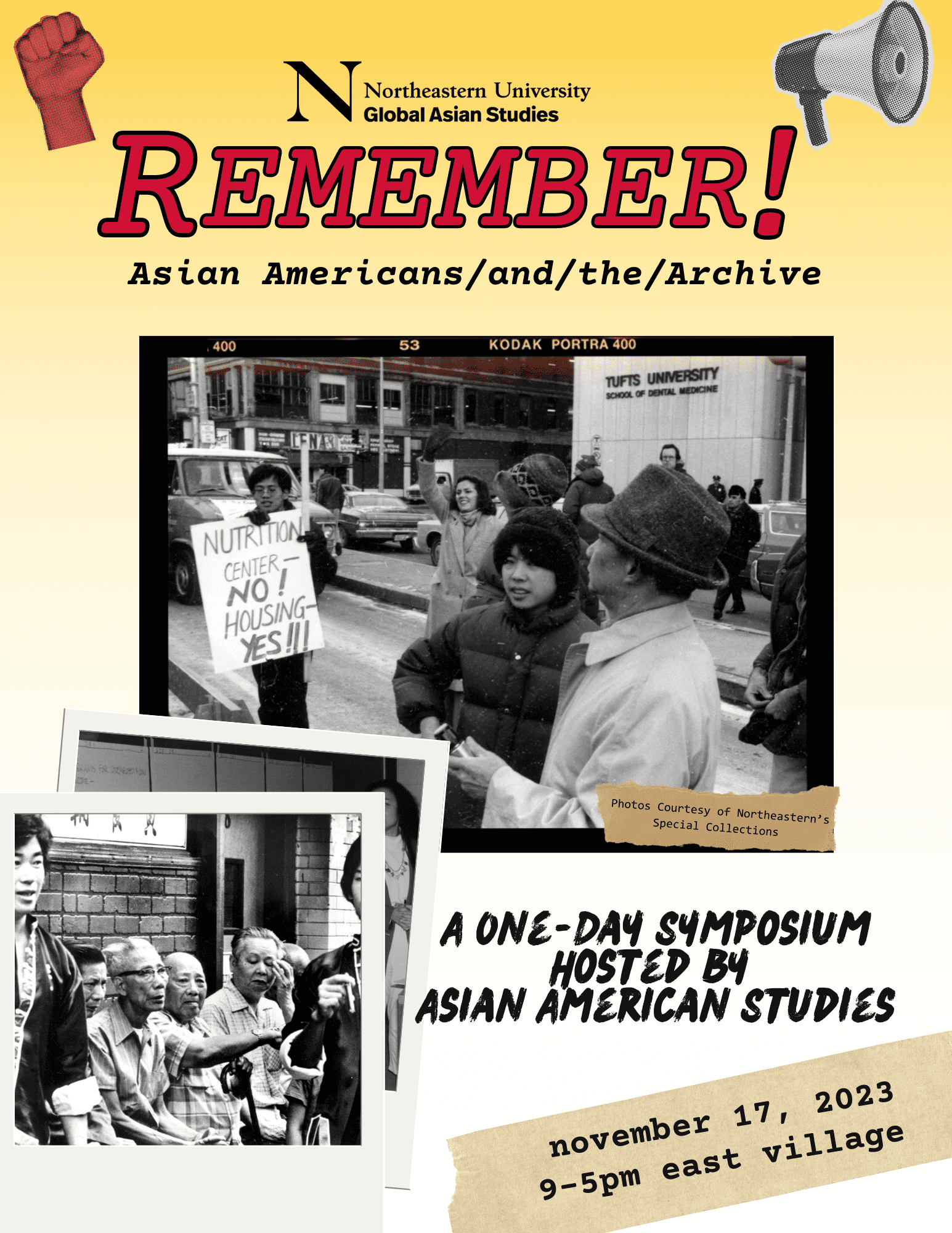
So I think I've talked myself into using this book in my course, if I get to teach it. It can also tie into a possible archival project I plan to have students do in the course. Coincidentally, Northeastern's Asian American Studies program is hosting a symposium called "Remember! Asian Americans and the Archive" on November 17, which I've signed up to attend.


[Update, 5/17/24: Here's a book talk by Shimabukuro from 2017.]