On a somewhat related note, as I was walking to class yesterday, I was enjoying the 75 degree weather. Then I thought about the election and the day's warm weather. The election is sort of like the weather. Sometimes if you get a warm day in November, it's easy to think, "maybe winter won't come this year." But it always does. As McNamara concludes, "All we have is now. That is all we ever have. Democrats, be bold."
Showing posts with label rhetoric. Show all posts
Showing posts with label rhetoric. Show all posts
Thursday, November 05, 2026
Post-midterms discussion
I'm going to use this op-ed by Eileen McNamara in my rhetoric class today, just to wrap up our midterm elections and rhetorical situations "unit." We've been looking at midterms-related rhetoric from the perspectives of the rhetorical situation, including Lloyd Bitzer's and Richard Vatz's classic texts, Mary Garrett & Xiaosui Xiao's important but under-cited discussion of discourse traditions, and Jenny Edbauer Rice's influential article on rhetorical ecologies. So to end it, today we'll see what rhetorical texts we can bring in that were written after the midterms and do a brief in-class analysis of them. I'll start with McNamara as an example.


Wednesday, September 23, 2026
Week three of classes--already knocked down by a cold
At least I hope it's just a cold. I've been coughing a lot the last day or two, so I don't know if it's getting worse or turning the corner. Just started taking Robitussin, though that hasn't helped much yet. I had to teach via Zoom today and might need to again tomorrow. I'm not a big fan of running a large class through Zoom, but desperate times call for desperate measures. The students seem interested and involved, though, which is good.
I'm enjoying the rhetoric class so far, though sometimes our conversation takes odd turns. Today we were talking about Lloyd Bitzer's foundational article, "The Rhetorical Situation," and a student's question ended up leading me to reflect on the "intentional fallacy" and the New Critical approach to literary criticism that I was (at least partly) educated in. I have since tended to take a more rhetorical approach to reading literature, though. (I remember when I was presenting about Vern Sneider and A Pail of Oysters on a panel about East Asia in Anglophone fiction--I looked over at the copy of my paper that one of my co-panelists had printed out and saw that she had written in the margin, "Intentional fallacy?" Was that her response to my whole paper?)
These disconnected recollections are brought to you by my cough syrup. More later...
Tuesday, June 23, 2026
Summer activities
I have turned in the grades for my two summer classes, so now I can focus a bit more on the three things that I want or need to work on the rest of the summer. A little update:
- Introduction to Rhetoric. I've got readings and a general schedule of activities mapped out, but there are still a few blanks to fill in. I'm meeting with the regular instructor next Thursday
on Fridayso we can talk over my plans for the course. I'm going in a bit of different direction from the one she takes, but she's OK with that, and there aren't any strict departmental expectations for what students should cover in the class. (Obviously it has to be an introduction to rhetoric, though!) I've been adapting what I did for the "Rhetorics in Contact" course that I taught a couple of years ago. I'm not doing a heavy focus on archival research this time around, though (too many students to take to the archives this time). I'm also planning to bring a lot more reflection into the course by ending it with a reflective portfolio project rather than a big essay. - Academia Sinica conference. I started a PPT (Google Slides) for this, which I'll fill with mostly images (I don't like slide presentations that are text-heavy, though once in a while I fall into that trap). One thing that has been troubling me about this is that my prepared remarks are supposed to be only 5 minutes max. Not sure what I can say in 5 minutes. ("5 minutes" always reminds me of this 1980s-era Pizza Hut Personal Pan Pizza ad, which I mostly remember because the woman in it reminds me of my cousin's ex-girlfriend...)*
- Ts'ai T'ieh-ch'eng (蔡鐵城) project. Am "scraping" all I can find about him from various archival websites. (By the way, this website from the 國立公共資訊圖書館 is really cool! Tons of digitized old newspapers, Japanese era books, etc. I'm probably the last person in the world to find it, but in case I'm not, here's the link.) Am realizing how big and difficult a project this will be for me, but I'm realizing that I need to keep in mind what I was telling my students last year about the need to be patient and go slowly. I'm working with all sorts of materials and technologies (like the website above) that makes this research, but a lot of this just takes old-fashioned patience, planning, and ... (I need another word that starts with "p"--"persistence"?).
BTW, the GHK book is at the publisher getting proofread. When I know its publication date, I'll post it here.
* OK, now I want to have pizza for lunch...
Wednesday, May 06, 2026
Historical narrative, "society's rhetors," and AI
I'm going to have to sit with this for a bit to work out my thoughts about what's being suggested here:
The suggestion to create an app, an AI tool, "that makes a kid feel the weight of what already happened" has my mind spinning. In the context of talking about World War II, I know that directly communicating with the people who lived through the war is becoming less and less possible--I had four uncles who fought in World War II, and my father was in General MacArthur's Honor Guard in Tokyo after the war. They've all been dead for at least 10 years.
However, there are documentaries, oral histories, histories, historical fiction and movies--probably even comic books graphic novels--many of which could be used to help "a kid feel the weight of what already happened." So while on the one hand, I applaud the idea of applying the latest technology to helping carry on public memory, on the other hand, I wonder if an AI app is really the best tool for this. Isn't what we want rather the voices of humans who experienced history or who have created nonfiction or fiction with the materials of history? If a machine can by itself manufacture something that can connect us empathetically with our past, our ancestors, I don't know if I should be impressed or scared. Perhaps as scared for what we've become as for what the technology has become.
I'm thinking about this point also in the context of the intro to rhetoric course I'll be teaching in the fall. This post brought to my mind something I read years ago by rhetorician Gerard Hauser from his book, Vernacular Voices: The Rhetoric of Publics and Public Spheres. Citing Paul Ricoeur, Hauser points to
the fragility of rhetoric in a context so overrun by alienation and difference that one has difficulty locating compelling terms that might anchor society in the silt of cultural memory. At the level of praxis, society's rhetors are custodians of history's story. By giving memorable form to distinctive episodes and persons, they evoke bonds of communal understanding and sympathy that can frame common commitments and motivate common actions. The question we face is whether the distance between the contracting relevance of the past and the fading horizon of an uncertain future precludes the possibility that we can still establish bonds of community. (p. 112)
I'd add that in addition to what he calls "the challenge of a past and future moving in opposite directions" is now the question of who or what will tell history's story--and what difference it makes.
I'm not sure that we will get into this in our course--I'm still working on developing the course, and these questions, while interesting and important, are perhaps not as central as the issues that arise from teaching an intro to rhetoric course in the US during the midterm elections. But I want to follow this thread and see where it goes.
It's late now, and I might come back to tinker with this post some more later.
[Update, 5/7/26: This article puts the learning of history in terms of "historical empathy": "'The more we can put it in terms of everyday people, and help people relate to those individuals, we find, the more successful we can be,' said Michael Hensinger, who oversees K-12 education for the museum. 'It can be really hard to relate to a general, a king, queen, somebody like that, which is often the lens through which a lot of history was taught when I was growing up.'"]
Wednesday, April 29, 2026
Summer plans
The spring semester is over here--and just in time, as a hay fever-driven lethargy has overtaken me, making it hard for me to concentrate on whatever it is I'm supposed to be doing right now. I have two online courses to run in May-June ("Summer A," which used to be known as "Summer 1"), though, so I need to get ready for them. I've got one prepared, but I need to go through the other one and update it, and then make a few screencasts before classes start May 6. (I hope I can talk without sounding like I have a stuffed-up nose.)
After the Summer A classes are ready, I need to get back to work on preparing for a new course I'll be teaching in the fall: Introduction to Rhetoric. The regular professor is going to be on leave, so I'm taking over. While there are no set-in-stone content requirements, the course description reads as follows:
Introduces major concepts, traditions, and issues in rhetorical studies. Explores topics such as the range of ways that people persuade others to change their minds or take action; the relationship among language, truth, knowledge, and power; the role of language in shaping identity, communities, and cultures; and the use of rhetoric for activism and advocacy. Focuses on rhetoricians and rhetorics from diverse traditions, emphasizing contemporary and interdisciplinary approaches to investigating a wide range of rhetorical artifacts.
The regular professor has given me access to her materials, which are, of course, excellent, reflecting her years of teaching the course. I think I need, though, to develop the course in a way that fits my own expertise and teaching style. I'm working on that now, and I hope to talk to her soon to see what she thinks of my ideas. She might be able to help me avoid some possible wrong turns I'd take! More on all this in future posts, perhaps.
In addition to the course development, I'll be going to Taiwan this summer for a conference at Academia Sinica in August. I'll be part of a roundtable on "Oberlin Shansi in China and Taiwan: The Transformation of a Transnational Educational Mission." I'm supposed to talk about how martial law-era Taiwan and Tunghai University were depicted in the campus letters reps in Taiwan sent back to the Oberlin community. It'll be interesting to revisit that period of my academic life when all I seemed to think about was that hardy band of young Oberlin grads who were teaching English in Taiwan and teaching Oberlin about Taiwan.
I might also try to do some research while I'm in Taiwan, but right now I'm not sure what I want to do research about. I was initially interested in the story of Ts'ai T'ieh-cheng (蔡鐵城), whom I first read about when working on a presentation about the White Terror for students who are going on a study-abroad trip to Taiwan this May. Ts'ai, who was born in Ta-chia (大甲) in 1923, reported for the Ho-p'ing Jih-pao (和平日報) in central Taiwan before becoming involved with Hsieh Hsueh-hung's (謝雪紅) "27 Brigade" (二七部隊) after the February 28 Incident. In 1953 he was executed. His story (here it is in Chinese, an excerpt from a book entitled 《二二八記者劫》) was very moving, particularly the part where he wrote a note to his younger sister the night before he died.
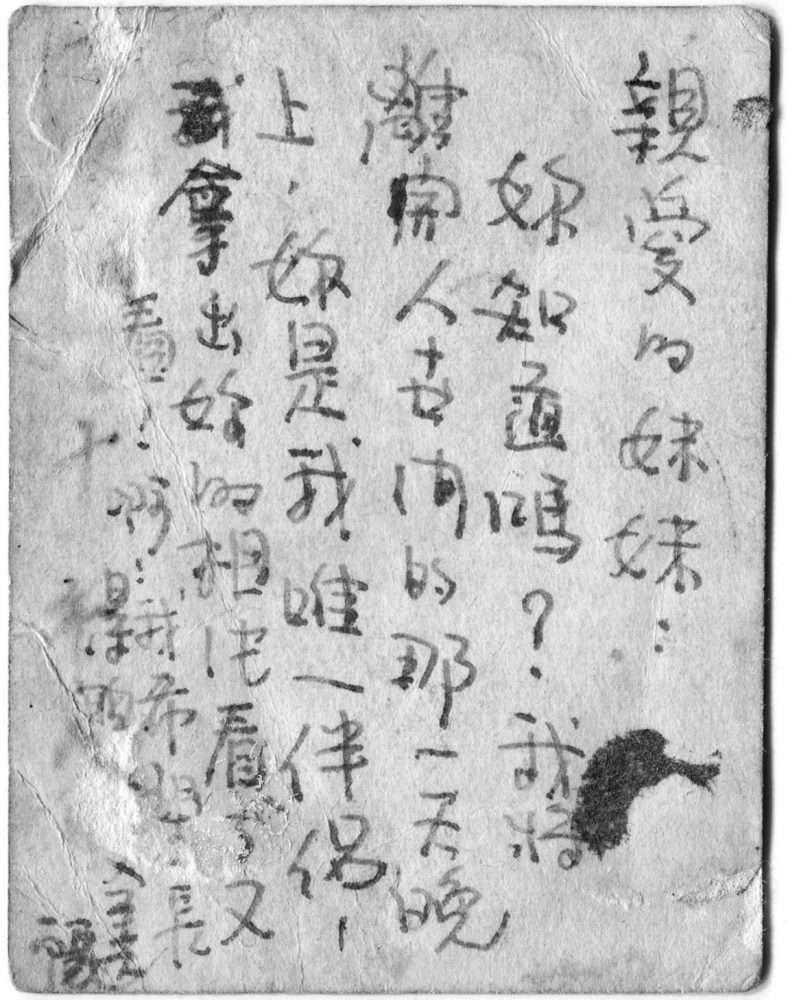 |
| A note that Ts'ai wrote to his sister the night before his execution: “Dear little sister: Do you know? On the night before I leave this world, you are my only companion. I took out your photograph and looked at it again and again. Ah, I hope—" And then the ink is smeared, perhaps by tears. Some believe the missing words were "that you grow up smart and beautiful." |
I thought about doing more research on his life and his reporting. The National Central Library appears to have microfilm of the Ho-p'ing Jih-pao, so I might take a look there if I get a chance. I'm still working out what my whole purpose would be for doing this research, though. Maybe I won't know until I see the newspaper microfilm. That's how it goes sometimes, right?
Tuesday, May 20, 2025
Another new book in the former native speaker's library
Christopher Joby, Christian Mission in Seventeenth-Century Taiwan: A Reception History of Texts, Beliefs, and Practices, Brill, 2025.

This attractively bound (but super-expensive!) book made its way to me from Lahore, and unwrapping it from its tight multilayered plastic covering reminded me of when Kasper Gutman was tearing the layers of newspaper off the Maltese Falcon.

Fortunately, I can confidently declare that it's not a fake, and I'm looking forward to reading it. The Dutch encounter with Taiwan is particularly interesting to me for its rhetorical dimensions, and Joby's book appears to address at least one side of it by discussing what rhetorical techniques Dutch and Spanish missionaries used to persuade (or coerce?) the Indigenous Austronesians in seventeenth-century Taiwan to adopt (or was it adapt?) Christianity.
But first I need to get back to work...
Saturday, April 12, 2025
Kerr paper revision sent off!
I just sent off my revision of my paper on the "pre-life" of George H. Kerr's Formosa Betrayed. The editor might require more revisions, but I thought that I should send him something since it has been over a year since I last contacted him. Sorry!
I also got the proofs for my review of Xiaoye You's Genre Networks and Empire yesterday and responded to them. I'm looking forward to seeing it in print! (The link is to some preliminary thoughts about the book, some of which I developed in the review.)
Now on to my grading...
Wednesday, December 25, 2024
Review of Resistance in the Era of Nationalisms published
My review of Resistance in the Era of Nationalisms: Performing Identities in Taiwan and Hong Kong, edited by Hsin-I Cheng and Hsin-i Sydney Yueh is out. It was a pleasure to read this book, particularly realizing the risks some of the authors took in writing it.
Friday, December 20, 2024
A few reflections on the "Rhetorics in Contact" course
Back in August, I wrote about my plans for the new course I was going to be teaching, "Rhetorics in Contact." Now that the course is over, I want to reflect on the course and think about what I might do better next time. In no particular order:
- I think the readings worked well. As we read and responded to them, we actually started finding connections that I hadn't noticed before. Shimabukuro's book was particularly good for bringing together a lot of points that we had discussed earlier, though often she would use different language for talking about similar kinds of concepts. I personally gained a lot from reading through her book again for the course.
- Here's something I posted on BlueSky about Shimabukuro's book and current events. (Hope you can read it!)
- We used Perusall for "socially annotating" the readings. It made things nice generally, but in the case of Shimabukuro, I was a little annoyed that the Perusall edition of the book didn't have any page numbers. It made it harder to cite the book when we were working on final papers. Haven't yet figured out a workaround for the next time, so any suggestions are welcome!
- Maybe because we were using Perusall and doing social annotation (and maybe for some other reasons, as well), class discussions weren't as active as I had hoped. I think I have to work harder next time on making sure class time is better used, and I'm not just doing most of the talking.
- We did a few informal writing assignments that I liked. I think I want to keep most of them and perhaps do a few more. After we read Garrett and Xiao's "The Rhetorical Situation Revisited," for instance, I asked students to write about any discourse traditions in their families or cultures. Their responses were interesting. (And I had fun writing my own response, too!) We also did some practice analysis of materials in NU's Digital Collections. I also had them write some reflections on their class trips to the archives.
- I think I need to do a bit more with helping them on the archival projects. (One student suggested starting earlier, but I have to think about that. Maybe we could go to the archives earlier.) More class time devoted to them bringing in archival materials and challenges they were facing would be useful, perhaps. And more work with citing archival documents.
- I also should do a bit more with helping them think about connections between the readings and the archival collections they were working on. One student in their final reflection pointed out how working on the archives helped them better understand the concepts from the readings, but I think I could do a bit more to help in that direction.
Anyway, overall the course went well (aside from problems with class discussions or lack thereof), so I'm encouraged to try teaching this again if I get the chance!
Friday, August 30, 2024
"Rhetorics in Contact" and August mushroom hunts
We're just a few days away from the beginning of the semester, and I've been feverishly working at getting my new "Rhetorics in Contact" course together. Right now it's a pretty small group of students (it's a freshman-level course in the Honors Program), but a few more people might trickle in before classes start next Wednesday, I hope.
My course description asks,
What happens when people try to communicate persuasively with each other across cultural boundaries? How do participants’ histories, traditions, and communication patterns shape cross-cultural encounters, and how do those encounters shape future communication within and across cultures?
In this course, we’ll be looking at different examples of how rhetorical traditions or legacies affect communication across cultural boundaries and how cross-cultural encounters are represented differently by the participants. Through the course readings, we’ll be developing a specialized vocabulary for talking about intercultural rhetoric and thinking about methods for studying it. We’ll go on to apply some of these methods to documents in the Special Collections of the Northeastern Archives, analyzing the discourses of social organizations and movements in Boston, such as the Chinese Progressive Association and the movement to desegregate Boston’s public schools. We’ll also reflect on how rhetoric across cultures affects (or should affect) advocacy in the complex global and local contexts that we currently face.
Because we're going to be working with the archives a lot, I'm not having us read a lot of different articles. Our reading list for the semester is as follows (links to relevant blog posts):
- Pratt, Mary Louise. "Arts of the Contact Zone." Profession, 1991, pp. 33-40. JSTOR, www.jstor.org/stable/25595469. (Although this isn't technically a rhetoric article, many of the concepts that Pratt discusses--like contact zones, autoethnography, transculturation, etc.--are very relevant to intercultural rhetorical studies.)
- Garrett, Mary, and Xiaosui Xiao. "The Rhetorical Situation Revisited." Rhetoric Society Quarterly, vol. 23, no. 2, 1993, pp. 30–40. JSTOR, http://www.jstor.org/stable/3885923. (See my discussion of the article in this post.)
- Gaillet, Lynée Lewis. "Archival Survival: Navigating Historical Research." Working in the Archives: Practical Research Methods for Rhetoric and Composition, edited by Alexis E. Ramsey, et al., Southern Illinois University Press, 2010, pp. 28-39. Project MUSE, https://muse.jhu.edu/book/4176. (Although this chapter is more aimed at graduate students and PhD-level scholars in rhetoric and composition, I think much of the discussion can be useful for undergraduate honors students, as well. For instance, when Gaillet discusses grant applications, I ask students (in Perusall) to consider what kinds of undergraduate research grants are offered at Northeastern. I think this could be useful to them in their future work.)
- Shimabukuro, Mira. Relocating Authority: Japanese Americans Writing to Redress Mass Incarceration, University Press of Colorado, 2015. (This will be interesting because I have to admit, rereading the book to annotate it on Perusall, it's pretty challenging in places. But see my discussion of the book here for my reasons for using this fascinating study.)
Other than these readings, students will be focusing a lot on exploring NU's Special Collections and settling on a collection or collections to focus on. One thing I'm trying to do with this assignment is stretch their ideas of what academic research is. Gaillet quotes the late compositionist Robert Connors as saying, "[A]rchival reading is ... a kind of directed ramble, something like an August mushroom hunt" (qtd. in Gaillet 38). Although the topics we'll be covering (and uncovering) in the course are serious (sometimes deadly serious), I also want students to experience archival research as a joyful (but sometimes depressing!) and exciting (but sometimes tedious!) process.
Friday, August 09, 2024
Review of A World of Turmoil published
My review of Stephen J. Hartnett's book, A World of Turmoil: The United States, China, and Taiwan in the Long Cold War, is out in the latest issue of Rhetoric & Public Affairs. (Although the issue is dated Fall, 2023, it was published almost a year later!)
While I had a few problems with Hartnett's conclusions and recommendations, I found the book to be a valuable overview of the roles of communication and rhetoric in the history of US-China-Taiwan relations from a Taiwan-sympathetic rhetoric scholar.
Monday, May 27, 2024
Six new books in the former native speaker's library
I have some money left over from my professional development fund for this fiscal year, so I bought a few more books that I thought might be helpful to my research.* Here they are:
- Haunted Modernities: Gender, Memory, and Placemaking in Postindustrial Taiwan, by Anru Lee (2023)
I read the introduction and part of the first chapter, and I'm already hooked! I just finished Niki Alsford's Taiwan Lives, and I think this will be the next book in my collection that I read. - Making Punches Count: The Individual Logic of Legislative Brawls, by Nathan F. Batto and Emily Beaulieu (2024)
This seems particularly timely, considering the fights that went on in Taiwan's Legislative Yuan recently. - Rhet Ops: Rhetoric and Information Warfare, edited by Jim Ridolfo and William Hart-Davidson (2019)
After Hart-Davidson's recent death, I read an obituary that mentioned this book. It looked interesting. - Guiguzi, China's First Treatise on Rhetoric: A Critical Translation and Commentary, trans. Hui Wu (2016)
I've already read C. Jan Swearingen's "wide-ranging" chapter from the book, but I think I should read the whole translation. - Rebel Island: The Incredible History of Taiwan, by Jonathan Clements (2024)
This looks like a good readable book about Taiwan, possibly useful in an introductory course. - Routledge Handbook of Contemporary Taiwan, ed. Gunter Schubert (2016)
One of these days, I'd like to get access to the Encyclopedia of Taiwan Studies Online, but this also looks like a useful reference.
Buying all these books has me wondering, though, what I'll do with them down the line. I've been following Kurt Bell on Twitter recently; he and his wife are retiring and moving to Japan. They decided that they could only take a total of 6 boxes of belongings with them, and this has me thinking about what I'll do with all my books if I get to that point in life. Maybe I can eventually donate these books to a library or organization (or person?) interested in Taiwan. Anyway, I think I have a few years before I get to that point.
*Or something like that.
Monday, November 27, 2023
Notes on Hsin-i Sydney Yueh, Identity Politics and Popular Culture in Taiwan
Hsin-i Sydney Yueh, Identity Politics and Popular Culture in Taiwan: A Sajiao Generation. Lexington Books, 2017.
A while back (OK, it was over three years ago--how the time flies!), I was asking some questions about sajiao (撒嬌) and Taike (台客) in response to an article on Taiwanese communication modes by Todd Sandel. This book by Hsin-i Sydney Yueh goes a long way towards answering those questions (and questions I didn't even know I had) about the these two Taiwanese concepts. As usual, here I'm not so much giving a formal review of the book as I am noting down some thoughts and questions that I have after reading it. (I'll link to some reviews below.)
Here are the two questions I had:
Is sajiao, which Sandel characterizes as a practice "associated with 'Mainlanders,'" not practiced as much by non-Mainlander Taiwanese? Is it practiced much in China?
Have the concepts of hen Tai (很台) and Taike (台客) become points of pride for Taiwanese?
From what I got from Yueh's book, sajiao, which she describes as "embod[ying] a set of communicative acts that express the vulnerability and helplessness of the actor through imitating a child's immature behavior" (2), is not so much a Mainlander-vs.-Taiwanese (or waishengren vs. benshengren) phenomenon as it is a Northern Taiwan (specifically Taipei) vs. Southern Taiwan (south of Taipei, I guess) phenomenon. That is to say, sajiao seems to be most successfully performed by Taipei residents and appears to be connected to what Yueh characterizes as "Taipei Chic." Taipei Chic represents a form of cultural capital characteristic of how people in Taipei are represented in the media (especially talk shows)--as "urban, fashionable, and middle-class" people with "standard" Mandarin accents (144-145). This is placed in opposition to Taike and Taimei, which present a "local, rural, and working-class ... image" (144). Taike and Taimei (Yueh focuses on Taimei because she's interested in Taipei Chic vs. Taimei when it comes to women performing sajiao) appear to be from southern Taiwan and usually speak Mandarin with a Taiwanese accent. According to the media representations of Northerners and Southerners that Yueh cites, being able to sajiao is not part of Southern Taiwanese women's repertoire.
It should be noted, as Yueh points out, that not all people who embody "Taipei Chic" are originally from Taipei, but that it's more of a style of behavior and speaking that one has to learn in order to "pass" as a Taipei person. It should also be noted that not all Taipei people (women) can be "Taipei Chic." as Yueh puts it,
The Taipei Chic female's uniqueness lies in a constructed scarcity, in comparison to other Taiwanese (such as taike, and taimei). According to these talk shows, people who live in Taipei are not automatically Taipei Chic. In other words, the geographic location is not sufficient to fulfill the Taipei Chic image. The Taipei Chic identity is a collective standard, aiming to discern the non-Taipei Chic and expel any such people from the group. Many people who have not obtained the ticket ot enter the group strive to become more similar to Taipei Chic. (155)
In answer to my second question, Yueh's book suggests that while the idea of identifying as Taike can be a point of pride for men, women identified as Taimei--at least ones who show up on talk shows--don't necessarily appreciate that appellation, though this appears to be true mainly in contexts where the concept or term is used by Taipei people to judge people from the south.
Something that Yueh doesn't mention (at least not that I remember) is that, as I understand it, Taipei's population is more "mainlander-dense" than the southern parts of Taiwan. In that sense, it seems to me that the adulation of Taipei Chic and the deprecation of Taike and Taimei might have some of its roots in the historical waishengren perspective on benshengren that the martial law government encouraged (or perhaps instigated). Sandel suggests this in the article I mentioned above, when he associates sajiao with Mainlanders. (At some point I need to read this review of Yueh's book by 莊佳穎, who brings up the Taiwanese concept of sai-nai [司奶] and compares it to Yueh's discussion of sajiao--h/t to Shao-wei Huang for sending me a copy of that article!)
Another point that interested me about Yueh's book was her last chapter, which moves the discussion of sajiao, Taipei Chic, and Taimei from a more interpersonal and mediatized domestic context to the larger context of what these phenomena have to say about Taiwanese identity in relation to Asia. She extends the interpersonal to the political, arguing that elements of sajiao practice have become part of domestic democratic politics in Taiwan. For instance, "Taiwan's political campaigns are full of cute marketing" (173). We see examples of this now, with vice-presidential candidate Hsiao Bi-khim calling herself a "cat warrior" and arguably even former presidential candidate Terry Gou using a "cute" English slogan "Good Timeing," which sounds similar to his Chinese name, Guo Taiming 郭台銘, (not sure why he kept the "e" in "Timeing"--maybe that makes it cuter?).
Yueh also casts Taiwan's role in world politics in terms of a sajiao position, suggesting that Taiwan's relative weakness in comparison to China could lead to a a re-situating of Taiwan "as a small entity in terms of the global civic society" rather than a part of a "cultural China framework" (174). She suggests that Taiwan could be treated and studied in a transnational Asian context, which would remove the historical burden that Taiwan had during the Cold War to represent "Chinese culture" to the world.
There's a lot more going on in this book than my notes here might suggest, so I'd of course recommend reading it to see what I've missed!
I didn't find many reviews of the book, but here are a couple of links in addition to the review I mentioned above:
- Thoughts on Sajiao (by Kerim Friedman)
- A review in the International Journal of Taiwan Studies (by Amélie Keyser-Verreault) (will download directly)
Tuesday, October 24, 2023
Notes on Mira Shimabukuro, Relocating Authority
Shimabukuro, Mira. Relocating Authority: Japanese Americans Writing to Redress Mass Incarceration. University Press of Colorado, 2015.
I read this book to see whether it would be good for the comparative rhetoric/"rhetorics in contact" course I'm developing. At first, I was thinking of just finding a chapter that I could use from it, but after reading the book, I think I'd be more interested in assigning the whole book. It's good for students to see how the author develops an overall argument or perspective as she works out the implications of her study, and I appreciate especially how reflective Shimabukuro is about her research and how the topic of her book connects to various aspects of her life.
A few other thoughts about the book that I think recommend it for my course (or for others to read it!):
- There's the exemplary way that she uses Japanese rhetorics/concepts together with rhetorics of Americanness in analyzing the rhetorical/literacy practices of the Japanese American internees. For instance, in chapter 6, she describes the writing/rewriting of a petition made by Japanese mothers to suspend the conscription of their Japanese American sons. (At the time, as Shimabukuro explains, the Issei, or first-generation, mothers were not allowed to become US citizens, but their sons, who were Nissei, or second-generation, were American citizens.) Shimabukuro shows how the mothers' petition combines the rhetoric of the "dutiful wife, intelligent mother" (ryosai-kenbo) that had become an important gender discourse during the Meiji era with rhetorics of American citizenship (and even what she calls "proto-model minority" rhetoric) to argue that the Japanese mothers had raised good American sons who deserved better than to be incarcerated in the "internment camps," only to be called up to fight for a country that didn't give them or their families the rights due American citizens. I like how Shimabukuro shows the nuance of the rhetorics in contact here, even showing how the idea of ryosai-kenbo is not some sort of timeless Japanese concept, but that it was a more recent phenomenon itself--and that it connected to the problematic "nation-unifying and empire-building efforts taking place in Japan" (180).
- I also like the way that Shimabukuro shows that the effects of these literacy activities stretch across time and intertwine with other literacy activities and rhetorical practices. As she points out, much of the writing that she discusses wasn't "successful" in the immediate sense of changing the mind of the US government. In the case of the mothers' petition, their Japanese American sons were still drafted, and the mothers only received a perfunctory response from Eleanor Roosevelt. (Oh, how you have gone down in my estimation, Mrs. Roosevelt!) In the case of the Heart Mountain Fair Play Committee's "Manifesto," in which they stated that they would refuse induction, the writers ended up in prison. But Shimabukuro demonstrates how these and other writings, including "private" writings such as poems written by internees, resurfaced or were brought back to the surface years later and served as models or inspiration for latter-day Asian American civil rights activists. She sees the recirculation of these texts as a kind of "relocated literacy" (196, emphasis in original), where there's a "reactivation of that rhetorical-activist force by Japanese American activist-descendants operating in contexts in which the Nikkei community has grown stronger" (196, emphasis in original).
- Shimabukuro also brings up the concept of "resistant capital," citing Tara Yosso--it's meant to be considered in opposition to Bourdieu's idea of "cultural capital," and it signifies "knowledges and skills fostered through oppositional behavior that challenges inequality" (Yosso 80, qtd. in Shimabukuro 199). It appears that Yosso primarily has in mind communities of color in the US, but I wonder if it could apply in other places, too, such as (of course) Taiwan.
- Part of the book is a narrative of Shimabukuro's family's (particularly her father's) involvement in Japanese American activism, and by extension it traces the author's own process of developing her research project. I think this makes it more accessible for undergraduates who can thereby see how she did the research rather than just reading the results of that research. It also shows that you can be passionate about your topic and that it can grow from your own experiences, so perhaps it's an angle on doing academic work that they might not be familiar with.
So I think I've talked myself into using this book in my course, if I get to teach it. It can also tie into a possible archival project I plan to have students do in the course. Coincidentally, Northeastern's Asian American Studies program is hosting a symposium called "Remember! Asian Americans and the Archive" on November 17, which I've signed up to attend.
[Update, 5/17/24: Here's a book talk by Shimabukuro from 2017.]
Tuesday, October 17, 2023
"Sabbatical" update
I noticed that I haven't posted anything yet this month, so I thought I should let my reader know that I'm still working on the projects I'm supposed to be doing this semester. I just sent a draft of my paper to my "mentor" (I'm calling him this; not sure he'd agree with the terminology!). The paper is still a bit of a mess--there's too much I want to say in it and a lot I haven't said. But I thought I should get someone else's view of it before I continue working on it.
I also need to work on the proposal for the comparative rhetoric course I'm planning. It has taken the form of a course in "rhetorics in contact" (as in contact zones), where we would look at situations in which two (or more) groups' discursive practices figure into the kinds of interactions those groups have. I have to read more for this to figure out how I might develop a course of this type.
I'm also working on finishing When They Were Not Writing Novels (【他們沒在寫小說的時候】), which I might have something to say about once I've read the last chapter. So stay tuned...
Tuesday, September 26, 2023
Notes on A-chin Hsiau, Politics and Cultural Nativism in 1970s Taiwan
A-chin Hsiau, Politics and Cultural Nativism in 1970s Taiwan: Youth, Narrative, Nationalism. Columbia University Press, 2021.
It's taken me a while to do some writing about this book because I'm not sure how I feel about it. I read five reviews of it that are generally quite positive, from Tanguy Lepesant, Scott Simon, Ming-sho Ho, Evan Dawley, and James Baron. (If you want to get an overall summary of the book, take a look at some of these reviews. I think Lepesant's and Baron's are not behind a paywall.)
I appreciated the book because of its perspectives on the literary discussions and debates going on during the 1960s and '70s in Taiwan. I particularly appreciated the many long quotations (translated into English) from a variety of literary figures from postwar Taiwan. Hsiau ties these quotations and figures together into an argument that Taiwan's intellectuals (mostly, though not exclusively, represented in the book by writers in the literary field) moved from viewing themselves as part of the Chinese nation to viewing themselves as Taiwanese, in contradistinction to the Chinese nation. Rather than viewing this transition from an "instrumentalist" perspective, which would suggest that writers decided whether to express themselves as Chinese or Taiwanese depending on which form of identification would help their interests, or from an "essentialist" perspective, which would suggest that writers were always Taiwanese and only pretended to be "Chinese" until it was safe to express their true selves, Hsiau takes a narrative view. In this view, over the generations, writers responded to historical events like the movement to "protect the Diaoyutai islands" (保釣運動), the ROC's loss of its UN seat, etc., by rethinking their relationship with Taiwan and the ROC. As Hsiau says in the conclusion,
Rather than a fit for an essence, or an instrument for advancing some collective's interest, I view narrative as an embodiment of human understanding that shapes human understanding and emotion in new ways with each generation. The perspective of narrative identity that I have adopted throughout this book could be described as interpretive. Historical narrative for political agents is interpretive in that it is a means of understanding the self in social and temporal context. It is a way of constructing collective identity and motivating praxis. Rather than an essence, there is a set of materials, to which new materials are continually being added, that is used to construct identity anew when the need for new kinds of action arises. There are indeed interests, but they are not calculated coldly; they are instead judged in the warmth of the chapters of the xin, the heard-and-mind that Chinese philosophers have been trying to understand since antiquity. On this understanding, it will not do for us to simply disbelieve the constant apparently heartfelt declarations of Chinese national identity in texts from the return-to-reality generation throughout the 1970s. We have to consider the possibility that if a person says he or she feels Chinese, he or she is at that moment in time. (171-2)
This quote, I think, encapsulates Hsiau's argument, and there's a part of me that agrees with him. Hsiau puts at least some of the responsibility for the "apparently heartfelt declarations of Chinese national identity" on "the power of ideological dissemination" through the educational system. As Kenneth Burke wrote in A Rhetoric of Motives, "[e]ducation ('indoctrination') exerts ... pressure upon ... [a person] from without" and that person "completes the process from within. ... Only those voices from without are effective which can speak in the language of a voice within” (39). The challenge in Taiwan, as the KMT government perceived it, was to make the voice within echo, or speak the language of, the voices from without.
I'm reminded of a story Lung Ying-tai (龍應台) told about a performance she and her university classmates were preparing for in 1972 upon the occasion of the National Assembly’s re-election of Chiang Kai-shek to yet another term as president. As Lung wrote,
My deepest memory was about the sentiment of comradeship felt by that bunch of 20-year-olds creating and working day and night, and we walked out in the middle of the night under the moonlit parasol trees to feel the silence of nature, the dreams of our people and the tranquility of the universe. We had no idea what "the leader" was up to, and we had no idea at that moment of youthful romance, a university student had been arrested, detained, interrogated and then sentenced to life in prison for "reading the wrong things" and "saying the wrong things."
Our gestures were exaggerated, our speech tones were artificial, our orations were stuffed with the learned wills of the adults, our emotions were sincere, our beliefs were earnest and our motives were pure, and that was because we had no idea that the most sorrowful darkness was hidden in the shadows of the parasol trees. (translation by Roland Soong)
As I wrote in my doctoral dissertation (many years ago!), Lung's reflections are a reminder that presenting government-approved thoughts with exaggerated gestures and artificial tones does not always negate the possibility of there being sincere emotions motivating the speaker. Yet at the same time, the presence in Lung’s story of the arrested university student is a reminder that not everyone had been convinced by what the schools and society had taught them. Because of this, I'm not sure that I can completely accept Hsiau's conclusions--his argument about the naiveté of the instrumentalist and essentialist explanations for the Chinese Nationalist rhetoric and its transformation into Taiwanese nationalist rhetoric seems a bit overstated.
When writing about Yeh Shih-t'ao's (葉石濤) earlier and later literary criticism, Chu Yu-hsun, in When They Were Not Writing Novels (【他們沒在寫小說的時候】), notes that from today's perspective, Yeh's earlier use of sentences like "Taiwan literature is part of Chinese literature" (台灣文學是中國文學的一部分), and "nativist literature is the literature of the Three People's Principles" (鄉土文學就是三民主義文學) would be annoying--and surprising, given Yeh's later Taiwan-centric perspective. Chu points out, however, that Yeh had been jailed by the KMT, which influenced his perspective on how to write. As Chu argues, looking at Yeh's rhetorical organization, after reciting a "party-state mantra," Yeh would follow up with the real point: "but in the context of Taiwan's natural environment and historical background, Taiwanese literature has developed a unique style..." (但是在台灣的自然環境和歷史背景下,台灣文學...形成了獨特的風貌......). The real point for Yeh, Chu argues, was about the locality and indigeneity of Taiwanese literature, but this was something he had to make less obvious, given the martial law context he was writing in. Hsiau would call this, probably, an example of an "essentialist" argument that Yeh was always Taiwan-centric but hid it until he could feel safe expressing it. Be that as it may, Chu's interpretation seems valid to me.
On a related point, this is where I agree with Tanguy Lepesant's critique that Hsiau should have spent more time discussing his methods. I also found Hsiau's explanation of how he was using discourse analysis a bit thin, and in my view, unconvincing. I did not find much in his book that resembled discourse analysis in any form that I would recognize. There was not a great deal of focus on language or language in use, for instance. Perhaps Hsiau is more focused on what James Paul Gee would call "Discourse" rather than "discourse" (here's a summary of that distinction). That is, Hsiau is more focused on "ways of being in the world" rather than on analysis of specific uses of language to communicate or persuade. Chu gives an example above of a more discourse-as-language-in-use form of discourse analysis that focuses on how writers use language and the contexts in which they are using language. While Hsiau's is an important book, I would like to have seen more of this kind of "discourse analysis" being used in it.
Friday, August 18, 2023
Notes on Xing Lu, Rhetoric of the Chinese Cultural Revolution
Xing Lu, Rhetoric of the Chinese Cultural Revolution: The Impact on Chinese Thought, Culture, and Communication. University of South Carolina Press, 2004.
I finished reading this last Friday, but it has been a busy week. As I mentioned before, there were a couple of negative reviews of this book. One the things that one of them complained about was Lu's use of her own personal experience, especially in the first chapter, "My Family Caught in the Cultural Revolution." Howard Goldblatt calls the first chapter "a nearly fatal distraction" and defends his arguably "churlish" response to Lu's reminiscences by arguing that
(1) [i]n the quarter century and more since the Cultural Revolution ended, with the death of Mao and the convenient indictment of the Gang of Four, dozens of memoirs (with "J'accuse" in evidence far more than "mea culpa") have appeared in English, along with numerous scholarly and journalistic works on the GPCR; one more may be of some psychological benefit to the author, but it essentially duplicates what others have already written, often with more power and evocative effect than the chapter of the book under review. (2) As I stated earlier, the inclusion of a personal memoir in a work of scholarship invests the entire project with an undesirable patchwork quality. (p. 170).
While it's true that there are already a lot of Cultural Revolution memoirs (many of which are cited by Lu), it's my feeling that Goldblatt is a bit off in his evaluation, largely due to what I'd say is a misunderstanding of the book's primary audience. Goldblatt characterizes Lu's audiences as "linguists interested in the study of rhetorical symbols and their impact on national citizenries, and those interested in China's modern history, such as scholars and 'China watchers'" (pp. 170-1), ignoring the obvious audience of rhetoricians, many of whom might be more focused on Western rhetorical traditions and practices and might not have read those "dozens of memoirs" that he mentions. Furthermore, different disciplines have different standards for the inclusion of personal experience in scholarship. While not all books in rhetorical studies include chapters on the author's related experiences, it's not unheard of, and it can sometimes be seen by scholars in the field as an important way of demonstrating the author's positionality in relation to their topic. In fact, a review of the book in Argumentation and Advocacy suggests that Lu's memories "give the book a human quality and make Lu's own feelings toward her subject clear" (p. 116), and a review in Rhetoric & Public Affairs argues that the "experiential context drives Lu's inquiry and indeed sets this work apart from (and above) other scholarly treatments of the period" (p. 506).
I find myself more in agreement with one of the critiques by Michael Schoenhals: he argues that Lu's adoption of both the weak and strong forms of the Sapir-Whorf hypothesis (the former being that language influences thought and the latter, that language determines thought) is not particularly helpfully used in explicating the rhetoric of the Cultural Revolution. As Schoenhals suggests, Lu's book seems to ask readers simply to accept that the Chinese people of that period lost their ability to think for themselves because of the language used in political slogans, wall posters, revolutionary songs, etc. For instance, Lu argues that "the use of violent language leads to violent action" (p. 89). While I'm inclined to believe her (particularly in the aftermath of January 6, 2021), I feel as though Lu is counting on us to believe her rather than explaining to us how/why this could happen. Her example of the persecution and murder of Bian Zhongyun, a high school principal in Beijing, shows a correlation between the violent rhetoric and her torture and murder by the Red Guards (p. 89), but as the old saying goes, correlation ≠ causation. Did the violent language in the posters cause the Red Guards to torture and kill Bian? How do you prove that? I'm not sure what kind of evidence I would want to see, however. (And I'm not sure Schoenhals is, either.) Perhaps I should look at some of Lu's other sources, such as her citation of Hannah Arendt on "the banality of evil." It might be that bringing in some of the other theorists that she cites in her literature review, like Burke, McGee, or Wander, would better support her argument here. (She does this later in her discussion of political ritual, where she cites Rowland and Frank on "rhetorical violence [that] often leads to societal violence" [qtd in Lu, p. 146].)
One interesting point about the idea that people lost their ability to think for themselves is that Lu also gives examples of people who were still able to think for themselves. For instance, one of her interviewees says, "I never knew what other people thought about the [political] rituals and bizarre things going on during the Cultural Revolution. I considered some of them problematic and foolish, but I never dared to say so. I couldn't speak my mind and I didn't trust what other people said, as I was afraid of being betrayed or persecuted" (qtd. in Lu, p. 150). This raises a question about whether most people had no "inner thoughts" or whether there were many people who were just afraid to express their inner thoughts.
I also have to agree that at times, the book seemed more descriptive than analytical. For instance, there's a description of a "big character poster" (dazibao) at a barbershop:
The cornerstone of the Cultural Revolution was the shared political understanding that everything deemed proletarian was moral and ethical while everything deemed nonproletarian was evil and harmful. This formula could even be applied to a person's hairstyle. Hairstyles considered bourgeois or revisionist were regarded as harmful to society and strictly prohibited. Liang (1998) recounts the following example of a wall poster seen in front of a barbershop: '"Only heroes can quell tigers and leopards I wild bears never daunt the brave' [Mao's poem]. For the cause of the Cultural Revolution, this shop will not cut hair that parts from behind, or in the middle, or that is less than one inch short, as these hair styles are nonproletarian. The shop does not provide hair oil, gel, or cream. The shop does not provide hair blowing or temple shaving services for male comrades, nor perms or curling hair services for female comrades" (125). The practice of starting a poster with one of Mao's poem was a common feature of poster writing, employed both as a stylistic device and as a justification to legitimize the action. (p. 78)
I think this description of the wall poster could have been enhanced by an analysis of how the poem was being used. Why was that particular poem chosen to head the poster? How did it legitimize the actions of the barber? (And if there's no connection, that might also be interesting to discuss, since it might signal how randomly quotations from Mao were being used in the big character posters.)
Ben Krueger, author of the Argumentation and Advocacy review, notes a failure in Lu's comparative approach: "Her comparisons of the Cultural Revolution's rhetoric to Nazi Germany and the Soviet Union seem particularly pedestrian" (p. 117). I have to agree with this, too. There are gestures toward comparison with other rhetorics, such as Lu's discussion of militaristic terms, where she notes that "Lakoff and Johnson (1980) discussed the use of war metaphors by U.S. presidents to distort realities and constitute a license for policy change" (p. 91), but the comparisons often don't go beyond this kind of quick reference.
There were several places in the conclusion where she makes predictions that, from the perspective of 2023, I could only respond to in the margins with "Oh well..." In her last paragraph, Lu writes that "one thing is certain [about China's future]: the age of ideological totalitarianism is over" (p. 205). I see that there is now a new preface to the paperback edition, written in 2020, in which she expresses concern that younger Chinese will not learn about the Cultural Revolution and that "such rhetoric of polarization, dehumanization, and violence in the name of morality and justice will be evoked, escalated, and manipulated again in China or elsewhere in the world on a similar scale" (p. xii). She also notes the chilling language of Trump during the 2016 election, which she says reminded her of the Cultural Revolution.
Despite all of these criticisms (or complaints), I did learn a lot from this book, and reading it also made me reflect on what was going on in Taiwan during the same time period. Some of the rhetorical features of the Cultural Revolution, such as the violent, ugly language, the attempts at brainwashing, and the use of political ritual, deification of the leader, etc., were similar in Taiwan during the martial law period. Like Mao, Chiang Kai-shek was called by such epithets as "the nation's savior, the helmsman of the era, the great man of the world" (民族的救星、時代的舵手、世界的偉人). And as I mentioned a couple of years ago in relation to Li Ang's story, "Auntie Tiger," there was a "feeling of fear and conspiracy in the air during that time." So was Taiwan's martial law period different from the Cultural Revolution in kind or just in degree? How might the rhetorics of these periods be compared?
Next up: A-Chin Hsiau's Politics and Cultural Nativism in 1970s Taiwan, which might give me some insight on how Taiwan moved from Chinese Nationalism to Taiwanese Nationalism.
Friday, July 28, 2023
Next up on my reading list
Taking a second look at the reading list that ChatGPT created for me (discussed here), I realized that not only did ChatGPT not actually work through the entire list of comparative rhetoric sources that I had provided, but that it also "lied" about how it had organized things. For instance, while it says it "started with some articles that introduce the concept of comparative rhetoric and translingual approaches to meaning-making, such as Cushman's "Translingual and Decolonial Approaches to Meaning Making" and Cousins' "Self-reflexivity and the Labor of Translation," it actually listed Ancient Non-Greek Rhetorics first, followed by Rhetoric in Modern Japan, and then Rhetoric of the Chinese Cultural Revolution. Hmmph.
Anyway, I've decided that after reading Culp's Articulating Citizenship, I'll read Xing Lu's Rhetoric of the Chinese Cultural Revolution, at least in part to get a sense of what was going on "across the pond" (from Taiwan) during the time period I'm working in. Lu's book got mixed reviews, but I'm going to try to read it with an open mind. (Michael Schoenhals described himself as "profoundly bored by what has to count as one of this century’s least successful works, so far, on a most important topic"(quite a judgement on a book published in 2004!)--at least Howard Goldblatt admitted that some might find some of his own objections to the book "churlish"!) I'm hoping this book is better than a book on language and politics in Taiwan that I never finished reading because, toward the end, I felt I was just reading a list of examples without much analysis (a "taxonomy" of language examples, basically). Wish me luck!
Thursday, July 27, 2023
Yameng Liu on "Translation and the Disciplinary Development of Rhetoric"
"Translation and the Disciplinary Development of Rhetoric" was a talk given by Yameng Liu about 12 years ago at Hong Kong Baptist University. I haven't watched the video yet, but I plan to. I'm currently reading Liu's chapter in Rhetoric Before and Beyond the Greeks and decided to look him up through Google. I haven't been able to find any more recent information about Liu, however.
Here's the abstract for Liu's talk:
While a rhetorical perspective on translation has started to attract scholarly attention, translation's impact on the disciplinary development of rhetoric remains unexplored by practitioners in the fields concerned. Even a cursory look into rhetoric's long history, however, would turn up much evidence of translation's crucial role in shaping up the conceptual and institutional contours of the art of persuasion. And questions such as "how key rhetorical concepts became translated from one language into another" or "when and what seminal texts were rendered available interlingually to rhetorical practitioners in different cultural contexts" actually point us to a more intelligent understanding of the way rhetoric has been constituting itself as an important area of studies.
[Update, 1:48 p.m. Just finished watching the talk, and I found it very interesting. But the second question/comment from the audience (at around 1:27 on the video) made me a bit uncomfortable...]
Thursday, July 13, 2023
Dog days of summer
My "productivity" has slowed down a bit since the beginning of the month. Though I did finish reading a book (Scott Simon's Truly Human), that was actually the result of a sleepless night after an outpatient procedure. I'm working on reading another book, Robert Culp's Articulating Citizenship: Civic Education and Student Politics in Southeastern China, 1912–1940, reference to which I came across somewhere or other last month. I haven't gotten far into it, but I think it'll be useful to me for thinking about my own project.
Speaking of that project, I was having a lot of trouble making any progress on it recently, until my wife told me to go the library and try to do something, which I dutifully did. I managed to write about 750 usable words for a new introduction to the paper after clearing my throat for about 2000 words. It's not a complete introduction yet, but I am somewhat satisfied for how I managed to fuse a few streams of thought together to give a better sense of the "so what" of my paper. I've had a lot of trouble with the "so what," but I feel more confident about it now. (I'm sure the voices of doubt will emerge at some point, though.)
I'm also thinking about the undergraduate comparative rhetoric class that I'm supposed to propose as part of my fellowship leave project. As I mentioned earlier, I have been considering using Mary Garrett and Xiaosui Xiao's article about the Opium Wars as a course reading; this made me think about the possibility of focusing the course in terms of something like "rhetorics in contact" in contexts of imperialism, colonialism, semicolonialism, etc., rather than a course where we would just read about ancient rhetorical traditions or "treatises." Of course, the trick in doing a "rhetorics in contact" course would be leading the students through the interpretation of what was coming into contact. The Garrett/Xiao article does a good job of the interpretation; another article I can think of that does something like that is Mary Louise Pratt's article on contact zones. I'll have to see what other examples I might find of this approach, if I decide to take it. Suggestions are welcome!
So my dog days are not a complete loss; I'm getting a bit done, just more slowly and more piecemeal than I'd like. But slow progress is better than no progress, I suppose.
Subscribe to:
Posts (Atom)