The spring semester is over here--and just in time, as a hay fever-driven lethargy has overtaken me, making it hard for me to concentrate on whatever it is I'm supposed to be doing right now. I have two online courses to run in May-June ("Summer A," which used to be known as "Summer 1"), though, so I need to get ready for them. I've got one prepared, but I need to go through the other one and update it, and then make a few screencasts before classes start May 6. (I hope I can talk without sounding like I have a stuffed-up nose.)
After the Summer A classes are ready, I need to get back to work on preparing for a new course I'll be teaching in the fall: Introduction to Rhetoric. The regular professor is going to be on leave, so I'm taking over. While there are no set-in-stone content requirements, the course description reads as follows:
Introduces major concepts, traditions, and issues in rhetorical studies. Explores topics such as the range of ways that people persuade others to change their minds or take action; the relationship among language, truth, knowledge, and power; the role of language in shaping identity, communities, and cultures; and the use of rhetoric for activism and advocacy. Focuses on rhetoricians and rhetorics from diverse traditions, emphasizing contemporary and interdisciplinary approaches to investigating a wide range of rhetorical artifacts.
The regular professor has given me access to her materials, which are, of course, excellent, reflecting her years of teaching the course. I think I need, though, to develop the course in a way that fits my own expertise and teaching style. I'm working on that now, and I hope to talk to her soon to see what she thinks of my ideas. She might be able to help me avoid some possible wrong turns I'd take! More on all this in future posts, perhaps.
In addition to the course development, I'll be going to Taiwan this summer for a conference at Academia Sinica in August. I'll be part of a roundtable on "Oberlin Shansi in China and Taiwan: The Transformation of a Transnational Educational Mission." I'm supposed to talk about how martial law-era Taiwan and Tunghai University were depicted in the campus letters reps in Taiwan sent back to the Oberlin community. It'll be interesting to revisit that period of my academic life when all I seemed to think about was that hardy band of young Oberlin grads who were teaching English in Taiwan and teaching Oberlin about Taiwan.
I might also try to do some research while I'm in Taiwan, but right now I'm not sure what I want to do research about. I was initially interested in the story of Ts'ai T'ieh-cheng (蔡鐵城), whom I first read about when working on a presentation about the White Terror for students who are going on a study-abroad trip to Taiwan this May. Ts'ai, who was born in Ta-chia (大甲) in 1923, reported for the Ho-p'ing Jih-pao (和平日報) in central Taiwan before becoming involved with Hsieh Hsueh-hung's (謝雪紅) "27 Brigade" (二七部隊) after the February 28 Incident. In 1953 he was executed. His story (here it is in Chinese, an excerpt from a book entitled 《二二八記者劫》) was very moving, particularly the part where he wrote a note to his younger sister the night before he died.
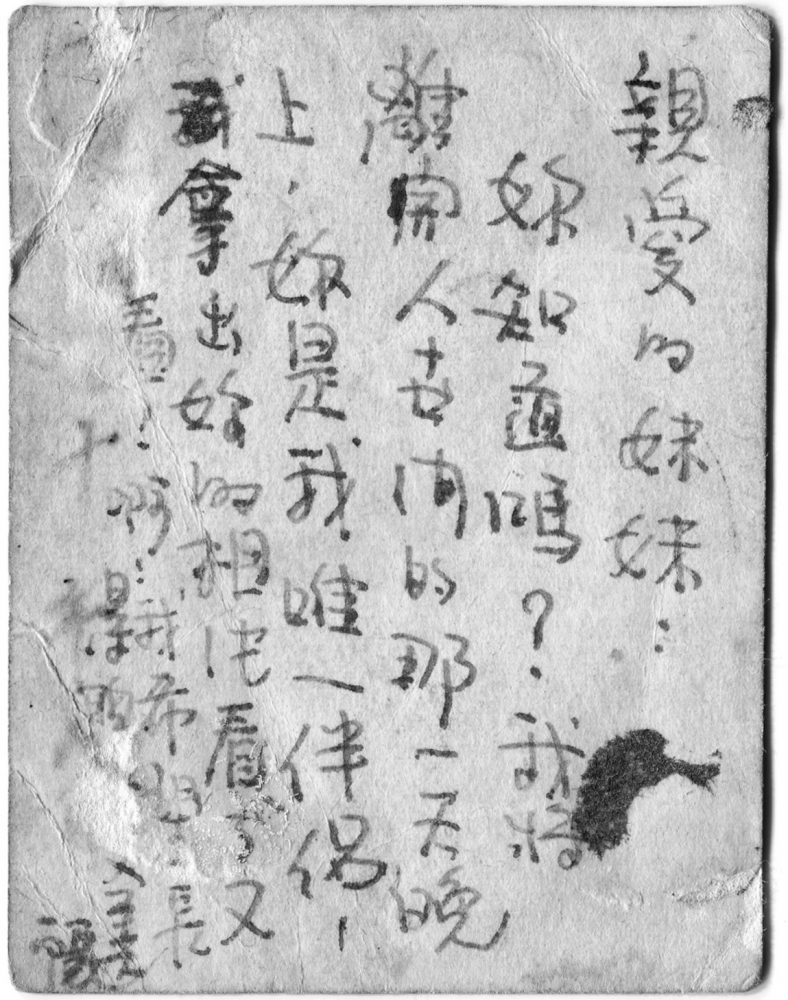 |
| A note that Ts'ai wrote to his sister the night before his execution: “Dear little sister: Do you know? On the night before I leave this world, you are my only companion. I took out your photograph and looked at it again and again. Ah, I hope—" And then the ink is smeared, perhaps by tears. Some believe the missing words were "that you grow up smart and beautiful." |
I thought about doing more research on his life and his reporting. The National Central Library appears to have microfilm of the Ho-p'ing Jih-pao, so I might take a look there if I get a chance. I'm still working out what my whole purpose would be for doing this research, though. Maybe I won't know until I see the newspaper microfilm. That's how it goes sometimes, right?

