Found out the other day that one of the titles in the running for the GHK biography has been approved by the sponsor of the book, the Taipei City Department of Cultural Affairs. The tentative title is 《葛超智傳記:亞洲、冷戰與一段未竟之志》 (roughly, George H. Kerr: Asia, the Cold War, and an Unfulfilled Ambition), and it should be coming out early next year. It's co-authored by Professors 蘇瑤崇 (Su Yao-tsung), 泉水英計 (Hidekazu Sensui), 吉原ゆかり (Yukari Yoshihara), and me. More details when I know more!
Showing posts with label writing. Show all posts
Showing posts with label writing. Show all posts
Saturday, August 22, 2026


Friday, June 26, 2026
Revisiting my dissertation
As I have mentioned a couple of times, I'm going to be participating in a roundtable on the Oberlin Shansi Memorial Association in China and Taiwan. I got an email early this morning that suggested that we are supposed to submit our presentation materials by July 5, which was a bit of a surprise. But I happened to have time today to do some work on it. So I woke up and got going on it.
The actual presentation (which I haven't done much of even now!) is only supposed to be five minutes long, but I also want to be ready for the roundtable discussion. We have worked up some questions that we'll discuss, so I spent the day going through them and drafting some responses. Doing that required me to read through parts of my dissertation and some of my dissertation notes from 15+ years ago. Some people have told me that they're horrified when they try to reread their dissertations, but I don't feel that way. Oh, there are some cringey places in it, and I've found more typos than I care to think about, but generally reading through it is a pleasurable experience. (As I told my brother, I think it's because my dissertation is so full of quotations of people who are smarter than I am!)
Reading the dissertation also brings back memories of the process of writing it, which was also (generally speaking) enjoyable. I have heard people talk about how their dissertation process was painful, and I'm sure there were painful aspects to mine, but I actually enjoyed reading and studying the archival documents, interviewing former Shansi reps, and putting it all together.* It wasn't all roses and cheese (to borrow my 11-year-old's phrase--don't ask me what it means!), but maybe because I took so long to write it (9+ years), I had time to "live" with the documents and the interviews and use them to sort of create a virtual Oberlin Shansi world in my mind. Rereading my dissertation brings all of the experience back to mind. It also allows me to make connections between what I knew then and what I have learned since then about Taiwan and about US-Taiwan relations through my work on George Kerr. I think the continued learning and making these connections is something that keeps me alive and keeps my few remaining brain cells working!
*Though it got a little scary when I started having dreams about Nicolas Cage helping me with it...
Tuesday, June 23, 2026
Summer activities
I have turned in the grades for my two summer classes, so now I can focus a bit more on the three things that I want or need to work on the rest of the summer. A little update:
- Introduction to Rhetoric. I've got readings and a general schedule of activities mapped out, but there are still a few blanks to fill in. I'm meeting with the regular instructor next Thursday
on Fridayso we can talk over my plans for the course. I'm going in a bit of different direction from the one she takes, but she's OK with that, and there aren't any strict departmental expectations for what students should cover in the class. (Obviously it has to be an introduction to rhetoric, though!) I've been adapting what I did for the "Rhetorics in Contact" course that I taught a couple of years ago. I'm not doing a heavy focus on archival research this time around, though (too many students to take to the archives this time). I'm also planning to bring a lot more reflection into the course by ending it with a reflective portfolio project rather than a big essay. - Academia Sinica conference. I started a PPT (Google Slides) for this, which I'll fill with mostly images (I don't like slide presentations that are text-heavy, though once in a while I fall into that trap). One thing that has been troubling me about this is that my prepared remarks are supposed to be only 5 minutes max. Not sure what I can say in 5 minutes. ("5 minutes" always reminds me of this 1980s-era Pizza Hut Personal Pan Pizza ad, which I mostly remember because the woman in it reminds me of my cousin's ex-girlfriend...)*
- Ts'ai T'ieh-ch'eng (蔡鐵城) project. Am "scraping" all I can find about him from various archival websites. (By the way, this website from the 國立公共資訊圖書館 is really cool! Tons of digitized old newspapers, Japanese era books, etc. I'm probably the last person in the world to find it, but in case I'm not, here's the link.) Am realizing how big and difficult a project this will be for me, but I'm realizing that I need to keep in mind what I was telling my students last year about the need to be patient and go slowly. I'm working with all sorts of materials and technologies (like the website above) that makes this research, but a lot of this just takes old-fashioned patience, planning, and ... (I need another word that starts with "p"--"persistence"?).
BTW, the GHK book is at the publisher getting proofread. When I know its publication date, I'll post it here.
* OK, now I want to have pizza for lunch...
Saturday, May 16, 2026
My college French teacher would be most disappointed
Just noticed that a footnote in my "Formosa Delayed" article (I'm already regretting the title) has the wrong date for Bastille Day:

Wednesday, April 29, 2026
Summer plans
The spring semester is over here--and just in time, as a hay fever-driven lethargy has overtaken me, making it hard for me to concentrate on whatever it is I'm supposed to be doing right now. I have two online courses to run in May-June ("Summer A," which used to be known as "Summer 1"), though, so I need to get ready for them. I've got one prepared, but I need to go through the other one and update it, and then make a few screencasts before classes start May 6. (I hope I can talk without sounding like I have a stuffed-up nose.)
After the Summer A classes are ready, I need to get back to work on preparing for a new course I'll be teaching in the fall: Introduction to Rhetoric. The regular professor is going to be on leave, so I'm taking over. While there are no set-in-stone content requirements, the course description reads as follows:
Introduces major concepts, traditions, and issues in rhetorical studies. Explores topics such as the range of ways that people persuade others to change their minds or take action; the relationship among language, truth, knowledge, and power; the role of language in shaping identity, communities, and cultures; and the use of rhetoric for activism and advocacy. Focuses on rhetoricians and rhetorics from diverse traditions, emphasizing contemporary and interdisciplinary approaches to investigating a wide range of rhetorical artifacts.
The regular professor has given me access to her materials, which are, of course, excellent, reflecting her years of teaching the course. I think I need, though, to develop the course in a way that fits my own expertise and teaching style. I'm working on that now, and I hope to talk to her soon to see what she thinks of my ideas. She might be able to help me avoid some possible wrong turns I'd take! More on all this in future posts, perhaps.
In addition to the course development, I'll be going to Taiwan this summer for a conference at Academia Sinica in August. I'll be part of a roundtable on "Oberlin Shansi in China and Taiwan: The Transformation of a Transnational Educational Mission." I'm supposed to talk about how martial law-era Taiwan and Tunghai University were depicted in the campus letters reps in Taiwan sent back to the Oberlin community. It'll be interesting to revisit that period of my academic life when all I seemed to think about was that hardy band of young Oberlin grads who were teaching English in Taiwan and teaching Oberlin about Taiwan.
I might also try to do some research while I'm in Taiwan, but right now I'm not sure what I want to do research about. I was initially interested in the story of Ts'ai T'ieh-cheng (蔡鐵城), whom I first read about when working on a presentation about the White Terror for students who are going on a study-abroad trip to Taiwan this May. Ts'ai, who was born in Ta-chia (大甲) in 1923, reported for the Ho-p'ing Jih-pao (和平日報) in central Taiwan before becoming involved with Hsieh Hsueh-hung's (謝雪紅) "27 Brigade" (二七部隊) after the February 28 Incident. In 1953 he was executed. His story (here it is in Chinese, an excerpt from a book entitled 《二二八記者劫》) was very moving, particularly the part where he wrote a note to his younger sister the night before he died.
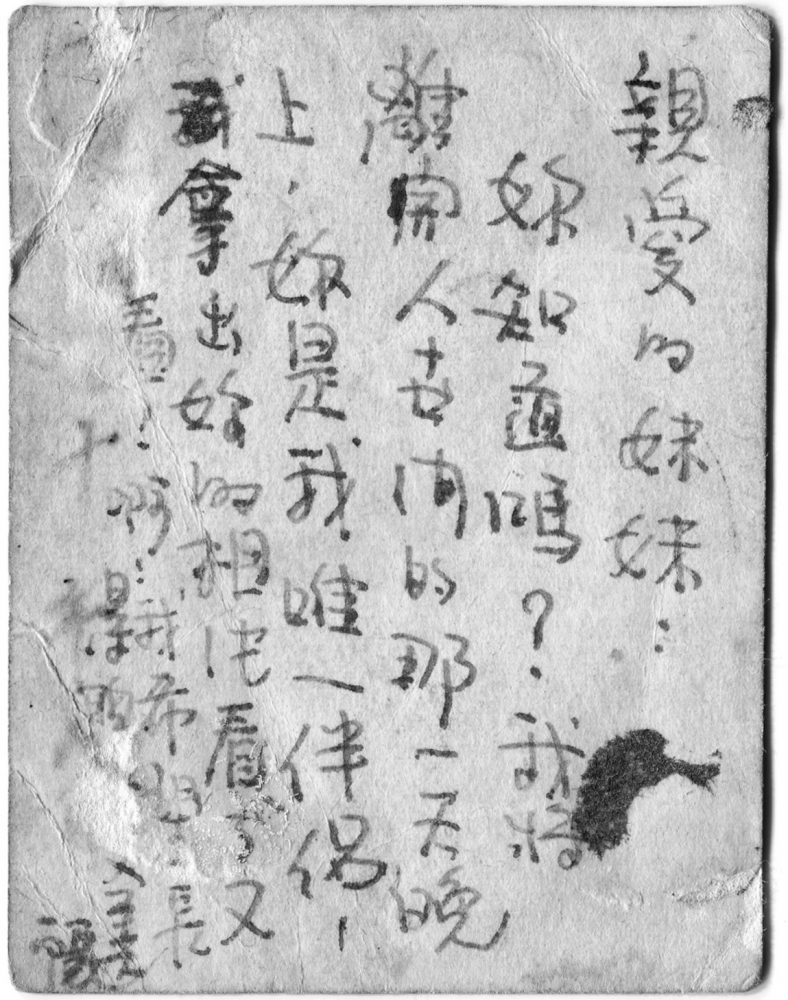 |
| A note that Ts'ai wrote to his sister the night before his execution: “Dear little sister: Do you know? On the night before I leave this world, you are my only companion. I took out your photograph and looked at it again and again. Ah, I hope—" And then the ink is smeared, perhaps by tears. Some believe the missing words were "that you grow up smart and beautiful." |
I thought about doing more research on his life and his reporting. The National Central Library appears to have microfilm of the Ho-p'ing Jih-pao, so I might take a look there if I get a chance. I'm still working out what my whole purpose would be for doing this research, though. Maybe I won't know until I see the newspaper microfilm. That's how it goes sometimes, right?
Wednesday, April 01, 2026
GHK bio updates
A couple of updates about the George Kerr biography:
- We have a publisher! (I'm not going to reveal the details yet, though. I'm not sure we have signed a contract yet.)
- The MS went out yesterday to be reviewed. Evidently, though, we have more time to work on it as we wait for the reviewers' comments. (I have some hopes about some of the things I'd like the reviewers to say, but I won't go into that here.)
- As I might have mentioned, this edition of the biography will be in Chinese. I'm hoping, though, that we will be allowed to have an English version done at some point. This is something we'll have to work out with the publishers, I suppose. If you have any suggestions for an English-language publisher, let me know!
OK, now that it's off to the reviewers, I should use the waiting time to get some grading done...
Friday, February 27, 2026
Things I'm (re)learning
I'm working on an application for a Humanities Center fellowship right now--here's their blurb about it:
2026-2027 Theme: Revolutions
We invite applications for our second annual Global Fellowship Program focused on the theme of revolutions. A revolution signals a foundational shift in action and thought. Whether they take the form of political uprisings, social movements, or collective struggles, revolutions transform our understanding of the world and our place in it by remaking our epistemologies and modes of relating. The word “revolution” also carries a physical and astronomical meaning: a full turn, a return, or a cyclical rotation. A revolution can signal either a dramatic break with the past or the completion of a cycle. Hence revolutions can serve as an entry point to discussions about the nature of change, progress, disruption, and time in our societies. We welcome proposals for Humanities research projects that engage the theme of revolutions, broadly conceived.
Without going into detail about what I'm proposing (or trying to propose), I've come to some realizations about this sort of thing that I'm thinking of sharing with the students in my advanced writing class, who are also working on developing topics, research questions, etc. for their projects. As I wrote in my offline journal (the aforementioned "Thoughts and Frustrations," aka "A Record of My Decline") while I was trying to figure out my "aims" for the project,
I think here I’m getting at aims (and maybe method, to some extent). What is my purpose? What kinds of questions am I trying to answer? It seems that part of the issue here is that I’m trying to come up with some sort of answer here already. A thesis rather than a research question. This is what I was talking to students about the other day. If this is a research project, I shouldn’t have an answer yet, should I?
It struck me that while I needed to focus on developing a research question, there is still a sneaky sort of thesis involved in that--the question of the significance of that research question. The "so what?" of it. As I put it later, "It’s harder sometimes to come up with a good question than it is to come up with a thesis."
Anyway, back to plugging along at this. I need to get it done by March 1(!), so I'm going to have to settle on something pretty soon.
Sunday, February 01, 2026
New title for my offline journal?
It occurred to me this morning to change the name of my offline journal, which I've been keeping for the better part of 20 years. Right now it's called "Thoughts and Frustrations," which comes from the original purpose of the journal, which was to be a place where I would brainstorm, draft, and reflect on the process of my dissertation. Looking through some earlier journals this morning (as I often do on the first of the month), I have to admit I was impressed by my ability to focus so well on my academic work.
After I finished the dissertation and moved to the US in 2011, the journal's purpose has broadened and my "thoughts and frustrations" have extended beyond academic work to life in general. I also suspect that it reflects less focused thinking more generally. I'm reminded of a study from a decade or so ago that used text mining to look at the novels of Agatha Christie to determine whether they indicated the onset of Alzheimer's. I had the thought this morning to run my 20 years' worth of journals through AI to see what conclusions it might come to regarding my cognitive state, but I have no desire to have all my private thoughts subjected to whatever Claude might want to do with them.
At any rate, based on those reflections, I am toying with the idea of renaming my offline journal "A Record of My Decline." Catchy, isn't it?
Wednesday, December 17, 2025
Formosa Delayed: George H. Kerr’s Struggles Writing About Taiwan
My article about the pre-life of Formosa Betrayed has just come out. Here's the abstract if you don't feel like clicking on the link:
George H. Kerr did not publish Formosa Betrayed, his 1965 book about the Guomindang’s early rule over postwar Taiwan and U.S. inaction during the 1947 massacre of thousands of Taiwanese people, until almost twenty years after those events. While scholars and pundits hold various theories about the reasons for the apparent delay, few have paid attention to Kerr’s attempts to write about Taiwan for the Institute of Pacific Relations (IPR) in the early years of the Cold War. Between 1947 and 1952, Kerr worked on two books, one arguing for the importance of Taiwan to postwar reconstruction in the Western Pacific, the other a more “polemical” study about the 1947 massacres that he had witnessed as a diplomat in Taiwan. Correspondence between Kerr and IPR Secretary-General William L. Holland reveals that several factors prevented Kerr from publishing an account about postwar Taiwan when it might have made the most difference – his inability to meet the IPR’s scholarly, objective expectations; his concerns about the IPR’s reputation during the McCarthy era; and the developing consensus in the United States that Taiwan was no longer a contentious issue. This article also explores why Kerr later constructed a different narrative about his failed publication efforts.
I'm glad that it's out, and I'm looking forward to any response that I get. Now back to the biography of Kerr...
Thursday, December 04, 2025
On the essay
Saw this on LinkedIn recently. Reminds me of the "exploratory essay" assignment I've been doing in First-Year Writing for the past few years. It's tough for students because they're used to writing those more formulaic texts that the author discusses.
Sunday, August 24, 2025
Third chapter draft finished!
I just emailed a draft of the third chapter I am working on to my partners. I am not confident in it, but at least it's done. Now I can focus on other things that I need to do, like preparing for the fall semester and pulling weeds in the front lawn. (My son's school bus will stop in front of our house this year, and I don't want his classmates to think that we're the Addams Family.)
But first, to bed...
Thursday, August 21, 2025
Still struggling...
I am close (I think) to finishing this chapter that I'm working on, and I really need to get it done asap so that I can prepare for my courses that start September 3. But instead of diving into some correspondence that I need to go over to write the last section, I keep adding to and tweaking other parts of the chapter. I think I'm scared of how much work it might turn out to be. But I've got to do it. What can this be called? It's not "writer's block" because it's not about the writing. Is there something called "reader's block"?
Saturday, August 09, 2025
One chapter down, two to go...
I sent to the other authors the first of the three chapters that I'm responsible for in the GHK biography. It's actually the second of the three, that covers Kerr's advocacy for Taiwan during the late 1940s-mid 1950s and the effects of McCarthyism on his academic career. It's interesting writing about this with a Taiwanese audience in mind because I have to make sure that I discuss the American historical context in more detail than I might have to with a US audience. (Then again, as I was reminded by a colleague, I should probably not expect the US audience to be that much more informed about the McCarthy era, unless they have studied it. I think folks today would consider it ancient history. Which they shouldn't, for some very pressing reasons... But I digress.)
The other concern I have is about my style/tone. It's going to be translated into Chinese, so I tried to write with that in mind, but I had some trouble figuring out how academic vs. how popular I should sound. I'm afraid I might have erred on the side of sounding academic. That might need some work depending on what the editors and publishers expect. To me, it's interesting stuff, but it might sound a bit dry and boring to readers. Perhaps I should spice it up a bit. I tried to include quotes from Kerr and others to bring their voices into it, but of course the results will depend on how it gets translated.
One extended quote that I liked was from a political science professor at Stanford who was interviewed by the Civil Service Commission about Kerr's loyalty when Kerr was applying for a contract position at the Hoover Institute that was funded by the International Cooperation Administration. He appears to have responded rather testily to the interviewer's questions:
In the last few years I have been interviewed by Government Investigators at least three or four times concerning George Kerr. I have always given George the highest recommendation and my opinion of him has not changed since the last time I was interviewed about a year or a year and a half ago. If I had any reason to question him either securitywise or from the standpoint of loyalty, I would surely inform the proper government agency.
I first met George while we were both assigned to the Formosa Research Unit at Columbia University while serving with the United States Navy around 1944. I have known him ever since. Last semester at Stanford University he taught a course in my department. He has been out at the University for a good number of years now. I think that any man who has served as a Naval Attache and a Vice-Consul for this government does not have to be investigated every time he turns around.
George’s character, habits and morals are beyond reproach. He is completely honest and trustworthy and a gentleman of the highest integrity. I can only reiterate all the statements I have made in the past. I cannot question his loyalty to this country. I feel the government is lucky to get his services and I would recommend him highly for work involving our national security program.
I'd love to know who this was, but unfortunately, his name has been redacted. I suppose I could figure it out pretty easily, though, if I did a little searching to find out who was at Columbia and then went to Stanford.
But I have those two other chapters to work on now... due 8/15! Wish me luck!
Source: James M. Murtha, investigator, Report of Investigation, George Henry Kerr, CSC [Civil Service Commission] Case Serial No. 5.22.55.5235, 2nd Regional Investigations Division (New York, NY: U.S. Civil Service Commission, Intermittently 24 June-12 July, 1955). (FOIA request).
Friday, August 01, 2025
Some possible language to use with students
I liked the language of "developmental editing" vs. "copyediting" from this. It might be a good way to explain to students why they have to do multiple drafts, rather than just saying that they have to do two drafts before the final draft.
Thursday, July 31, 2025
I'm still alive...
Just a note here to let all of my reader know that I'm still around. I've been working on my book chapter drafts, trying to crank out words words words and cite sources sources sources. There are some interesting things that I've noticed about my process (and then unfortunately forgotten) that I'd like to tell students about in the fall.
I'm going to be teaching First-Year Writing, and I've decided to bring the students to NU's archives and special collections to try their hand at working with archival documents. I don't expect to turn them into historians (I'm not technically a historian myself, if I'm honest with myself), but as I said almost a year ago, I want to give them experience with a different kind of academic research (most of the students so far appear to be computer science or engineering majors). For that matter, perhaps they'll find some interesting points of similarity between the archival research process and research they're learning about in their own disciplines. Who knows?
Anyway, back to my own work. I have about 2 weeks to go before I have to submit my chapter drafts. Wish me luck!
Tuesday, June 17, 2025
Summer 1 almost done! Question about writing for translation
Just a few days left with the two (!) Summer 1 courses I'm teaching. Although these are pretty intensive, cramming 14 weeks worth of work into 7 weeks, so far it has gone fairly smoothly. At first when I found out I was going to be teaching two different writing courses this term, I was a little horrified. But it wasn't as bad as I thought it would be; in fact, it was kind of nice to teach two different courses because there was some variety in the kinds of texts students were writing.
I just finished talking with one group from my business writing course that dropped in during my virtual office hours. It was good to talk to some people from my class. These online asynchronous courses have their advantages, but the disadvantage is that you can go for an entire term without ever meeting your students face-to-face. At times, I've required it, but this summer, I didn't because the term went by so quickly and quite a few of the students are located in various places around the world. (And I always feel that some people might be taking an online asynchronous course precisely because they don't want to talk to the instructor for whatever reasons. So I guess I should honor that!)
After I finish my grading for this course, I have to get back to my 3+ book chapters that I need to finish by mid-August. Fortunately, these don't need to be completely polished, though I suppose they should be as complete as I can make them. Since they're going to be translated into Chinese, I don't have to spend as much time struggling over stylistic issues as I would usually do (believe it or not!). I just have to make sure the sentences are clear and easily translatable. Out of curiosity, have any of my reader(s) had to work like this before--writing something that is specifically meant to be translated? How does knowing that it will be translated change your approach to how you write the text?
Monday, April 07, 2025
Busy times ahead
My contributions (?) to this blog are going to slow down in the coming months, I'm afraid. I'm looking forward to heavy grading the next couple of weeks, followed by course preparation for two intensive summer classes I'll start teaching in May, accompanied by work drafting three chapters (due end of June) for a collaborative book project. (And somewhere in there is that Kerr paper I've been trying to finish!)
So what am I doing here? Off to get the grading worked on! Wish me luck!
Thursday, February 27, 2025
New Books Network interview with the authors of Revolutionary Taiwan
New Books Network has a great interview with Catherine Lila Chou and Mark Harrison about their book, Revolutionary Taiwan: Making Nationhood in a Changing World Order, which I wrote briefly about earlier. (That's a lot links in one sentence!)
As a writing teacher, I really liked listening to their discussion early on about their writing process and how they viewed the kind of book they were trying to write. Harrison calls the style of the book that they were going for as "readable academic," where on the one hand they didn't want to write a dense academic monograph but on the other wanted to do justice to the complexity of Taiwan's histor(ies) and identit(ies). He says that that they "landed on" the idea of starting with events from contemporary Taiwan and interpret those events in terms of Taiwan's histor(ies) and culture(s). Chou compares the chapters and style of writing in terms of New Yorker essays that begin with specific stories that "bring the reader in" and then unpeel the "multiple layers" of meaning that make up those stories. She also talks about their limitations as academics that made it more challenging to them to write in this style. They also talked about how they collaborated on the book from a great distance (Chou was in Taiwan and Harrison was in Australia for most of the process, much of which took place during the Covid pandemic.) These are all interesting reflections that I'd like to point my students to when we talk about the writing process, envisioning your audience, collaborating as writers (particularly in online classes where students might not ever meet in person), and reflecting on writing, as well.
The authors also bring up the image of Taiwan's "spectral presence," which (as I've said elsewhere, I think) is a concept that has come up a lot in my reading lately in relation to Taiwan. I mentioned the metaphor of "hauntings" that are prominent in two books I read recently, Anru Lee's Haunted Modernities and Kim Liao's Every Ghost Has a Name. Derek Sheridan also wrote an article a few years ago about "the spectre of American empire" in Taiwan. The idea that Taiwan itself has a "spectral presence," though, as a country/not-country (in terms of international recognition) that exists in almost a ghostly form outside of time and place is new and insightful to me.
This blog also got a hat tip in the discussion (which, of course, is the real reason I'm talking about this interview!), citing a post of mine summarizing an article discussing Taiwanese cooking shows. (This reminds me--I haven't written any summaries of communications articles about Taiwan in quite a while!)
Monday, January 06, 2025
Classes starting this week; interview assignment
I have two on-ground classes tomorrow--two sections of "Advanced Writing in the Business Administration Professions." I have been teaching this course on and off for over ten years now, but I'm trying a new/old thing this semester. New in that I haven't done it in this course--at least not in this way or for these reasons--before, but old in that I have done it before, both in this course (for different reasons) and in other previous courses.
The assignment is an informational interview assignment with someone whose job aligns with the student's expected/hoped for/dreamed of career path. This being a writing course, I ask students to focus a good part of the interview on the writing expectations and practices of the job. I've done this assignment in some previous advanced writing courses (and it occurs to me that I did this assignment at least once in a composition class I taught at Tunghai, where I asked students to focus on how people in the job used English--or didn't!).
The new thing this time is that we're going to throw GenAI into the mix--(how) are the interviewees using GenAI as part of their work? What are the implications, if any, for what students should be learning in an "Advanced Writing in the Business Administration Professions" course? This assignment occurred to me last semester after running into a previous student from ten years ago who was telling me about how the company she works for has its own proprietary ChatGPT-like system that employees are expected to use to write letters to clients. She hates it--it writes sentences that are too long. I want to get a sense of how widespread this is, and I want students to learn about it, too.
I attended an online discussion today on "Scaffolding GenAI Conversation in Your Courses," and one of the things that came out of it is that, perhaps not surprisingly, faculty are taking very different approaches to how or whether to allow students to use GenAI in their work. I got the sense from the discussion, for example, that while in my writing classes, learning how to synthesize sources is an important practice that I want students to work on without help from AI, in courses in some other disciplines/professions, it would be acceptable to have AI do the work of synthesis because the pedagogical focus of the assignment is not necessarily on synthesis. (In those cases, though, I'm sure the instructors would still want the students to tell them how they used AI to help them.) This reminds me again to make clear what I'm hoping students get out of assignments--what they should learn how to do, presumably unaided by AI. And maybe from this, what things might be OK to get help with from AI (for instance, APA citation, at least to a certain extent).
Well, now to go back to my materials and see if I need to do any tweaks on the syllabus before tomorrow morning.
Tuesday, December 24, 2024
"Midterm" reflections on August's "new year's resolutions"
Back in August, I wrote up a few new year's resolutions for the 2024-2025 academic year. In the past, I've usually written them up and then ignored them, but this time I'm going to take a look back at them and figure out what I did, what I didn't do, and what course corrections I might make.
- "Try to get up earlier in the morning"--the idea here was go get up early enough to do my Duolingo and a little writing. This didn't work at all as planned. I did manage to get up early some mornings and do a little journaling, but I didn't have enough time to do my Duolingo before I had to get the day started. And many days, I woke up just in time to jump in the shower before starting to get my son ready for school.
- "Use my commute time to read"--since I didn't have time to do my Duolingo in the morning, I usually did it on the trip into school. Sometimes I read on the way home from school, but a lot of times, I was using that time to catch up on work.
- "Make time for writing"--I pretty much failed at this during the semester, unless you count my teaching-related writing and service-related writing. I had the usual amount of the former and, it seems, more than the usual amount for the latter. I did a few little revisions on a couple of book reviews that will be coming out soon, but besides that, I didn't work on any of the papers I have to revise.
So things didn't go quite as well as planned. I think one thing that cut down on my writing time was that I was teaching a new course, so that involved a lot of work to keep ahead of the students. This semester, I'll be teaching "old" courses (though of course I can't seem to stop myself from fiddling with the assignments), which might help.
Another thing that might help in terms of the writing is that next semester, I'm rejoining a writing accountability group that has always forced me to spend at least an hour and a half a week on writing. I've always found that helpful. I need to finish that George Kerr paper first, then get started on the chapters I need to write for the collaborative biography.
I think I need to add "going to bed earlier" to the list of resolutions because if I don't get to bed earlier, I can't wake up earlier. I'll try to work on that. I've been napping a lot recently because of some muscle relaxants I have had to take for a sciatica problem, but hopefully I'll get over that before vacation is over. Napping always throws off my evening sleep schedule.
As for using commuting time for reading, I think I'll still end up doing Duolingo during the trip in. I'll try to do some reading on the way home. I'll have to decide what I want to read, though! Right now, I'm about a third of the way through David S. Reynolds' John Brown: Abolitionist, but I'm going to try to finish it before the semester starts. I have to think about what to read after that. Any ideas?
Subscribe to:
Posts (Atom)