Showing posts with label half-formed thoughts. Show all posts

Wednesday, May 06, 2026

Historical narrative, "society's rhetors," and AI

I'm going to have to sit with this for a bit to work out my thoughts about what's being suggested here:
 

The suggestion to create an app, an AI tool, "that makes a kid feel the weight of what already happened" has my mind spinning. In the context of talking about World War II, I know that directly communicating with the people who lived through the war is becoming less and less possible--I had four uncles who fought in World War II, and my father was in General MacArthur's Honor Guard in Tokyo after the war. They've all been dead for at least 10 years. 

However, there are documentaries, oral histories, histories, historical fiction and movies--probably even comic books graphic novels--many of which could be used to help "a kid feel the weight of what already happened." So while on the one hand, I applaud the idea of applying the latest technology to helping carry on public memory, on the other hand, I wonder if an AI app is really the best tool for this. Isn't what we want rather the voices of humans who experienced history or who have created nonfiction or fiction with the materials of history? If a machine can by itself manufacture something that can connect us empathetically with our past, our ancestors, I don't know if I should be impressed or scared. Perhaps as scared for what we've become as for what the technology has become.

I'm thinking about this point also in the context of the intro to rhetoric course I'll be teaching in the fall. This post brought to my mind something I read years ago by rhetorician Gerard Hauser from his book, Vernacular Voices: The Rhetoric of Publics and Public Spheres. Citing Paul Ricoeur, Hauser points to 
the fragility of rhetoric in a context so overrun by alienation and difference that one has difficulty locating compelling terms that might anchor society in the silt of cultural memory. At the level of praxis, society's rhetors are custodians of history's story. By giving memorable form to distinctive episodes and persons, they evoke bonds of communal understanding and sympathy that can frame common commitments and motivate common actions. The question we face is whether the distance between the contracting relevance of the past and the fading horizon of an uncertain future precludes the possibility that we can still establish bonds of community. (p. 112)

I'd add that in addition to what he calls "the challenge of a past and future moving in opposite directions" is now the question of who or what will tell history's story--and what difference it makes. 

I'm not sure that we will get into this in our course--I'm still working on developing the course, and these questions, while interesting and important, are perhaps not as central as the issues that arise from teaching an intro to rhetoric course in the US during the midterm elections. But I want to follow this thread and see where it goes. 

It's late now, and I might come back to tinker with this post some more later. 

[Update, 5/7/26: This article puts the learning of history in terms of "historical empathy": "'The more we can put it in terms of everyday people, and help people relate to those individuals, we find, the more successful we can be,' said Michael Hensinger, who oversees K-12 education for the museum. 'It can be really hard to relate to a general, a king, queen, somebody like that, which is often the lens through which a lot of history was taught when I was growing up.'"]

Wednesday, April 29, 2026

Summer plans

The spring semester is over here--and just in time, as a hay fever-driven lethargy has overtaken me, making it hard for me to concentrate on whatever it is I'm supposed to be doing right now. I have two online courses to run in May-June ("Summer A," which used to be known as "Summer 1"), though, so I need to get ready for them. I've got one prepared, but I need to go through the other one and update it, and then make a few screencasts before classes start May 6. (I hope I can talk without sounding like I have a stuffed-up nose.)

After the Summer A classes are ready, I need to get back to work on preparing for a new course I'll be teaching in the fall: Introduction to Rhetoric. The regular professor is going to be on leave, so I'm taking over. While there are no set-in-stone content requirements, the course description reads as follows:

Introduces major concepts, traditions, and issues in rhetorical studies. Explores topics such as the range of ways that people persuade others to change their minds or take action; the relationship among language, truth, knowledge, and power; the role of language in shaping identity, communities, and cultures; and the use of rhetoric for activism and advocacy. Focuses on rhetoricians and rhetorics from diverse traditions, emphasizing contemporary and interdisciplinary approaches to investigating a wide range of rhetorical artifacts.

The regular professor has given me access to her materials, which are, of course, excellent, reflecting her years of teaching the course. I think I need, though, to develop the course in a way that fits my own expertise and teaching style. I'm working on that now, and I hope to talk to her soon to see what she thinks of my ideas. She might be able to help me avoid some possible wrong turns I'd take! More on all this in future posts, perhaps.

In addition to the course development, I'll be going to Taiwan this summer for a conference at Academia Sinica in August. I'll be part of a roundtable on "Oberlin Shansi in China and Taiwan: The Transformation of a Transnational Educational Mission." I'm supposed to talk about how martial law-era Taiwan and Tunghai University were depicted in the campus letters reps in Taiwan sent back to the Oberlin community. It'll be interesting to revisit that period of my academic life when all I seemed to think about was that hardy band of young Oberlin grads who were teaching English in Taiwan and teaching Oberlin about Taiwan. 

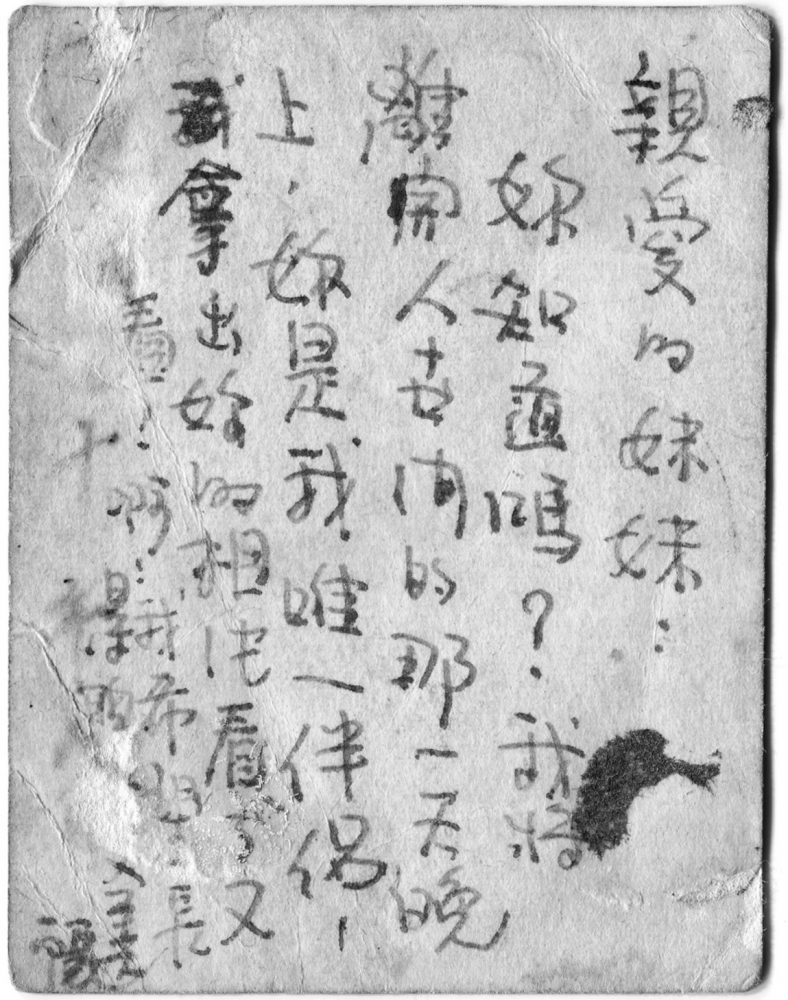
I might also try to do some research while I'm in Taiwan, but right now I'm not sure what I want to do research about. I was initially interested in the story of Ts'ai T'ieh-cheng (蔡鐵城), whom I first read about when working on a presentation about the White Terror for students who are going on a study-abroad trip to Taiwan this May. Ts'ai, who was born in Ta-chia (大甲) in 1923, reported for the Ho-p'ing Jih-pao (和平日報) in central Taiwan before becoming involved with Hsieh Hsueh-hung's (謝雪紅) "27 Brigade" (二七部隊) after the February 28 Incident. In 1953 he was executed. His story (here it is in Chinese, an excerpt from a book entitled 《二二八記者劫》) was very moving, particularly the part where he wrote a note to his younger sister the night before he died. 

A note that Ts'ai wrote to his sister the night before his execution: “Dear little sister: Do you know? On the night before I leave this world, you are my only companion. I took out your photograph and looked at it again and again. Ah, I hope—" And then the ink is smeared, perhaps by tears. Some believe the missing words were "that you grow up smart and beautiful."

I thought about doing more research on his life and his reporting. The National Central Library appears to have microfilm of the Ho-p'ing Jih-pao, so I might take a look there if I get a chance. I'm still working out what my whole purpose would be for doing this research, though. Maybe I won't know until I see the newspaper microfilm. That's how it goes sometimes, right?

Tuesday, May 02, 2023

Some more play with ChatGPT

This evening, my wife and I were playing with ChatGPT to see how it translates from Japanese and Chinese. I remembered that I had once translated a passage about rhetoric from Tseng Yueh-nung, the first president of Tunghai University. It's written in a more literary style (although it is fairly understandable if you read modern Chinese), so I wanted to test ChatGPT on it. Here are the results:

Me: Translate: 希臘羅馬政治即臻全盛,日中則昃。於是道德淪亡,人懷自競之心,挾數任術,以獵取功名而致富貴。雄辯學 (rhetoric),逐為必修之科。整體教育反失去重心,一時消極與失望,詭詐與荒瑩,籠罩全歐,不可救藥,如是者數百年。

ChatGPT: During the heyday of Greek and Roman politics, the situation in China and Japan was declining. As a result, morality decayed, and people harbored a sense of rivalry, employing any number of schemes to hunt for fame, wealth, and status. The study of rhetoric became a mandatory subject. Overall, education lost its focus, leading to passivity and despair, deceit and confusion, enveloping all of Europe for hundreds of years, with no hope of recovery.

Me (somewhat rudely): 日中則昃 doesn't have anything to do with Japan and China. It's talking about the sun at its zenith declining.

ChatGPT: You are correct, I apologize for the mistake. "日中則昃" is a Chinese idiom that means "the sun is at its zenith and then begins to decline," and it has nothing to do with Japan and China as I previously stated. Here's the corrected translation:

At the height of Greek and Roman politics, the sun was at its zenith and then began to decline, just as the morality of society began to decline. People became competitive, using various means to pursue fame and fortune. The study of eloquence and rhetoric became a required subject. Overall, education lost its focus, leading to a period of passivity and despair, deceit and confusion, that enveloped all of Europe for several hundred years, and seemed irreparable.

I think it did a decent job on the revised translation. It makes the comparison between the sun's decline and the decline of morality in society more obvious with "just as," which is not (I don't think) in the Chinese original (於是 is more like "therefore" or "as a result," not "just as"). So it's taking an implicit comparison and making it explicit. 

We tried ChatGPT with 陋室銘 by 劉禹錫. My wife got a similar kind of situation with the last line, "孔子云:「何陋之有?」", which it translated as something like "What does it matter if it's humble as long as I am at peace?" I generated 10 translations but never got that version. Here's what I got for the last sentence:

  1.  Confucius said, "What does it matter if the room is humble?"
  2. Confucius said: "What does it matter that the room is simple?"
  3. Confucius said, "What does it matter if it's humble?"
  4. Confucius said, "How humble it is, yet how significant!" [Hmmm... this one is interesting...]
  5. Confucius said, "What humble abodes can also have admirable qualities?" [Hmmm...]
  6. Confucius said, "How can a humble abode be considered inferior?"
  7. Confucius said, "What does being shabby matter?"
  8. Confucius said, "What is humble can also be distinguished."
  9. Confucius said, "What does it matter that it is humble?"
  10. Confucius said, "What is humble about it?" [I think ChatGPT was getting tired here...]
I looked for some English translations online. This one by Abby Lu notes that "Confucius actually said: ‘What is ugly about the home of a gentleman?’, the latter of which the author cut out of humility." (子曰:君子居之,何陋之有?). See also this translation (an interesting website, by the way!). 

Anyway, I'm getting off-track now, and I should go to bed so I can get back to my book review tomorrow. My book review is coming along well, by the way (thanks for asking); I think I'll be able to get a good draft of it done by Friday. 

Friday, September 30, 2022

Reading for pleasure or reading "for pressure" in other languages?

In my first-year writing for multilingual students class today, we were talking about Jhumpa Lahiri's 2015 article, "Teach Yourself Italian," and about how her passion for Italian led her to decide to move to Italy and, in preparation, to "pledge to read only in Italian." The section of her article about that decision is called "The Renunciation." Lahiri writes, 

I consider it an official renunciation. I’m about to become a linguistic pilgrim to Rome. I believe I have to leave behind something familiar, essential.

We talked about the idea of renouncing our native language (in the students' case, to speak only in English). The students weren't very keen to renounce their native languages in order to speak only English. One mentioned that there is pressure from friends and classmates from their home country to speak their common language. Another suggested that because it's more difficult to speak English, to speak only English would result in a great loss of confidence. Also, their native languages are tied to their sense of who they are.

Lahiri's description of what it's like to read in Italian reminds me of what it's sometimes like when I read in Chinese:

I read slowly, painstakingly. With difficulty. Every page seems to have a light covering of mist. The obstacles stimulate me. Every new construction seems a marvel, every unknown word a jewel.

There's both pleasure and pressure in this depiction of reading in another language. You run into obstacles in the form of unfamiliar vocabulary or syntax, but getting past those obstacles seems to launch you forward (toward new obstacles!). If you take the time to work through those obstacles instead of bypassing them (as I admit I sometimes do), you have a feeling of accomplishment, and maybe you learn something new. As Lahiri puts it,

After I finish a book, I’m thrilled. It seems like a feat. I find the process demanding yet satisfying, almost miraculous. I can’t take for granted my ability to accomplish it. I read as I did when I was a girl. Thus, as an adult, as a writer, I rediscover the pleasure of reading.

As we were discussing Lahiri's experience, I asked the students if any of them read in English for pleasure. Some of them shook their heads, others laughed. My guess is that their reading in English is mostly (as a former Tunghai colleague put it) "for pressure" rather than for pleasure. I can understand this feeling. Most of the time when I read in Chinese, it's in order to write something (like that blog post on bookstores in colonial Taiwan), so there's some degree of pressure. 

But I wonder if we should (re)define the notion of "reading for pleasure"; after all, Lahiri's depiction of her experience reading in Italian shows that it's a lot of work to read in a language that you're not as strong in. Despite that, she treats the work of reading as pleasurable even if it is demanding (or perhaps because it is demanding).  

Thursday, August 18, 2022

Casting about for my next reading project

The fall semester is going to start soon, so I'm busy preparing my three classes (two sections of first-year writing for multilingual students and one section of business writing for multilingual students), but I'm also interested in getting into another book. I finally (FINALLY!) finished John Robert Shepherd's Statecraft and Political Economy on the Taiwan Frontier, 1600-1800, which I see I mentioned starting in June of 2021(!). 

As you can imagine, I've forgotten a lot of the details in the book (of which there are many). As I wrote in a text back in May to someone more well-read in Taiwan history than I am, "My main takeaway so far is that it doesn't seem at all that the Qing were ignoring Taiwan the way the popular imagination seems to have it. (Not to say that their governing was super effective.)" That's still my main conclusion--obviously the Qing didn't control most of Taiwan; Paul Barclay's book Outcasts of Empire: Japan’s Rule on Taiwan’s “Savage Border,” 1874–1945 explains Qing rule in terms of "multicentric legal pluralism" (p. 17), where "heterogeneous communities and ranked status groups stood in differentiated legal relationships to the apical center of authority in Beijing. Implicit in the notion of multicentric legal pluralism is the possibility that sovereignty can be graded, and even diminished, at the margins of a polity" (p. 17). This accounts for the Qing's initial response to, for instance, Japanese protests in the aftermath of the Mudan village incident of 1871 in which Paiwanese villagers killed 54 Okinawan survivors of a shipwreck in southern Taiwan. But, getting back to Shepherd, I think his book shows that the Qing did not "neglect" the parts of Taiwan over which they ruled. 

Shepherd's book is almost 30 years old, though, so I would like to read something more recent that might supplement my knowledge. I started to read Barclay's book a while back, so that's one possibility, though its focus is mostly on the Japanese period. University of Washington professor James Lin also asks students in his graduate survey of Taiwan studies to read Tonio Andrade's How Taiwan Became Chinese, though that seems to end with the fall of the Dutch colony. I could reread Emma Teng's Taiwan's Imagined Geography, though I think I'd rather spend my time reading something new. Any recommendations?

[Update, Aug. 19: I ended up choosing Lien Heng (1978-1936): Taiwan's Search for Identity and Tradition, by Shu-hui Wu (mainly because it was within reach...). So far it's interesting reading, though there are a couple of details that have puzzled me. Maybe I'll write more about that when I finish the book.]

Saturday, August 14, 2021

Summer writing grading project (Week Fifteen): More on translingualism

This has been the next-to-last week of class, so I've been reading and commenting on paper drafts, conferencing with students, and doing some grading. It's been busy. I haven't had much time to do anything else, although I do have a few things to finish before the end of the month. (And I need to prepare for the fall semester, when I'll be on campus for the first time since February 2020! Not really looking forward to that, but what can you do?)

One quick addition to what I wrote last week about Bruce Horner and the relationship of translingualism to SRTOL. My colleague Cherice Jones steered me to the CCCC Demand for Black Linguistic Justice, which I had seen before. What I hadn't noticed previously, and what seems relevant to Horner's argument in the chapter I referenced last week, is part of Demand #3 ("We Demand that Political Discussions and Praxis Center Black Language as Teacher-Researcher Activism for Classrooms and Communities!"), where there is a "sub-demand" that:

  • "researchers, educators, and policymakers stop using problematic, race-neutral umbrella terms like multilingualism, world Englishes, translingualism, linguistic diversity, or any other race-flattened vocabulary when discussing Black Language and thereby Black Lives."
If I understand correctly, the writers aren't saying that those terms like translingualism, etc., are problematic in other situations, but they specifically point to how these terms ignore race when discussing language--specifically, Black Language. This raises an issue that I hadn't considered before, but now seems very obvious: in arguing that "translingualism sees difference in language—located in time as the ever emerging product of language practices—not simply as the norm but as inevitable, arising even in exact repetitions of conventional usage" (Horner 60), there appears to be a validation of the "inevitable" difference in language and language practice at the expense of the very specific experiences of users of particular languages--specifically, users of Black Language. April Baker-Bell, et al. (the authors of the Demand), tie Black Language to Black Lives in a way that "translingualism" as an ideology doesn't seem (able) to account for. 

I'm still thinking about all this and I'm admittedly no expert, so I'm open to input on this....

[Update, 8/16: And now I realize that Keith Gilyard wrote about these very issues back in 2016! h/t again to Cherice.]

Friday, July 02, 2021

Summer writing project (Day Forty-Five): Current events and my project

Since yesterday, there's been a lot of discussion on Twitter about one particular "idiom" (chengyu) in Xi Jinping's speech on the 100th anniversary of the founding of the Chinese Communist Party--the line where he says that the enemies of China will find themselves crashing into a steel wall formed by the bodies of 1.4 billion Chinese; he uses the phrase 头破血流, which literally means "head break blood flow." The question in the tweets I've been reading, though, is whether this phrase is supposed to be taken literally (someone, whose tweet I unfortunately can't find now, compared it to idioms like "raining cats and dogs"). Frankie Huang suggests we should take it in the spirit of the famous ST:TNG episode where Picard tries to figure out the allegorical language of the Tamarian ship captain; that is, the broken and bleeding heads are not meant to be taken literally. She goes on, in fact, to suggest that taking the phrase literally is actually a purposeful act of misunderstanding driven by a bias against Xi or, more generally, China. 

This has made me think again about my reaction to some of the postwar Taiwan elementary textbook passages I've been reading, and whether I'm reading too much into them. I mentioned the "urban warfare" lesson in a 1946 fourth-grade reader that struck me (and my wife) as pretty violent, and this all started with a lesson from 1956 that I translated years ago about Yan Haiwen, a Chinese pilot who kills himself rather than being taken by the enemy soldiers. But I'm starting to rethink my response what I'd consider the graphic violence of these stories. Going back to 头破血流, a thread by Chenchen Zhang arguing that the emotional valence (if I'm using that term correctly) of the language of Xi's speech and, I guess, Chinese nationalistic discourse in general, is more important to think about than one four-character chengyu. 

I think with Yan Haiwen, I understood this on a certain level when I wrote about it in my dissertation (and in this paper, if I ever finish it)--I thought about this story in terms of Suzanne Keen's theory of strategic empathizing, where student readers were taught to admire and identify with the feelings and motivations of people like Yan Haiwen. In this case (and perhaps in the case of the urban warfare story), it's perhaps important to turn away from the horror I feel reading about the violence and to the feelings that the writers are trying to evoke from readers. 

That all said, however, I'm resisting the idea that there's one "right" way to read these stories (or the chengyu in question in Xi's speech). Different readers will interpret these texts differently, depending on their positionality. A non-native speaker of Mandarin, for instance, might be properly accused of reading 头破血流 too literally, and it might be said that since I'm not the primary audience for this speech, I don't have the right to interpret it. On the other hand, in our globalized world of instantaneous worldwide communication and immediate translation, it seems to me a bit naïve to think that there's only one audience for any big speech like this. After all, this part of the speech is also serving as a warning to the enemy, so in that sense it's at least partly addressing that potential enemy.* And as Bessie tweeted in response to Frankie Huang's post, for a Taiwanese person, it's hard to assume "good faith" on the part of the speaker when Taiwan is under constant threat of violent annexation by that same speaker. So interpretation also has a lot to do with how you see yourself in relation to the speaker. (I'm sure I'm not saying anything new here.) Even in postwar Taiwan, stories like those of Yan Haiwen might be read differently by Taiwanese students as opposed to Mainlander students. (Unfortunately, I'm not sure how I would be able to test this at this point. One thing I'm constantly looking for is stories of people's experiences of schooling at that time.)

Anyway, this is what looking through Twitter got me thinking about today. It's useful to think about this, and it gives me another perspective on what I've been working on, but it also reminds me of my own place or position in this project I'm working on (and possibly why it's taking me so long to finish it!). 


*Then again, when my son is playing dangerously on the stairs, I sometimes tell him to be careful or he'll fall down the stairs and break his neck. That's pretty graphic...

Saturday, June 12, 2021

Next on my reading list

I'm sure my dear reader is dying to know which book I'm going to read now that I've finished A Son of Taiwan. I'm still working on John Shepherd's Statecraft and Political Economy on the Taiwan Frontier, but that's sort of leisure reading. (Sorry, Professor Shepherd!) I've decided to read Language, Politics and Identity in Taiwan: Naming China, by Hui-Ching Chang and Richard Holt (Routledge, 2014). I've read some of it before but never the whole book. 

And as I mentioned in a previous post, the book is notable (to me, anyway) for being a rhetorical study that is published in a Routledge series on Taiwan rather than rhetoric or communication. I was looking to see if Stephen Hartnett had cited it, and it appears he doesn't, which is odd since his book is also about the rhetoric of China-Taiwan(-US) relations. I would think that Chang and Holt's book would be quite relevant. One possible reason that it slipped through his radar is that, from what I can tell, the book has never been reviewed in any communications-related (or any other) journals. (I'm judging this from a search of my library database. If anyone can find any reviews of this book in a scholarly journal, please correct me.) I wonder why this book doesn't seem to have been reviewed. It also has been cited only 25 times, according to Google Scholar. Could it have fallen through the disciplinary cracks? 

(By the way, I really wish A World of Turmoil had a bibliography--it was very hard to check through its endnotes to see if Chang and Holt had been cited. Maybe in a future printing/edition?)

Friday, March 26, 2021

Is anyone in Taiwan doing work on atmospheric water harvesting?

OK, I'm going way out of my own comfort zone when it comes to this topic, but I'm going to toss out an idea anyway. I heard about this idea of harvesting water from the atmosphere on NPR a long time ago (was it this many years ago?). Lately, the news from Taiwan has been about the lack of rainfall (fewer typhoons, which is resulting in less water for industrial, agricultural, and residential purposes). It has come up most recently in worries about how Taiwan's production of semiconductors will be affected by the drought.

What I haven't seen yet is any reporting on the possibility of using the idea of atmospheric water harvesting to provide more water to Taiwan. I wrote a couple of friends about it--one a Taiwanese industrial engineer at my school, and the other, a faculty member in a university in Taiwan that has a sustainability science program. Neither of them knew much about what might be going on in Taiwan in relation to this idea. 

I also wrote an email to President Tsai's office (through their website--I don't have her personal email or anything). I mentioned a couple of articles about this idea (they don't let you forward links, unfortunately): this more general-audience article on metal-organic frameworks (MOFs) for water harvesting, and this academic article on "autonomous atmospheric water seeping MOF matrix." 

I don't know if anyone in Taiwan is working on this already. I don't know if it would even work--maybe it's too humid in Taiwan (a lot of the places where they use these things seem to be pretty arid). But it might be worth a try. 

[See update here.]

Thursday, December 31, 2020

End of 2020

It's the end of 2020, but I can't say I have a lot of hope for 2021. Despite having some vaccines, COVID-19 is still raging--particularly in the US, where "toxic individualism" and governmental corruption/incompetence have combined to give the US the dubious honor of accounting for almost a fifth of the world's COVID deaths, despite accounting for only 4.25% of the world's population. Hard to be proud of that statistic. And it's hard for me to be optimistic at this point. Maybe I'll feel better tomorrow.

Monday, August 17, 2020

Interview of Taiwan's Digital Minister Audrey Tang on PRI's "The World"

Marco Werman from PRI's radio program The World interviewed Taiwan's Digital Minister Audrey Tang today about her role and, more generally, the role of technology and democracy in Taiwan's thus far successful battle against COVID-19. The whole interview is worth reading (and listening to), but there are a couple of quotes that really intrigued me. 

[Werman:] When I think about this intersection specifically of public health and technology — philosophically, what would you say is Taiwan's motivation? 
[Tang:] Well, I used to tweet that in democratic Taiwan, ministers trust you. And radically trusting the citizens, I think, is the main philosophy. Because we're a very young democracy, having the direct presidential election only in 1996, we see democracy itself as a set of technologies that we can tweak and improve so that it’s not just about a few people talking to millions of people but rather listening to millions of people.

This quote strikes me by her characterization of democracy as "a set of technologies" rather than as a value or a political system. I just Googled "democracy as a set of technologies," and the first page of results included sites questioning whether technology would save democracy, kill democracy, or transform democracy, but nothing about democracy as a technology (or a set of technologies). There was a link to a Wikipedia article on "E-democracy," but even that doesn't seem to be getting exactly at the sense that Tang is speaking of the relationship of democracy and technology. I'm not a political scientist, so I don't know how "original" Tang's formulation is, but I find it fascinating for how it casts democracy as something almost pliable--that it can be "tweaked" and "improved," rather than being something frozen in some centuries-old documents.

The other quote that struck me had to do with the relationship between Tang's spiritual beliefs and her work in politics:

[Werman:] So, calling yourself a poetician, I'm not surprised to know that you're also pretty in tune with meditation, Daoism specifically. How do you think that helps you as a member of government? 

[Tang:] One of the central tenets of Daoism is this way of not doing. When we in the government try to do something, we kind of limit the public sectors’ imaginations. That is to say, when career public servants are deprived of the freedom to innovate because the high-level politicians think they know best, we lose a very important ally in connecting with the public. So, not doing is the most important thing.

From what I remember from my Chinese poetry class way back when, the saying was that when one became a scholar-official, they were Confucian, but when they were kicked out of their position, they became a Daoist. I don't know how true that is, but there seems to be quite a bit of discussion of the role of wu wei (無為) in Chinese statecraft. According to this Wikipedia article, both Confucianism and Daoism have contributed to the concept (or concepts) of wu wei (defined in the article as "inexertion," "inaction," or "effortless action") as both a personal philosophy and as a governmental practice. In fact, Tang's comment about the need for high-level politicians to allow public servants to innovate is reminiscent of the Confucian or Legalist ideas of governance--again, according to the Wikipedia article (I know, I know, but I don't have time to dive into scholarship on Chinese statecraft right now!),

Unable to find his philosopher-king, Confucius placed his hope in virtuous ministers.[22] Apart from the Confucian ruler's "divine essence" (ling) "ensuring the fecundity of his people" and fertility of the soil, Creel notes that he was also assisted by "five servants", who "performed the active functions of government".[10] Xun Kuang's Xunzi, a Confucian adaptation to Qin "Legalism", defines the ruler in much the same sense, saying that the ruler "need only correct his person" because the "abilities of the ruler appear in his appointment of men to office": namely, appraising virtue and causing others to perform. 

(I'll keep that in the original formatting--hopefully the links will work.) And later on, to Legalist Shen Buhai 

is attributed the dictum "The Sage ruler relies on method and does not rely on wisdom; he relies on technique, not on persuasions",[26] and used the term wu wei to mean that the ruler, though vigilant, should not interfere with the duties of his ministers, saying "One who has the right way of government does not perform the functions of the five (aka various) officials, and yet is the master of the government".[27][28]

How this fits in with democracy is another question, since later on in the article, it is suggested that Shen Buhai viewed the people as in almost an antagonistic relationship with the ruler:
Sinologist Herrlee G. Creel explains: "The ruler's subjects are so numerous, and so on alert to discover his weaknesses and get the better of him, that it is hopeless for him alone as one man to try to learn their characteristics and control them by his knowledge... the ruler must refrain from taking the initiative, and from making himself conspicuous – and therefore vulnerable – by taking any overt action."[36]
Anyway, I'm getting out of my depth now (and I need to get back to grading). I would like to hear from anyone more well-versed in theories of Chinese statecraft about this, though. I might be completely misinterpreting things! At any rate, read the interview!

Saturday, July 18, 2020

We gotta get out of this place...

Watching the news. Even though Taiwan is an island, I feel more trapped in the US than I ever felt when I lived there.

Probably not an original observation, but the US right now is the biggest island in the world, and it's floating away from all of the others...

Thursday, July 16, 2020

For instance,

I found out about this webinar today about two hours after it ended, along with this "Advocacy Call to Challenge Institutionalized Xenophobia against International Students" (in response to the ICE rule about online classes that has already been rescinded) and this anonymous survey for international students (that will close at 10:00 a.m. tomorrow), all via the NEXTGEN Twitter feed, which I came to via Sharon Yam's Twitter feed, which I came to via this tweet by Bad China Takes, which had been retweeted by ... well, I lost the thread at this point.

This example points out two contradictory points:
  1. I would need a Twitter account (or the aforementioned RSS thingy) to keep up with all of this info (and be able to sign petitions and join webinars on time).
  2. I can manage to go down the Twitter rabbit hole just fine without a Twitter account, and this is really something I should avoid, anyway.
So I guess I'll stick with the status quo for now.

Plus the webinar was only open to CCCC members, and I let my membership lapse about 5 years ago. 

Twitter conundrum

I've had two Twitter accounts in the past that I used for a while and then deleted; I've had one account that I never finished setting up because I  wouldn't give them my phone number. I skim some people's Twitter feeds to keep up on some of the goings-on about Taiwan-related research and other things of interest, but I'm afraid to set up yet another account because I know how I get when I join a social network, and I just don't need that right now. But on the other hand, the number of Twitter feeds that I am interested in following keeps growing, and I don't know what else to do. I suppose I could bookmark all the feeds I'm interested in, but that doesn't seem very efficient.

I might look into figuring out how to set up RSS feeds for Twitter. Maybe I can add them to my Feedly app and see them that way.

(A little while later) Hmmm... Looks like you need to get Feedly Pro+ to be able to integrate Twitter. Have to decide if I want to pay $8.25 a month for that.

OK, I've decided that I don't.

There's also something called "FetchRSS" that will allow Twitter. But the free version deletes unused feeds after 7 days of  inactivity and updates feeds only once every 24 hours.

This article suggests a few options, but it seems most of them don't work anymore.

I suppose I can try the free version of FetchRSS if I can keep myself down to 5 feeds and 5 articles in a feed. Except that the whole reason for doing this was that I am interested in more and more feeds...

Oh how I miss Google Reader!!

[Update: I'm trying to use Blogger's "Blogs I'm following" function to see if that will work. It seems I can at least catalog the Twitter feeds I'm interested--sort of like bookmarking them. Which means I'm back to where I started....]

Monday, June 29, 2020

Broken links

I wonder what bloggers do (or are supposed to do) when the links from old posts get broken. I mentioned a couple of posts from seven years ago and 14 years ago to a colleague and in the process noticed that most of the links didn't work anymore. A search on one of the sites that had hosted the linked-to pages didn't turn up the material I had linked to; I'm guessing that the material was considered time-sensitive or not worthy of archiving. Speaking of archiving, I guess I could try to use the Wayback Machine to find some of those pages; that would be worthwhile in some cases if not in all of them.

Trouble is, I tried a Wayback Machine search on one of the "worthwhile" pages and nothing turned up. "This page is not available on the web because page does not exist," they tell me. But it must have existed at some point--I linked to it, after all. Anyway, I think there's no realistic solution to this problem, though I'd be happy to hear of some if anyone has any ideas.

Friday, June 26, 2020

In Search of... Y. F. Yeh

Remember the old Leonard Nimoy-hosted In Search of... shows? (The link will take you to one on astrology--just in time for the upcoming full moon!) This post doesn't really have anything to do with that show, but I am in search of something--or rather, someone.

My fellow Kerrologists and I are trying to figure out the identify of the writer of this letter to Kerr. A partial transcription of the letter by Kerr indicates that the author is the same person as the writer who sent letters to Kerr under the name "Antenna." As this letter indicates, the writer, Y. F. Yeh, had taken a job in 1949 working for the British shipping company Butterfield and Swire. As of the date of the letter (1954), he was working in the Keelung office.

Not surprisingly, it's kind of difficult to find out more about Y. F. Yeh of Butterfield and Swire based on what we have. I did find the archives of John Swire & Sons Ltd (at SOAS), which look interesting but I'm guessing wouldn't include anything on Yeh (in fact, there's no online finding aid).

After finding out through the first article in this journal (pdf) that the Chinese name of Butterfield and Swire is/was 太古輪船公司, I found some references to the company on Taiwan's 國史館 website. It looks, though, like most of the materials predate Mr. Yeh's time.

I've also tried the Taiwan Biographical Ontology database, though I'm not sure Yeh would count as an "elite." (And not knowing the characters for "Y. F." doesn't help...)

Wednesday, May 27, 2020

Our second floor feels like a three-warms

My wife told me this afternoon that our upstairs felt like a 三溫暖 (sān wēnnuǎn; sauna), and that got me thinking about the origins of this term.

But to start with a digression: for some reason, when I typed 三溫暖 into Google Translate, it romanized it as "Sān wēng nuǎn" instead of "Sān wēn nuǎn." I'm not sure why. But I noticed that if I put spaces between the characters: 三 溫 暖, Google "fixed" the transliteration to ""Sān wēnnuǎn." If I leave a space between 三 and 溫暖, it's OK. But as soon as I put 三 and 溫 together, it becomes "Sān wēng nuǎn." Why is that? Here are some screen shots to prove it!


Getting back to the point of this post. I found several sources that say 三溫暖, like its synonym 桑拿 (sāngná) are transliterated loanwords from English. (To me, though, it's easier to hear "sauna" from sāngná than from sān wēnnuǎn.) 

This led me to wonder if there was actually something in traditional Chinese referring to "three warms." Looking up "三溫暖是什麼意思" I found that a lot of people in China were evidently curious about this, too. One respondent on a forum on Baidu wrote, that 三溫暖 was what people in Taiwan call 桑拿: 
一个台湾朋友给了很权威的解释:Sauna,在台湾翻译成“三温暖”,其实是兼顾了音译和意译。“三温暖”除了跟英语的“Sauna”读音相近外,意思上也表达了这个蒸汽浴的传统。传统的芬兰桑拿房是全木结构,在桑拿房靠墙建有三阶木榻,每阶的温度各不一样,中下层的温度更低,方便老人家和小孩子,而上面那层温度最高,适合身体好的青壮年人享用,因为Sauna屋有三阶温度各异的木榻,所以称“三温暖”,意思也贴合。
To Googlify:
A Taiwanese friend gave a very authoritative explanation: Sauna, translated as "three warmth" in Taiwan, is actually a combination of transliteration and free translation. "Sanwennuan" is similar to the English pronunciation of "Sauna", which also expresses the steam bath tradition. The traditional Finnish sauna is made of all-wood structure. There are three steps of wooden couches built against the wall of the sauna. The temperature of each step is different. The temperature of the middle and lower levels is lower, which is convenient for the elderly and children. The upper level has the highest temperature and is suitable for young and middle-aged people who are in good health to enjoy. Because a sauna house has wooden beds with third-order temperatures, so it is called "three warmth", and the meaning also fits.
But then they add, interestingly, something about the meaning of 三溫暖 in Korea:
韩式“三温暖”:就是头一汤泡到摄氏36度的水池里十分钟,然后跳到冷水池里;第二汤泡到40度的水池里十分钟,接着再跳到冷水池里;最后是干、湿桑拿十分钟,再跳到冷水池里。这样,热水下皮肤伸张,排出身体中的污垢、头屑等排泄物;冷水下,皮肤收紧,防止脏物回流。如此“三热”、“三冷”,构成“三温暖”。按照韩国人的说法,三温暖可促进血液循环和新陈代谢,对肌肤美容和体形塑造有神奇效果。
To roughly (and Googly) translate:
Korean-style "three warmth": the first time is to soak in the pool at 36 degrees Celsius for ten minutes, and then jump into a cold pool; the second time is to soak in the pool at 40 degrees for ten minutes, and then jump into the cold pool. The last is a dry and wet sauna for ten minutes before jumping into the cold pool. In this way, the skin stretches under hot water to discharge dirt, dandruff and other excretions from the body; under cold water, the skin tightens to prevent the backflow of dirt. Such "three hots" and "three colds" constitute "three warms". According to Koreans, Sanwennuan can promote blood circulation and metabolism, and has a magical effect on skin beauty and body shape.
I'm not much of a saunaphile, so I can't say which of these interpretations best fits the Taiwanese idea of saunas. (I should add that my wife is also not a frequenter of saunas, but said she has heard the "Korean" description more than the "Finnish" one in Taiwan.) All I can say is that it was hot upstairs today!

Tuesday, April 21, 2020

Ragesurfing

This is the term I came up with this morning to describe how I lurch from one anger-inducing news story to another about the intersection of politics and COVID-19 (and, sometimes, bad reporting).* I imagine I'm not the only person who does this. I've seen the term "doomsurfing," but that describes something a bit different--as Kevin Roose defines it, doomsurfing consists of "falling into deep, morbid rabbit holes filled with coronavirus content, agitating [one]self to the point of physical discomfort, erasing any hope of a good night’s sleep." Ragesurfing, perhaps a subspecies of doomsurfing, is characterized by the active pursuit of news articles that you know will make you angry and a descent into the rabbit hole of reading the comments on stories or social media posts with an emphasis on the ones that you strongly disagree with or that are dismissive or insulting to your perspective. "I knew there would be some idiots who would agree (or disagree, as the case may be) with this posting!" you say, vindicated in your belief that not everyone on the internet is as enlightened as you (OK, this is about me), at the same time growing more and more angry and despairing at how stupid and/or evil "they" are.

I'm not sure what motivates ragesurfing; Roose, in another article, argues that what he calls "machine drift" happens when our thoughts and emotions are influenced by our online experiences through "a combination of humans and sophisticated forms of artificial intelligence." He quotes the adage that "We shape our tools, and thereafter our tools shape us." His objective is to explore how our tools shape us, which, if you believe that ragesurfing is a result of being manipulated by our tools, seems an important consideration. Maybe his podcasts will shed some light on this phenomenon (though he'll probably end up giving it another name that will stick better than "ragesurfing," which will probably make me even madder).

Note that ragesurfing doesn't imply engaging those other points of view, though I guess it doesn't preclude engagement. Personally, I don't have a Twitter or Facebook account, so my consumption of social media is strictly from the sidelines. This might enhance the feelings of impotent rage--Roose suggests that "using social media actively makes us feel better than consuming it passively," but I have no intention of diving into the volcano just because I'm burning my feet by dancing around the edge.

I suppose that ragesurfing, unlike doomsurfing as it's currently being used, does not have to be concerned only with coronavirus-related content. However, it makes sense that it would surface now, when I'm stuck at home, sitting in front of the computer or staring at my phone way too much.

I need to get back to grading right now, so I'm just going to post this as a "half-formed thought." I'll try to stay away from my usual grazing locations. Like a cow that eats too much lush green grass in the spring, I'm liable to start staggering around and fall over. (That simile probably proves I'm a suburbanite.)

*Update: I found the hashtag "#RageSurfing used once in a late 2018 tweet:

Doesn't seem to be exactly what I mean by the term, though... "Ragesurf" also comes up, as in this tweet:

Still doesn't seem to mean the same thing.

I'm supposed to be grading...

Tuesday, April 14, 2020

Clearing out yesterday's fallen branches

Yesterday a big storm came through, with heavy rain and strong winds that tossed branches around the yard and even cut out our power for about 45 minutes.  (We were lucky on both counts--other people in the state had trees fall on their houses or lost power for much longer times.) Today was a reasonably nice day, so this afternoon my five-year-old and I went out to clean up the fallen branches that were scattered all over the yard.


My son alternated between picking up branches to put in my wheelbarrow and playing with his wooden Thomas trains; sometimes his trains helped carry the branches over. Henry, the big green tender engine, was especially helpful. While we worked on collecting the branches, we discussed Henry--his helpful but sometimes "arrogant and vain" personality (as my son described it), his fear of rain, of wind, and of heights. Every once in a while it amazes me not just that he's talking so much, but that we have things to talk about (though our most content-rich conversations seem to circulate around Thomas and his friends, which I know more about now than I ever wanted to).

Of course, now that we have all of these branches, I have to figure out how to get them to the dump on Saturday...

Saturday, March 21, 2020

We still live in interesting times, but I'd like them to be more boring...

I started this blog 16 years ago tonight with the rather bland line, "We live in interesting times in Taiwan."

Sixteen years ago, we had just come out of the SARS scare; I remember lecturing about library research to classes of masked students. Now all the instructors at my current school are teaching online.

I'm teaching a travel writing course to students who are strongly advised, if not required, to stay inside. Luckily, one of the most recent readings for this class was the chapter, "On Habit," from Alain de Botton's book, The Art of Travel. In this chapter, de Botton relates the experience of trying to treat his familiar surroundings as new and strange. Drawing on the ideas of eighteenth-century Frenchman Xavier de Maistre, who wrote a book about traveling around his bedroom, de Botton suggests that we need to revisit the familiar; as he puts it, "Xavier de Maistre was gently nudging us to try, before taking off for distant hemispheres, to notice what we have already seen" (249).

In response to this reading, I asked students to walk around their neighborhoods and try to treat them as strange new places. I didn't know when I set up the course that COVID-19 would confine us to our immediate surroundings, but as I say, we live in interesting times. Some students addressed the coronavirus directly in their writings, pointing out how it had changed their surroundings and the way they viewed them. One cited a line from Pascal that de Botton quotes toward the beginning of his chapter:
"The sole cause of man's unhappiness is that he does not know how to stay quietly in his room"--Pascal, Pensées, 136.
I guess we have a chance to train ourselves to stay quietly in our rooms.