Sunday, June 26, 2005

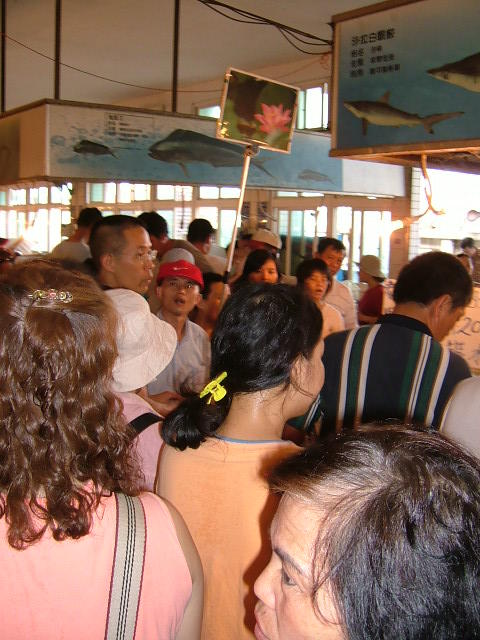
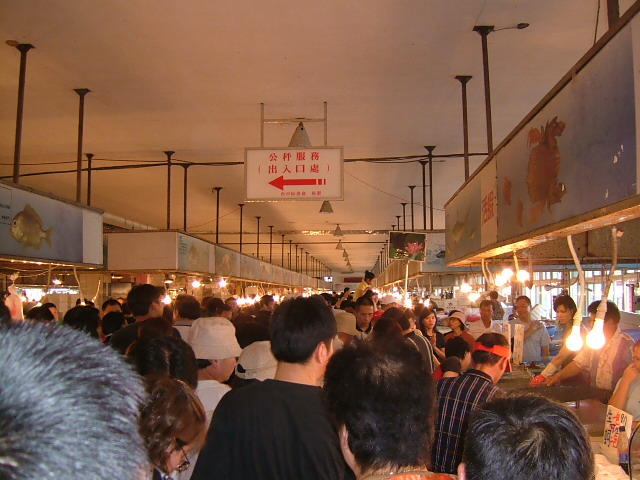
It must have been "Foreigner Day" at the Taichung Harbor fish market today...

Michael Turton went to the fish market with his family and friends this morning and posted his pictures while we were at the fish market with my sister-in-law, brother-in-law, and their son. He's got some beautiful shots, and I'll try not to post "repeats" of his pictures...

When Michael and his family went, there weren't many people there. But by the time we got there...


This fish was just taking a rest--I think it had heat stroke, like I had.


These fellas look kind of prehistoric... From what I could find on the web, they're called "Chikamekintoki" in Japanese...


There were some devout Buddhists at the fish market today, buying (and asking other people to buy) live fish so they could release them back into the water. They didn't appear particularly successful... (They're the people in the back holding up the red sign with a picture of a lotus on it.)


"Dragon's Intestines"--actually the intestines of mambo fish.


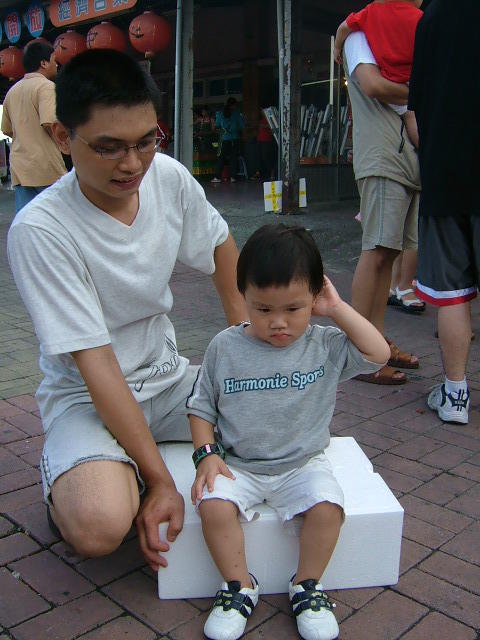
Our nephew found another use for the styrofoam coolers Michael mentions...

OK. What's our next outing gonna be, Michael? (heh)

Saturday, June 25, 2005

Another interview about Taiwan

Konrad Lawson, on his blog Muninn, relates a chat he had with an elderly Taiwanese couple at a coffee shop in Taipei. They talked mostly in Japanese. It's an interesting read. Here's one paragraph to pique your interest:
When the war ended and Taiwan reverted to the control of Nationalist Chinese forces, he finished his high school education in Taipei though all of his classes switching suddenly from Japanese to Chinese. The couple said that the switch was particularly difficult for elementary school teachers who had to study Chinese via the radio and change their materials from Japanese to Chinese, while junior and high school teachers came largely from China. After graduating the husband was accepted to and went to Zhongyang University in Nanjing after turning down an offer from Taiwan National University. The year was 1948 and within only a few months of starting college, he would be fleeing Nanjing with the rest of the Nationalist government and his fellow students as the Nationalist forces started crumbling in the face of Communist advances.

Link to the former native speaker's abode

I found our apartment complex (or "community," as they often call it here) using Google's satellite images: here it is, in case you're interested. We're in the building in the middle of the picture. Tunghai University is here, with the FLLD building in the middle (the big building to the far left that looks like a rectangular donut is the university library).

By the way, I heard on the news that Taiwan's government is worried about the easy availability of satellite images of the island. They're worried that our enemies will be able to get free images of Taiwan's military bases through Google Maps.

[Update, 10:06 p.m.: Also took a trip to China--I think this is the Forbidden City, right?]

Friday, June 24, 2005

Amazing!

Am listening to an interview I did yesterday, using my MP3 player for the first time. It is SO clear! I'll never go back to bulky cassette recorders...

And the interview went quite well, too--the interviewee was able to take a lot of my "yes-no" questions (note: don't ask so many yes-no questions next time!) and talk for quite a while on them. I got a lot of good stories, too, that will make my dissertation not so dry. He was definitely better at being interviewed than I was at interviewing!

Preparing for ISHR

I found out Tuesday afternoon that Tunghai has accepted my proposal for a travel grant to present a paper at the conference of the International Society for the History of Rhetoric. I was a little worried I wouldn't get the grant because, as you can see from my abstract, I'm not going to be talking about English teaching. (Actually, I could probably make a decent argument that it relates to the work we do in the intercultural communication class I teach here.) So I'm grateful to Tunghai for agreeing to help foot the bill for my trip to LA in July.

I'm shortening the paper to focus mainly on post-war Taiwan because I don't think I could cover both colonial and post-war Taiwan adequately in a 20-minute presentation. (I found out in April how hard it was to cover to any depth a few presidential inaugurals in 20 minutes!) The paper explores some issues pertaining to how the KMT government defined the Chineseness that it encouraged (or perhaps "coerced" is a better word in some cases) the people of Taiwan to identify with--specifically, "Chinese" as equal to "citizen of the Republic of China, temporarily exiled to the island of Taiwan but diligently at work on recovering the nation from the Russian Communists and their puppet Mao Zedong" (or something along those lines). I'm arguing that in order to have an understanding of the complexities of 20th-century Chinese rhetoric, it's necessary to look at competing notions of Chineseness rather than focusing only on rhetoric that is considered Chinese simply because it is produced on the Chinese mainland--though admittedly, the mainland figures prominently into the notions of Chineseness that the KMT on Taiwan emphasized. I argue that it's important to pay attention both to the claims the KMT government made about how it represented the last bastion of true Chineseness in the world, and to the "contents" of the Chineseness that the R.O.C. on Taiwan represented. (Why, for instance, some Republican era Chinese writers and thinkers were acceptable and others, such as Lu Xun, weren't. Or why some aspects of language simplification were acceptable and others weren't.) The main angle on this that I will take is how what I call "the rhetoric of Chineseness" was fundamental to educational theory and practice in early martial-law Taiwan, particularly in terms of learning to use language/rhetoric. Learning was in large part, as Richard Wilson wrote 35 years ago, "learning to be [a particular kind of] Chinese" or learning to speak and write as a particular kind of Chinese.

Most of what I will have to say would probably be no surprise to anyone who has lived in Taiwan for a while (and hasn't been asleep the whole time) or has read about Taiwan. (In fact, there's some interesting material at--of course!--Scott's blog about some of this.) But Taiwan hasn't had much representation, to my knowledge, at international rhetoric conferences, though there have been some good articles on Taiwan in NCA/Sage's Intercultural and International Communication Annual (see here for links to tables of contents). In fact, while there are about half a dozen scholars from the mainland who will be at ISHR, I'm the only one I know of who is coming from Taiwan. (A-chin Hsiau of the Academia Sinica was going to present what looked like an interesting paper, but won't be there.) So again I'm in the odd position of being the "foreigner" representing Taiwan at an international conference. Hope that's not always the case...

Tuesday, June 21, 2005


What do you do when your car won't start and it's the middle of the night? You call MacGyver, of course! Using only a paperclip and his wits, our friend Manfred "MacGyver" Sablotny helped us fix a blown fuse when all the auto supply stores were closed last night. Thanks, MacGyver--er, Manfred! Posted by Hello

Friday, June 17, 2005

Link smorgasbord, with a picture of my dog thrown in for good measure

I've been playing around with Technorati tags for my posts, but I have a feeling this is going to defy any tag besides ...

First the links--they're from my Bloglines feeds (which I'll make public one of these days, when I get around to it), so I want to post them here for future reference. In no particular order:

And now for Mei-mei:

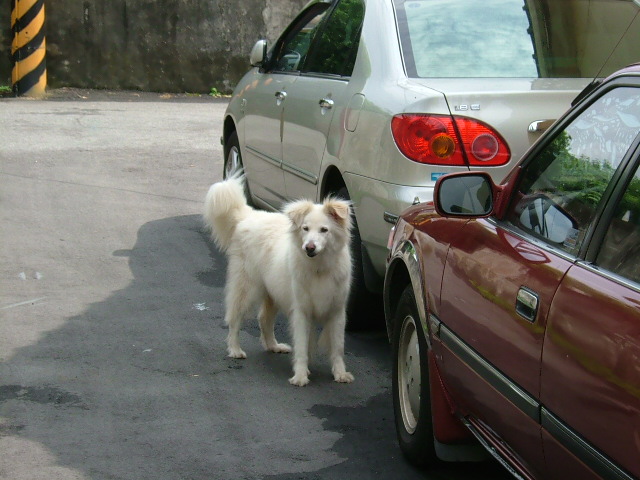
Mei-mei, who lives with her "grandparents" in Hsin-she, likes to hang out around our car when we visit. She always looks forward to going on rides with us, even though those rides usually end up at the vet's where she gets her blood sugar checked... Posted by Hello

Alex Reid on assessment at SUNY

Came across a post by Alex Reid on "SUNYwide assessment and the failure of composition" that critiques the school's rubric for assessing the teaching of writing. Interesting...

Friday, June 10, 2005

Don't know why I have time to do these things...

Your IQ Is 120

Your Logical Intelligence is Above Average
Your Verbal Intelligence is Genius
Your Mathematical Intelligence is Exceptional
Your General Knowledge is Exceptional

Some blog entries on mentoring

There are a couple of interesting posts about mentoring over at the blog of the Synecdochic Prof (not to be confused with Schenectady Synecdoche--hmmm... wonder if they know each other?).

I'm particularly interested in this subject because I tried (unsuccessfully) to get a mentoring program started in my department. One of the reasons it failed was that a lot of people (including junior faculty) didn't feel a formal program was necessary--enough mentoring is done informally, I guess.

Thursday, June 09, 2005

Study on scientific misconduct

Issues in Scholarly Communication links to a study reported in the Chronicle of Higher Education that found that a third of respondents to a survey about scientific misconduct in the U.S. admitted to having "engaged in actions such as overlooking others' use of flawed data, failing to present data contradicting one's own work, and circumventing minor requirements of human-subject research."

The original article from Nature, entitled "One in three scientists confesses to having sinned" (written by Meredith Wadman), is available online (for how long, I don't know). It quotes Brian Martinson, who conducted the survey with colleagues at the HealthPartners Research Foundation, as saying that "'[t]he majority of misbehaviours reported to us are more corrosive than explosive,'" but also that they are still a serious matter.

Martinson, according to Nature,
thinks the main cause of all the questionable behaviour is the increasing pressure that scientists are under as they compete to publish papers and win grants. "We need to think about the working conditions in science that can be addressed," he says, suggesting better salaries and employment conditions for young scientists, and a more transparent peer-review process.
The U.S. government, evidently, has a policy of only policing "fabrication, falsification and plagiarism" and does not concern itself with other types of misconduct like the ones mentioned above. The article concludes,
Martinson and his colleagues say their study is the first attempt to quantify such activities. They hope their results will persuade scientists to stop ignoring the wider range of misbehaviour.

Tuesday, June 07, 2005

More on research in the UK (and, by extension, Taiwan)

Chris Bertram at Crooked Timber cites an article by Jonathan Wolff about "the distorting effects" of the funding of humanities research on the research itself. The original article, from the Guardian, is here and the Crooked Timber discussion is here.

One paragraph from Wolff's article that I think is quotable concerns how the AHRC (the Arts and Humanities Research Board), which gives out the grants and evaluates the research results,
wants to reassure itself that it is funding work of the highest international standards. How can you demonstrate this? Not easily. Citation rates rely on quickfire take-up of ideas in the peer-reviewed literature; fine in the sciences but poor in the humanities, where response time is more measured. And anyway, published citation rates ignore mentions in monographs and book chapters, which remain central to the humanities.
This reminds me of the situation in the humanities in Taiwan.

Sunday, June 05, 2005

Grumble grumble

Tunghai's computer center picked the dumbest of all possible times to make major changes to the school's web and e-mail service. So now my "official" website is offline until I can find time to figure out what they've done.

[Update at 6:19 p.m.: I've moved the my official homepage over to the new server, but have to do some editing to get it all looking the way it should be. But I don't have time to do that right now, so it'll have to stay ugly for a while...]

Wednesday, June 01, 2005

The Peking Duck on Singlish

There's a nice discussion going on at the Peking Duck on Singapore English, the bane of Lee Hsien Loong's existence, evidently (Singapore English, that is, not the Peking Duck).

Monday, May 30, 2005

'Nother useful blog entry I have no time to comment on

Earth Wide Moth's notes on readings from the genre theory class he's taking this summer. Hope to see more of these, since I can't be there in person (*sniff*).

[Update: here's a link to Derek's genre studies category.]

['Nother Update: Baron Miguel Secluna is also blogging the course. Way to go, Baron... er... sir?]

Sunday, May 22, 2005

Taking a break

I've got a couple of projects to get done between now and the end of June, so my blogging will be light-to-nonexistent until then. (If I can control myself!)

Friday, May 20, 2005

Teaching vs. research universities revisited

In blog-time, this is slightly old news, but I'll post it anyway:
MOE Grants 90M to THU

May 7, 2005

90 million NT dollars was granted to Tunghai University by the Ministry of Education. THU ranked no. 3 after the MOE reviewed the Teaching and Learning Plans from 54 universities. Twelve other universities benefited from the 1 billion NTD subsidy.

THU President Haydn Chen thanked Dr. Cheng-Tung Lin, Dean of Academic Affairs, as well as, all faculty and staff for the work and effort that was put into producing the Teaching and Learning Plan. President Chen said, "Education is an ongoing affair. At present universities are putting too much emphasis on research, leaving the teaching and learning facet as secondary. Our school cares for general education emphasizing on holistic education for the development of the ideal student."
(Source: Tunghai's website)

Does this relate in some way to the issue of classifying Taiwan's universities into research universities and teaching universities? It seems to--judging from this May 8 China Times article that mentions that some schools had already received grants from a plan to promote research universities (「推動研究型大學整合計畫」), so they were disqualified from competition for the grants that Tunghai and the other 12 universities got.

Interestingly, the same article concludes,
教育部指出,近年國內大學普遍「重研究、輕教學」,對高等教育發展不利。「獎勵大學卓越計畫」是要幫助大學提升教學,如果成效不錯,明年經費將擴增為五十億元,更多教學型大學可以受惠。
The MOE complains about the overemphasis on research at the expense of teaching, but it seems to be talking out of both sides of its mouth here, considering its hand in encouraging the heavy emphasis on research. (As Scott has mentioned, the MOE plays a major role in the promotion of faculty members of Taiwan's universities.) It's nice to see an attempt at establishing a balance, though. On the other hand, I'm a little worried that the balance will be between research universities (with their more easily quantifiable results) and teaching universities (with their less quantifiable, potentially more subjective results). In the long run, where will more of the money go?

[Update, 2:42 p.m.: Perhaps that last question doesn't get at the real issue, which is the role the MOE should or shouldn't have in promoting universities as places of high-quality (undergraduate) education as well as institutes of high-quality research. Direct injections of money to support innovative teaching plans are one approach, but not the only one.]

More fun with SSCI

Clyde and I have been having a nice chat over on Scott's blog about the uses of the SSCI in Taiwan, and Scott himself has thrown his two cents' in, too (well, it's his blog--of course he has!).

The line that I got the biggest kick out of is the beginning of the third paragraph: "No one would deny, not even Jonathan Benda, that publication in an SSCI journal is a major accomplishment in a research career." I don't know if I'm supposed to take this as a sign that I'm becoming infamous for disagreeableness, but if so, well, I'll try to take it as a compliment.

At any rate, I do agree that publication in an SSCI journal (or, say an A&HCI journal, etc.--depending on your field) is a big achievement in a researcher's career. But... well, check out Scott's blog for more of my crazy comments.

Monday, May 16, 2005

A cultural *what*??!!

You scored as Cultural Creative. Cultural Creatives are probably the newest group to enter this realm. You are a modern thinker who tends to shy away from organized religion but still feels as if there is something greater than ourselves. You are very spiritual, even if you are not religious. Life has a meaning outside of the rational.

Cultural Creative

81%

Fundamentalist

69%

Romanticist

69%

Postmodernist

56%

Existentialist

31%

Modernist

31%

Idealist

25%

Materialist

13%

What is Your World View? (corrected...hopefully)
created with QuizFarm.com

Saturday, May 14, 2005

More pictures from Ghent

I've got a lot of pics, but it has taken me forever to get around to posting them. And most of them are of old buildings... (Duh!) But here are some pictures.


This fortified me for presenting my paper... (No pics of me--I ate too much.)


Guess what's special about these shoes...


Gravensteen, a 12th-century castle in the middle of Ghent. Taken from a tour boat on the Leie River. Gravensteen has an (ahem) interesting collection of torture instruments on display. There was one where they'd strap someone to a wooden bed and put his meals on a table, just slightly out of reach. (Someone should have done that to me while I was there...) Posted by Hello

Friday, May 13, 2005

Enough with the rain already!

Nine o'clock in the evening. It's been raining HARD since yesterday. Living at the top of Dadu Hill (I'm refusing to call it a mountain) helps keep our home dry, but some folks in other parts of Taiwan (Hsinchu, Miaoli, Yunlin, for instance) aren't quite as lucky.


This shot, from the United Daily News, is from Hsinchu.

Thursday, May 12, 2005

Guóyǔ (國語) as prerequisite to citizenship

Mark Swofford's Pinyin News reflects on a Taipei Times report regarding a proposed language requirement for foreign nationals wishing to become Taiwan (R.O.C.--so far) citizens. The Times article refers to "a basic grasp of Mandarin," but when Swofford checked with the Ministry of the Interior, he was told other Taiwan languages (Hakka, Minnan, and possibly Aboriginal languages) would be acceptable alternatives. Swofford comments,
I suspect some of the ambiguity may lie in how Guóyǔ (國語) is translated. Most of the time the word refers to Mandarin. Recently, however, the government has occasionally chosen to translate Guóyǔ not as "national language" (i.e. Mandarin) but "national languages" (i.e. the more than one dozen languages of Taiwan: Mandarin, Taiwanese, Hakka, and the languages of Taiwan's tribes).

Tuesday, May 10, 2005

Boston--a land of contradictions

a better tomorrow has a nice post about the use of the phrase "land of contradictions" in much (too much) travel writing. His parody of a travel article is worth quoting (check out the whole thing here):
Boston is indeed a land of contrasts and contradictions. Meander along any of its cobblestone streets and you can feel the deep Puritan spirituality of the people. But walk through the bustling business district, and you can feel the vibrant pulse of one of America's oldest cities trying to adapt to its status as a newfound economic powerhouse. ...
Unfortunately, this is unlikely to happen in any English-language travel guide. But I haven't checked out any Chinese travel guides lately. Maybe they have their own version of this.

Sunday, May 08, 2005

How to distinguish foreigners from Americans

Some little kids noticed me when I got out of my brother-in-law's car near my in-laws' house Sunday afternoon. One of the kids yelled, "Foreigner! Foreigner!" in Chinese to his siblings and parents. Another kid said to him, "He's not a foreigner, he's an American. The ones with long noses are Americans."

Monday, May 02, 2005

On defining rhetoric at family reunions and other awkward occasions

This is not quite in response to a request by Paul Stob at the Blogora for a "quick" definition of rhetoric for use at family-type gatherings:

When I went to my first Rhetoric Society of America conference in 1998 they were selling a cool T-shirt with the heading "What is rhetoric, anyway?", followed by a bunch of definitions on the back, including Aristotle's "the faculty of discovering in any given case the available means of persuasion", I. A. Richards's "the study of misunderstanding and its remedies", George Campbell's "that art or talent by which discourse is adapted to its end", and Kenneth Burke's "[t]he use of language as a symbolic means of inducing cooperation in beings that by nature respond to symbols", among others. I wore this T-shirt with pride and would point to the back of it whenever someone asked me what I was studying. (To be honest, it also helped me define for myself exactly what it was I was supposed to be studying. And to be honest, I think the definitions helped me a lot more than they helped those asking me what rhetoric is.)

Unfortunately, after many washings, the definitions of rhetoric faded away and in the end, I was left with a T-shirt that only asked, "What is rhetoric, anyway?" Oddly appropriate that all the definitions of rhetoric would self-destruct like that, leaving me again to my own devices.

[Cross-posted as a comment to the Blogora]

Sunday, May 01, 2005

The dreaded reading meme

I've been avoiding responding to the 9th grade Tuba Player's mention of me in her response to the reading meme. But I figure I'll need to respond sooner or later...

You're stuck inside Fahrenheit 451. What book do you want to be?
To be honest, I've never read Fahrenheit 451, but I did look up the book on (*gasp*) SparkNotes (don't tell anyone). Sounds like an interesting book that I'll probably not be able to read for a good long time. So maybe I'd like to be Fahrenheit 451 if I were stuck in Fahrenheit 451...

Have you ever had a crush on a fictional character?
Princess Leia--not Carrie Fisher, mind you, but Princess Leia from the Star Wars book. (When Star Wars came out, I was only 9 and I wasn't allowed to see it, so I read the book. Actually, when I got to see the movie years later, I was very disappointed. The book was better...)

The last book you bought is?
The Content of the Form: Narrative Discourse and Historical Representation by Hayden White.

What are you currently reading?
The Content of the Form, Is Taiwan Chinese? by Melissa J. Brown, Between Assimilation and Independence by Stephen Phillips, and a bunch of Research Methods proposals.

Five books you would take to a desert island:
I like 9th Grade's choice of the U.S. Army Survival Manual. In addition to that, I would take the Bible (maybe I'd finally be able to read the whole thing, something that 30 years of church-going hasn't been able to get me to do), Black Athena volumes 1 and 2 by Martin Bernal (another work I've been trying to read for years), The English Patient by Michael Ondaatje (I read it every summer), and (heh heh) a blank diary (hope that's not cheating!).

Who are you going to pass this stick to and why?
1. last updated, because he probably read Fahrenheit 451 during his science fiction phase
2. ERG, 'cause he's judicious and even-tempered (though he doesn't have a blog--use the comments function!)
3. Clyde Warden, who also doesn't have a blog (probably because, unlike me, he has a life!), because he's such an eclectic reader

For that person who found my blog when searching for "pictures of people being acupunctured," here ya go... sort of... Posted by Hello

Friday, April 29, 2005

Some of my notes from Hayden White's 4/21 talk in Ghent

The title of White's plenary at the Rhetoric, Politics, Ethics conference was "Historicality as a Trope of Political Discourse." I wrote down a few, probably not very helpful, notes about what he had to say:

White said that rhetoric "used to be the theory of the political uses of language." He felt that the separation of history from rhetoric [or rhetoric from history?], which was meant to make history into a science, "deprived it [history] of sources of invention and of literary sensibility" (rough quote). History as science separated history from philosophy and detaching history from rhetoric "deprived it of a theory of composition", which gave rise to the myth that history is found in materials, not the writing of it. White also spoke of the "domestication of historical sensibility" and of the current belief that historical empirical details give rise to the form as well as the content of history. [Some of these ideas remind me of White's The Content of the Form, which I've been reading lately.]

White cited Hume's Essays Moral and Political, where Hume argued that the relationship between ethics and politics couldn't be dealt with conceptually because of the separation of "is" from "ought" [that you can't get from statements about what is to ethical statements about what ought to be]. But, said White, Hume didn't see that rhetoric "is precisely the discourse that examines the anomolies [? can't read my handwriting] of trying" to bring together "is" and "ought." White described rhetoric as a "theory of trope" or "tropology", which he characterized as how "turns" are used to move "from statements of fact to statements of 'ought'" (and not just from the literal to the figurative).

White characterized rhetoric, ethics, and politics in a humorous formula:
  • rhetoric=what can I say?
  • ethics=what should I do?
  • politics=what can I get away with?
He obviously said a lot more than this (including a long quote from Hobbes, who accused the ancient writers as producing in readers a "tyrranophobia--the fear of being strongly governed"), but my notes aren't clear enough for me to be able to figure out how to put them together here.

Lien Chan's speech at Beijing University

My wife and I just finished watching a rebroadcast of Lien Chan's "historic" speech at Beida and came to the conclusion that one of his main points ran along the lines of "what a great man I am to have come to the mainland and to Beida". His speech was full of quotes from the leaders of different countries (Churchill, for instance, and Reagan's [ugh] "If not us, then who? If not now, then when?") that would make you think, if you didn't know better, that Lien was a national leader himself. (The Reagan quote came near the end of the speech, and Lien connected it to his reasons for being in China.)

He also got some shots in on the DPP and TSU, criticizing their ideas as still being in the 20th century. (Which is kind of ironic--I thought half the 20th century in Taiwan was dominated by a political party that spent a lot of its time thinking about how it would retake the mainland...) Altogether it looked like it was lapped up by the Beida audience (even though Lien did imply at one point that a lot of the intellectual giants of Beida, like Hu Shih and Fu Ssu-nien, escaped to Taiwan after 1949... ahem...).

Monday, April 25, 2005

Back from Ghent

My experience of the conference on Rhetoric, Politics, Ethics at the University of Ghent last week was great, particularly because I felt my session went quite well. The session title was "Direct Address" and featured Maria Boletsi from the University of Amsterdam, Olaf Du Pont from Hogeschool Ghent, and Fernand Vandamme from Ghent University (and me, of course!).

Boletsi's paper (abstract) on the conflicts between Greece and the Former Yugoslav Republic of Macedonia over the issue of the name "Macedonia" was a very interesting counterpart to my paper (abstract) on the naming of Taiwan in R.O.C. presidential inaugural addresses. Du Pont's paper (abstract) on the rhetoric of American exceptionalism also fit our "mini-theme" of rhetoric and national identity quite well. And the final paper by Vandamme introduced the idea of content management as it related to the study of rhetoric. I think the best part of this session was that the four of us hadn't planned to present together (we didn't submit a panel proposal, that is), but our papers still fit together so well. (This usually doesn't happen to me...) And the fact that we were all talking about different nations broadened our views of the rhetoric and politics of national identity.

I'll say more about the conference later. Just wanted to post this for now...

Saturday, April 16, 2005

良藥苦口

"良藥苦口," my wife tells me (good medicine tastes bitter). Then she gives me the cup of Chinese medicine that is supposed to help bring down the swelling on my foot. I taste it and gag, instantly getting the the second part of this chengyu. "Hold your breath and swallow it in one gulp," she suggests. I can do the first half of this, but can't bring myself to accomplish the second. Wow! This is awful stuff! Indescribably awful! It must be really good for me!

Friday, April 15, 2005

Pedestrians need sidewalks

My colleague Michael Jacques had a letter printed in the Taipei Times yesterday on the lack of usable sidewalks in Taichung.

Thursday, April 14, 2005

13th R.O.C. English and American Literature Association Conference

While I'm posting Tunghai-related events, here's some information about this conference that will be held at Tunghai in December. The conference theme is "(De)Constructing Identities: Cultural Translation and Literary Empowerment" and the Keynote Speaker is Dr. Shirley Geok-lin Lim of UCSB, who will be speaking on "Asian American Inventive Identities: Rethinking Difference and Hybridity in Chinese American Mixed Race Identities."

From the call for papers:
We welcome paper proposals on topics related to the study and teaching of English literature, particularly in Taiwan. We are particularly interested in the following: the ways in which literary texts dismantle and (re)construct such identity categories as race, nation, class, gender, etc.; the strategies via which Taiwan-situated readings of Anglophone literature recognize and negotiate cultural difference; and the ways in which literary works contribute to an increased sense of agency for and when acting in the world.

Abstracts (in Chinese or English) are due May 10. For more information, click the top link.

Panel discussion on "The Image of Taiwan in Europe"

My OFL colleagues in Tunghai's FLLD are going to hold a panel discussion on April 22. The topic is "The Image of Taiwan in Europe." They've invited panelists from Belgium, Britain, France, Germany, Spain, and Taiwan to talk about stereotypes that Taiwanese might encounter in (and have about) Europe and "how to overcome such hurdles in intercultural communication." The panel discussion will be held at 6:30 p.m. in L007 (the FLLD theater). Attendance is free. I wish I could go, but I'm going to be in Belgium on that day. (Ironic, isn't it?)

I'm a little bit country, ...

If you can believe this... Seems to leave out a ton of varieties of American English. (I also think quite a bit of my English has been shaped by my experiences teaching English in Taiwan all these years.)


Your Linguistic Profile:


55% General American English

25% Dixie

20% Yankee

0% Midwestern

0% Upper Midwestern


[4/17/05 Update: Bridget Samuels (a.k.a. ilani ilani) has put together an analysis of the dialect test in order to answer "why is it that a bunch of Californians have been scoring 5% Dixie" on it... Check it out.]

Wednesday, April 13, 2005

Fourth acupuncture treatment

Today we went to a different place to get my ankle worked on. Originally we had been going to the China Medical University's hospital, but my recovery seemed kind of slow. So we went to a Chinese medicine clinic (a clinic of Chinese medicine? a Chinese medical clinic? er...) recommended by our neighbor. The doctor there agreed that the recovery was going a little too slowly. He said I should probably come to the clinic every day or every other day (which will be easier because the clinic is closer to home than the hospital).

Then he took me into the back and stuck two needles in the top of my head (to help my foot regain some of its flexibility--don't ask me how) and four in my ankle. That's about 3 times as many needles as they used at the CMU hospital. I told my wife I felt like a bulletin board. After a while the nurse took out the needles (almost forgot to take the needles out of my head!) and packed my ankle in some Chinese medicine. I'll go back tomorrow for another treatment.

After 15 years, Julien again

ERG will remember how in the early 90s, our mutual professor S would greet me as "Julien" every time he saw me. For some reason, I never had the heart to tell Professor S my real name (or maybe I just didn't care enough to tell him), but I was curious why he always addressed me as Julien. I guessed he was mixing me up with Julien Benda, author of The Treason of the Intellectuals.

Anyway, yesterday I ran into a former student who was visiting campus for the day, and he greeted me with a big smile: "Julien!" I'm pretty sure he was mixing me up with a former teacher here named Julien, though. Wonder if I should change my name, though...

Saturday, April 09, 2005

Conference prep

Getting geared up to go to Belgium later this month for a conference on Rhetoric, Politics, Ethics (for some reason, I find the lack of an "and" in the conference title kind of cool). Now that I'm no longer worrying about how I'm going to pay for the trip, I can spend some time productively--worrying about what I'm going to say. I've got a paper that's about 8500 words and I'm still fiddling with the conclusion, which will probably make it longer. I've got 20 minutes in which to deliver it. So I'm trying to figure out what can be cut out of the oral presentation. My subject is presidential inaugural addresses in Taiwan, so I figure I'm going to need to keep a lot of the background information in, otherwise the presentation will be incomprehensible to most of the people at the conference. I suppose I can keep my quotations from the inaugurals to a minimum (though that means my audience will miss out on the A-bian imitation I've been working on).

I think this will be a good experience, though, because it's one of those times where I'm talking about Taiwan to people who probably don't have more than a general knowledge about Taiwan and its history. I need more practice with that, I think. It'll be interesting to see how clear and meaningful I can make my presentation in terms of the conference's focus.

[Update, 4/18/05: I've managed to cut the paper down from 30 double-spaced pages to 15, by cutting out all the inaugural addresses except for those of the democratically elected presidents. The word count is reading 5,218 right now, but I think I need to cut out more. At the same time, I've got to make sure this thing still makes sense to people who don't know much about Taiwan's history...]

Tuesday, April 05, 2005

Spring break gripes

I'll limit these to only a couple, since no one likes a complainer:
  1. I told my students a few days before the break that I'd probably wait for the vacation before I got the flu that they were passing around. Well, so far I've avoided getting sick. Instead, I fell on the stairs the first day of spring break and twisted my ankle pretty badly (sorry, no pictures, but you can look at this from Earth Wide Moth to get a general idea). The good news is that I survived my first experience being acupunctured [is that a word?] without freaking out. I get the second treatment today. News at 11.
  2. Because of 1., I've spent a bit of time on the sofa during the break. Besides moaning and groaning (like a typical male, I didn't go to get any treatment for my ankle until a couple of days after falling), I started watching 好美麗診所 on TV. It's fairly entertaining, but why'd they have to make the bad gal (Peng Chunmei 彭春妹) a Hakka? (And why did they choose A-ya (阿雅), who's about as Hakka as Ma Ying-jeou, to play a Hakka?)
  3. On the bright side, I managed to hobble down to the travel agent yesterday to pick up my tickets to Belgium. Now if the NSC would just hurry up and approve my travel grant before the government disbands the NSC...

Monday, March 28, 2005

Finding new audiences for the former native speaker

I've been thinking about how I might expand my audience base beyond personal friends, family, and people googling for donuts. (Not that I'm at all unhappy with you folks!) But, I wondered, what could I do to ensure a connection with the savvy erudite group that I hope to reach? Then it hit me. The problem with this blog is that it just hasn't been discussed enough at scholarly conferences. In an attempt to help out would-be "former native speaker" scholars, I provide the following titles (courtesy of the amazing ... PoMo English Title Generator):
  • Appropriation and Nationalism in Notes of a Former Native Speaker: Jonathan Benda Desiring Political Power
  • The Borders of Subjectivity and the Seductive in Jonathan Benda's Notes of a Former Native Speaker
  • The Labor of Womanhood and the Transformational in Jonathan Benda's Notes of a Former Native Speaker
  • Fragments as Subject: Hybridizing Historicist Dis-ease in Jonathan
    Benda's Notes of a Former Native Speaker
  • The Murder of Intercourse and the Erotic in Jonathan Benda's Notes of a Former Native Speaker
  • Advocating Ethnocentrism: Primal Autobiography in Jonathan Benda's Notes of a Former Native Speaker
  • Male Transgression and the Transgression of Animal Mythos in Jonathan Benda's Notes of a Former Native Speaker
  • The Self of Labor and the Peripheral in Jonathan Benda's Notes of a Former Native Speaker
  • Transforming the Patriarchal Politics in Jonathan Benda: Notes of a Former Native Speaker and Alterity
  • Performing the Orgasmic Influence in Jonathan Benda: Notes of a Former Native Speaker and Labor
  • The Resistant Assimilating The Marginalized: Jonathan Benda, Notes of a Former Native Speaker and Tyranny
  • The Supplement of Autobiography and the Convicted in Jonathan Benda's Notes of a Former Native Speaker
  • Community and Danger in Notes of a Former Native Speaker: Jonathan Benda Dismembering Neocolonialist Vision

Remember, this is a win-win situation--I'll get publicity, and you can get a line on your CV!

This has got to be a joke

I got this e-mail message today:
D‮ae‬r Ba‮syalcr‬ Me‮ebm‬r,

T‮sih‬ e‮am‬il was se‮tn‬ by the B‮yalcra‬s s‮re‬ver to v‮re‬ify y‮ruo‬ em‮lia‬ ad‮sserd‬. You m‮su‬t c‮pmo‬lete t‮sih‬ pr‮sseco‬ by cl‮ikci‬ng on the l‮kni‬ bel‮wo‬ and ent‮gnire‬ in the s‮llam‬ w‮dni‬ow yo‮ru‬ Barcla‮sy‬ Member‮hs‬ip numb‮re‬, p‮edocssa‬ and m‮rome‬able w‮ro‬d.

Th‮si‬ is d‮eno‬ for y‮ruo‬ protec‮it‬on - b‮suace‬e s‮emo‬ of our memb‮re‬s no lon‮eg‬r h‮eva‬ acc‮sse‬ to the‮ri‬ e‮am‬il a‮serdd‬ses and we m‮tsu‬ ver‮yfi‬ it. To v‮ire‬fy y‮uo‬r e‮liam‬ a‮erdd‬ss and acc‮sse‬ y‮uo‬r b‮na‬k a‮occ‬unt , b‮na‬k a‮occ‬unt , clikc on the lnik bolew: ...
I've gotten some bad spam before, but this is ridiculous...

Thursday, March 24, 2005

Donut update

Stopped by Waili Donuts again the other evening and was pleasantly surprised to find a jelly donut filled with blueberry ... uh... jelly! This made me a little more hopeful about the future of my relationship with this institution.

On the other hand, Poagao reports that he found red bean paste-filled donuts at the Mr. Donut in Taipei. I guess this is one of those "glocalization" examples I can mention in my ICC class next semester.

By the way, I was interested (but a little disappointed) to see that one of the most frequently used search terms that led people to this blog was "donuts" (including "Mr. Donut" and "taiwan donuts"). I'd like to think I have more to offer than commentary on donuts, but I guess it's a surfer's market. And "donuts" is a better fitting search term than another one I noticed: "Who cares. Taiwan is a mess anyway."

Sunday, March 20, 2005

A year older, none the wiser

Well... "the former native speaker" is a year old(er) today. A lot has happened in the past year (most of which, unfortunately, I can't talk about in this forum). One thing that hasn't changed, though, is that Lien Chan and the KMT aren't giving up on their search for "the truth" about President Chen and V-P Lu's shooting (even the pro-pan-blue China Post puts quotes around "the truth"!). But at least PFP Chairman James Soong had the sense to stay home from yesterday's protest march.

[Update: this is what I get for trying to be clever--my own brother (who knows my bd is in January) e-mailed me to ask if I'd changed my birthday and thinks I'm talking about "my" birthday and not the blog's birthday... (I'll resist getting into any mumbo-jumbo about mediated selfhood... for now... and just say "thanks" on behalf of the blog to those who wished us/it/me a happy birthday!) And now I've added quotation marks to "the former native speaker" which will probably make it clearer (or perhaps even more confusing...).]

Sunday, March 13, 2005

Thursday, March 10, 2005

"...false friendships, deals, grudges, acts of political sabotage, indecorous alliances, favoritism"

"V. S. Ravens" writes about "The Limits of Tenure" at her large public university in the U.S. What strikes me is that her description depiction of dirty campus politics in the U.S. is remarkably similar to the way some folks describe depict university life in Taiwan. Which is to say, to quote Erma Bombeck, "the grass is always greener over the septic tank". (Gotta remind myself of this sometimes...)

(I should also note that I'm not particularly sympathetic regarding her attempt at what she admits was a "political deal" to remove "the department's ineffectual staff member". It comes off sounding both underhanded and politically naive at the same time.)

Saturday, March 05, 2005

Hmmm... don't think they asked anyone around here...

According to a BBC World Service poll, most people see the PRC's influence in the world as positive rather than negative.

The small print that accompanies the graph, though, notes that the margin of error for this poll is + or - 2.5%-45%...

Wednesday, March 02, 2005

Hu Shih and public speaking

I was looking through Two Self-Portraits: Liang Ch'i-Ch'ao and Hu Shih and came across Hu Shih's description of how he learned how to be a public speaker in English. He was a student at Cornell when he first took a course in public speaking in 1912. As he describes the experience,
My professor, Professor Everett, was a very good teacher. Summer school began in July, and the first time that I was called upon to make a speech, I actually trembled. I had made some speeches before, but this was the first time that I had had to get up and speak in a class of public speaking. Though it was a hot July day, I felt so cold that my feet trembled, and I had to hold on to the small table while I tried to think of what I had prepared to speak. Professor Everett noticed that I held on to the table, so the next time he took away the table and I was forced to think of my subject unaided. In thinking of the subject I forgot my cold feet, so I did not tremble, and that was the beginning of my career as a trained public speaker. (216)
I want to mention this to the students in my FENM class on Friday--I think the Chinese majors in particular will appreciate it...

[3/6/05 Update: At first I thought the "Professor Everett" Hu Shih mentioned was Everett Lee Hunt, one of the early members of the "Cornell School of Rhetoric," according to Thomas W. Benson. But Benson says it wasn't until 1913 that Hunt graduated from Huron College in Huron, South Dakota, "whereupon he was immediately hired [by Cornell] as an instructor in Oratory and Debate" (5). Perhaps, however, Hu Shih was mistaken about the year he took the public speaking course.

Work Cited: Benson, Thomas W. "The Cornell School of Rhetoric: Idiom and Institution." Communication Quarterly 51.1 (2003): 1-56.]

Weather

Here it is only March 2 and it's already rained for about 300 days this month...

Today we did an impromptu speaking activity in FENM (Freshman English for Nonmajors) class. (I always feel like an enormous fraud conducting this kind of activity because I'm about the worst impromptu speaker on the planet... er... well, come to think of it, there's always GWB to make me look good.) In her speech, a student expressed her preference for Taichung because it's not as rainy and windy in the winter as Taipei. It's hard for me to believe that right now, given the rain and wind that have been pounding our apartment this evening, but I suppose it's possible that it's even worse in Taipei right now.

And I just bought a Lonely Planet guide to Belgium that suggests I take an umbrella with me because April is a rainy month...

Monday, February 28, 2005

Sunday, February 27, 2005

Scholarly publishing in the humanities

James Aune over at the Blogora raises an interesting question: why should scholarly journals in the humanities refuse to allow multiple submissions?

[And here's more discussion from Crooked Timber on the speed (or lack thereof) of academic publishing...]

Friday, February 25, 2005

Language teaching conference cfp--last call

Got this call for papers in my e-mail box the other day. It sounds interesting, despite its use of the dreaded "interrogating". Unfortunately, I'm not going to be able to submit anything. But you can!

FINAL CALL FOR PAPERS

INTERNATIONAL CONFERENCE ON
INTERROGATING THIRD SPACES IN LANGUAGE TEACHING,
LEARNING AND USE

CENTRE FOR ENGLISH LANGUAGE TEACHER EDUCATION AND APPLIED LINGUISTICS
(CELTEAL), UNIVERSITY OF LEICESTER

27-28 JUNE 2005

This conference, hosted in the multicultural and multilingual city of Leicester in the centre of England, marks the establishment of CELTEAL (Centre for English Language Teacher Education and Applied Linguistics) within the School of Education in the University of Leicester. The theme of the conference, 'Interrogating Third Spaces in Language Teaching, Learning and Use', derives from the interests of the group who have all been involved in working across multilingual and multicultural contexts.
We would like to interrogate the concept of third space which has been in use for several years in cultural studies and applied linguistics. We believe it is time now to explore the validity of this concept, both theoretically and practically in terms of its applicability to a wide range of applied linguistic topics. We would like to take the opportunity to invite those with an interest in the idea of third spaces to engage with us in discussion of its potentials and problematic.

Plenary Speakers
  • Adrian Holliday
  • Bonny Norton
  • Ben Rampton
  • Helen Spencer-Oatey

The intermediate spaces - linguistic, discursive and cultural spaces - between established norms have habitually been seen as problematic, because they constitute neither one thing nor another but are, by definition, in-between. A result of contact, they are heterogeneous spaces, but they can also reach autonomy, transcending their component sources through a dialectical process to make a new, expanded space which had not been dreamt of before. On the other hand, the very concept of 'Third Spaces' presupposes, and thereby reinforces, relatively stable and homogeneous norms in the 'first' and 'second' spaces, and this presupposition needs to be examined.

Postmodern theory, particularly in anthropology and cultural studies, has taught us to celebrate these intermediate zones, which have been named 'Third Spaces', because through the struggles of those who create them they present the possibility for stimulation and renewal, as well as threat. But we do not need to adopt postmodernist theory to begin to value these third spaces, whether they become stable or are always in transition.

This Conference will examine what there is to celebrate in the existence of third spaces, and will interrogate the usefulness of the concept itself, in the following areas:

  • How language learners construct (or are constrained from constructing) learning experiences that are meaningful for themselves out of what teachers and others intend for them.
  • How inter-language (phonology, syntax, pragmatic strategies, discourse strategies, genres...) thrives as an independent system in the spaces between the norms of L1 and L2, as fossilised forms, pidgins, idiolects, emergent systems and 'errors'.
  • How language varieties emerge against established standards, in regional and sub-cultural pockets.
  • How particular teachers and learners in particular classrooms adopt, adapt, co-opt and corrupt teaching methodologies, course materials, syllabi, curricula and examination systems, and make them work for themselves.
  • How participants in multi-language interactions mix, switch, translate, and otherwise manage to communicate in one language or another.
  • How identities are lost, reduced, confounded, re-shaped, and re-made in the move from one language to another.
  • How learning to write in academic and other genres means finding a way between the established conventions and how you want to express who you are.
  • How readers extract and impose their own meanings from and on texts, moving themselves towards the text, and the text towards themselves.

Submitting abstracts:

Abstracts of 250-300 words, in English, should demonstrate a clear relationship to the conference theme. Deadline for submission of abstracts is 7 March 2005.

Papers will last for 30 minutes, including at least 10 minutes for discussion. PowerPoint and OHPs will be available as standard.

Abstracts should contain:

  • Title of presentation
  • Name(s) of the author(s)
  • Affiliation of the author(s)
  • Both email and postal addresses
  • Telephone and Fax numbers
  • Any special audio-visual/IT requirements

Abstracts should be submitted as email attachments by 7 March 2005 to the following address: email:its2005@le.ac.uk

Details about registration, accommodation, etc. can be found on the conference website: www.le.ac.uk/se/conference/its2005/

Saturday, February 19, 2005

Book meme: 123.5

(After reading the chutry experiment)
  1. Grab the nearest book.
  2. Open the book to page 123.
  3. Find the fifth sentence.
  4. Post the text of the sentence in your journal along with these instructions.
  5. Don't search around and look for the "coolest" book you can find. Do what's actually next to you.

Well, this definitely won't impress anyone:
Note that M. and P. before names may be abbreviations for the titles Monsieur 'Mr.' and Père 'Father' (M. René Char, P. J. Reynard). (123)
From the MLA Handbook for Writers of Research Papers, sixth edition. (Yeah, I'm working on my Research Methods syllabus...)

Wednesday, February 16, 2005

Online resource for Chinese speech communication study

Found this website in my travels: 網上口語傳播研究中心 (Speech Communication on the Web), set up by Jack Tzu-hsiang Yu of Shih-Hsin University's Speech Comm. department. It looks like he hasn't updated it in a while, but it has some interesting links, such as to the full texts of most of the R.O.C. presidential inaugural addresses, resources on debating, and resources on interpersonal communication. (It's mostly in Chinese, I should mention.)

Monday, February 14, 2005

Identity crisis

Hmmm... might use this to start off my presentation in Belgium...

Googlism for: taiwan

taiwan is business as
taiwan is the future of china'
taiwan is safe for now
taiwan is qualified for membership of the international
taiwan is getting ready for a war with china
taiwan is integral part of china
taiwan is an inalienable part of
taiwan is "very dangerous"
taiwan is ready
taiwan is a province of china
taiwan is a province of china?
taiwan is now available for temporary importations using a tecro
taiwan is committed to reunification
taiwan is developing advanced technologies for electronic warfare
taiwan is inextricably linked to security
taiwan is this
taiwan is uncertain 6/16/
taiwan is independent"
taiwan is taiwan"
taiwan is business as usual
taiwan is a 'state
taiwan is key issue
taiwan is looking good for 2000
taiwan is not a part of china
taiwan is here
taiwan is ignored
taiwan is a beacon of hope for chinese
taiwan is an important reminder to us all
taiwan is not a province of china
taiwan is to auction five 3g mobile phone licenses in october
taiwan is not a member
taiwan is nobody's pawn
taiwan is experiencing job losses due to global it slowdown
taiwan is a rabies
taiwan is an unwatered region
taiwan is an island and the main water resource is precipitation
taiwan is my harashi
taiwan is a de
taiwan is the future of china' jimmy lai on feeling lucky
taiwan is safe for now the washington post
taiwan is the `motherland'
taiwan is standing in china's way
taiwan is not china by jeff jacoby
taiwan is qualified for membership of the international community
taiwan is down
taiwan is expected to grow to more than us$60 billion by 2010
taiwan is getting ready for a war with china the relations between china and taiwan could be best described with one phrase ? no peace
taiwan is integral part of china member states of the shanghai cooperation organisation proceed from the fact that the chinese
taiwan is an inalienable part of china"? taiwan has belonged to china since ancient times
taiwan is "very dangerous"
taiwan is an internal affair of china
taiwan is a matter of honour
taiwan is ready; are you?
taiwan is 394 kilometers
taiwan is a province of china"
taiwan is now available for temporary importations using a tecro / ait carnet
taiwan is rare and valuable
taiwan is uncertain
taiwan is a sovereign state
taiwan is independent"
taiwan is taiwan"
taiwan is business as usual by bruce einhorn
taiwan is in the first place of the worldwide cd
taiwan is not troublemaker
taiwan is not a part of china in the first year when yung
taiwan is a modern industrialised megalopolis clinging to the fringes of an ancient culture; a string of teeming cities at the feet of a glorious
taiwan is an independent sovereign country
taiwan is ready on 16/7 http
taiwan is not a protectorate of any country
taiwan is a multi
taiwan is world's second
taiwan is world's third
taiwan is ___ island
taiwan is not a member of the who
taiwan is
taiwan is a part of china
taiwan is experiencing job losses from global it slowdown
taiwan is a modern industrialized megalopolis clinging to the fringes of an ancient culture; a string of stinking cities at the feet of a
taiwan is the right thing to do
taiwan is not united with china
taiwan is by definition independent of people's republic of china
taiwan is a thriving free
taiwan is a beautiful island home to over twenty
taiwan is so convenient i wonder if it's a bit much
taiwan is now
taiwan is ready to produce its own submarines
taiwan is a small island on the west side of the pacific
taiwan is free for evangelism
taiwan is turning its back on software from the likes of microsoft to
taiwan is easy to find
taiwan is now ranked among the top countries in the number of sci papers published per capita
taiwan is a small island with a population of only 23 million people
taiwan is an island of 36
taiwan is probably not the first country mentioned when the conversation turns to the spectacular scuba diving that exists in asia; but
taiwan is one of the few countries in the world that has been barred from the 190
taiwan is made a province of china and liu ming
taiwan is a stable democracy
taiwan is controversial
taiwan is at a point about midway
taiwan is a very delicate question because of the tenseness that has historically
taiwan is a modern industrialised megalopolis clinging to the fringes of an ancient culture; a string of teeming cities at the feet of a glorious mountain range
Saturday, February 12, 2005

New journal on Taiwan Studies

Just received this information about a new journal:


New Journal

Taiwan Inquiry


Editor: Wylie I. Lee


Editorial Board

Ching-chi Chen, Southern Illinois University-Edwardville; Wen-yen Chen, University of District of Columbia; Y. Frank Chiang, Fordham University; Shutsung Liao, University of Chicago; Bao-tyan Wang, Changhwa Chirstian Hospital; De-min Wu, University of Kansas; Shi-kuei Wu, University of Colorado-Boulder.

Editor, Media Graphics: Bor-jiunn Niu

Assistant Editor, Final Proof: Taitzer Wang

Taiwan Inquiry is the new official publication of the North America Taiwanese Professors' Association (NATPA). It is intended to be published twice a year, but the first phase of publication will be annually. The journal invites the submission of original articles on Taiwan in all disciplines of the social sciences and humanities with a close examination of matter. All articles are refereed for acceptance.


Manuscripts, in English, must not exceed 25 pages and should be typed and double-spaced. Footnotes are to be typed at the bottom of the text, with references at the end of the manuscript. For information on styling, please consult The Chicago Manual of Style.


Please send two hard copies of your double-spaced manuscript and a Windows compatible disk, preferably in Microsoft Word, and a short biographical note to:


Dr. Wylie I. Lee,

Editor-in-Chief

Taiwan Inquiry

TI_editor@natpa.org

8 Bayonne

Mission Viejo, CA 92692

Friday, February 11, 2005

International publishing and local academic discourse

I was working on another post re: the SSCI discussion(s) from here and Scott's blog, but the discussion that has gone on in my absence has made my comments sort of irrelevant. (Don't you guys go anywhere for Lunar New Year? ;-) )

It seems that the discussion has moved from how much we should push individual professors to try to publish in SSCI (or A&HCI) journals to the (possible) effects of SSCI-type criteria on publishing within Taiwan. I think Michael and Clyde are correct that the long-term effects of this new emphasis could be positive if the system leads to a careful reevaluation of what consitutes good research, rather than simple mimicry (or worship) of the Western system. I still share Chu's concern about a "blind following of Western theory"--particularly Western theories of what constitutes "knowledge."

To give an example: Suresh Canagarajah (who grew up and taught in Sri Lanka until 1994) writes about how an article of his was rejected by an American journal partly because of the article's "'unnecessarily hostile tone ... towards western society and values in general'" (this is quoted from a referee's comments). Let me quote from his book, A Geopolitics of Academic Writing:
Consider the many ironies behind my own experience of writing a paper on the social and cultural conflicts for local students in using an American textbook in ESL classrooms. I sent the paper to an American journal after considerable revision, well aware of the need to restrain the expression of feelings in my writing. However, no amount of postgraduate training in the West and further efforts helped to efface all direct indexes of affect (some of which were necessary to carry out my purposes in that paper). The paper was subsequently rejected, primarily on the findings of the referees that a demonstration of excessive feelings betrayed my ideological biases. This is how one referee stated his or her judgment:
Certainly, impassioned writing is to be admired, especially if it is grounded in theoretical writings, as much of this article is. ... Despite these valid aspects of the article, the unnecessarily hostile tone of the writer towards the specific materials used and towards western society and values in general undermines the logic of this argument. ... While I will always support provocative articles which enable readers to re-examine long-held beliefs, articles whose logic is obscured by hostility are counterproductive. Rather than open dialog, they preclude it. For this reason, I am not recommending publication.
It is interesting how in such an important gatekeeping context this reviewer adheres to the classic Western stereotype that feelings are automatically opposed to logic. Feelings are translated as "hostility," which is then rules as "unnecessary" and turns out to be a reason to bar the paper from publication. It is significant how easily something "critical" becomes something that is "hostile." It is in this sense that writing conventions can become a weapon for suppressing positions oppositional to the dominant discourse. Style colonizes! (153-4)
Note also that this article was rejected despite the admission by the referee that it was well-grounded in theory. But the theory upon which rejection was based was the "classic Western stereotype" regarding what constituted acceptable expression of emotion (coming out of the mind/body logic/feeling divisions that still have a great deal of influence in Western academia, despite postmodernist and feminist critiques of these divisions).

This kind of example indicates to me that Western academia has some way to go in opening up to the concerns and ways of knowing of non-Western thinkers. I hope that what happens as a result of local adoption of SSCI/A&HCI is not a one-way transfer of a system of evaluation. In terms of Taiwan, what I hope will come out of these experiments by the MOE in the long run is some kind of understanding of academic discourse that irons out some of the practical problems that Clyde, Michael, and others see with the local academic scene and usefully complicates the standards handed "down" from the West so that we can address the legitimate concerns of people like Chu.

Thursday, January 27, 2005

Research in Taiwan in an international context

Now that the semester is over, I had some time to go over some of articles in the "Forum" section of the Taiwan News. Two articles were particularly interesting to me for their attacks on the Ministry of Education's (over-)emphasis on international ranking criteria such as SCI, SSCI, and A&HCI:
  1. "Academic Production Amid Global Neo-liberalism" by Chen Kuang-hsing (published Nov. 30, 2004)
  2. "Reflections on Academic Evaluation and Academic Production: Taking Economic Sciences as Example" by Chu Wan-wen (pub. Dec. 1, 2004)
These two articles focus on Taiwan's academic production in a global context and how the push for publication in international academic fora have both disadvantaged Taiwanese researchers and led researchers here to neglect local concerns in favor of broader international issues. (Note: there has been extensive discussion on Scott Sommers's blog about this. I just want to point out two other places where this issue is being discussed.)

Chen argues that the government-encouraged value of competing internationally in the academic marketplace (including having the goal of placing a Taiwanese university among the top 100 of international universities) has led Taiwan "to treat academic production as a quantifiable indicator that counts toward national competitiveness and to implement rewards and punishments based on quantified scores." International academic production necessarily means writing in English instead of Chinese and writing for an audience that is perhaps not so interested in the Taiwan situation for its own sake, he continues.
At the same time, if researchers must use the theoretical framework and language familiar to the English-speaking world in exchange for the possibility of publication, then in the longer term the context and concerns of our society, politics, culture, and history will gradually be hollowed out and publication in the humanities and social sciences will more and more resemble that of the natural sciences and become equally monadic. This obviously runs counter to the recent trend in world academia of emphasizing diversity and heterogeneity.
Chu agrees with this assessment, pointing out that
international evaluation criteria do not attach importance to the functional goal of "serving the needs of the local society." The problems that international journals are concerned about, their problem awareness, is led by the European and North American (it would be more accurate to say the U.S.) academic circles. While these concerns also have their universal significance, they do not necessarily have a lot of overlap with the immediate concerns of Taiwan and any other region.
Chu goes on,
The globalization phenomenon of the humanities and social sciences in catching-up economies like Taiwan is not at all an "international division of labor." Instead, under the shroud of U.S. cultural hegemony, we invoke on our own account U.S. criteria (that we affirm) as standard for mutual evaluation. This might lead to a blind following of Western theory. At the same time it might translate into the commitment of vast academic resources for the research of U.S. mainstream issues as well as the examination of local issues from an American perspective and American problem awareness.
Chen and Chu both argue that Taiwan scholars and government organizations like the Ministry of Education should be aware that using "international" criteria for judging academic production can come with a price if the concept of international standards of quality is conflated with the goal of publishing internationally in Western (mostly U.S.) academic journals. What gets lost is a concern with locally pressing issues and concerns.

Monday, January 24, 2005

Comments on proposal to classify Taiwan's universities?

From the January 21 Taipei Times:
Plan divides universities
A proposal championed by the Ministry of Education's higher education department for universities to be classified into a number of categories was the subject of heated debate yesterday during a national conference of university heads. Participants in the panel discussion, which was presided over by Mou Tsung-tsan (牟宗燦), chairman of the Association of Private Universities and Colleges, were divided on the proposal, in which universities would be divided into four categories -- teaching universities, research universities, professional universities and community universities. Due to a jump in the number of institutions, universities have shifted from providing an elite education to a universal education, which has resulted in financial pressure, lower quality graduates and low competitiveness, an departmental official said. To iron out these problems, the department proposed that universities be classified into the categories and that the government offer them funds based upon specific needs, the official said.
Intriguing idea, I must admit--at least on first glance. But also a little scary. Anyone know more about this?

Saturday, January 22, 2005

Too young to feel this old...

I'm a little slow in linking to this, but this post from Wil Wheaton's blog cracked me up. His conversation with his kids about why Phil Collins could possibly have been "an international superstar" in the 80s and why Bono sported a mullet ("'The mullet was the official haircut of rock and roll,' I said") reminded me of how I feel every year when I'm facing a new group of students. I don't quite have the same experience over here, but I have noticed that some of my students don't know that Zhang Fei and Fei Yuqing used to have a weekly show together... (OK, I'm not even going to try to explain that reference...)

"Institutionalizing Rhetoric"?

Although I've taken the Blogora off my "Other blogs I frequent" list (b/c I don't look at it very frequently anymore), there was an interesting post (to me, anyway) up about the future of 'the profession' of rhetorical studies in the U.S. (or at least North America, I take it). (Hmmm... 3 parentheticals in one sentence--overkill?)

I'm not much in contact with other rhetoricians in Taiwan--this is something I hope to start doing if and when I get that &#@!!*& dissertation done. But I wonder if they have a similar situation. I get the impression they (we?) are primarily in English (Foreign Language) and Communication departments here, too. Wonder how they (we?) see their (our?) future as a profession here. Any Taiwan rhetoricians reading this? What say ye?

For starters, I have a heckuva time figuring out how to classify my work according to the National Science Council's classification system. They have a category for Communication Studies (fairly recently added, if I'm not mistaken--it used to be part of Sociology, I think). But last time I submitted a grant proposal (I'm doing historical work on language/rhetorical education in Taiwan), they didn't feel my study fit into that category. I forget what they ended up classifying it as, but my proposal got rejected, partly, I imagine, because it didn't fit the category into which the NSC folks placed it. I suppose I could do more "traditional" rhetoric studies such as work on public address (actually, I'll be doing a presentation on p.a. in April), but I'm a little concerned about having my research program determined by the NSC's classification system.

Not really a surprise...

"Satan-Worshipping Bushes?" (from Language Log)

Thursday, January 20, 2005

Joining the crowd at the donut shop

Well, I succumbed to the donut craze that has been sweeping the island recently and stopped at our new local (well, not that local) donut shop to buy some donuts--or as they call them here, 多拿滋 duonazi (no, that's not pronounced "Nazi"--it's more like nah-dz). As mentioned by Poagao and in the Taipei Times, folks in Taiwan have been going nuts over donuts recently, with Mr. Donut opening in Taipei and a Japanese place opening around here called 威力 (Waili, they spell it, although it should be "Weili" The word means "might", "force", or "power"). People stand outside these places for hours waiting for their chance to buy donuts.

I didn't stand outside for hours--when I got there this evening there wasn't a line outside (only inside), so I went directly in and bought a few donuts to sample. So far I'm unimpressed, but I guess these are better than the stuff you find in supermarkets around here. My wife says the Waili donuts are more suited to Asian tastes--kind of chewy and not too sweet. I haven't tried their coffee yet (which was the main reason we always went to Dunkin' Donuts when we were in Syracuse). It might be a while, though, since going there always involves braving traffic and waiting in lines.

"I read the comics so you don't have to"

Found this site--joshreads.com--via Collin's blog. Being a Spider-Man fan, I went directly to the posts about the Spider-Man comic strip. Hilarious!

"Danger" + "Opportunity" = "Crisis"?

There's a little discussion going on at Languagehat about whether or not the popular saying, "The Chinese word for 'crisis' (危機) is made up of the words 'danger' (危) and 'opportunity' (機)" is accurate or meaningful. I've been guilty (if that's the word to use) in the past of repeating this saying, so I wondered what the problem with it might be. (I knew there might be a problem when my Chinese history professor rolled his eyes after I repeated the saying. On the other hand, one of my professors in the rhetoric program thought it was pretty cool. Guess it depends also on who you repeat the saying to.)

Anyway, it seems that a lot of the problem boils down to two things:
  1. whether or not we should say "ji" (機) should be translated opportunity
  2. whether or not this kind of "etymological" understanding (if it's a real etymology) reflects some sort of deeper Eastern (or at least Chinese) understanding of the notion of crisis.
The discussion grows out of a post to the Pinyin.info website by Victor Mair. (Mair also has his own blog, "Pinyin News", for those of us who can't get enough discussion about romanization and East Asian writing systems. I've added it to my blogroll to the right...)

Friday, January 14, 2005

W learns himself someuthat speech act theory

From The Guardian:
"Sometimes, words have consequences you don't intend them to mean," Mr Bush said. "'Bring 'em on' is the classic example, when I was really trying to rally the troops and make it clear to them that I fully understood, you know, what a great job they were doing."

Sampler of a sampler of "Ask Mister Language Person"

Mark Liberman has a post about Dave Barry up on Language Log that includes a sampler of quotable quotes from Barry's "Ask Mister Language Person" column. At the risk of putting together a sampler of a sampler, here's one of the quotations below. Go to Language Log for the rest of the sampler.
Q. Please explain the expression: "This does not bode well.''
A. It means that something is not boding the way it should. It could be boding better.

Thursday, January 13, 2005

Last day of ICC

Today was the last day of Intercultural Communication for this semester. We spent the class (and last week's class, too) talking about the students' research projects that are due next week.

Several folks are doing cross-cultural comparisons of corporate websites and advertising, which will probably be a direction we will pursue in more depth the next time I teach this class--they seem pretty interested in it, but we (including the former native speaker!) need to develop more knowledge about how to analyze visual material from a cross-cultural perspective. I have found a few articles from technical communications journals that discuss website design from a cross-cultural perspective, but I need to do more research into this. (Another reason I am taking at least a semester off from teaching ICC!)

I also want to incorporate blogging more into the ICC class. We had some fits and spurts of group blogging this semester, but it kind of came to an end before midterms. I'm not sure why that happened (one reason might be that I didn't really require it consistently). I'm also not sure if my long and windy blog entries did more to encourage talk or discourage it!

Overall, I think I learned a lot from class this semester--as I have each time I've taught this course. I'm looking forward to a break, though, so I can take some time to figure out what is working and what isn't, and what I might be leaving out. Suggestions welcome!

Sunday, January 09, 2005

Yahoo! video search

Yahoo! now has a beta version of a video search engine up and running. Some of the students in my Intercultural Communication class have been looking for different countries' TV commercials for the same product (for instance, Mitsubishi ads from Taiwan and other countries). This might help.

Thursday, January 06, 2005

Naming Taiwan(ese) students

We're nearing the end of the fall semester here (not a moment too soon), which perhaps explains my recent inattention to this blog. I've finally managed to match the (mostly English) names of my 65 first-year English students with their faces; I suppose when we come back from winter break I'll have forgotten again. Fortunately, first-year English goes for a whole year here (is "fortunately" the word I should use?), so by the end of next semester I'll have their names and faces all matched up again.

We're using Neil Anderson's Active Skills for Reading in our class; I told my students that back when Dr. Anderson was teaching at Ohio University, I had the honor of taking a summer class in language testing with him. One of the things that struck me the most was that he could identify every student by name by the end of the first class (and there were over 30 students, if memory serves me). And he didn't forget our names after the first class. Of course, I'm a little embarrassed to mention that, since it has taken me so long to remember my own students' names...

Sunday, January 02, 2005

Slow relief efforts in eastern Sri Lanka

The BBC News has several articles about the slow relief efforts in eastern Sri Lanka. The efforts in this part of the country are being hampered both by seasonal rains and flooding and by the political situation.

I've been forwarded this information about how to aid people in this area:
The following is a fund by the Bishop of Batticoloa in the East of the island. The money should get channelled to the people who are not getting any help from governmental organizations at present.

Name of the Account: "TSUNAMI-2004 Quake Disaster Relief"

Account No. 810 5008632

Name of the Bank: The Commercial Bank of Ceylon,
7056 - 105,
Batticaloa, Sri Lanka.

Swift code: CCEYL KLX