每年一到七夕,人們成雙成對上街,情人濃情密意地赴約會,卿卿我我。而我每年七夕有自己的習慣:身上穿著黑衣服,臉上帶著憔悴的表情,晚上七點睡覺。P.S. The former native Chinese speaker wants everyone to know that she never sold papaya milkshakes at the night market. ;-)
今年七夕也不例外:電視新聞的播報員一開始眉開眼笑地報告有關台灣貪官污吏搜刮人民財產的事情,我就生氣的關了電視、關了燈,並上床睡覺。可是,我在床上輾轉反側,無法入眠;千頭萬緒,環繞我心。
想起我的老母常常苦口婆心地對我說:「兒子,我以我這輩子最寶貴的經驗告訴你,你如果覺得煩惱,無法接受世界快速變遷的話,你就去夜市走走,因為,夜市反映了人生百態。千萬記得,可別光說不練!」
母親的啟示讓我怦然心動,所以我就到了夜市。到了夜市之後,我遇到了一位和尚,他手上拿著一個缽。我丟了一個十塊錢的銅板進去。和尚對我說:「祝您多子多孫多福壽,生意昌隆。」我問他這句話有甚麼涵義,他說,就是祝我能有很多的子孫。我告訴他說,世界那麼亂,社會形態瞬息萬變,我不想有孩子。和尚說,我的話是大逆不道的,生孩子就是一件理所當然的事。古人說:「不孝有三,無後為大。」然後,我罵他是個墨守成規的老頭子。之後,我們就吵得天翻地覆,不可開交。最後,我把我的十塊錢從他的缽中拿回來。
其實,我是想用那十塊錢去買隔壁攤子的木瓜牛奶。我問賣木瓜牛奶的小姐說:「妳認識那位和尚嗎?」她說:「認識。他常常來夜市跟市民講道。他非常關心世界大問題,尤其是政府勞民傷財的情況。」我跟她說,他好像要以增加人口數量來救世濟民。她說:「他是個言行合一的人,已經有好幾個孩子了!」
我常常回去夜市幫那位賣木瓜牛奶的小姐,我們分工合作:她賣木瓜,我賣牛奶。雖然生意不是很好,但是我們兩個很談得來。不久之後,我們便結婚了。
Sunday, July 30, 2006
愛情故事
Tomorrow is Chinese Lovers' Day, so it seems appropriate to resurrect a story that I wrote--with lots of help from the former native Chinese speaker--for a Chinese class that I took during the summer of 1996. My teacher asked us to write some sentences using Chinese idiomatic phrases (成語) that we had learned in the course, but I decided to write a story instead. Any mistakes in grammar or usage are mine!
Sunday, July 23, 2006
Something of an update
Still working on the diss. Have been working on a chapter that I intended to send to my advisor this weekend. Unfortunately, I haven't been able to (in the words of my high school classmate Dwight) "aggregate my fecal matter". (Dwight is, I imagine, a high-powered lawyer by now. He'll probably sue me for quoting him here.) So the chapter will take a little longer to get together. I can probably focus more on it during this typhoon that will hit us this week.
Wednesday, July 19, 2006
Saying goodbye to friends
Just saw off my friend and colleague Michael Jacques at the bus station. Didn't get mushy or anything, but I hope he and Karen (and Henry!) know that I'll miss them a lot. Although it's easy to stay in touch through e-mail, Skype, etc., their leaving Tunghai/Taiwan still feels so ... permanent.
Best of luck in your new lives (back) in the States! (And by the way, Karen's got a book of translations of Zhang Ailing novellas coming out in October. You can preorder at Amazon ;) ...)
Best of luck in your new lives (back) in the States! (And by the way, Karen's got a book of translations of Zhang Ailing novellas coming out in October. You can preorder at Amazon ;) ...)
Wednesday, July 12, 2006
Bilis coming for a visit... and a weird dream...
Here's how it looks as of midnight 7/13...
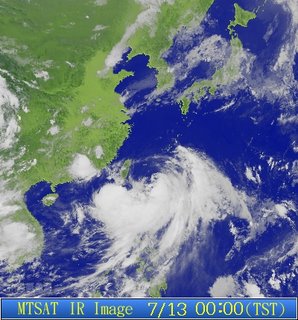
Click here for a more up-to-date satellite image from the Central Weather Bureau.
In other news, I had a disturbing dream last night: Our department received official notification that because of an oversupply of university graduates and a worsening economy, English majors who graduated in the bottom third of their class were to be executed on the athletic field immediately following the graduation ceremony. The most frightening thing about the dream was how calmly everybody (including the graduating students) was taking the news. Students just said, "Wow--I hope it's not me..."

Click here for a more up-to-date satellite image from the Central Weather Bureau.
In other news, I had a disturbing dream last night: Our department received official notification that because of an oversupply of university graduates and a worsening economy, English majors who graduated in the bottom third of their class were to be executed on the athletic field immediately following the graduation ceremony. The most frightening thing about the dream was how calmly everybody (including the graduating students) was taking the news. Students just said, "Wow--I hope it's not me..."
Monday, July 03, 2006
Open Call for Proposals: Writing Research Across Borders
Hoping we can get some representatives from Taiwan to go...
Open Call for Proposals: Writing Research Across Borders
February 22-24, 2008
University of California Santa Barbara
Conference website; http://education.ucsb.edu/netshare/wrconf08/
Proposal Deadline: May 1, 2007
Email: writing@education.ucsb.edu
Recent decades have seen the growth of writing studies in many nations, focused on all levels of education, and all uses of writing in society, using the resources of many different disciplines. This increased research attention to writing reflects an increased recognition of the importance of writing in modern societies. Yet to a large extent the many emerging traditions of writing research have neither connected fully nor shared their work.
This conference brings together the many writing researchers from around the world, drawing on all disciplines, and focused on all aspects of writing at all levels of development and in all segments of society. This will be an opportunity to learn from different research traditions, share our findings, seek common agendas, and lay the groundwork for future communication and alliances.
As a first step to building this important conversation we have invited some of the leading writing researchers, and those listed at the bottom of this call have already committed to participating.
We are now issuing an open call for proposals for panels, roundtables, individual presentations, and poster presentations addressing
* current research on writing,
* methodological issues
* reflections on ongoing research programs
* considerations of national or disciplinary trajectories of research
* agendas for further research
We anticipate a program of up to two hundred and fifty presentations.
Proposals to present current research should specify research questions, methods, data corpus, and findings, as well as the scope and duration of the research project. Proposals to provide overviews of and reflections on research traditions and agendas should identify clearly the relevant literatures to be considered.
Proposals for individual and poster presentations should be from 250 to 500 words in length and panel and roundtable proposals, 500 to 1000 words. Please indicate your preferred format.
Proposals should be sent by May 1, 2007 via email to writing@education.ucsb.edu. Please include complete contact information.
For further information please visit our conference website:
http://education.ucsb.edu/netshare/wrconf08/
If you have any questions contact us at writing@education.ucsb.edu
INVITED SPEAKERS already committed to participating:
Paula Carlino, Argentina, University of Buenos Aires
Caroline Channock, Australia, Latrobe
Rosemary Clerehan, Australia, Monash University
Luuk van Waes, Belgium, University of Antwerp
Angela Dionisio, Brazil, UFP, Recife
Angela Kleiman, Brazil, Unicamp-Sao Paulo
Marilyn Chapman, Canada, University of British Columbia
Graham Smart, Canada, Carleton University
Denis Alamargot, France, University of Poitiers
Michel Fayol, France, University Blaise Pascal
Frederic Francoise, France, Universit� de Paris V
Annie Piolat, France, University de Provence
Sylvie Plane, France, IUF de Paris
Yves Reuter, France, Universit� Lille
Joachim Grabowski, Germany, University of Education, Heidelberg, Germany
Pietro Boscolo, Italy, University of Padua
Emilia Ferreiro, Mexico, National Polytechnic Institute
Gert Rijlarsdam, Netherlands, University of Amsterdam
Lisa Emerson, New Zealand, Massey University
Olga Dysthe, Norway, University of Bergen
Rochelle Kapp, South Africa, University of Cape Town
Liliana Tolchinsky, Spain, University of Barcelona
Linda Allal, Switzerland, Universite de Geneve
Otto Kruse, Switzerland, University of Applied Sciences Erfurt, Switzerland
David Galbraith, UK, University of Staffordshire
Ken Hyland, UK, University of London
Roz Ivanic, UK, Lancaster University
Theresa Lillis, UK, Open University
Brian Street, UK, Kings College- London
Mark Torrance, UK, University of Staffordshire
Arnetha Ball, USA, Stanford University
Charles Bazerman, USA, University of California Santa Barbara
Anne Beaufort, USA, SUNY Stony Brook
Carol Berkenkotter, USA, University of Minnesota
Virginia Berninger, USA, University of Washington
Sheridan Blau, USA, University of California Santa Barbara
Ulla Connor, USA, Indiana University-Purdue University Indianapolis
Christiane Donahue, USA, University of Maine, Farmington
Ann Dyson, USA, University of Illinois Urbana-Champaign
Jill Fitzgerald, USA, University North Carolina Chapel Hill
Steve Graham, USA, Vanderbilt
Kris Gutierrez, USA, University of California Los Angeles
Christina Haas, USA, Kent State University
Richard Haswell, USA, TAMU Corpus Christi
John R. Hayes, USA, Carnegie Mellon University
George Hillocks, USA, University of Chicago
Tom Huckin, USA, University of Utah
Susan Jarratt, USA, University of California Irvine
Ilona Leki, USA, University of Tennessee
Paul LeMahieu, USA, University of California Berkeley
Andrea Lunsford, USA, Stanford University
Karen Lunsford, USA, University of California Santa Barbara
Charles MacArthur, USA, University of Delaware
Paul Matsuda, USA, University of New Hampshire
Debra McCutcheon, USA, University of Washington
Heidi McKee, USA, Miami University
Sandy Murphy, USA, UC Davis
Bill Nagy, USA, Seattle Pacific University
Sondra Perl, USA, CUNY Graduate Center
Jim Porter, USA, Michigan State University
Paul Prior, USA, University of Illinois Urbana-Champaign
David Russell, USA, State University
Rebecca Rickly, USA, Texas Technological University
Tony Silva, USA, Purdue University
Peter Smagorinsky, USA, University of Georgia
Melanie Sperling, USA, University of California Riverside
Clay Spinuzzi, USA, University of Texas Austin
John Swales, USA, University of Michigan
Chris Thaiss, USA, University of California Davis
Gary Troia, USA, Michigan State University
Kathleen Blake Yancey, USA, Florida State University
Thursday, June 22, 2006
Summer vacation begins
Just turned in my final grades, so that means the get back to the Big D on a fulltime basis season begins. Big D also means "Big Deadline" looming, so there'll be at most about 2 posts coming out of here this summer (probably around the end of July, if anyone cares). I'll still check my e-mail, but only once or so a day. Wish me luck!
[Update: OK, so I lied about the "2 posts". There might be a few more than that.]
[Update: OK, so I lied about the "2 posts". There might be a few more than that.]
Sunday, June 18, 2006
Vacation
I won't be posting here for a while. I also intend (with help) to cut back drastically on my other online activities. I have some offline priorities that I need to make priorities again.
Have a good summer if you're in the northern hemisphere or winter if you're in the south! Be good to yourself!
Have a good summer if you're in the northern hemisphere or winter if you're in the south! Be good to yourself!


Wednesday, June 14, 2006
Land of a million Britneys
Sorry, but my reference here is to how Britney drove around with her baby in her lap instead of in a safety seat.
In Taiwan, as Michael Turton illustrates (literally), we have thousands--possibly millions?--of parents who neglect their children's safety by carrying them "unhelmeted" around town on motorcycles or scooters. Michael's next project should be to photograph parents who don't put their kids in child safety seats. I don't know how many kids I've seen bouncing around in the front seats of cars or sticking their heads out of the sun roofs of Benzes...
Update: Taiwanonymous, coincidentally, also blogs about traffic problems in Taiwan: "Road Rage Scooter Style".
In Taiwan, as Michael Turton illustrates (literally), we have thousands--possibly millions?--of parents who neglect their children's safety by carrying them "unhelmeted" around town on motorcycles or scooters. Michael's next project should be to photograph parents who don't put their kids in child safety seats. I don't know how many kids I've seen bouncing around in the front seats of cars or sticking their heads out of the sun roofs of Benzes...
Update: Taiwanonymous, coincidentally, also blogs about traffic problems in Taiwan: "Road Rage Scooter Style".
Monday, June 05, 2006
Five new books in the former native speaker's library
(Warning: mixed romanization follows. Proceed with caution.)
After our interesting non-vegetarian meal, the former native Chinese speaker and I wandered up to the 18th floor of Sogo, where there was in progress a large book sale benefitting the Cheng Feng Hsi Cultural and Educational Fund (鄭豐喜文化教育基金會). The fund is named after Cheng Feng Hsi, a famous writer who was born with severely handicapped legs. Despite the hardships of being disabled and poor, he graduated from National Chung Hsing University and returned to his native village to teach. He also wrote a best-selling book, A Boat on the Boundless Ocean (汪洋中的一條船). After Cheng succumbed to liver cancer at the age of 31 in 1975, his widow Wu Chi-chao (吳繼釗) started a foundation for helping the disabled and poor. (The book sale at Sogo goes until June 11, by the way. Books were donated by area bookstores and are on sale for half the cover price.)
OK--the books I bought are:
After our interesting non-vegetarian meal, the former native Chinese speaker and I wandered up to the 18th floor of Sogo, where there was in progress a large book sale benefitting the Cheng Feng Hsi Cultural and Educational Fund (鄭豐喜文化教育基金會). The fund is named after Cheng Feng Hsi, a famous writer who was born with severely handicapped legs. Despite the hardships of being disabled and poor, he graduated from National Chung Hsing University and returned to his native village to teach. He also wrote a best-selling book, A Boat on the Boundless Ocean (汪洋中的一條船). After Cheng succumbed to liver cancer at the age of 31 in 1975, his widow Wu Chi-chao (吳繼釗) started a foundation for helping the disabled and poor. (The book sale at Sogo goes until June 11, by the way. Books were donated by area bookstores and are on sale for half the cover price.)
OK--the books I bought are:
- Photographs of Taiwan During the 1960's (六十年代台灣攝影圖像), by Ellen Johnston Laing (藝術家出版社, 2002).
This book has a nice bilingual introduction in which Laing describes her life in Taiwan during the early 1960s. She had received a Fulbright to study Chinese language and art in Taiwan, and she lived in Taipei and Taichung. While in Taichung, she and her husband Richard lived in an old Japanese-style house on a lane off Minquan Road and she took the bus to Tunghai to study Chinese. She also went to the pre-Taipei National Palace Museum, which she describes as "a few unpretentious buildings nestled below the foothills outside Wu-feng and guarded by military police" (26-7). This book has some wonderful pictures of her house and 1960s Taichung. By the way, its "intended" English title seems to be Photographs of Bygone Taiwan: Taiwan in the 1960s, but it's also (mysteriously) titled Photography of Taiwan During the 1960s on the National Library stamp in the back of the book.
- 台灣五大家族 (Taiwan's Rich and Powerful Families: The Old Monies), by Sima Xiaoqing (司馬嘨青) (玉山社, 2000).
This book introduces the Yans of Keelung, the Lins of Banqiao, the Lins of Wufeng, the Gus of Lugang, and the Chens of Kaohsiung. - 阿樺:台灣建國烈士詹益樺紀念專書 (Ah-Hua: A Book Commemorating Chan Yi-hua, Martyr for the Cause of Building the Taiwanese Nation), ed. Zeng Xinyi (曾心儀) (editor, 1989)
Chan Yi-hua committed suicide by self-immolation on May 19, 1989, during a funeral procession for Cheng Nan-jung, a pro-independence journalist who also committed self-immolation when police tried to arrest him for sedition. (More information on this is available in this issue (PDF) of the pro-independence Taiwan Communique. There's also an article available here.) - 台灣歷史年表:終戰篇 I (1945-1965) (A Chronology of Taiwan History: 1945-1965), chief ed. Xue Huayuan (薛化元) (Institute for National Policy Research, 1993)
- 台灣歷史年表:終戰篇 II (1966-1978) chief ed. Xue Huayuan (薛化元) (Institute for National Policy Research, 1994)
These two volumes list major political, economic, social, and international events that affected Taiwan. They also cite contemporary newspaper and magazine articles that covered those events.
All in all, the five books cost me less than the cover price of the last two books. Not a bad deal.
Saturday, June 03, 2006
Tunghai symposium on distance language learning
This afternoon I attended a symposium at Tunghai on the topic of "Issues in Distance Language Learning." It was run by the MOE-sponsored Distance Language Learning project at Tunghai. There two speakers: Professors Herng Yow Chen (陳恒佑) of National Chi Nan University and Michael Jacques of Tunghai University.
Professor Chen, of the Computer Science and Information Engineering department, was the first to talk. He introduced us to Chi Nan's impressive multimedia language program infrastructure. He explained how the multimedia language learning program was making use of kiosks and the wireless net to allow students to make use of language learning programs from all over campus, not only through computers, but also via cell phones and PDAs. He emphasized that the advantage of online learning is reusability, and explained how the multimedia system makes use of live and recorded versions of "English Corner" activities to provide students with Video on Demand (VoD) and Audio on Demand (AoD). He demonstrated some of the resources to which the Chi Nan students had access.
Most interesting to me was the student-produced materials located at NCNU's Mountain Media site. With Prof. Chen's assistance, students write the news items and record and edit audio and video presentations for this site. Prof. Chen mentioned that participating students are paid part-time workers. In answer to a question I asked, he said that students have to be recruited for these jobs--and they're not exactly knocking down the doors to participate--and don't get paid a great deal, but that they receive a lot of training and practical experience in producing online multimedia content in English. One of the challenges that the program has to face is the difficulty of paying teachers (and students) to stay active in these kinds of activities. Although the program is part of an MOE Teaching Excellence project, the money isn't coming in very regularly to help pay for things and people. (Also, as I understand it, full-time faculty cannot be paid out of the MOE grant money.)
Prof. Chen also introduced an online English writing program that Chi Nan is using to require students to write more in English and get feedback from their teachers (or TAs) regarding grammar, spelling, and other formal issues. Right now only first-year students are making use of this online program, but he hopes that in the future all students from the first to the third year are required to participate.
During the break, I was talking with Prof. Chen and he mentioned that the school is thinking of phasing out the Freshman English program (大一英文) in favor of requiring students to study English during their first, second, and third years of attendance. This would require some major changes in staffing, however, and the logistical issues haven't been completely worked out. The idea is intriguing, though.
The next speaker, Michael Jacques, demonstrated the FLLD Online materials that he has developed for the students and teachers at Tunghai. He also discussed three key questions related to online language learning:
Professor Chen, of the Computer Science and Information Engineering department, was the first to talk. He introduced us to Chi Nan's impressive multimedia language program infrastructure. He explained how the multimedia language learning program was making use of kiosks and the wireless net to allow students to make use of language learning programs from all over campus, not only through computers, but also via cell phones and PDAs. He emphasized that the advantage of online learning is reusability, and explained how the multimedia system makes use of live and recorded versions of "English Corner" activities to provide students with Video on Demand (VoD) and Audio on Demand (AoD). He demonstrated some of the resources to which the Chi Nan students had access.
Most interesting to me was the student-produced materials located at NCNU's Mountain Media site. With Prof. Chen's assistance, students write the news items and record and edit audio and video presentations for this site. Prof. Chen mentioned that participating students are paid part-time workers. In answer to a question I asked, he said that students have to be recruited for these jobs--and they're not exactly knocking down the doors to participate--and don't get paid a great deal, but that they receive a lot of training and practical experience in producing online multimedia content in English. One of the challenges that the program has to face is the difficulty of paying teachers (and students) to stay active in these kinds of activities. Although the program is part of an MOE Teaching Excellence project, the money isn't coming in very regularly to help pay for things and people. (Also, as I understand it, full-time faculty cannot be paid out of the MOE grant money.)
Prof. Chen also introduced an online English writing program that Chi Nan is using to require students to write more in English and get feedback from their teachers (or TAs) regarding grammar, spelling, and other formal issues. Right now only first-year students are making use of this online program, but he hopes that in the future all students from the first to the third year are required to participate.
During the break, I was talking with Prof. Chen and he mentioned that the school is thinking of phasing out the Freshman English program (大一英文) in favor of requiring students to study English during their first, second, and third years of attendance. This would require some major changes in staffing, however, and the logistical issues haven't been completely worked out. The idea is intriguing, though.
The next speaker, Michael Jacques, demonstrated the FLLD Online materials that he has developed for the students and teachers at Tunghai. He also discussed three key questions related to online language learning:
- Who should be the audience for online language learning materials?
This is a huge issue, he said, because users can be added for "free" (in terms of the costs to the school of providing the materials online to other users). While this doesn't affect the technical details of the online project, it does affect how producers of the materials should view their pedagogical aims and approaches. - Who is going to do all the work?
Here he mentioned the need for language teachers, computer scientists, and computational linguists to work together on the project. All these parties have expertise in certain important areas, but they do not have enough expertise in other areas--so, for instance, a language teacher might have ideas about how to teach, but not know how to write a program to do what he or she wants to do. - How and when do you compensate people?
Prof. Jacques, who has a JD, emphasized that producing these online materials does not exactly seem to fall under the umbrella of "work for hire", which isn't really a concept often used among academics. Since creating these materials is not explicitly part of anyone's job description, he said, this work "challenges the boundaries" between academic work and work for hire. Also, it appears that the laws and university policies governing producing distance learning materials are not very well developed in Taiwan (this might be my own observation).
This was an informative and interesting symposium. Unfortunately, Michael Jacques is leaving Tunghai at the end of this semester to return to the U.S., so he won't be able to continue working on the Distance Language Learning project for Tunghai. (By the way, he has a list of items for sale in case you're looking for furniture or other equipment.)
[academia] [distance learning] [ELT] [language learning] [Taiwan]
Sunday, May 28, 2006
CFP: Tamkang Review issue on "The Neighbor: Literature, Politics and Ethics in the Age of Globalization"
TAMKANG REVIEW
English Department, Tamkang University, Tamsui, Taipei Hsien, Taiwan 251
TEL: 886-2-26215656 EXT. 2329 E-MAIL: tfwx@www2.tku.edu.tw
CALL FOR PAPERS
The Neighbor:
Literature, Politics and Ethics in the Age of Globalization
Deadline for Submissions: 20 September 2006
The neighbor, as a central figure in Kierkegaard’s Works of Love, Freud’s Civilization and Its Discontents, and Lacan’s Ethics of Psychoanalysis, is a nebulous, enigmatic category that calls for rethinking in terms of subjectivity, desire, fantasy, communication, and community. The neighbor in its various manifestations―immigrants, ideal egos, ethnic Other, enjoyment, for example―provokes ambivalent responses of love and hate, fascination and fear, and problematizes the demarcations of the private and public, proximity and distance, inside and outside, hospitability and aggressivity, law and transgression. In our age of globalization, driven by fluidity, becoming, and deterritorialization, the neighbor turns out to be an unavoidable issue in the fields of literature, politics and ethics.
Tamkang Review will launch a special issue on the neighbor in spring 2007. Papers addressing the following topics are particularly welcome:
- ethnic differences and conflicts
- Neo-Nazism and xenophobia
- fundamentalist and terrorist violence
- urbanization, immigration, and diaspora
- global consumerism and tourism
- cultural translation
- monsters in Gothic fiction or horror films
Please note:
- Tamkang Review only publishes papers in English not being simultaneously submitted elsewhere.
- Please send your MLA-styled manuscript, an abstract of (no more than 250 words), a list of no more than 10 keywords, and a curriculum vita as Word-attachments to tfwx@www2.tku.edu.tw.
- The manuscript should be anonymous. Your name and affiliation should only appear in the curriculum vita.
Wednesday, May 24, 2006
A book the former Bianchi-rider hopes someone will buy for him...
- The Tour de France: A Cultural History, by Christopher S. Thompson (U of California P, 2006)
Get my copy now! ;-)
Taiwan fails to get into the World Health Assembly again...
...and neither the BBC's nor CNN's websites even mention it.
For those who are counting, this was the tenth attempt by Taiwan to get observer status (not even full status as a member!) in the World Health Assembly. For those who are not counting, you should be.
As the Taipei Times reports, the assembly refused (again) even to include Taiwan's application on its meeting agenda (pdf). This was after the assembly listened to protests from Pakistan and the PRC (those role models of humanitarianism). (If you're interested in the discussion of the adoption of the agenda, you can find it in this document [pdf], page 10, Item 1.4)
The Taipei Times quotes "Ambassador and permanent representative to the UN Sha Zukang (沙祖康)" aslying saying, "'We have been very concerned about the [Taiwanese people's] health. This is absolutely for sure'." As the Times editorialized during the SARS crisis of 2003, "the biggest contribution China has made to the health of the people of Taiwan and the world lately is the transmission of the SARS virus." Those of us with memories that go back to the 921 earthquake also recall how China's Red Cross demanded international Red Cross organizations work with it if they wanted to help Taiwan. Typically, what the PRC says and what it does regarding its "concern" for the people of Taiwan are diametrically opposed.
Maybe the reason that CNN and the BBC haven't reported on this is that, after 10 years, it isn't news anymore.
For those who are counting, this was the tenth attempt by Taiwan to get observer status (not even full status as a member!) in the World Health Assembly. For those who are not counting, you should be.
As the Taipei Times reports, the assembly refused (again) even to include Taiwan's application on its meeting agenda (pdf). This was after the assembly listened to protests from Pakistan and the PRC (those role models of humanitarianism). (If you're interested in the discussion of the adoption of the agenda, you can find it in this document [pdf], page 10, Item 1.4)
The Taipei Times quotes "Ambassador and permanent representative to the UN Sha Zukang (沙祖康)" as
Maybe the reason that CNN and the BBC haven't reported on this is that, after 10 years, it isn't news anymore.
Sunday, May 21, 2006
On the bright side, it's impossible to be denied tenure here...
[Update: I've made some changes to this, based on some informative comments from Clyde Warden.]
Got this in our mailboxes on Friday. It confirms something I heard about earlier, but didn't want to mention here because I didn't have all the details.there is no tenure system in Taiwan the tenure system in Taiwan is quite different from what many applicants might expect. (Some say there was never any tenure system--this is probably true. [But see Clyde's comments below.]) If any department or university in Taiwan is advertising for a "tenure-track position", the writers of the ad have either been misinformed and/or are misinforming the audience need to make sure applicants understand what exactly is meant by "tenure" in the Taiwan system.
My questions:
Got this in our mailboxes on Friday. It confirms something I heard about earlier, but didn't want to mention here because I didn't have all the details.
The university is following an MOE mandate to evaluate teachers every three years. Teachers are evaluated by four categories: Teaching (40-50%), Research (20-40%), Service (10-30%) and Student counseling (10-30%). Teachers need to have 70 points in total to pass the evaluation. There is no minimal point requirement for each category, but there has to be at least some points for each category. Teachers will be evaluated every three years and the evaluation is done at the college level, not the department level. If a teacher does not pass the first time, then s/he will be evaluated once a year (maximum of 6 years) also, the teacher will not be allowed to teach part-time outside of Tunghai, will not be paid overtime, annual-promotion-pay will be frozen, and cannot be "lent to other institution". If a teacher does not pass after 6 years of yearly review, s/he will be referred to the university FAC, which reserves the right to terminate his/her contract. Each college needs to come up with guidelines to calculate points for evaluation. These guidelines have to be approved by the college FAC and university FAC, but they also have to meet the MOE mandate. Each college has flexibility in assigning points. We need to create guidelines to submit to the college that will meet the needs of the teachers in our department.The main conclusion that I draw from this is that
My questions:
- Are other schools doing this? Is this only new for private universities or is it new for public and private schools?
- Can someone point me to the relevant MOE guidelines/mandate? I'd just like to take a gander at it myself.
Wednesday, May 17, 2006
Comparative driving
Had to link to this description of driving practices in Burlington, NC. Sounds so much like home (here), only without the motorcyles and scooters:
Sound familiar?See, over the last three years, I've lived in a town where there are no rules, exactly, for driving. They're more like suggestions. You know: "if it's not too much trouble, you might want to consider keeping your car right of the center line--but no biggie. We know sometimes you just need the whole road." Since moving here, Lee and I have (in most cases, many times) seen drivers:
turn left from the right lane
turn right from the left lane
wait in the right
lane until traffic clears so they can get into the left lane to turn left
back up on the interstate to take an exit
back up on a busy four-lane
road to turn into a business (and then still just drive onto the curb and into the grass between the street and the parking lot)
stop in the middle of the road to hand a package from one DHL van to another
park in the entry drive of the TJ Maxx lot because it's easier than finding a spot
pull up to an intersection, wait until we were upon said intersection, then pull out in front of us (and proceed to go 15 mph below the posted limit)
come to a complete stop to turn right from a busy street
There are more, too, but my neural net can only process so much at once.
Two more books that the former native speaker ordered, and one that he didn't...
Today I received my last shipment of books from the University of California Press sale that I mentioned earlier. One of the books that I ordered didn't arrive, though, and was replaced with a book on a completely unrelated subject. I wrote to UCP to find out what happened, as no explanation was given on the invoice.
Here are the two books I ordered:
Here are the two books I ordered:
- Radio Goes to War: The Cultural Politics of Propaganda during World War II, by Gerd Horten (Berkeley: U of California P, 2002)
- Importing Diversity: Inside Japan's JET Program, by David L. McConnell (Berkeley: U of California P, 2000)
- The Bodhidharma Anthology: The Earliest Records of Zen, by Jeffrey L. Broughton (Berkeley: U of California P, 1999) (One of my colleagues has already laid claim to it if I am unable to return it!)
[Update, 5/20/06: The representative I e-mailed apologized for the error and sent out the book I had actually ordered. She asked me to tear off the cover of The Bodhidharma Anthology and send it back so that they can count it for inventory purposes. So I cut off the cover (if you're reading, Mr. Broughton, my apologies!) with one of those razor-knives that all Taiwanese elementary students seem to carry around, and I'll send it back on Monday.]
Wednesday, May 10, 2006
Monday, May 08, 2006
"Perspectives on the Language Centers in Taiwan's Universities" Symposium
I know I'm supposed to be finishing up that third post on A Pail of Oysters, but I wanted to mention a couple of other things in the mean time. One is the symposium that Tunghai's FLLD held this past Saturday (May 6). Our department hosted nine invited speakers who run language centers at different universities around Taiwan. The directors were asked to address the following questions about their programs:
I'm not going to summarize each person's presentation, but I want to mention a few of the major themes that came out of the presentations. In no particular order, here they are:
Again, this summary of the symposium is based on my impressions/memories of the meeting. I'd appreciate the corrections of anyone else who was there. (Like Kris Vicca, who in a careless moment admitted that he's read this blog before!) I have thought about whether or not I should mention who said what, but have opted not to at this point, though if the directors want their names attached to particular comments or opinions, I'll be happy to comply with their requests. And the paragraph above is based almost entirely on my own slightly muddled view of things. I'll try to develop these ideas in more depth at some point in the future.
- What is the mission of your language center?
- What is the history/development/reasons for creation?
- Introduce your language center (staff, faculty, students, structure within the universities, etc.).
- What are the facilities (space, allotment/office space)?
- What is the number of faculty and staff?
- What is the status of teachers/kind of contracts?
- What are the requirements in terms of teaching load and responsibilities for teachers?
- What programs/classes do you offer?
- What are some of the pros and cons of having a language center?
- How are teachers in the language center evaluated?
I'm not going to summarize each person's presentation, but I want to mention a few of the major themes that came out of the presentations. In no particular order, here they are:
- There's an increasing attempt to reach out to honors or otherwise advanced students through special semester-long or short-term courses. The program at one school (and possibly more) is also feeling pressure from the rest of the school to offer courses and other kinds of help to graduate students and faculty who now are feeling more pressure to publish in English-language international academic journals.
- Most of the language centers would probably be better labelled "language programs" because they are responsible for the required first-year English courses and elective language courses. There was one (if I remember correctly) language center that did not have the responsibility for the FY-English program. It operates more as a center that offers short-term courses, lectures, study groups, and other activities for extracurricular English learning. (And the staff there consists of one director, 2 staff members, and no faculty.)
- There are more and more attempts to make use of computer-aided self-study systems so that students can learn on their own. Some programs require the computer-aided learning to be graded as part of required courses; some just provide the learning stations and hope that students will come. (One director mentioned that they had increased the number of computers in one lab from 7 to 41, but only the same 7 students were showing up...)
- Most of the directors complained of being understaffed, particularly in terms of full-time faculty. As one director put it, the problem is not a sense that part-time teachers are not as hard-working; the problem is that because it is difficult to give part-time teachers the same level of pay and facilities as full-timers (office space, etc.), part-timers usually have to teach at more than one school and therefore cannot be around for program activities, office hours, or important program meetings. This makes it harder both for students to have more interaction with their teachers outside of the classroom and for programs to be as unified as directors would like. [This is my recollection of what was said--if it doesn't quite accurate to others who were there, please let me know!]
- I felt a sense that teachers and administrators in the language center are not as highly respected as teachers or administrators in regular departments. The term "second-class citizens" was used more than once in characterizing the language centers' status.
- Related to this, I noticed a concern that language center faculty will end up being evaluated in the same way as faculty in other departments (in other words, a heavy emphasis on research), despite the heavier teaching responsibilities that come with teaching English to the entire freshman class, teaching English electives to upperclass students, and running various programs to encourage students to use English outside of class and to ensure that the English proficiency of the students meets some sort of externally defined standard (the GEPT or TOEFL, for example).
Again, this summary of the symposium is based on my impressions/memories of the meeting. I'd appreciate the corrections of anyone else who was there. (Like Kris Vicca, who in a careless moment admitted that he's read this blog before!) I have thought about whether or not I should mention who said what, but have opted not to at this point, though if the directors want their names attached to particular comments or opinions, I'll be happy to comply with their requests. And the paragraph above is based almost entirely on my own slightly muddled view of things. I'll try to develop these ideas in more depth at some point in the future.
Saturday, April 29, 2006
Two brief comments on Silent Hill, which we just got back from seeing
- I pretty much agree with Roger Ebert's review of it. 'Specially the part where he says that "everybody wanders through the town for two hours while the art direction looks great." That's basically the whole story.
- There's a scene where the main character's husband (who's looking for her and their child) breaks into a small-town archives, finds the burnt boxes of the Silent Hill police records in plain sight, and discovers in seconds exactly the record that he seems to be looking for. (I say "seems" because I'm not even sure why he wanted to check out the police records in the first place.) As someone who has done research in several archives, I just have 5 words in response to the situation I've just described: Not. In. A. Million. Years.
A Pail of Oysters II
[Note: I took this down for a while, but have re-posted it. Some of what is below is developed in more detail in my 2007 article, "Empathy and its Others: The Voice of Asia, A Pail of Oysters, and the Empathetic Writing of Formosa" (Concentric: Literary and Cultural Studies, 33(2), 35 - 60).]
In my earlier post I mentioned what little criticism or analysis I could find about A Pail of Oysters. Here I'm not going to summarize the entire novel, but I want to point out a few things that were interesting to me about the book.
There are four main characters in A Pail of Oysters:
The two run into Li Liu, who has accidentally ended up in Taipei after he hitched a ride on the jeep carrying Ralph Barton. Precious Jade's brother buys some food for Li Liu and invites Li to live with Precious Jade and him, despite Precious Jade's objections.
I want to dwell, at this point, on an interesting part in the story where Precious Jade's brother and Li Liu are talking and Li Liu asks the brother what to call him:
I don't know if Sneider intended it, but Didi's (or "Billy's") issues with his name and parentage (distinguishing clearly between "the one who was supposed to be my real father" and "the one who bought me") sound like a metaphor for Taiwan's situation at the time. The boy's confusion about his name involves the same confusion over national identity that people in Taiwan might have been experiencing at the time. The use of Japanese and Chinese names mirrors the problems of identification for the Taiwanese. Each "father" gives a different name that requires the child to reject the previous identity.
In the end, Precious Jade's brother rejects both his Japanese names and his Chinese names, settling first for the label "Didi", then also for an English name that is given to him by an American. Did Sneider mean this to be symbolic of the ideal American relationship with Taiwan--one in which the Americans would help the Taiwanese people establish an identity for themselves that would not only reject the oppressive identities forced upon them by the Chinese but also be friendly to the American people?
Another narrative thread in the book suggests that this conclusion might not be too far off. Barton also becomes involved with a Mr. Chou, the head of an architectural firm who arranges secret meetings with the American to tell him about the plans some Formosans have to try to reform the Nationalist government by getting rid of the "Communistic-technique" faction of the KMT. (Here Sneider alludes to Chiang Ching-kuo, not by name, but as a member of the "Communistic-technique" faction who "has lived almost half his life" in Russia [177]). Chou wants Barton to write articles about Formosa in order to let Americans know about the problems there so that the "Democratic-technique" faction can overcome the Communistic-technique faction. He also describes the Formosans' plans to build Formosa's democracy through economic development, specifically via "free enterprise," and their hopes that the Americans will help with this. Chou assures Barton that their plan to "build Formosa" will also "be helping to build all of Asia" (180). He argues that building a strong capitalist economy on Taiwan that breaks up government monopolies and allows for the participation of Formosans will help build a better society and more appealing alternative than that of Red China. Chou implies, then, that a democratic and capitalistic Taiwan would help further the U.S.'s fight against Communism in Asia.
Chou (or Sneider?) is at pains to emphasize that the opponents of the government are not Communists, even labelling CCK's faction of the KMT as the "Communistic-technique" faction. (I'm not going to argue with that characterization, though.) The future of Asia, it is implied, lies in developing a strong free-market economy in Taiwan, which will lead to a more democratic Taiwan that would be more friendly to U.S. interests.
This is, by the way, in sharp contrast to the impressions James Michener gives of the situation in The Voice of Asia, which was published only 2 years prior to Sneider's book. After interviewing a few Mainlanders on Taiwan (see my list of his interviewees here), Michener gives the following answer to the question, "Is the present Formosa Government responsible?"
Toward the end of the novel, Barton finds out that Billy and Precious Jade have been caught by the "Peace Preservation Corps" and taken to a racetrack in Tamshui and shot. (Their adoptive "father" found out where they were and turned them in, accusing them of being Communists.) At first Barton is sick of Taiwan and wants to leave. Then, after he runs into Li Liu, he "borrows" a jeep and helps him escape back to the South before Li Liu can be arrested. As Barton drives, the car, he changes his mind about staying in Taiwan:
Morehere... [Not yet...]
In my earlier post I mentioned what little criticism or analysis I could find about A Pail of Oysters. Here I'm not going to summarize the entire novel, but I want to point out a few things that were interesting to me about the book.
There are four main characters in A Pail of Oysters:
- Li Liu, a part-Hakka, part-Pepohuan (Plains Aborigine--or literally, "plains savage") who has been sent by his ailing father to bring back their god (a framed picture, possibly like this, which was stolen by some KMT soldiers);
- Precious Jade, a young prostitute who escapes the House of the Laughing Gods;
- her younger brother, a middle school graduate who is about Li Liu's age; and
- Ralph Barton, an American reporter who is being dragged around Taiwan by KMT people so that he can write glowing accounts of how the Nationalists are running Taiwan.
The two run into Li Liu, who has accidentally ended up in Taipei after he hitched a ride on the jeep carrying Ralph Barton. Precious Jade's brother buys some food for Li Liu and invites Li to live with Precious Jade and him, despite Precious Jade's objections.
I want to dwell, at this point, on an interesting part in the story where Precious Jade's brother and Li Liu are talking and Li Liu asks the brother what to call him:
"...I was thinking. You call me by my name. You call me Li Liu, and I do not know what to call you."Eventually, they agree that Li Liu should call him "Didi" (younger brother), just as Precious Jade does. Later on, Precious Jade's brother gets a job at the Friends of China Club and meets Barton. The two of them get to talk a lot (Precious Jade's brother is trying to improve his English), and Barton gives the boy the English name Billy.
"I see."
"You said you thought your name was Yamamuro at one time, and more recently Wang, but that you did not want these names any more. Truly, though, you must have a first name by which I can address you."
"The one who was supposed to be my real father used to call me Modiharu," the youth said slowly. "And the one who bought me named me Ching-Meng." He considered. "But I don't want those names either."
"Then what am I to call you?"
"I do not know. Would you want to call me nameless one?"
Li Liu shook his head. "No."
"I see." (120-1)
I don't know if Sneider intended it, but Didi's (or "Billy's") issues with his name and parentage (distinguishing clearly between "the one who was supposed to be my real father" and "the one who bought me") sound like a metaphor for Taiwan's situation at the time. The boy's confusion about his name involves the same confusion over national identity that people in Taiwan might have been experiencing at the time. The use of Japanese and Chinese names mirrors the problems of identification for the Taiwanese. Each "father" gives a different name that requires the child to reject the previous identity.
In the end, Precious Jade's brother rejects both his Japanese names and his Chinese names, settling first for the label "Didi", then also for an English name that is given to him by an American. Did Sneider mean this to be symbolic of the ideal American relationship with Taiwan--one in which the Americans would help the Taiwanese people establish an identity for themselves that would not only reject the oppressive identities forced upon them by the Chinese but also be friendly to the American people?
Another narrative thread in the book suggests that this conclusion might not be too far off. Barton also becomes involved with a Mr. Chou, the head of an architectural firm who arranges secret meetings with the American to tell him about the plans some Formosans have to try to reform the Nationalist government by getting rid of the "Communistic-technique" faction of the KMT. (Here Sneider alludes to Chiang Ching-kuo, not by name, but as a member of the "Communistic-technique" faction who "has lived almost half his life" in Russia [177]). Chou wants Barton to write articles about Formosa in order to let Americans know about the problems there so that the "Democratic-technique" faction can overcome the Communistic-technique faction. He also describes the Formosans' plans to build Formosa's democracy through economic development, specifically via "free enterprise," and their hopes that the Americans will help with this. Chou assures Barton that their plan to "build Formosa" will also "be helping to build all of Asia" (180). He argues that building a strong capitalist economy on Taiwan that breaks up government monopolies and allows for the participation of Formosans will help build a better society and more appealing alternative than that of Red China. Chou implies, then, that a democratic and capitalistic Taiwan would help further the U.S.'s fight against Communism in Asia.
Chou (or Sneider?) is at pains to emphasize that the opponents of the government are not Communists, even labelling CCK's faction of the KMT as the "Communistic-technique" faction. (I'm not going to argue with that characterization, though.) The future of Asia, it is implied, lies in developing a strong free-market economy in Taiwan, which will lead to a more democratic Taiwan that would be more friendly to U.S. interests.
This is, by the way, in sharp contrast to the impressions James Michener gives of the situation in The Voice of Asia, which was published only 2 years prior to Sneider's book. After interviewing a few Mainlanders on Taiwan (see my list of his interviewees here), Michener gives the following answer to the question, "Is the present Formosa Government responsible?"
It is probably the most efficient government in Asia today, not even excepting Japan's. It has solved the food problem. It has rationed goods so that everyone gets a fair break. It polices the island so that even white men can move about at night without risk of murder. It has launched an education program, prints liberal newspapers and insures just trials. Furthermore, in order to erase evil memories of initial Chinese occupation, the Government has specifically worked to protect the indigenous Taiwanese population. (106)Michener's "Observations" section consists almost entirely of issues related to how and when the Mainland should be retaken militarily. He doesn't suggest any changes are needed on Formosa, and in the above paragraph gives unstinting praise to the KMT regime for reforms that the characters in Sneider's novel would say hadn't even happened. To Michener, the KMT government is taking care of the Taiwanese people and Americans don't need to worry about it. Sneider's book argues that American ignorance of the real conditions on Taiwan--ignorance exacerbated by reportage like Michener's--would be disasterous for Asia.
Toward the end of the novel, Barton finds out that Billy and Precious Jade have been caught by the "Peace Preservation Corps" and taken to a racetrack in Tamshui and shot. (Their adoptive "father" found out where they were and turned them in, accusing them of being Communists.) At first Barton is sick of Taiwan and wants to leave. Then, after he runs into Li Liu, he "borrows" a jeep and helps him escape back to the South before Li Liu can be arrested. As Barton drives, the car, he changes his mind about staying in Taiwan:
No, he told himself, he wasn't finished with this part of the world. His glance slid to the boy who held his god. He would stay here. He would learn all that he could. And then he would reveal--in articles and fiction--in any way he could, the utter stupidity, the ignorance of a small group who not only enslaved eight million people, but who endangered all of Asia. (304)This is the last we see of him. And perhaps the alleged fate of A Pail of Oysters--pulled out of libraries then and virtually ignored now--might tell us what the fate of Barton's words would have been.
More
Subscribe to:
Posts (Atom)