CALL FOR PAPERS
National Conference on College English
March 29, 2008
Foreign Language Center, National Chengchi University
“Perspectives on College English:
Transformation, Reformation, and Innovation”
We are pleased to announce that the 2nd National Conference on College English with the theme of “Perspectives on College English: Transformation, Reformation, and Innovation” will be held on March 29, 2008. The conference is an annual gathering of English specialists organized by the Foreign Language Center of National Chengchi University. It provides a professional venue for teachers and scholars to discuss various issues regarding English education in colleges.
Though both the required and the elective English courses for undergraduates serve massive students from different disciplines, college English has long been marginalized as a “sub-subject” in universities in Taiwan. Recently, college English has been gaining ground due to new demands from globalization and international competition and cooperation on higher education in Taiwan. Proliferating studies have broadened the spectrum of college English research beyond discussions of freshman English or English skill instruction in Taiwan. This year’s conference will focus on how teachers help students transform their English learning attitudes to become autonomous learners and student researchers, how teachers challenge their teaching philosophy to meet pressing demands in an age of globalization, how teachers adopt/adapt/design new curricula/pedagogies/materials for innovation, how students are empowered to critically participate in public debates and intellectual communications, what the impacts of English admission/graduation requirements are, and how school systems are being changed or reformed to support teachers’ teaching and research as well as students’ learning.
The 2008 conference features well-respected speakers who will address various aspects and issues in terms of transformation, reformation and innovation in college English. This conference invites proposals on topics that include but are not limited to the following:
- The dynamics of English in higher education
- Institutional policies and politics on college English
- English requirements for college admission/graduation and their impacts on teaching and learning
- Teachers’ or students’ transformation in teaching or learning
- Theory and practice in college English
- Learner autonomy
- Evaluation and assessment
- Curricular, material, or pedagogical innovations and developments
The Conference Organizing Committee is now circulating a call for abstract proposals for individual paper presentations. Abstracts are welcome in any areas that fit the conference theme. Please submit your abstract proposal of 250-500 words and a brief bio in either English or Chinese as a Word/PDF attachment file to flcenter@nccu.edu.tw by February 1, 2008. Final manuscripts submitted for blind review of the conference proceedings are due by April 1, 2008.
Important dates:Conference organizer: Foreign Language Center, National Chengchi University
- Conference Date: March 29, 2008
- Abstract Date: February 1, 2008
- Abstract Acceptance: February 19, 2008
- Full manuscript Due: April 1, 2008
Venue: Conference Rooms, Administration Building, National Chengchi University
Postal Address:Foreign Language Center, National Chengchi UniversityE-mail Address: flcenter@nccu.edu.tw
64, Sec 2, Zhi-nan Rd., Wenshan District
Taipei 11605, Taiwan
Contact Person:
Chang, Ya-jing
(02)2939-3091 ext. 62396
nada@nccu.edu.tw
Thursday, November 01, 2007
CFP: National Conference on College English


ICRT's oral histories
Has anyone been listening to the "oral histories" that Rick Monday has been featuring this week on ICRT? Evidently he's been interviewing American expats who have lived in Taiwan for a long time. I only caught one--today--as I was driving to work this morning. (I know, it's embarrassing to admit that I listen to ICRT, but it was either that or Rum, Sodomy & the Lash for about the 5,000th time.)
Today, Rick was interviewing Doris Brougham (of Studio Classroom fame) and a gentleman whose name I didn't catch. They were having a grand old time praising the virtues of the Generalissimo and Madame Chiang Kai-shek. Now I respect the fact that they have been in Taiwan a lot longer than I have, but some of their comments didn't reflect very well on them, in my view.
Particularly odd was a comment that I believe Dr. Brougham made when they were discussing the dismantling of Chiang statues. Her statement was to the effect that people in the South (by which she meant the southern U.S.) didn't take down statues of Lincoln just because the South lost the Civil War. Besides the very strange equation of Chiang and Lincoln, her comment made me wonder how many Lincoln statues there are in the South that could have been torn down. According to this article, the first statue of Lincoln in one of the former Confederate states was unveiled in 2003. So it's not like carpet-baggers put up dozens of statues of Lincoln after the Civil War that are available for tearing down.
I think a more comparable controversy concerning tradition (they used the word "traditional" to defend the Chiang statues), public memory, and remembering vs. honoring would be the statues of Lenin in Russia. Would Dr. Brougham defend keeping Lenin's statues up because it's "tradition"?
That said, I wish I could have heard more of the oral histories they have been conducting. Wonder if ICRT will release a CD or have them available on their website?
Today, Rick was interviewing Doris Brougham (of Studio Classroom fame) and a gentleman whose name I didn't catch. They were having a grand old time praising the virtues of the Generalissimo and Madame Chiang Kai-shek. Now I respect the fact that they have been in Taiwan a lot longer than I have, but some of their comments didn't reflect very well on them, in my view.
Particularly odd was a comment that I believe Dr. Brougham made when they were discussing the dismantling of Chiang statues. Her statement was to the effect that people in the South (by which she meant the southern U.S.) didn't take down statues of Lincoln just because the South lost the Civil War. Besides the very strange equation of Chiang and Lincoln, her comment made me wonder how many Lincoln statues there are in the South that could have been torn down. According to this article, the first statue of Lincoln in one of the former Confederate states was unveiled in 2003. So it's not like carpet-baggers put up dozens of statues of Lincoln after the Civil War that are available for tearing down.
I think a more comparable controversy concerning tradition (they used the word "traditional" to defend the Chiang statues), public memory, and remembering vs. honoring would be the statues of Lenin in Russia. Would Dr. Brougham defend keeping Lenin's statues up because it's "tradition"?
That said, I wish I could have heard more of the oral histories they have been conducting. Wonder if ICRT will release a CD or have them available on their website?
Wednesday, October 31, 2007
CFP: "National Image Management in Asia"
Got this in my e-mail the other day.
Place Branding and Public Diplomacy
Call for Papers for Special Issue
National Image Management in Asia
Guest Editor
Dr. Jian “Jay” Wang
Department of Communication
Purdue University, USA
Asia looms large in our global imagination. Today, it is home to the world’s second largest economy, and the world’s two most populous nations and fastest-growing markets. It has diverse cultural heritage, distinct political traditions, and varying levels of development. With their growing role and impact in global politics and economy, countries in Asia are increasingly aware of the importance of their image and reputation as an integral part of their development strategies.
This special issue of Place Branding and Public Diplomacy seeks to advance our understanding of national, regional and city image management in East, Central, South, and Southeast Asia. Topics may include but are certainly not limited to the following:We welcome empirical research (with no preferences for methods or approaches) and concept papers that genuinely advance the field of place branding and public diplomacy. We are also interested in case studies that detail all or some of the key aspects in problem definition, objectives, actions taken, program organization, results/impact, and lessons learned/recommendations.
- Perceptions and images of these countries/regions/cities in the international arena, and their sources and outcome (intended or unintentional);
- Production, distribution, reception, and impact of image management and communication efforts undertaken;
- Structure, process, and policy for place image management;
- Goals and priorities embodied in these efforts, e.g., policy communication, promotion of ideals and values, mutual understanding and relationship development;
- Actors/players in the process, e.g., nation-state and local governments, civic/nongovernmental organizations, business, media, citizens, diasporas, cultural institutions, and celebrities and pop culture figures;
- Communication platforms, e.g., media-oriented programs, cultural communication tools, new media technologies, advertising, public relations, and other communication tactics.
Manuscripts will be double-blind peer reviewed. All submissions must follow the author guidelines, available at http://www.palgrave-journals.com/pb/author_instructions.html. The deadline for submission is January 15, 2008. Papers should be emailed as Word files to Dr. Jay Wang at jianwang@purdue.edu.
Thursday, October 11, 2007
Hmmm... seems to me I was gonna say something here...
Been doing a lot of waiting recently. Yesterday the former native Chinese speaker and I went to a certain unnamed teahouse (that claims it's the inventor of bubble/pearl milk tea) and waited an hour for my lunch to show up. (The fnCs got hers relatively quickly.) But the guy who delivered my meal apologized all over the place and gave us some coupons for free tea the text time we have a spare afternoon to wait for it.
Then this morning we went to the New! Improved! Mini-story of Foreign Affairs office in Fengyuan to get the address on my Alien Residence Card changed. (You gotta do that within 15 days of moving, or they'll fine you NT$5000.) Used to be you could go to the Foreign Affairs Police in the Fengyuan Police Station, wait a few minutes, get yelled at by the officer because you didn't bring the right documents, and be on your way pretty quickly.
Now you go to the New! Improved! MoFA office across the street--look for the banner that says, "Taiwan for UN--Peace Forever!" (or is it "UN for Taiwan--Peace Forever"?). We waited in the office for close to two hours, got nagged by the officer because we didn't bring the right documents (Can anyone tell me why they insist you bring a 戶籍謄本 instead of a 戶口名簿? Don't you need the latter to get the former?), and were out in a minute and a half.
But at least the fnCs and I had some nice conversations while we waited, so I can't really complain...
Then this morning we went to the New! Improved! Mini-story of Foreign Affairs office in Fengyuan to get the address on my Alien Residence Card changed. (You gotta do that within 15 days of moving, or they'll fine you NT$5000.) Used to be you could go to the Foreign Affairs Police in the Fengyuan Police Station, wait a few minutes, get yelled at by the officer because you didn't bring the right documents, and be on your way pretty quickly.
Now you go to the New! Improved! MoFA office across the street--look for the banner that says, "Taiwan for UN--Peace Forever!" (or is it "UN for Taiwan--Peace Forever"?). We waited in the office for close to two hours, got nagged by the officer because we didn't bring the right documents (Can anyone tell me why they insist you bring a 戶籍謄本 instead of a 戶口名簿? Don't you need the latter to get the former?), and were out in a minute and a half.
But at least the fnCs and I had some nice conversations while we waited, so I can't really complain...
Thursday, October 04, 2007
Looks like this will be a typhoon weekend
Typhoon Krosa is on its way and looks like it'll be a big one. So I imagine we won't be going out much this weekend. It's just as well. We're exhausted. We finally finished getting all the stuff out of the old apartment, but now our new place is a mess. I keep expecting to come home and find Jupiter Jones setting up shop in the living room. (I probably referenced myself out of an audience with that.)
Well, at least perhaps I can make use of the time by trying to un-muddle chapter four, which is currently 15,000 stream-of-unconsciousness words with no end in sight. Either that or un-muddle the living room. Whatever I end up doing, though, it might have be done by candlelight. And in either case, organization seems to be the biggest challenge. That, and "knowing what to throw away and knowing what to keep." (Ha ha! Now you won't get that song out of your heads for weeks!)
Well, at least perhaps I can make use of the time by trying to un-muddle chapter four, which is currently 15,000 stream-of-unconsciousness words with no end in sight. Either that or un-muddle the living room. Whatever I end up doing, though, it might have be done by candlelight. And in either case, organization seems to be the biggest challenge. That, and "knowing what to throw away and knowing what to keep." (Ha ha! Now you won't get that song out of your heads for weeks!)
Wednesday, September 26, 2007
Oops...
During our recent move, we unpacked a box of books that contained the Ohio cookbook that ERG's mother had given us five years ago when we were leaving the U.S. to return to Taiwan. Inside the front cover, a nice note from her and an unsigned, un-mailed thank you card....
Sunday, September 23, 2007
Never too old to learn...
The former native speaker's four-year-old nephew (we'll call him "the not-yet-native speaker," or nyns, for short) just explained to me why he's not yet bathing himself:
Because little children can't wash behind themselves, they need their mothers to help them wash their backs.Hmmm... made sense when he said it.
Friday, September 14, 2007
Current events (or why I'm not blogging)
- Health "events" in the family
- Moving and redecorating "events" (and sometimes redecorating "un-events" that should have been "events")
- Dissertation/IRB-related "events"
- An eventful publication process for an article that will come out soon
- Beginning of the semester events
- Recommendation-writing requests from all over (I'm happy to write 'em, but they're still an "event")
Sunday, August 19, 2007
Sunday, August 12, 2007
A coupla IRB-related links (mostly for my benefit)
Been doing work to apply for IRB review of my research (again--but it's my fault since my 5-year renewable approved whatchamajiggit is expiring soon). In the midst of all that, I've seen two posts that represent different views of the process:
- Using informed consent forms in fieldwork (at Savage Minds)
- To the Historian All Men are Dead (at the Institutional Review Blog)
Wednesday, July 25, 2007
Checking in
Just a note to say that I'm still alive. If you imagine that I have spent the summer thus far productively writing my dissertation, well, you're partly right. It's been an eventful summer, though. (I hasten to add that the events have been mostly good. Or, rather, that most of the events have been good.)
Anyway, I'll check back in again at some point in the future. Meanwhile, you can read this post from Stewgad.
Anyway, I'll check back in again at some point in the future. Meanwhile, you can read this post from Stewgad.
Monday, July 16, 2007
Eric Gardner on contingent faculty
My Ohio University grad. school classmate Eric has an article in the Cleveland Plain Dealer about part-time labor in U.S. colleges and universities (and in particular, Ohio). It's an issue that probably a lot of people in academia are aware of (particularly in English departments or writing programs), but perhaps people outside of academia aren't as aware. Hopefully Eric's article will open a few eyes.
Tuesday, June 26, 2007
No wonder hardly anyone reads this blog

Mingle2 - Online Dating
Isn't a G rating the kiss of death for a movie? Maybe I need to throw in a few gratuitous expletives, like "Daggone it!" or "Great day in the morning!"via
Saturday, June 23, 2007
Another idea for RSA: Rhetorical Agency for the "Orphan of Asia"
Here's another timely topic for the upcoming Rhetoric Society conference. It's another one I am interested in, but don't have time right now to explore.
Earlier this month, Michael Turton wrote a post about the U.S. government's response to a teleconference between Taiwan President Chen Shui-bian and members of the National Press Club. This teleconference was (predictably) denounced by the PRC, and U.S. government officials avoided the event. According to a Taipei Times article that Turton quotes, "at least one [U.S. State Department] official charg[ed] that Chen's appearance violated the US ban on Taiwanese presidents visiting Washington". Turton comments,
This made me think of a question that Cheryl Geisler noted was raised by Joshua Gunn in a discussion of rhetorical agency at a meeting of the Alliance of Rhetoric Societies: "Under the impact of digital technologies, we have the ability to be in virtual places beyond our physical reach--how does this affect agency?"
The answer in this case seems to be "not a whole lot", but I'd be interested in hearing the views of those who have studied rhetorical agency (particularly in digital environments) in more depth than I have.
Earlier this month, Michael Turton wrote a post about the U.S. government's response to a teleconference between Taiwan President Chen Shui-bian and members of the National Press Club. This teleconference was (predictably) denounced by the PRC, and U.S. government officials avoided the event. According to a Taipei Times article that Turton quotes, "at least one [U.S. State Department] official charg[ed] that Chen's appearance violated the US ban on Taiwanese presidents visiting Washington". Turton comments,
In other words, officials within the US State Department -- thankfully not the whole State Department -- decided to take the exact position that Beijing had advanced: that pixels containing Chen Shui-bian's image should not be allowed to re-assemble themselves on digital screens inside the territory of the United States, especially when accompanied by audio.The Taipei Times article also notes that no one from the State Department attended the teleconference.
This made me think of a question that Cheryl Geisler noted was raised by Joshua Gunn in a discussion of rhetorical agency at a meeting of the Alliance of Rhetoric Societies: "Under the impact of digital technologies, we have the ability to be in virtual places beyond our physical reach--how does this affect agency?"
The answer in this case seems to be "not a whole lot", but I'd be interested in hearing the views of those who have studied rhetorical agency (particularly in digital environments) in more depth than I have.
Wednesday, June 06, 2007
Your assignment, should you choose to accept it
I was recently reminded that Robert Oliver, author of Communication in Ancient China and India (1971), worked as a publicizer of and ghostwriter for Syngman Rhee, Korea's first (through third) post-WWII president. Oliver wrote quite a few pamphlets and books about Korea and Rhee (Korea's Fight for Freedom, Why War Came in Korea, The Truth about Korea, Syngman Rhee: The Man Behind the Myth, etc.). He also gave a lot of speeches about Korea that have been published in various issues of Vital Speeches of the Day. Rhee, a strong anti-Communist, left office in 1960 after protests regarding the 1960 election and was exiled in Hawai'i.
This got me to thinking about the possible relationships between Oliver's work as a scholar of rhetoric (particularly intercultural rhetoric) and his Cold War-era rhetorical work for Rhee. I haven't seen anyone in the field of rhetoric write about Oliver's work on Korea--no dissertations, book chapters, or even articles. Goodwin Berquist has a little to say about Oliver's Korea period in "The Rhetorical Travels of Robert T. Oliver", but it's not a critical article. Oliver himself mentions his work with Rhee in his memoir The Way It Was--All the Way, but it doesn't appear that anyone else has taken up this topic.
But I don't really have time to work on this topic. So I'm passing it out to whoever wants to work on it, assuming no one has thought of this topic before. If anyone picks it up, I'd be grateful to hear about it. It might make a good paper for the RSA 2008 conference that's focusing on the responsibilities of rhetoric. Might even make a good dissertation topic.
[Update, 6/21/07: There's an article about ghostwriting from the Journal of Business Ethics that mentions Oliver and cites a 1991 book chapter in which Oliver is interviewed. Surprisingly, our library has that book...]
This got me to thinking about the possible relationships between Oliver's work as a scholar of rhetoric (particularly intercultural rhetoric) and his Cold War-era rhetorical work for Rhee. I haven't seen anyone in the field of rhetoric write about Oliver's work on Korea--no dissertations, book chapters, or even articles. Goodwin Berquist has a little to say about Oliver's Korea period in "The Rhetorical Travels of Robert T. Oliver", but it's not a critical article. Oliver himself mentions his work with Rhee in his memoir The Way It Was--All the Way, but it doesn't appear that anyone else has taken up this topic.
But I don't really have time to work on this topic. So I'm passing it out to whoever wants to work on it, assuming no one has thought of this topic before. If anyone picks it up, I'd be grateful to hear about it. It might make a good paper for the RSA 2008 conference that's focusing on the responsibilities of rhetoric. Might even make a good dissertation topic.
[Update, 6/21/07: There's an article about ghostwriting from the Journal of Business Ethics that mentions Oliver and cites a 1991 book chapter in which Oliver is interviewed. Surprisingly, our library has that book...]
CFP: Rhetoric Society of America, 2008
I should probably try to go--my first RSA presentation was in 1998 and my most recent one was in 2002...RSA 2008: Call for Proposals
The Responsibilities of Rhetoric
Seattle, the location of RSA 2008, by virtue of its identity and its imagery compels us to meditate together on the macroforces that are currently shaping our discipline and our democracy.
Seattle means coffee and Boeing and the Port--all of them symbols of the international, globalized market economy and its attendant perils. Seattle means Microsoft and Amazon.com --megacorporations produced by and producing new (and sometimes vexing) communications technologies and practices. Seattle means "metronatural" life: REI (Recreation Equipment Inc.) and bicycles, eco-consciousness and the just-launched Puget Sound Partnership, urban spaces surrounded by Elliott Bay and Mt. Rainier--all of it a reminder of ecological challenges that must be negotiated through rhetoric. And Seattle means multiculturalism: the polyglot citizens who gather at Pike Place Market or Starbucks are African American and native American, Anglo and Asian, Latino and mestizo, native and immigrant.
Let us come together in Seattle, therefore, to consider The Responsibilities of Rhetoric. How can the study and practice of rhetoric contribute to social progress? What does rhetoric offer as means of understanding and coping with globalization, particularly at a time when "global" is associated with "terror" and "exploitation"? What do rhetorical studies have to offer in a presidential election year when political discourses and popular fundamentalisms are polarizing, confrontational, divisive? How do new media affect civic participation and the conduct of argument half a century after The New Rhetoric, The Uses of Argument, and The Rhetoric of Motives? How can rhetorical studies contribute to scientific exchange, technology transfer, and risk management--all in the interest of public and disciplinary good, and particularly on environmental issues? In a nation suspicious of difference, concerned with security, and newly armed with snooping technologies, can rhetorical pedagogies nevertheless protect civil liberties, sustain civic cooperation, and promote understanding and identification? And how can our professional society be sure that our scholarly methodologies and assumptions are themselves highly ethical?
While participants are invited to present their current research on all the topics that fall within the domain of rhetorical studies, the Program Committee will especially appreciate proposals that engage with The Responsibilities of Rhetoric.
Proposals for sessions and individual presentations – due by September 15, 2007 – must be submitted electronically: directions will be posted here shortly. There you will also find information (and regular updates) on housing, registration, special features, and other aspects of RSA 2008.
Monday, May 28, 2007
Kang-i Sun Chang's new book on living through the White Terror
A while back I reviewed Kang-i Sun Chang's (孫康宜) book 走出白色恐怖 (Farewell to the White Terror). At least one commenter mentioned interest in an English version of the book.
Now I see that the author has published an English version of this book--Journey Through the White Terror: A Daughter's Memoir, published by National Taiwan University Press.
She also has a new edition of the Chinese book out. Unfortunately, neither book appears to be available through Amazon.
Now I see that the author has published an English version of this book--Journey Through the White Terror: A Daughter's Memoir, published by National Taiwan University Press.
She also has a new edition of the Chinese book out. Unfortunately, neither book appears to be available through Amazon.
Friday, May 25, 2007
The end of an era?
Got this in my e-mail today:
二、停止電話撥接上網服務(計中)It's basically saying that they're shutting down Tunghai's dial-in Internet service because it's not being used very much.
由於本校電話撥接上網(Remote Dial In Service)使用率極低,而且此項上網設備維護及零件更新不易,故2007年6月1日起計中停止電話撥接上網服務,原使用者請改以學校寬頻、無線(WiFi)、或各網路ISP公司ADSL上網,不便之處敬請見諒。
Monday, May 21, 2007
A reminder to myself not to count on e-mail for communicating with students
This showed up in my inbox yesterday:
您的信件It basically means that the e-mail I sent out to a student last June was just read by that student yesterday. Hmmm...
收件者: s94xxxx@thu.edu.tw
主旨: FENM Reminder
傳送時間: 06/09/06 06:55:05 PM
在 05/20/07 10:59:11 PM 被讀取。
Monday, May 14, 2007
My boring dream & Susan's exciting defense
I dreamt that I was at a literature conference in England and that the whole Q & A part of one session was devoted to someone reading a list of the bookstores where a new up-and-coming scholar would be having book-signings. I got up and started walking to the door, muttering to myself, "I gotta get out of this dream! It's so boring!"
On a completely different note, I am 100% sure that Susan's diss. defense will be illuminating, exciting, and just generally wonderful. I wish I could be there. I know I wouldn't want to leave!
[Update: HRH Dr Susan informs us that her defense was indeed a success. As I predicted. (Ahem.) Congratulations! Can I call you "HRH" for short?]
On a completely different note, I am 100% sure that Susan's diss. defense will be illuminating, exciting, and just generally wonderful. I wish I could be there. I know I wouldn't want to leave!
[Update: HRH Dr Susan informs us that her defense was indeed a success. As I predicted. (Ahem.) Congratulations! Can I call you "HRH" for short?]
Wednesday, May 02, 2007
Machine-translated student writing
I mentioned a while back what appeared to be the beginnings of a trend in using translation software to complete English writing assignments. More and more, I'm (literally) having to translate students' writing into Chinese to be able to understand what they're talking about. I've been grading student-written plays the last few days (for a first-year English program-wide student play assignment that I find of dubious value in the first place). I keep coming across sentences like this (credit for those of you who can figure out the correct Mandarin or Taiwanese meaning):
combat deal with this apparent increase in the use of machine translation. I'm thinking that one possible approach is to try to work with students to help them use the translators to get meaningful English sentences (rather than trying to think of ways to stop students from using them). But I don't know... Ideas?
[Update: I talked to my students about this situation. They laughed at the examples (the "If you go the speech" one was hard to figure out even for them). Some of them expressed frustration at the idea of starting out by writing in English rather than writing in Chinese and translating. They said they felt they wouldn't be able to say anything if they started out using English. (I don't think that's true, but I admit it would probably take them longer to work out their ideas in English.) On the other hand, when I was working with them and I pointed out particular sentences, they were able to come up with decent-sounding English sentences that more-or-less conveyed their meaning (like, "I don't want to talk to you!" instead of "Lazy have to say with you"). So it's not like they're not capable of putting together a script in English. It's more a matter of how they go about this process.]
- "Eat smoke."
- "(Disguises shy)" (stage direction)
- "Usually work overtime and all do not go home, the daughter-in-law comes after him to also eat a few bitter."
- "Lazy have to say with you."
- "If you go the speech..." (this last one is tricky)
[Update: I talked to my students about this situation. They laughed at the examples (the "If you go the speech" one was hard to figure out even for them). Some of them expressed frustration at the idea of starting out by writing in English rather than writing in Chinese and translating. They said they felt they wouldn't be able to say anything if they started out using English. (I don't think that's true, but I admit it would probably take them longer to work out their ideas in English.) On the other hand, when I was working with them and I pointed out particular sentences, they were able to come up with decent-sounding English sentences that more-or-less conveyed their meaning (like, "I don't want to talk to you!" instead of "Lazy have to say with you"). So it's not like they're not capable of putting together a script in English. It's more a matter of how they go about this process.]
Monday, April 16, 2007
Not again...
I remember checking CNN's website 8 years ago (almost to the day) and feeling sick when I read about the shootings at Columbine. Now this happens at Virginia Tech...
What sixth graders were reading about fifty years ago
I'm almost finished a revision of what has felt like an interminable chapter--and for part of that translated the following lesson from the sixth grade, second semester Guoyu textbook published in late 1956. Thought I'd post it to give a sense of what sixth-graders in Taiwan were reading in their Chinese classes about 50 years ago.
This textbook includes another martyr tale--a two-part story about Wu Feng, who was said to have sacrificed himself in order to persuade Aborigines to stop headhunting. That the Guoyu textbook of that time contains violent tales of martyrs isn't particularly surprising, considering the government's project of trying to condition young people to be willing to sacrifice themselves for the cause of retaking the mainland. I was surprised, however, by the composition exercise that asks students to write about bombing an enemy country. I'd really be interested in seeing what sixth-graders came up with in response to that kind of prompt. (Doubt I'll ever run across anything like that, though.)
I'm also curious about how long this story of Yan Haiwen was used in elementary school language textbooks. I haven't seen any earlier Guoyu textbooks from Republican China, so I'm not sure if this story was retained from that time. And it would be interesting to see when it went "out of fashion", too.
(Source: Guomin xuexiao Guoyu keben gaoji disi ce 國民學校國語課本高級第四冊--this was the textbook for second-semester sixth-graders, published in December 1956)
The story of Yan Haiwen has shown up in at least one movie (1977's 筧橋英烈傳 "Heroes of the Eastern Skies"), which I haven't yet seen.Air Force Martyr Yan Haiwen
On the morning of August 17, 1937, in the blue and cloudless skies above the Jiangsu-Shanghai area, a Chinese bomber was surrounded by the enemy's antiaircraft shells and was clearly in great danger. Because of the concentration of the enemy’s antiaircraft guns, countless shells burst around this plane, bringing heavy smoke and blocking its movement. Suddenly, black smoke burst from the plane's tail; then a tiny dot jumped from the plane's cockpit, becoming a beautiful parachute, perfectly round and white, which floated down.
There was immediate commotion among the enemy, and the enemy soldiers climbed from their trenches; a clamor coming from their mouths, they headed over to where the parachute landed.
A Chinese pilot appeared in front of them.
Young--not much more than twenty--he stood on a piece of high ground.
Dozens of enemy soldiers began to surround him. Although he was only one man, he showed not a trace of fear, and in his hand he held a handgun, raising it imposingly.
An enemy officer ran over to him, trying to persuade him to surrender. He used his gun to reply to this great insult: bang, bang, bang--the gun sounded three times, and that officer and two enemy soldiers fell. There was a clamor among the rest of the enemy soldiers, and they dropped back. From behind, a Type 38 rifle sounded, and hundreds of enemy soldiers holding weapons once again surrounded him.
At this point, he only had one bullet left. He looked around him--the enemy was everywhere, a turbulent yellow wave. Above was the fatherland's beautiful blue sky; underneath, the fragrant grass of the fatherland. This young soldier's heart felt great pain; his hot blood rushed upwards, and when the enemy was no more than fifty meters away, standing on the field of the fatherland he raised his gun to his temple and fired, a young warrior who finally died for the fatherland.
The enemy, honoring his bravery, buried him and set up a memorial for him that said: "The Grave of Yan Haiwen, a Brave Soldier for China."
Exercises:
Speaking: How did China's Air Force defeat the enemy? Why did the martyr Yan Haiwen have to jump out in a parachute? How did he appear to the enemy? How did he treat the enemy? Why did the enemy bury him and set up a memorial for him? Who was China's enemy at that time? Now what enemies do we have?
Writing Characters: Listen and write the following words and phrases:
轟炸機 (bomber), 高射礮 (antiaircraft gun), 渾圓 (perfectly round), 騷動 (commotion), 亂嚷 (clamor), 威風凜凜 (imposing, or awe-inspiring), 洶湧 (turbulent), 殉職 (die at one’s post)
Composition: Write a narrative about bombing the enemy country.
This textbook includes another martyr tale--a two-part story about Wu Feng, who was said to have sacrificed himself in order to persuade Aborigines to stop headhunting. That the Guoyu textbook of that time contains violent tales of martyrs isn't particularly surprising, considering the government's project of trying to condition young people to be willing to sacrifice themselves for the cause of retaking the mainland. I was surprised, however, by the composition exercise that asks students to write about bombing an enemy country. I'd really be interested in seeing what sixth-graders came up with in response to that kind of prompt. (Doubt I'll ever run across anything like that, though.)
I'm also curious about how long this story of Yan Haiwen was used in elementary school language textbooks. I haven't seen any earlier Guoyu textbooks from Republican China, so I'm not sure if this story was retained from that time. And it would be interesting to see when it went "out of fashion", too.
(Source: Guomin xuexiao Guoyu keben gaoji disi ce 國民學校國語課本高級第四冊--this was the textbook for second-semester sixth-graders, published in December 1956)
Monday, April 09, 2007
Another reason I gotta get this diss. done
I woke up early this morning, then fell asleep again and dreamed that I was at a used book sale at a university in the States. I got the idea to look through some old hymnals from the late nineteenth and early twentieth centuries to see if I could find the tune to the Shansi Hymn that used to be sung on Shansi Day at Oberlin College. (That was the day they would announce which Oberlin graduates would be representatives to China.) The hymn, written by Herbert A. Youtz, was sung to the tune of "No. 541" in some mysterious hymnal which I haven't yet found. So I was looking through old hymnals for "No. 541" to see if the tune would fit the lyrics.
Meanwhile, Nicolas Cage was standing a few yards away looking at an old art book and talking to the seller about an oddity in something that the book said about an artist's life. I was going through hymnals, some of which didn't go up to 541, some of which skipped 541 (went from 540 to 542), then I came to one that had 541. I was having trouble singing the Shansi Hymn to the tune of 541 because I'm not very good at sight-reading, and Nicolas Cage said to me, "I didn't know you were interested in old hymnals, Jon."
"Oh, I'm trying to find the tune that fits a hymn that they used to sing on Shansi Day in the early 1900s, Nic."
"Oh," he said.
"But I'm not very good at sight reading, so I can't tell if this hymn fits the words."
"Oh, well give me a few lines and I'll try," he said. (He's quite the Renaissance man, you know.)
So I reeled off a few lines to the hymn:
"But I want to stay asleep and see if Nicolas Cage and I find the right hymn," I said.
"Give it up, Jon," I said. "It's just a dream. Even if you find the hymnal, it might not be real."
"Oh--yeah. I guess so." So I woke up.
[Update, 6/26/07: Nic Cage never got back to me on this, but the amazing team of Ken Grossi (of the Oberlin Archives) and Mary Louise Van Dyke (Oberlin Library's resident hymnologist) solved the mystery of Tune No. 541 for me. From Ken's e-mail to me:
[Update 2, same date: That was quick! The tune turns out to be by Haydn; Hymn 541, "Glorious Things of Thee are Spoken". Here's the tune (sorry, it's not a link to my singing...)]
Meanwhile, Nicolas Cage was standing a few yards away looking at an old art book and talking to the seller about an oddity in something that the book said about an artist's life. I was going through hymnals, some of which didn't go up to 541, some of which skipped 541 (went from 540 to 542), then I came to one that had 541. I was having trouble singing the Shansi Hymn to the tune of 541 because I'm not very good at sight-reading, and Nicolas Cage said to me, "I didn't know you were interested in old hymnals, Jon."
"Oh, I'm trying to find the tune that fits a hymn that they used to sing on Shansi Day in the early 1900s, Nic."
"Oh," he said.
"But I'm not very good at sight reading, so I can't tell if this hymn fits the words."
"Oh, well give me a few lines and I'll try," he said. (He's quite the Renaissance man, you know.)
So I reeled off a few lines to the hymn:
Founded on the blood of martyrs,So there Nicolas Cage and I were, digging through old hymnals, trying to find a hymn that would fit the lyrics to the Shansi Hymn. Then I suddenly felt I should wake up.
See the walls of Shansi stand
Witness to a great devotion,
Tomb of an heroic band.
From the death of her slain Master,
Grows the Living Church today;
Through self-sacrifice of heroes
Comes the power of God alway.
"But I want to stay asleep and see if Nicolas Cage and I find the right hymn," I said.
"Give it up, Jon," I said. "It's just a dream. Even if you find the hymnal, it might not be real."
"Oh--yeah. I guess so." So I woke up.
[Update, 6/26/07: Nic Cage never got back to me on this, but the amazing team of Ken Grossi (of the Oberlin Archives) and Mary Louise Van Dyke (Oberlin Library's resident hymnologist) solved the mystery of Tune No. 541 for me. From Ken's e-mail to me:
The title of the hymnal is "Church Hymns and Tunes," edited by Rev. Herbert B. Turner, D.D. and William F. Biddle (New York: A.S. Barnes and Company, 1909). The book contains an Austrian Hymn 8.7.8.7.D. with the Tune No. 541 at the top of the page. Mary Louise concluded that the tune for this song was also used for the words of the song on the Shansi Day Program (by Herbert Alden Youtz).There you have it. I should be getting a copy of the tune in a few days, after which I'll let all you who are waiting with bated breath know what exactly "Austrian Hymn 8.7.8.7.D is. Oh! the supsense!]
[Update 2, same date: That was quick! The tune turns out to be by Haydn; Hymn 541, "Glorious Things of Thee are Spoken". Here's the tune (sorry, it's not a link to my singing...)]
Friday, March 23, 2007
A big piece of real estate
The Taichung City Government's website reports here that a Hong Kong investor, Richard Li, is interested in developing the old Shuinan Airport. We heard about this on the TV news earlier (though they focused more on how a city councilwoman was trying to act as a matchmaker between Li and the mayor's daughter Hu Ting-Ting).
 Shuinan Airport
The TV news was suggesting that the redevelopment might result in a rise in the cost of housing in Taichung. But the story on the website mentions some problems with the Ministry of National Defense that might slow down the redevelopment of the airport. Anyone heard anything more about this?
 Shuinan Airport
The TV news was suggesting that the redevelopment might result in a rise in the cost of housing in Taichung. But the story on the website mentions some problems with the Ministry of National Defense that might slow down the redevelopment of the airport. Anyone heard anything more about this?
Thursday, March 22, 2007
Oysters coming home to roost
(Don't ask me what that title's supposed to mean--I have no idea!)
My colleague and fellow disser-commiserator John just sent me a copy of the original short story "A Pail of Oysters" that Vern Sneider published in the Antioch Review in 1950. (The novel, about which I've written three posts, was published in 1953.)
I haven't had time to read the story yet--I'm too busy fighting my way through a dissertation chapter that I want to finish before the end of the month--but I notice it seems a lot more focused on Li Liu and his family. There doesn't appear to be any Didi, Precious Jade, or Ralph Barton in this story. Hmmm... (More later...)
And thanks, John!
My colleague and fellow disser-commiserator John just sent me a copy of the original short story "A Pail of Oysters" that Vern Sneider published in the Antioch Review in 1950. (The novel, about which I've written three posts, was published in 1953.)
I haven't had time to read the story yet--I'm too busy fighting my way through a dissertation chapter that I want to finish before the end of the month--but I notice it seems a lot more focused on Li Liu and his family. There doesn't appear to be any Didi, Precious Jade, or Ralph Barton in this story. Hmmm... (More later...)
And thanks, John!
Sunday, February 25, 2007
Back from Oberlin
Had a nice time in Oberlin, despite all the warnings we got prior to going about the terrible weather in the Cleveland area.
 (Saw this igloo on Oberlin's campus on Tuesday. By Wednesday it had mostly melted away.)
Got some good productive time in at Oberlin's Archives, thanks to the kind help of Roland Baumann, Ken Grossi, and Tammy Martin (and their assistants). Thanks, all!
We had dinner Monday night with our friend ERG, who came to Oberlin to visit. Had a great time with him!
We also got some needed shopping in. (It's nice to be able to buy shoes in a place where the clerks don't keep reminding you that you have big feet...)
I read three books on the flight there and back. On the way over, I read From Evangelicalism to Progressivism at Oberlin College, 1866-1917 by John Barnard (available for free online at OSU's Knowledge Bank). On the way back, helped by a 3-hour delay on the runway due to a heavy crosswind, I read The Kite Runner by Khaled Hosseini and Ordeal by Slander by Owen Lattimore. Good books! (See, I don't just buy 'em...)
But now it's back to work. Classes begin March 1, so I have syllabi to write and a few days to get some quality dissertating time in. So... talk to y'all later...
[Update: And now I can see what we just missed, weather-wise...]
 (Saw this igloo on Oberlin's campus on Tuesday. By Wednesday it had mostly melted away.)
Got some good productive time in at Oberlin's Archives, thanks to the kind help of Roland Baumann, Ken Grossi, and Tammy Martin (and their assistants). Thanks, all!
We had dinner Monday night with our friend ERG, who came to Oberlin to visit. Had a great time with him!
We also got some needed shopping in. (It's nice to be able to buy shoes in a place where the clerks don't keep reminding you that you have big feet...)
I read three books on the flight there and back. On the way over, I read From Evangelicalism to Progressivism at Oberlin College, 1866-1917 by John Barnard (available for free online at OSU's Knowledge Bank). On the way back, helped by a 3-hour delay on the runway due to a heavy crosswind, I read The Kite Runner by Khaled Hosseini and Ordeal by Slander by Owen Lattimore. Good books! (See, I don't just buy 'em...)
But now it's back to work. Classes begin March 1, so I have syllabi to write and a few days to get some quality dissertating time in. So... talk to y'all later...
[Update: And now I can see what we just missed, weather-wise...]
Wednesday, February 07, 2007
Sunday, February 04, 2007
"And you know, I don't even feel any withdrawal symptoms..." (he said, his lips trembling...)
Our home has been without Internet service for the past few days (lousy phone company), but we haven't had time to call them to find out what's wrong. And we don't miss it that much, either. So the former native Chinese speaker and I decided tonight that we're going to cancel our ADSL service at home. And I feel pretty good about it, actually. (But I wonder if I'll start to gain weight...)
Thursday, January 25, 2007
Friday, January 19, 2007
I would be remiss not to mention this...
Dunkin' Donuts has arrived in Taiwan. (And I just went to Mr. Mister Donut for the first time last Sunday. I'm so out of style.)
It sounds like the Taiwan stores will also offer the ham, egg, and cheese breakfast bagels that helped me face those awful Syracuse winters...
Update: Thanks to Heather's comment and the wonder that is YouTube, I now present...
It sounds like the Taiwan stores will also offer the ham, egg, and cheese breakfast bagels that helped me face those awful Syracuse winters...
Update: Thanks to Heather's comment and the wonder that is YouTube, I now present...
Monday, January 15, 2007
Weekend trip
We had some time off yesterday, so we took the High-Speed Rail (HSR) to Taipei yesterday. We could only get a one-way trip, and we could only get seats on the 7 o'clock train. But that turned out to be OK.

People like to take pictures when the train is coming. Here's one guy trying to fit in his family and the train. I love that photographer's pose. Looks like he's in training for the next Matrix movie....
The trip was smooth and quick--we left right at 7:00 and arrived in Banqiao (or "Banciao", as they write it) 53 minutes and 25 seconds later. (In contrast, the bus we took from Taipei to Taichung last night took about 2 hours--and I think the driver was speeding the whole way.)
We spent the morning at the Taipei 228 Memorial Museum. Quite a sobering experience. (There's also a "virtual museum" that contains a lot of the pictures that are on display at the museum. Unfortunately, it's only available in Chinese.)
Coming back to Taichung, we felt kind of jealous of Taipei's MRT system, though we know how much people in Taipei suffered during the construction of the subway. But we're hoping to see something like it in Taichung one of these days...

People like to take pictures when the train is coming. Here's one guy trying to fit in his family and the train. I love that photographer's pose. Looks like he's in training for the next Matrix movie....
The trip was smooth and quick--we left right at 7:00 and arrived in Banqiao (or "Banciao", as they write it) 53 minutes and 25 seconds later. (In contrast, the bus we took from Taipei to Taichung last night took about 2 hours--and I think the driver was speeding the whole way.)
We spent the morning at the Taipei 228 Memorial Museum. Quite a sobering experience. (There's also a "virtual museum" that contains a lot of the pictures that are on display at the museum. Unfortunately, it's only available in Chinese.)
Coming back to Taichung, we felt kind of jealous of Taipei's MRT system, though we know how much people in Taipei suffered during the construction of the subway. But we're hoping to see something like it in Taichung one of these days...
Thursday, January 11, 2007
Goal
To finish my dissertation before my fortieth birthday. (Let's see, that gives me about 31,449,600 seconds, give or take.)
Four new books in the former native speaker's library
It was almost like a birthday present (except that I paid for them...). This afternoon I got a box from Labyrinth Books, containing the four books that I ordered in November. They are all hardbound books, but only one (the Luce book) has a dust jacket. But three of them were less than US$10 each, and the last book was only $15. Not a bad deal...
- Henry R. Luce, Time, and the American Crusade in Asia by Robert E. Herzstein (Cambridge UP, 2005)
- Renaissance Debates on Rhetoric edited and translated by Wayne A. Rebhorn (Cornell UP, 2000)
- A Tragic Beginning: The Taiwan Uprising of February 28, 1947 by Lai Tse-han, Ramon H. Myers, and Wei Wou (Stanford UP, 1991)
This has been characterized as a "case study of pseudo-objectivity" written by KMT apologists at the Hoover Institution, but it's still important to read, I think. - The United States in the Asia-Pacific since 1945 by Roger Buckley (Cambridge UP, 2002)
Wednesday, January 10, 2007
"Draco dormiens nunquam titillandus"
It's the week that all the first-year students take their English oral final exams here. Walking around the building, you can see students standing all over, holding papers and mumbling strange words to themselves. It's times like these that I begin to think I'm actually teaching at Hogwarts.
One of my first-year students just used "vouchsafe" in her oral test, and another used "artifice." Either I'm doing something right, or their electronic dictionaries are working overtime...
One of my first-year students just used "vouchsafe" in her oral test, and another used "artifice." Either I'm doing something right, or their electronic dictionaries are working overtime...
Back to the archives
(I gotta work on writing better titles...)
I just read Christopher Phelps's (or is it Christopher Phelps'?) column in the Chronicle about his dream archive. Some points to remember before I dig around in the Oberlin archives this winter break (or that I wish I had thought of last time I was there, so I wouldn't have to dig around in the archives this winter break):
[Update, 1/12/07: OK--got the donation box up and running (on the upper right-hand side of the page. I don't expect much, but it's worth a try...]
I just read Christopher Phelps's (or is it Christopher Phelps'?) column in the Chronicle about his dream archive. Some points to remember before I dig around in the Oberlin archives this winter break (or that I wish I had thought of last time I was there, so I wouldn't have to dig around in the archives this winter break):
- "Archival copy rates vary a great deal. The top end often seems usurious at 50 cents or more a page. Nevertheless, price cannot deter a scholar. Should I order $319 worth of copies? Answer: of course. It's cheaper than a plane ticket or gasoline, room, and board should I have to return for a second trip."
[Update, 1/12/07: OK--got the donation box up and running (on the upper right-hand side of the page. I don't expect much, but it's worth a try...]
Tuesday, January 09, 2007
TaichungPAWS
My colleague Douglas informed us about an organization he's involved with called Taichung People Animals Welfare Society (Taichung PAWS) that has begun recently. Here's an introduction from the organization's website:
We are a group of concerned people from various countries who have joined together to care for homeless animals in the Taichung area. Each of us has different motivations and ideas about homeless animals in Taiwan, but we have one thing in common: that we all care deeply about animals. We want to see some changes in our local society. We hope that there will no more homeless animals in Taiwan. We hope that more people will adopt and care for animals. We hope that people will stop killing animals and choose TNR (trap/neuter/release) to control homeless animal populations. We hope that the next generation of Taiwanese will be more educated about animals and that they will have concern for animals as we do. We hope to solve the problems of homeless animals in the Taichung area through Adoption/fostering, TNR, and education.They're holding an event from 1 to 5 p.m. on Saturday 1/13 at the Our Home Cafe near World Gym. (Here's a map.) More details here.
Monday, January 08, 2007
Three books the former native speaker wishes were in his library, but is content (for now) to borrow from someone else's library
During an online search this past weekend for materials related to Vern Sneider's A Pail of Oysters, I came across a reference to some letters that he exchanged with George Kerr, author of Formosa Betrayed. Some images of those letters are available online via the National Repository of Cultural Heritage, but I also found out that the 228 Museum in Taipei published a 3-volume set related to Kerr:
- Collected Papers by George H. Kerr
- Correspondence by and about George H. Kerr (I)
- Correspondence by and about George H. Kerr (II)


Saturday, January 06, 2007
Didn't realize they were so healthy...
BBC News reports that Momofuku Ando, the Taiwan-born Japanese inventor of instant noodles and founder of Nissin Food Products, has died at the ripe old age of 96. Notable is the fact that, according to the BBC, Ando "often ate his company's instant noodles." Guess Nissin really produces "long-life noodles"...
Hegemony
It's windy this evening, so I wore my favorite baseball cap when I went out for a quick walk:
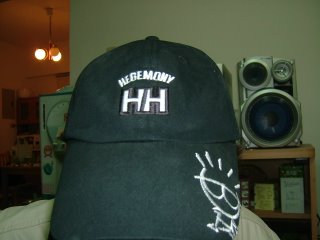
I get a strange feeling of power whenever I wear it. (Unfortunately, it didn't stop the guy in the SUV from almost running me over. Guess that's another example of the material world trumping language.)
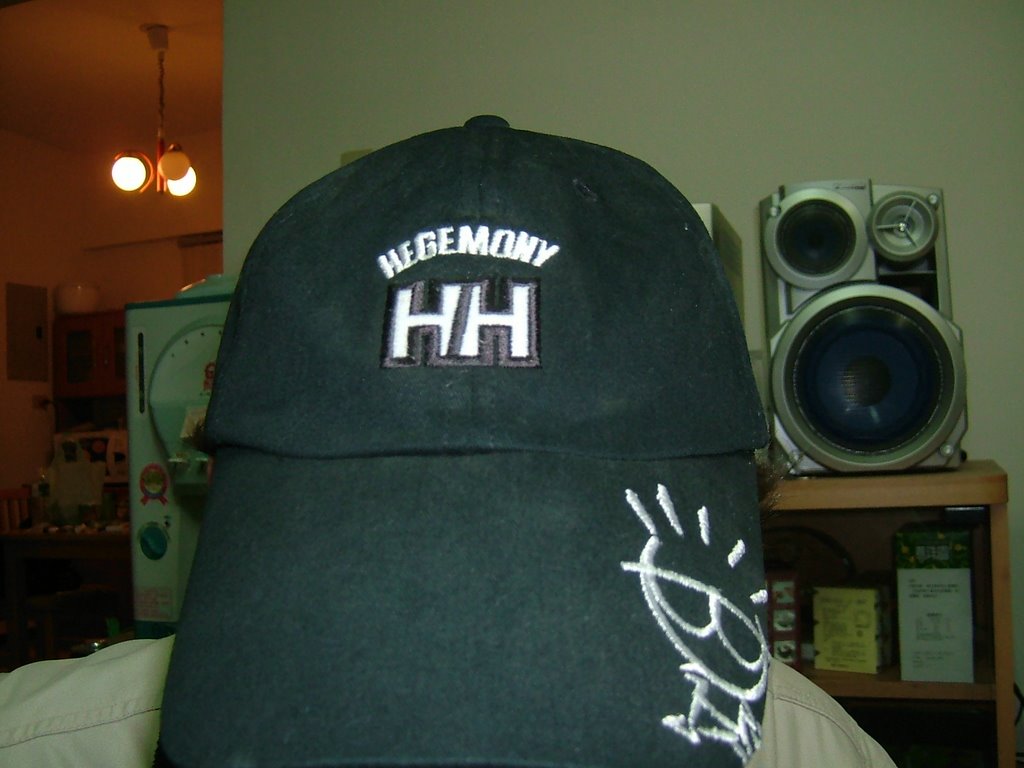
I get a strange feeling of power whenever I wear it. (Unfortunately, it didn't stop the guy in the SUV from almost running me over. Guess that's another example of the material world trumping language.)
Thursday, January 04, 2007
I'm starting off 2007 with this?!
We've been going to a certain restaurant in Taichung for a couple of years, and I always found amusing a sign that is stuck on the door of a stall in the men's restroom. It's in the stall where the "squatter" toilet is located. Well, this time I happened to have my camera with me, so I took a picture of the sign:
 Now I don't teach technical writing, but it would be interesting to do some usability testing on these instructions. (Would people think that they had to take off their shoes before "dropping"?...)
I had a little trouble getting a clear shot because the sign kept reflecting the light of the flash, so I tried a couple of times until I found that standing at an angle and using red-eye reduction made for a pretty clear picture.
It was at about this point that I also realized that if anyone had come into the restroom and seen multiple flashes coming from inside one of the stalls, I'd have had a bit of explaining to do... Guess I could have told them I was 閃電俠 (the Flash)...
(Remind me to get a picture of the other sign--the one that contains the words "Memento excrementi"*--some time.)
*Sounds like a great title for a blog, doesn't it?
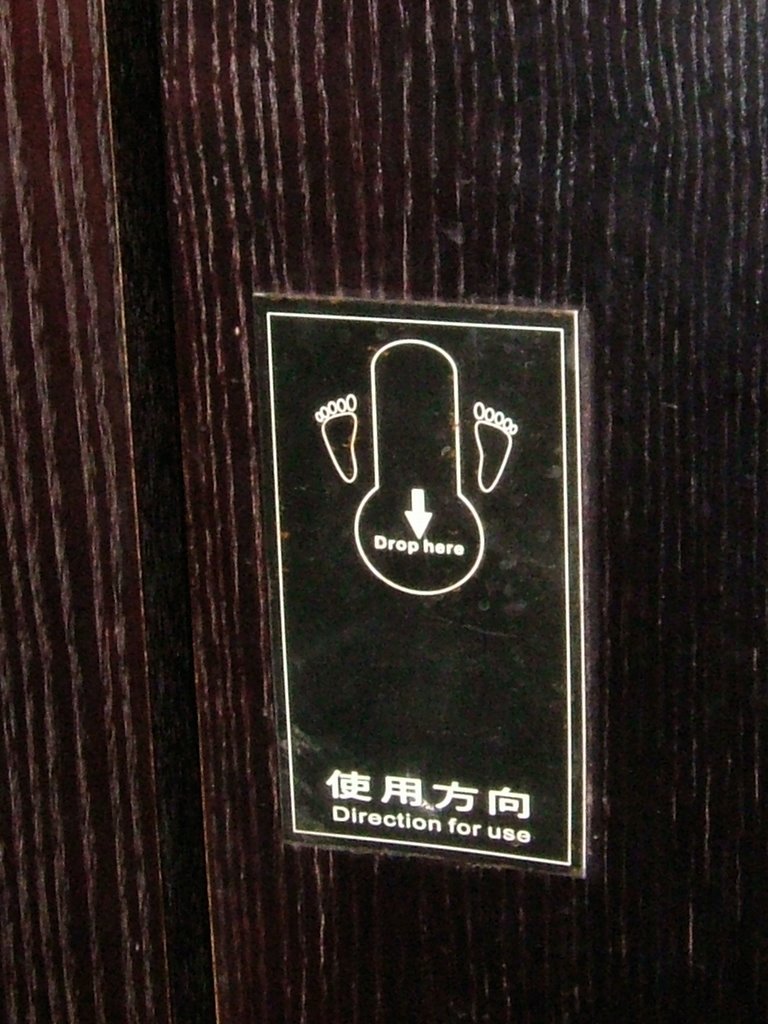 Now I don't teach technical writing, but it would be interesting to do some usability testing on these instructions. (Would people think that they had to take off their shoes before "dropping"?...)
I had a little trouble getting a clear shot because the sign kept reflecting the light of the flash, so I tried a couple of times until I found that standing at an angle and using red-eye reduction made for a pretty clear picture.
It was at about this point that I also realized that if anyone had come into the restroom and seen multiple flashes coming from inside one of the stalls, I'd have had a bit of explaining to do... Guess I could have told them I was 閃電俠 (the Flash)...
(Remind me to get a picture of the other sign--the one that contains the words "Memento excrementi"*--some time.)
*Sounds like a great title for a blog, doesn't it?
Saturday, December 30, 2006
Anniversary wandering around Dadu
One way that the former native speaker family likes to spend its wedding anniversary is by randomly driving around and looking at historical sites. (Actually, we don't need the excuse of a wedding anniversary to do this.) One year, when we were visiting my parents during winter vacation, we went to Shepherdstown, WV to eat lunch at a German restaurant, then found ourselves crossing the Potomac River into Sharpsburg and visiting Civil War battlefields. (Don't read too much into that particular way of spending a wedding anniversary.)
This year we were both working on our anniversary, so we saved the random driving for today. We started out searching for a new housing development we wanted to take a look at, but ended up taking a winding road down Dadushan and into the town of Dadu.
We drove around a little there. Then I saw a sign that said "Huangsi Academy" (磺溪書院) and we decided to drive there to take a look. It turned out that the Huangsi Academy ("Huangxi" in pinyin) is a "3rd class historical site" in Taiwan. I'm going to quote the English part of sign in front of the school (without correcting the grammar which, comparatively speaking, isn't that bad):
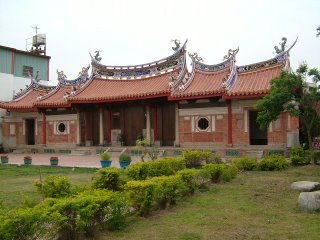 Huangsi School
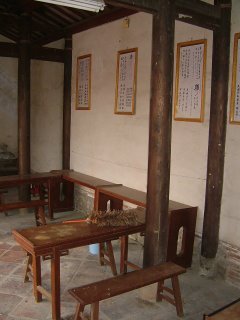 Lecture room
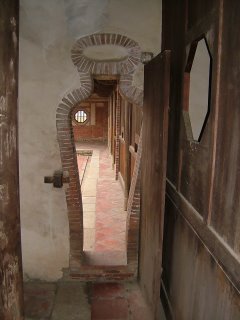 Vase-shaped door
 Ceramic adornments
 More ceramic adornments
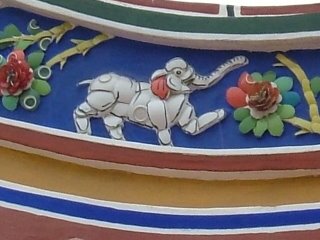 A ceramic elephant
The interesting thing about these ceramic adornments is, if you look carefully, you can see that they're actually bowls that have been broken, cut, and shaped into these decorations. (The former native Chinese speaker saw a TV show that described how this is done.)
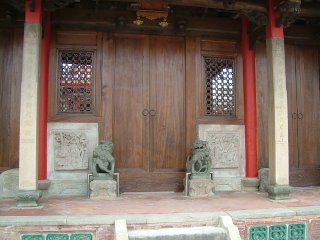 The main door to the temple
 A plaque that says "Huangsi School" but, for some reason, identifies the founding year as the twelfth year of the Guanxu Emperor's reign. Wonder who's right...
 Some of the carving they mentioned
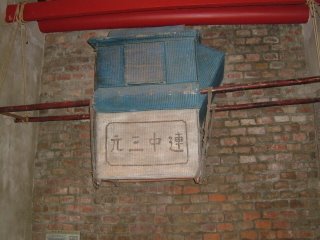 This last picture is a palanquin (轎子) used to carry someone who had passed the civil service examinations and become a jinshi (進士). The phrase on the side refers to someone who had come in in first place in all of the 3 levels of the civil service examinations.
The former native Chinese speaker is convinced that in a previous life, I was a "fragile scholar" (文弱書生) who probably died young of T.B. I don't know about that, but I'm hoping being near that palanquin will help me as a scholar... (*cough*)
[Update, 8/19/16: Here's a picture of a round portal in the temple, taken more recently by Alexander Synaptic.]
This year we were both working on our anniversary, so we saved the random driving for today. We started out searching for a new housing development we wanted to take a look at, but ended up taking a winding road down Dadushan and into the town of Dadu.
We drove around a little there. Then I saw a sign that said "Huangsi Academy" (磺溪書院) and we decided to drive there to take a look. It turned out that the Huangsi Academy ("Huangxi" in pinyin) is a "3rd class historical site" in Taiwan. I'm going to quote the English part of sign in front of the school (without correcting the grammar which, comparatively speaking, isn't that bad):
Huangsi School, commonly known as Wunchang Temple [文昌祠], was the culture and education center of the Dadu area in the past. During the fourth year of the reign of Emperor Jiacing [Jiaqing, 嘉慶] in the Cing [Qing, 清] Dynasty, (1799 A.D.), for the purpose of encouraging literacy, an aristocrat from Dadu, Jhao, Shun-Fang [趙順芳] and a Wurih aristocrat, Yang, Jhan-Ao [楊占鰲], cofounded Si Yong Society, later converted to Wunchang Temple. Later, Huangsi School was established on the site of Wunchang Temple in the thirteenth year of Emperor Guangsyu [Guangxu, 光緒] in the Cing Dynasty (1887 A.D.).Let me provide a few pictures of what they're talking about.
Huangsi School, positioned north faced south and leaned toward east, is a Chinese Quadrangle [四合院], with the width of seven rooms (seven Kaijian [開間]), two units of buildings (two Jin [進]), two wings of chambers (two Hulong [護龍]), a joint worship pavilion, and a grand front court. In the first unit, at the center of three Kaijian is the main gate, on which the swallowtail eaves cascade at the both sides, to allow the seven-Kaijian facade to spread evenly. The lecture room of three Kaijian situates at the second unit, where Wunchang God is worshiped at the center. Right in the front, a joint worship pavilian with eight-pillar and the Sieshan [歇山] style roof is decorated with characteristic eaves and vivid ceramic encrusted adornments. The passing corridors which spread two sides of the lecture room are connected to the dormitory at the wings. The exterior walls of the corridors are embellished with delicate brick carving. The architecture is vastly adorned with engraved brick carvings, from the wall panels, to the door and window frames, to the windowsills, to the semicircular-shaped dadoes, and to vase-shape corridor doors. These features make the architecture stand out from the rest in Taiwan during the Cing Dynasty.
November 27, 1985, Ministry of the Interior declared "Huang S Academy" a 3rd class national historical site.
Cultural Affairs Bureau, Taichung County
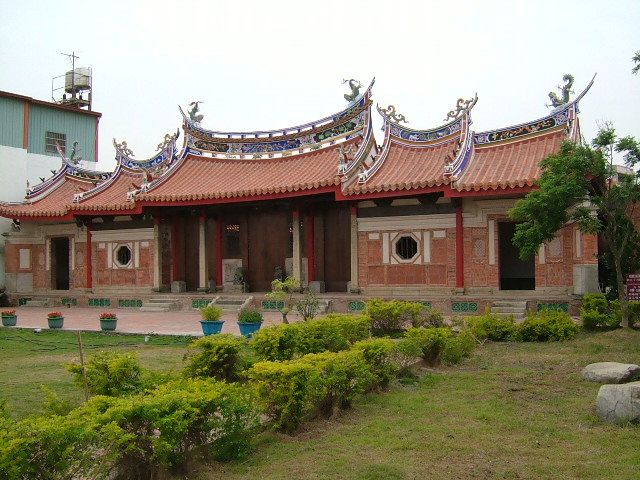 Huangsi School
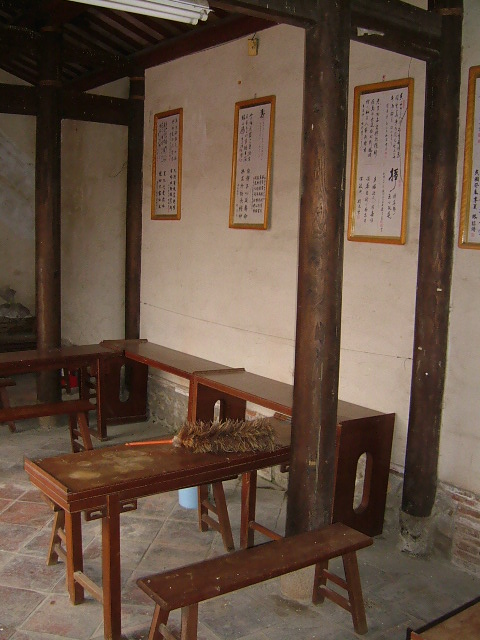 Lecture room
 Vase-shaped door
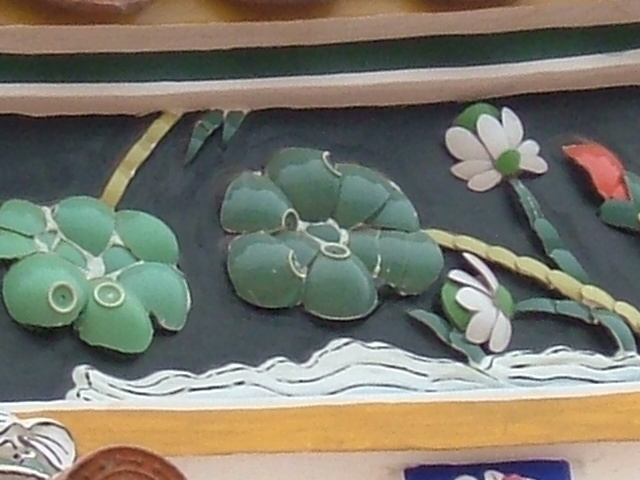 Ceramic adornments
 More ceramic adornments
 A ceramic elephant
 The main door to the temple
 A plaque that says "Huangsi School" but, for some reason, identifies the founding year as the twelfth year of the Guanxu Emperor's reign. Wonder who's right...
 Some of the carving they mentioned
 This last picture is a palanquin (轎子) used to carry someone who had passed the civil service examinations and become a jinshi (進士). The phrase on the side refers to someone who had come in in first place in all of the 3 levels of the civil service examinations.
The former native Chinese speaker is convinced that in a previous life, I was a "fragile scholar" (文弱書生) who probably died young of T.B. I don't know about that, but I'm hoping being near that palanquin will help me as a scholar... (*cough*)
[Update, 8/19/16: Here's a picture of a round portal in the temple, taken more recently by Alexander Synaptic.]
Tuesday, December 26, 2006
Movin' and shakin'
[Updated, 11:10 p.m] Not in relation to James Brown (r.i.p.). Just had a 'little' earthquake. About 3 or 4 tremors, actually. [As Amanda says, though, it wasn't that little down south! And I just heard on the news (11:00 p.m.) that it was the biggest in the Pingtung area in about 100 years.] Here's some basic information.
[Slightly sarcastic aside: The CNN article I linked to below is notable for being one of the few CNN articles about Taiwan that does not contain the line, "China considers Taiwan a renegade province." Where were their copy editors?]
[12/27/06 update] The BBC News' website notes that communications have been affected by last night's quake:
[Slightly sarcastic aside: The CNN article I linked to below is notable for being one of the few CNN articles about Taiwan that does not contain the line, "China considers Taiwan a renegade province." Where were their copy editors?]
[12/27/06 update] The BBC News' website notes that communications have been affected by last night's quake:
Taiwan's largest telephone company, Chunghwa Telecom Co, said damage to an undersea cable had disrupted 98% of Taiwan's communications with Malaysia, Singapore, Thailand and Hong Kong.And Mabel Liao writes in the comments (below) from "the center of the earthquake" in Hengchun, where she teaches. She says her school was closed today because of rockslides.
Son of Frankenscheduling
 We just got our schedules for the spring semester. Because this semester everyone so enjoyed the long weekend of Oct. 6-10 and the Saturday make-up on Oct. 14, it has been decided that we'll have not one, not two, not three, but FOUR make-up classes on the Saturdays of March 3, March 10, April 14, and June 9 (to make up for days off on Feb. 26, Feb. 27, April 6, and June 18, respectively). Joy joy joy.
The reasons for this are, first, to give people a longer winter break--beginning classes on March 1 rather than Feb. 26 (too bad I already bought my plane tickets). And April 6 is the day after Tomb-Sweeping Festival, so they had to give that Friday off. (But why make it up? What happened to Spring Break?) And then June 18 is the day before Dragon Boat Festival (a Tuesday), which is a day off.
So is this going to be a trend? Every semester we'll be getting these bizarre schedules? I've been around long enough to remember teaching on Saturdays, but at least it was a regular thing back then. Maybe we should just get rid of the 5-day week here and go back to the good old days...
Anybody else's schedule for spring looking like this, or are we the only ones?
Friday, December 22, 2006
Two (plus one) new books in the former native speaker's library
Just the facts:
- Colonial Development and Population in Taiwan, by George Barclay (Princeton UP, 1954)
- Unruly Examples: On the Rhetoric of Exemplarity, ed. Alexander Gelley (Stanford UP, 1995)
And from last time:
- Art and Answerability: Early Philosophical Essays, by M. M. Bakhtin (U of Texas P, 1990)
Thursday, December 21, 2006
Something Mei-mei would appreciate
Rosa Eberly at the Blogora asks,
[Update: I was thinking of what A Christmas Carol would sound like if Fred's greeting to his uncle were changed (apologies to the Ghost of Charles Dickens):
What is "joyous afterstool"??Well, Mei-mei always used to have joyous afterstools...
or, better
What do you have to say about "joyous afterstool"?
[Update: I was thinking of what A Christmas Carol would sound like if Fred's greeting to his uncle were changed (apologies to the Ghost of Charles Dickens):
And at this point, I think I'd better stop...]'A joyous afterstool, uncle! God save you!' cried a cheerful voice. It was the voice of Scrooge's nephew, who came upon him so quickly that this was the first intimation he had of his approach.
'Bah!' said Scrooge, 'Humbug!' ...
'Afterstool a humbug, uncle!' said Scrooge's nephew. 'You don't mean that, I am sure?'...
'Don't be cross, uncle.' said the nephew.
'What else can I be,' returned the uncle, 'when I live in such a world of fools as this? Joyous afterstool! ... If I could work my will,' said Scrooge indignantly,'every idiot who goes about with 'Joyous afterstool' on his lips, should be boiled with his own...'
Saturday, December 16, 2006
Another new book in the former native speaker's library
Today was a pretty miserable day--cold (by Taiwan standards), windy, and rainy. But the former native speaker family still had to venture out to Bookman Books on some "family business". ("Stella!"--well, got the right actor this time, at least.)
But before we get to the new book, I feel it my duty to post several photos that are only vaguely related to the content of this post, a la a certain other Taiwan blogger (his pictures are better than mine, though, I admit [as my aunt would say, he has a better camera {and I've got more parenthetical comments, so there!}]).
I've been trying for weeks to get a decent picture of the mountains east of Taichung from my Tunghai vantage point. The closest I came to accomplishing this was this morning around 9:00 when I took some pictures from the top floor and a stairwell in the new Humanities building.

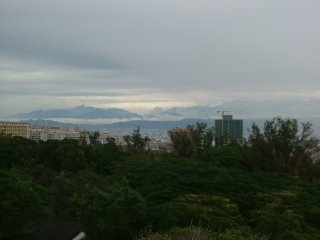 In this picture, you can see the "Central Park" luxury apartment building that is going up across from Tunghai on Taichung Harbor Rd.
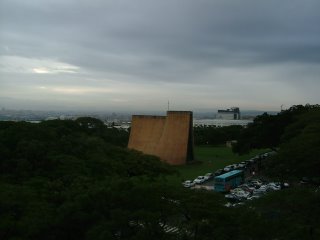
No photo-taking trip to Tunghai is complete without a shot of Luce Chapel:
And for lunch (actually these were taken last month):

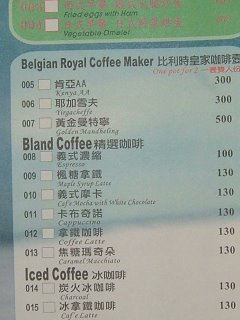
And would you like some bland coffee to go with something from the Snake bar?
Hmmm... seems like I'm forgetting something here. Anyway...
But before we get to the new book, I feel it my duty to post several photos that are only vaguely related to the content of this post, a la a certain other Taiwan blogger (his pictures are better than mine, though, I admit [as my aunt would say, he has a better camera {and I've got more parenthetical comments, so there!}]).
I've been trying for weeks to get a decent picture of the mountains east of Taichung from my Tunghai vantage point. The closest I came to accomplishing this was this morning around 9:00 when I took some pictures from the top floor and a stairwell in the new Humanities building.

 In this picture, you can see the "Central Park" luxury apartment building that is going up across from Tunghai on Taichung Harbor Rd.
No photo-taking trip to Tunghai is complete without a shot of Luce Chapel:

And for lunch (actually these were taken last month):

And would you like some bland coffee to go with something from the Snake bar?

Hmmm... seems like I'm forgetting something here. Anyway...
Friday, December 15, 2006
CFP: The Journal of Diplomatic Language
From the H-Rhetor list:
JOURNAL OF DIPLOMATIC LANGUAGE - CALL FOR PAPERSSounds interesting...
http://www.jdlonline.org/about.html
The study of diplomatic language lies at the crossroads of the social sciences--combining aspects of international relations, communication, linguistics, psychology, anthropology, history, law and political science. Its analysis employs methodologies, both qualitative and quantitative, that are rapidly evolving. The Journal of Diplomatic Language aims to provide an Internet-based forum for timely publication of academic-quality manuscripts that will foster development of more sophisticated conceptual frameworks and methodological techniques within this inherently interdisciplinary field.
We are currently inviting submissions from prospective authors, for the January 2007 issue, of relatively short conceptual papers that critically analyze some aspect of diplomatic language in a systematic and innovative manner. We are open to contributions spanning the entire range of topics relevant to studies of political language and diplomacy. Research reports or that cut across traditional disciplinary boundaries are especially encouraged. As with any refereed academic journal, submitted papers will be evaluated through a process of peer review on the basis of quality, theoretical importance, originality, relevance to a broad cross-disciplinary audience, and clarity of presentation. Papers may present results from completed research, as well as report on current research, with an emphasis on novel approaches, methods, ideas, and perspectives.
Please forward your papers to DrHaroldBashor [at] aol.com with a short biographical sketch and abstract/summary.
--------------------
Dr. Harold W. Bashor, Ph.D.
Editor-in-Chief
Monday, December 04, 2006
Good news...
You paid attention during 97% of high school!
85-100% You must be an autodidact, because American high schools don't get scores that high! Good show, old chap!
Do you deserve your high school diploma?
Create a Quiz
Now if only the nightmares would stop...
Local donut shop closes
The former native Chinese speaker and I drove by our nearest Waili's Donuts (on the corner of Chaoma and Liming Roads) this evening, only to find it closed down and the building for rent.
Hey, you saw the prediction first here--Clyde Warden, pastry prognisticator, predictor of Taiwan donuts futures wrote,
Hey, you saw the prediction first here--Clyde Warden, pastry prognisticator, predictor of Taiwan donuts futures wrote,
I tend to be with the sceptics on the future of any doughnut chain in Taiwan. Foods that are not core to chinese consumption tend to be very fadish, and doughnuts are a great example. Doughnuts are not at all new to Taiwan, and they are generally of medium popularity, but the market for the raised dough, which is very chewy, is not so large. Also, with so many breakfast shops/stands, is there a need for a breakfast chain? Can people take the time to sit down and eat in the morning (which is one of the big success markets for Mister donut in Japan. Lastly, local bread stores are so numerous and very competitive, soon people will feel there is nothing special, and the idea of paying a 60K NT$ rent a month and only selling doughnuts will be like the Scotch Tape store in Saturday Night Live (too narrow a product line).(Who says we don't track the important trends here?)
Saturday, December 02, 2006
Yet another name for the former native speaker
The latest in a series:
Yesterday we were in Carrefour (which, despite having a collection of kitchy Christmas decorations that rivals Wal-Mart's, still doesn't sell dirt cookies) when a cute little kid saw me, ran to his mother, and said, "英文人! 英文人!" (Roughly, "English language person.") His mom wasn't so cute, though: "Bah! Humbug!" she spat. "What's a 英文人? He's a 外國人!"* Way to stifle your kid's language play, Mom...
*OK, so she said it all in Chinese. Without the "Bah! Humbug!" part. Anyway...
Yesterday we were in Carrefour (which, despite having a collection of kitchy Christmas decorations that rivals Wal-Mart's, still doesn't sell dirt cookies) when a cute little kid saw me, ran to his mother, and said, "英文人! 英文人!" (Roughly, "English language person.") His mom wasn't so cute, though: "Bah! Humbug!" she spat. "What's a 英文人? He's a 外國人!"* Way to stifle your kid's language play, Mom...
*OK, so she said it all in Chinese. Without the "Bah! Humbug!" part. Anyway...
Poem on someone's birthday
(Before you criticize this, think of Rhymin' Hyman Pressman...)
Today is someone's birthday
But, you probably ask, whose?
In this poem I won't say
But I'll try to drop some clues.
When he counted his comic books on the hallway floor, he
Probably never counted on so quickly turning forty.
When he got his first glasses, which made him look kind of funny,
He didn't think that one day he'd be seeing twenty-twenty.
When he sat in his chair in the dorm and said, "Enter",
He didn't consider the day he'd be thirty and ten, or
When he went with my future sis-in-law on their first date, he
Probably didn't think about the date he'd be half-eighty.
He's now an XL but he's not that big a guy;
Now he fits just fine between XXXIX and XLI.
Today is someone's birthday
But, you probably ask, whose?
In this poem I won't say
But I'll try to drop some clues.
When he counted his comic books on the hallway floor, he
Probably never counted on so quickly turning forty.
When he got his first glasses, which made him look kind of funny,
He didn't think that one day he'd be seeing twenty-twenty.
When he sat in his chair in the dorm and said, "Enter",
He didn't consider the day he'd be thirty and ten, or
When he went with my future sis-in-law on their first date, he
Probably didn't think about the date he'd be half-eighty.
He's now an XL but he's not that big a guy;
Now he fits just fine between XXXIX and XLI.
Friday, November 24, 2006
Cross-cultural kinship terms
In Thursday's Intercultural Communication class, we discussed the different functions of language covered in our textbook. One part of the discussion that was particularly interesting to me was when we compared Chinese and English kinship terms and saw how the use of kinship terms in Chinese affects how English kinship terms are interpreted.
We found, for instance, that if I said, "My uncle is a farmer", students felt a need to specify in their minds whether that uncle was on my father's side or mother's side, and whether the uncle was older or younger than my parent. (Some students automatically thought in terms of a father's brother, but one student said she was closer to her mother's side of the family, so thought in terms of a mother's brother.) Students were also a bit surprised when I suggested that if I said the same sentence to a native speaker of English, that person might (but probably wouldn't) ask if I meant my father's or my mother's brother, and most likely wouldn't wonder about whether or not the uncle was older or younger than my parent.
The powerful role of kinship terms is also discussed in "The Cultural Connotations and Communicative Functions of Chinese Kinship Terms" (American Communication Journal 3.3 [2000]). Shaorong Huang and Wenshan Jia argue that there are three main communicative functions served by kinship terms in Chinese:
- They serve a "linking function," in that they serve as a way of connecting individuals to their social groups. Huang and Jia point out--as we did in class--that kinship terms are not just used among family members, but are also used to address non-family members.
- They serve a "mentation function"--meaning that they are involved in stimulating "the development of higher mental processes."
For instance, when a child addresses her maternal grandfather by the kinship term of [外祖父] "wai zu fu," she may at least understand, or try to understand, the following: 1) she has a family relation with the old man, but the old man does not live in her family; 2) as a senior member, the old man has certain power over her, and she must respect and obey him; and 3) comparing with her paternal grandfather, this man is less powerful and less strict with her behavior. The single kinship term works as a stimulus in the child's mind to help the child go through a complicated cognitive process.
- They serve a "regulatory function" because use of kinship terms "helps individuals regulate their personal behavior in speech communication."
I'm not sure I agree with everything they say in this article (for instance, they imply a uniqueness for the Chinese family system that I'm not sure about--our textbook suggests that Indian kinship terms are also quite complicated). But the points I cited above extend what we were discussing on Thursday about how kinship terms fit into both the naming and the interactional functions of language.
(cross-posted, with slight adjustments, to the ICC course blog)
Saturday, November 18, 2006
No. 7, Minquan Road, Lane 237?
Looks like Minquan Road, Lane 237 (民權路237巷) is now Dahe Road (大和路). Anyway, that's what the clerk at the check-in desk at the Yadian Commercial Hotel (雅典商務旅館) on 3 Dahe Rd. told us. (She was very helpful even though we didn't want a room.)
So from what we could gather, the Japanese-style house that used to be at No. 7 is now this:
(A parking lot, that is, not a car.) Oh well...
(Note to self: one of these days I ought to standardize my romanizations...)
So from what we could gather, the Japanese-style house that used to be at No. 7 is now this:

(A parking lot, that is, not a car.) Oh well...
(Note to self: one of these days I ought to standardize my romanizations...)
Tuesday, November 14, 2006
CFP: America's Asia, Asia's America
The 2007 Texas Tech Comparative Literature Symposium on "America's Asia, Asia's America"(via CFP list)
April 13-14, 2007 at Texas Tech University in Lubbock, Texas
Texas Tech University houses the largest Vietnam Archive in the United States, and West Texas has been home to thousands of Vietnamese/Asian Americans. Late spring in Lubbock is usually mild and sunny.
Keynote Speakers:
Sheldon Xiao-peng Lu, Comparative Literature Program, UC-Davis;
Rob Wilson, Department of Literature, UC-Santa Cruz;
Sau-ling Cynthia Wong, Asian American Studies Program, UC-Berkeley
Proposal Submission Deadline: January 12, 2007
With great progress in technological innovation and economic development in China, India, and other Asian countries in recent decades, the twenty-first century has increasingly been identified and envisioned as "the Asian-Pacific century" or "the Chinese century" in the global media. What political and cultural implications does this new construction of Asia generate? How will these revitalized Asian nation-states articulate their own desires and reposition themselves in the context of the U.S.-centered global order? How will the United States redefine itself in relation to the rise of this new Asia? What lessons has the United States drawn in its political, economic, cultural, and military encounters with these Asian nation-states since the late nineteenth century?
This symposium looks for papers that will engage these challenging questions and theorize their complexity and historicity in both the Asian and North American contexts. We not only welcome proposals that examine the construction of Asia in terms of space production and reconsider Asian America as a process of racial formation, but we also encourage projects that investigate ways in which information technology, trans-Pacific movements, as well as Asian language communication may impact the futures of both Asia and North America.
Possible topics may include but are not restricted to the following:
--Modernism and the Literary Representation of Asia
--The Cold War and the Cultural Imagination of Asia
--Cold War Legacy and National Division
--Cyberpunk Fiction and the Reinvention of Asia
--Orientalism Revisited
--Postcolonial Asian Literatures and Cultures
--Trash Aesthetics and the Hong Kong Kung Fu Cinema
--Sex, Violence, and Fantasy in the Japanese Manga and Anime
--From Hollywood to Bollywood
--Asians and Asian Americans in Hollywood Cinema and American Popular Culture
--Transnational Asian American Literature
--Globalization and Asian American Popular Culture
--Asian American Studies and Latino/a Studies
--Asian American Studies and African American Studies
--The Discourse of "Human Rights" and the Re-construction of Asia
--SARS, Avian Flu, and the New "Yellow Peril"
--Technology, Espionage, and Asian American Communities
--Blogging and New Asian Nationalisms
--Vietnam War Literature and Culture
--War, Empire, and the Global Market
Please send your one-page proposal and one-page C.V. by January 15, 2007:
Dr. Yuan Shu
Department of English
P.O. Box 43091
Texas Tech University
Lubbock, TX 79409-3091
You may email your inquiry, proposal, and C.V. to Dr. Yuan Shu at (yuan.shu [at] ttu.edu).
Yuan Shu
Associate Professor of English
Director of the Comparative Literature Program
Texas Tech University
Box 43091
Lubbock, TX 79409-3091
E-mail: yuan.shu [at] ttu.edu
V-mail: 806-742-2500x240
Fax: 806-742-0989
Monday, November 13, 2006
Number 7, Lane 237, Min-ch'uan Road
Ever since I bought Ellen Johnston Laing's Photographs of Taiwan During the 1960's, I've been interested in finding the area of Taichung where she lived when she was studying at Tunghai. She mentions having lived in "a pleasant Japanese-style house at number 7, Lane 237, Min-ch'uan Road" (28). This was as close as I could find to that address--I couldn't find a Lane 237 on the map. (Thanks to Kerim for the heads up about UrMap!) I can find a Lane 233 near the intersection of Minquan and Zhonggang Roads, but the next Minquan Road Lane xxx is Lane 359, near the Science Museum. So I guess Lane 237 got renamed or built over at some point. [Update, 11/17/06: I Googled 民權路237巷 and got some results for some companies on that lane, so I guess it still exists! Just doesn't show up on the map. Maybe it's too small. Off to check tomorrow... will bring my trusty camera.]
Monday, November 06, 2006
Did Chen mention Taiwanese independence in his speech?
Edward Cody of the Washington Post writes,
It doesn't surprise me that the Post would misrepresent Chen's speech in this way, though. As Tim mentioned, they got all bent out of shape over Chen's use of Taiwanese. (So did the other Post, which accused Chen of "ignor[ing] the foreign journalists and most TV audience to use mostly the southern Fujianese dialect (prevalent in a southern China district) to cater his remarks to his own supporters in southern Taiwan" (emphasis added). I think the words they use to describe Taiwanese are quite... ummm... interesting. They're really emphasizing the mainland-Chineseness of the Taiwanese language, aren't they? I'll agree, though, that Chen was speaking more to his supporters than to anyone else...)
Acknowledging the damage to his presidency and to the cause of Taiwanese independence from China, as well as the disappointment felt by many of his followers, Chen apologized both to the Democratic Progressive Party and to inhabitants of the self-ruled island in general. (emphasis added)Did I miss something? Did Chen mention the cause of Taiwanese independence from China in his speech? I can't find anything about it in this Chinese transcript, either.
It doesn't surprise me that the Post would misrepresent Chen's speech in this way, though. As Tim mentioned, they got all bent out of shape over Chen's use of Taiwanese. (So did the other Post, which accused Chen of "ignor[ing] the foreign journalists and most TV audience to use mostly the southern Fujianese dialect (prevalent in a southern China district) to cater his remarks to his own supporters in southern Taiwan" (emphasis added). I think the words they use to describe Taiwanese are quite... ummm... interesting. They're really emphasizing the mainland-Chineseness of the Taiwanese language, aren't they? I'll agree, though, that Chen was speaking more to his supporters than to anyone else...)
Wednesday, November 01, 2006
Tunghai turns 51; fns pressed into duty
[Corrected version] In less than 8 hours, I shall be celebrating Tunghai University's 51st year by engaging in the grand ritual of gripping a tennis ball with chopsticks, running 20 meters with them, then dropping the tennis ball into a bucket before passing the chopsticks on to another celebrant. You're not allowed to use your hands--if you drop the tennis ball, you have to pick it up with the chopsticks. When the department chair asked me to take part in this important event, I tried to tell him that I was not worthy, but it was to no avail.
And no, I am up at this hour not because I don't take such an august activity seriously... what would make you say that?
[Update, 11/3/06] Well, I survived the Sports Day activities. I ended up taking part in two events because there weren't enough faculty and staff from the College of Arts (where were you guys?). The first event is too hard to describe, but suffice it to say that Mr. Bean-like, I managed to trip my teammate during that activity...
On the other hand, I received praise from several people after the chopsticks-carrying-tennis-ball event. Unlike a lot of people, I didn't drop the tennis ball at all. (Of course, I was also probably the slowest tennis ball carrier in the event...)
And no, I am up at this hour not because I don't take such an august activity seriously... what would make you say that?
[Update, 11/3/06] Well, I survived the Sports Day activities. I ended up taking part in two events because there weren't enough faculty and staff from the College of Arts (where were you guys?). The first event is too hard to describe, but suffice it to say that Mr. Bean-like, I managed to trip my teammate during that activity...
On the other hand, I received praise from several people after the chopsticks-carrying-tennis-ball event. Unlike a lot of people, I didn't drop the tennis ball at all. (Of course, I was also probably the slowest tennis ball carrier in the event...)
Monday, October 30, 2006
"Formosa Betrayed"--the movie
Not exactly about the 228 Incident that is the focus of George Kerr's account, this upcoming feature film will tell the following story:
Formosa Betrayed is a feature film about the harassment, torture, and murder of Taiwanese-American activists during the 1980s. Inspired by a true story, the film centers on the murder of a Taiwanese-American professor at the University of Kansas. An American detective—who knows nothing about Taiwan—is assigned to the case. Through the investigation of the professor's murder, the detective begins to understand the complex nature of politics, identity, and power in Taiwan-U.S.-China relations.In his search for the murderer and his accomplices, the detective learns that there is a vast Chinese spy network within most major U.S. college campuses which focuses on the political and social activities of Chinese and Taiwanese-American students. The detective turns to the FBI for help, only to realize that the FBI is aware of this spy network but is unwilling to do anything about it in order to protect U.S. spies in Taiwan and elsewhere.
The detective's search for the murderer takes him across the Midwest onto other college campuses and Chinatowns, and finally to Taiwan, where he learns the real reason for the professor's murder—that the professor was an outspoken advocate of Taiwanese independence, and thus he threatened the legitimacy of Chiang Kai-Shek's government on Taiwan. The hit was sanctioned by those at the highest level of power.
The detective takes this information to the de facto U.S. Embassy in Taipei (American Institute of Taiwan), only to be rebuffed because the issue is "too sensitive" for U.S. foreign policy. He returns to the States, frustrated with his knowledge and lack of power to do anything about it—when he is invited to testify before the U.S. Congress in Washington D.C. and finally given the chance to declare the truth.
Will Tiao, a former intern for the Formosa Association for Public Affairs and founder of Formosa Films LLC, is the executive producer.
Thanks to Henk for the link!
Friday, October 27, 2006
Well, at least this goes with the Jane Austen quiz results...
...but I have to admit I'm getting a bit suspicious about the accuracy of these quizzes...
You scored as A classic novel. Almost everyone showers praise upon you for your depth and enduring relevance. According to your acolytes, everything you say is timeless, erudite and meaningful. Of course, none of them actually listens to you. Nobody listens to you at all, but it's fashionable to claim you as a friend. Fond of obscure words, antiquated notions and libraries, you never have a problem finding someone to hang out with. The fact that they end up using you to balance their kitchen tables is an unfortunate side effect, but you're used to being used for others' benefit. Oh the burden of being Great.
Your Literary Personality
created with QuizFarm.com
You scored as A classic novel. Almost everyone showers praise upon you for your depth and enduring relevance. According to your acolytes, everything you say is timeless, erudite and meaningful. Of course, none of them actually listens to you. Nobody listens to you at all, but it's fashionable to claim you as a friend. Fond of obscure words, antiquated notions and libraries, you never have a problem finding someone to hang out with. The fact that they end up using you to balance their kitchen tables is an unfortunate side effect, but you're used to being used for others' benefit. Oh the burden of being Great.
A college textbook | 57% | ||
A classic novel | 57% | ||
An electronics user's manual | 50% | ||
The back of a froot loops box | 46% | ||
A coloring book | 43% | ||
Poetry | 36% | ||
A paperback romance novel | 32% |
Your Literary Personality
created with QuizFarm.com
CFP: Writing Research Across Borders
(I'm posting these partly for my own convenience--it's easier for me to find them this way!)
Open Call for Proposals: Writing Research Across Borders
February 22-24, 2008
University of California Santa BarbaraProposal Deadline: May 1, 2007
Email: writing@education.ucsb.eduRecent decades have seen the growth of writing studies in many nations, focused on all levels of education, and all uses of writing in society, using the resources of many different disciplines. This increased research attention to writing reflects an increased recognition of the importance of writing in modern societies. Yet to a large extent the many emerging traditions of writing research have neither connected fully nor shared their work.
This conference brings together the many writing researchers from around the world, drawing on all disciplines, and focused on all aspects of writing at all levels of development and in all segments of society. This will be an opportunity to learn from different research traditions, share our findings, seek common agendas, and lay the groundwork for future communication and alliances.
As a first step to building this important conversation we have invited some of the leading writing researchers, who have already committed to participating.
We are now issuing an open call for proposals for panels, roundtables, individual presentations, and poster presentations addressing
* current research on writing,
* methodological issues
* reflections on ongoing research programs
* considerations of national or disciplinary trajectories of research
* agendas for further research
We anticipate a program of up to two hundred and fifty presentations.Proposals to present current research should specify research questions, methods, data corpus, and findings, as well as the scope and duration of the research project. Proposals to provide overviews of and reflections on research traditions and agendas should identify clearly the relevant literatures to be considered.
Proposals for individual and poster presentations should be from 250 to 500 words in length and panel and roundtable proposals, 500 to 1000 words. Please indicate your preferred format.
Proposals should be sent by May 1, 2007 via email to writing@education.ucsb.edu. Please include complete contact information.
CFP: Second-language writing in the Pacific Rim
Call for Proposals
Symposium on Second Language Writing 2007
Nagoya Gakuin University, Nagoya, Japan
September 15-17, 2007
2007 Theme: Second Language Writing in the Pacific Rim
We seek proposals for 20-minute presentations that address any aspect of second language writing theory, research, instruction, and assessment as well as teacher education and program administration. Any topic related to second language writing is welcome, but we particularly welcome proposals that address L2 writing issues in the Pacific Rim. We are interested in L2 writing issues in any language and at various levels of education--from emerging literacy to adult literacy education and development. We also encourage proposals that connect L2 writing with other related areas of inquiry, such as computer assisted instruction, corpus analysis, language testing, and world Englishes. We welcome proposals from around the Pacific Rim as well as from other parts of the world. Graduate students are also encouraged to submit proposals. (We do not have a separate graduate student conference this year.)
Each proposal should include: A) contact information for the corresponding author; B) presenter information, including name, institution, email, and 25-word bio statement; C) proposal information, including title, 50-word abstract for the program, and 250-word abstract for blind review; and D) any additional information, such as information about additional presenters. To submit a proposal, please use the online submission form available at:
http://sslw.jslw.org/2007/cfp.html
Proposals must be received by January 31, 2007.
Tony Silva and Paul Kei Matsuda, Chairs
Symposium on Second Language Writing
This looks interesting--and it's nearby... (But right now my research isn't about second-language writing, so I don't know if I'll propose anything...)
Subscribe to:
Posts (Atom)