- Collected Papers by George H. Kerr
- Correspondence by and about George H. Kerr (I)
- Correspondence by and about George H. Kerr (II)
Monday, January 08, 2007
Three books the former native speaker wishes were in his library, but is content (for now) to borrow from someone else's library
During an online search this past weekend for materials related to Vern Sneider's A Pail of Oysters, I came across a reference to some letters that he exchanged with George Kerr, author of Formosa Betrayed. Some images of those letters are available online via the National Repository of Cultural Heritage, but I also found out that the 228 Museum in Taipei published a 3-volume set related to Kerr:


Saturday, January 06, 2007
Didn't realize they were so healthy...
BBC News reports that Momofuku Ando, the Taiwan-born Japanese inventor of instant noodles and founder of Nissin Food Products, has died at the ripe old age of 96. Notable is the fact that, according to the BBC, Ando "often ate his company's instant noodles." Guess Nissin really produces "long-life noodles"...
Hegemony
It's windy this evening, so I wore my favorite baseball cap when I went out for a quick walk:
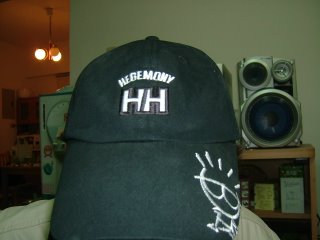
I get a strange feeling of power whenever I wear it. (Unfortunately, it didn't stop the guy in the SUV from almost running me over. Guess that's another example of the material world trumping language.)
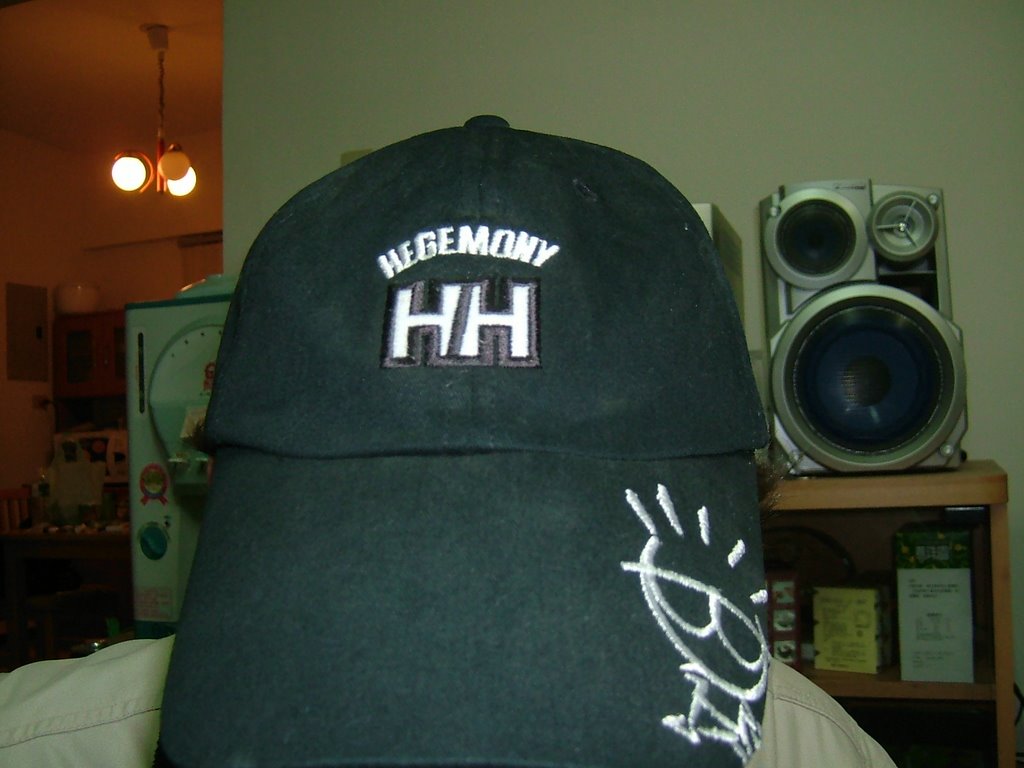
I get a strange feeling of power whenever I wear it. (Unfortunately, it didn't stop the guy in the SUV from almost running me over. Guess that's another example of the material world trumping language.)
Thursday, January 04, 2007
I'm starting off 2007 with this?!
We've been going to a certain restaurant in Taichung for a couple of years, and I always found amusing a sign that is stuck on the door of a stall in the men's restroom. It's in the stall where the "squatter" toilet is located. Well, this time I happened to have my camera with me, so I took a picture of the sign:
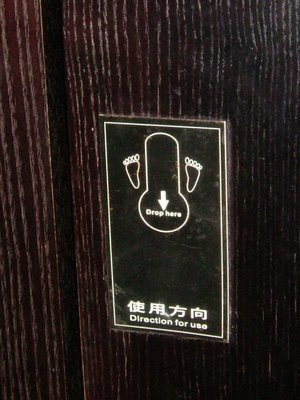 Now I don't teach technical writing, but it would be interesting to do some usability testing on these instructions. (Would people think that they had to take off their shoes before "dropping"?...)
I had a little trouble getting a clear shot because the sign kept reflecting the light of the flash, so I tried a couple of times until I found that standing at an angle and using red-eye reduction made for a pretty clear picture.
It was at about this point that I also realized that if anyone had come into the restroom and seen multiple flashes coming from inside one of the stalls, I'd have had a bit of explaining to do... Guess I could have told them I was 閃電俠 (the Flash)...
(Remind me to get a picture of the other sign--the one that contains the words "Memento excrementi"*--some time.)
*Sounds like a great title for a blog, doesn't it?
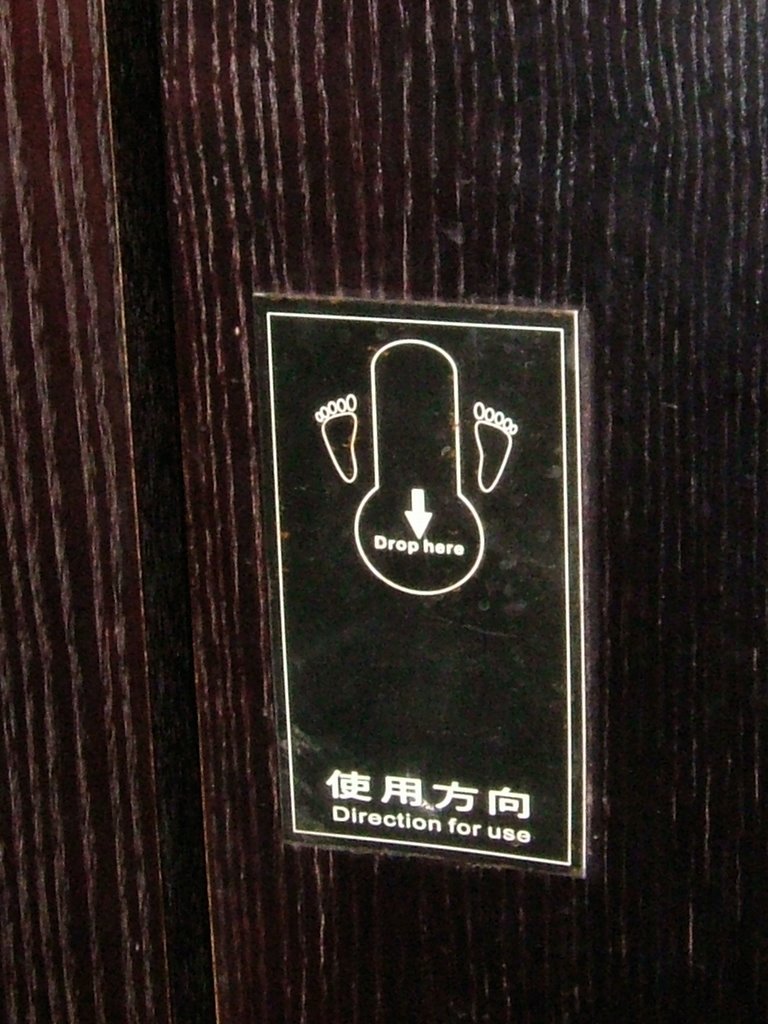 Now I don't teach technical writing, but it would be interesting to do some usability testing on these instructions. (Would people think that they had to take off their shoes before "dropping"?...)
I had a little trouble getting a clear shot because the sign kept reflecting the light of the flash, so I tried a couple of times until I found that standing at an angle and using red-eye reduction made for a pretty clear picture.
It was at about this point that I also realized that if anyone had come into the restroom and seen multiple flashes coming from inside one of the stalls, I'd have had a bit of explaining to do... Guess I could have told them I was 閃電俠 (the Flash)...
(Remind me to get a picture of the other sign--the one that contains the words "Memento excrementi"*--some time.)
*Sounds like a great title for a blog, doesn't it?
Saturday, December 30, 2006
Anniversary wandering around Dadu
One way that the former native speaker family likes to spend its wedding anniversary is by randomly driving around and looking at historical sites. (Actually, we don't need the excuse of a wedding anniversary to do this.) One year, when we were visiting my parents during winter vacation, we went to Shepherdstown, WV to eat lunch at a German restaurant, then found ourselves crossing the Potomac River into Sharpsburg and visiting Civil War battlefields. (Don't read too much into that particular way of spending a wedding anniversary.)
This year we were both working on our anniversary, so we saved the random driving for today. We started out searching for a new housing development we wanted to take a look at, but ended up taking a winding road down Dadushan and into the town of Dadu.
We drove around a little there. Then I saw a sign that said "Huangsi Academy" (磺溪書院) and we decided to drive there to take a look. It turned out that the Huangsi Academy ("Huangxi" in pinyin) is a "3rd class historical site" in Taiwan. I'm going to quote the English part of sign in front of the school (without correcting the grammar which, comparatively speaking, isn't that bad):
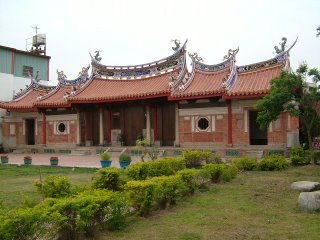 Huangsi School
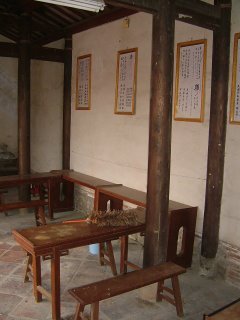 Lecture room
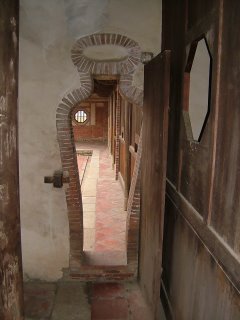 Vase-shaped door
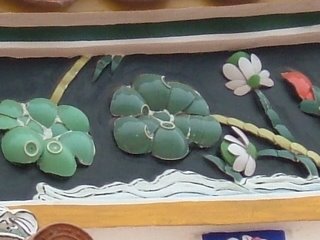 Ceramic adornments
 More ceramic adornments
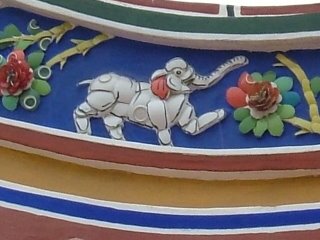 A ceramic elephant
The interesting thing about these ceramic adornments is, if you look carefully, you can see that they're actually bowls that have been broken, cut, and shaped into these decorations. (The former native Chinese speaker saw a TV show that described how this is done.)
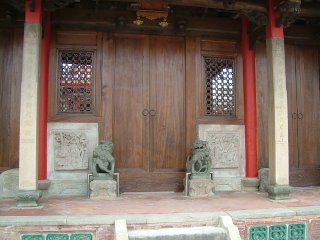 The main door to the temple
 A plaque that says "Huangsi School" but, for some reason, identifies the founding year as the twelfth year of the Guanxu Emperor's reign. Wonder who's right...
 Some of the carving they mentioned
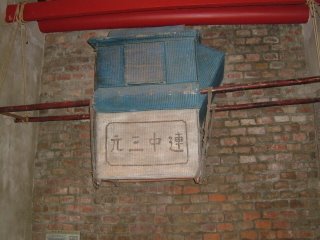 This last picture is a palanquin (轎子) used to carry someone who had passed the civil service examinations and become a jinshi (進士). The phrase on the side refers to someone who had come in in first place in all of the 3 levels of the civil service examinations.
The former native Chinese speaker is convinced that in a previous life, I was a "fragile scholar" (文弱書生) who probably died young of T.B. I don't know about that, but I'm hoping being near that palanquin will help me as a scholar... (*cough*)
[Update, 8/19/16: Here's a picture of a round portal in the temple, taken more recently by Alexander Synaptic.]
This year we were both working on our anniversary, so we saved the random driving for today. We started out searching for a new housing development we wanted to take a look at, but ended up taking a winding road down Dadushan and into the town of Dadu.
We drove around a little there. Then I saw a sign that said "Huangsi Academy" (磺溪書院) and we decided to drive there to take a look. It turned out that the Huangsi Academy ("Huangxi" in pinyin) is a "3rd class historical site" in Taiwan. I'm going to quote the English part of sign in front of the school (without correcting the grammar which, comparatively speaking, isn't that bad):
Huangsi School, commonly known as Wunchang Temple [文昌祠], was the culture and education center of the Dadu area in the past. During the fourth year of the reign of Emperor Jiacing [Jiaqing, 嘉慶] in the Cing [Qing, 清] Dynasty, (1799 A.D.), for the purpose of encouraging literacy, an aristocrat from Dadu, Jhao, Shun-Fang [趙順芳] and a Wurih aristocrat, Yang, Jhan-Ao [楊占鰲], cofounded Si Yong Society, later converted to Wunchang Temple. Later, Huangsi School was established on the site of Wunchang Temple in the thirteenth year of Emperor Guangsyu [Guangxu, 光緒] in the Cing Dynasty (1887 A.D.).Let me provide a few pictures of what they're talking about.
Huangsi School, positioned north faced south and leaned toward east, is a Chinese Quadrangle [四合院], with the width of seven rooms (seven Kaijian [開間]), two units of buildings (two Jin [進]), two wings of chambers (two Hulong [護龍]), a joint worship pavilion, and a grand front court. In the first unit, at the center of three Kaijian is the main gate, on which the swallowtail eaves cascade at the both sides, to allow the seven-Kaijian facade to spread evenly. The lecture room of three Kaijian situates at the second unit, where Wunchang God is worshiped at the center. Right in the front, a joint worship pavilian with eight-pillar and the Sieshan [歇山] style roof is decorated with characteristic eaves and vivid ceramic encrusted adornments. The passing corridors which spread two sides of the lecture room are connected to the dormitory at the wings. The exterior walls of the corridors are embellished with delicate brick carving. The architecture is vastly adorned with engraved brick carvings, from the wall panels, to the door and window frames, to the windowsills, to the semicircular-shaped dadoes, and to vase-shape corridor doors. These features make the architecture stand out from the rest in Taiwan during the Cing Dynasty.
November 27, 1985, Ministry of the Interior declared "Huang S Academy" a 3rd class national historical site.
Cultural Affairs Bureau, Taichung County
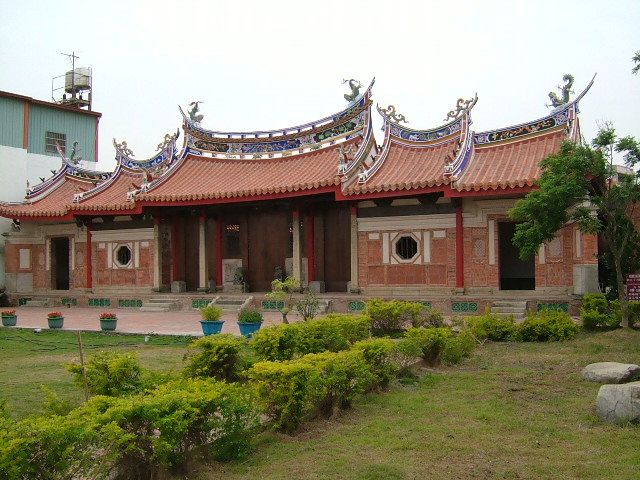 Huangsi School
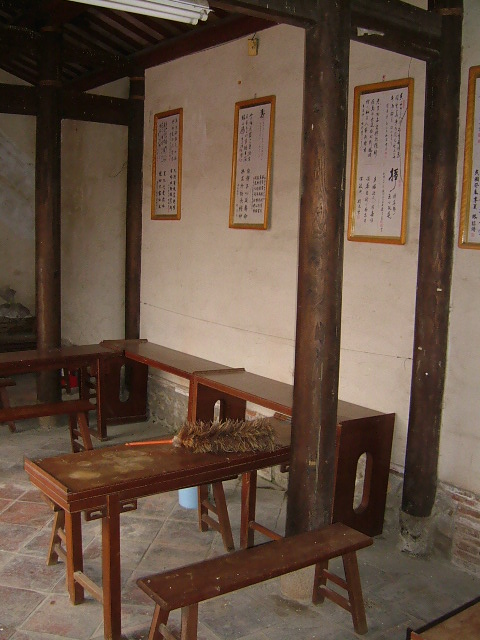 Lecture room
 Vase-shaped door
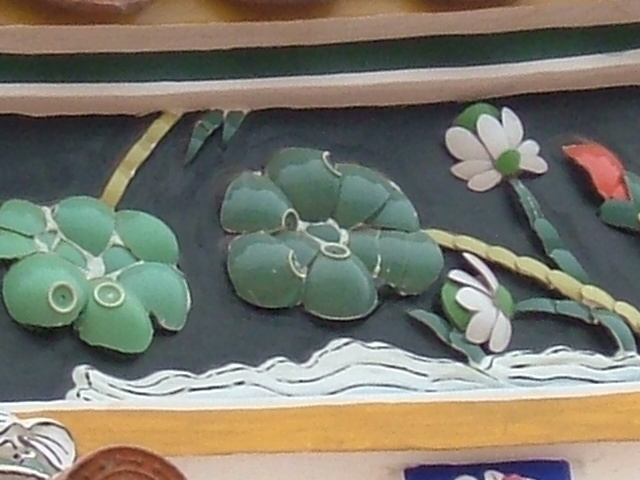 Ceramic adornments
 More ceramic adornments
 A ceramic elephant
 The main door to the temple
 A plaque that says "Huangsi School" but, for some reason, identifies the founding year as the twelfth year of the Guanxu Emperor's reign. Wonder who's right...
 Some of the carving they mentioned
 This last picture is a palanquin (轎子) used to carry someone who had passed the civil service examinations and become a jinshi (進士). The phrase on the side refers to someone who had come in in first place in all of the 3 levels of the civil service examinations.
The former native Chinese speaker is convinced that in a previous life, I was a "fragile scholar" (文弱書生) who probably died young of T.B. I don't know about that, but I'm hoping being near that palanquin will help me as a scholar... (*cough*)
[Update, 8/19/16: Here's a picture of a round portal in the temple, taken more recently by Alexander Synaptic.]
Tuesday, December 26, 2006
Movin' and shakin'
[Updated, 11:10 p.m] Not in relation to James Brown (r.i.p.). Just had a 'little' earthquake. About 3 or 4 tremors, actually. [As Amanda says, though, it wasn't that little down south! And I just heard on the news (11:00 p.m.) that it was the biggest in the Pingtung area in about 100 years.] Here's some basic information.
[Slightly sarcastic aside: The CNN article I linked to below is notable for being one of the few CNN articles about Taiwan that does not contain the line, "China considers Taiwan a renegade province." Where were their copy editors?]
[12/27/06 update] The BBC News' website notes that communications have been affected by last night's quake:
[Slightly sarcastic aside: The CNN article I linked to below is notable for being one of the few CNN articles about Taiwan that does not contain the line, "China considers Taiwan a renegade province." Where were their copy editors?]
[12/27/06 update] The BBC News' website notes that communications have been affected by last night's quake:
Taiwan's largest telephone company, Chunghwa Telecom Co, said damage to an undersea cable had disrupted 98% of Taiwan's communications with Malaysia, Singapore, Thailand and Hong Kong.And Mabel Liao writes in the comments (below) from "the center of the earthquake" in Hengchun, where she teaches. She says her school was closed today because of rockslides.
Son of Frankenscheduling
 We just got our schedules for the spring semester. Because this semester everyone so enjoyed the long weekend of Oct. 6-10 and the Saturday make-up on Oct. 14, it has been decided that we'll have not one, not two, not three, but FOUR make-up classes on the Saturdays of March 3, March 10, April 14, and June 9 (to make up for days off on Feb. 26, Feb. 27, April 6, and June 18, respectively). Joy joy joy.
The reasons for this are, first, to give people a longer winter break--beginning classes on March 1 rather than Feb. 26 (too bad I already bought my plane tickets). And April 6 is the day after Tomb-Sweeping Festival, so they had to give that Friday off. (But why make it up? What happened to Spring Break?) And then June 18 is the day before Dragon Boat Festival (a Tuesday), which is a day off.
So is this going to be a trend? Every semester we'll be getting these bizarre schedules? I've been around long enough to remember teaching on Saturdays, but at least it was a regular thing back then. Maybe we should just get rid of the 5-day week here and go back to the good old days...
Anybody else's schedule for spring looking like this, or are we the only ones?
Friday, December 22, 2006
Two (plus one) new books in the former native speaker's library
Just the facts:
- Colonial Development and Population in Taiwan, by George Barclay (Princeton UP, 1954)
- Unruly Examples: On the Rhetoric of Exemplarity, ed. Alexander Gelley (Stanford UP, 1995)
And from last time:
- Art and Answerability: Early Philosophical Essays, by M. M. Bakhtin (U of Texas P, 1990)
Thursday, December 21, 2006
Something Mei-mei would appreciate
Rosa Eberly at the Blogora asks,
[Update: I was thinking of what A Christmas Carol would sound like if Fred's greeting to his uncle were changed (apologies to the Ghost of Charles Dickens):
What is "joyous afterstool"??Well, Mei-mei always used to have joyous afterstools...
or, better
What do you have to say about "joyous afterstool"?
[Update: I was thinking of what A Christmas Carol would sound like if Fred's greeting to his uncle were changed (apologies to the Ghost of Charles Dickens):
And at this point, I think I'd better stop...]'A joyous afterstool, uncle! God save you!' cried a cheerful voice. It was the voice of Scrooge's nephew, who came upon him so quickly that this was the first intimation he had of his approach.
'Bah!' said Scrooge, 'Humbug!' ...
'Afterstool a humbug, uncle!' said Scrooge's nephew. 'You don't mean that, I am sure?'...
'Don't be cross, uncle.' said the nephew.
'What else can I be,' returned the uncle, 'when I live in such a world of fools as this? Joyous afterstool! ... If I could work my will,' said Scrooge indignantly,'every idiot who goes about with 'Joyous afterstool' on his lips, should be boiled with his own...'
Saturday, December 16, 2006
Another new book in the former native speaker's library
Today was a pretty miserable day--cold (by Taiwan standards), windy, and rainy. But the former native speaker family still had to venture out to Bookman Books on some "family business". ("Stella!"--well, got the right actor this time, at least.)
But before we get to the new book, I feel it my duty to post several photos that are only vaguely related to the content of this post, a la a certain other Taiwan blogger (his pictures are better than mine, though, I admit [as my aunt would say, he has a better camera {and I've got more parenthetical comments, so there!}]).
I've been trying for weeks to get a decent picture of the mountains east of Taichung from my Tunghai vantage point. The closest I came to accomplishing this was this morning around 9:00 when I took some pictures from the top floor and a stairwell in the new Humanities building.

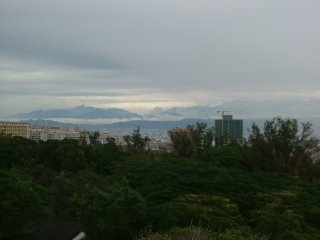 In this picture, you can see the "Central Park" luxury apartment building that is going up across from Tunghai on Taichung Harbor Rd.
No photo-taking trip to Tunghai is complete without a shot of Luce Chapel:
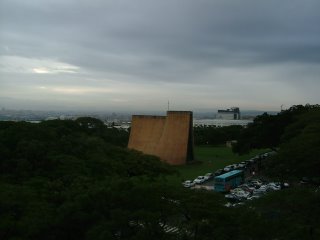
And for lunch (actually these were taken last month):

And would you like some bland coffee to go with something from the Snake bar?
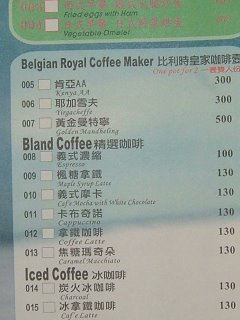
Hmmm... seems like I'm forgetting something here. Anyway...
But before we get to the new book, I feel it my duty to post several photos that are only vaguely related to the content of this post, a la a certain other Taiwan blogger (his pictures are better than mine, though, I admit [as my aunt would say, he has a better camera {and I've got more parenthetical comments, so there!}]).
I've been trying for weeks to get a decent picture of the mountains east of Taichung from my Tunghai vantage point. The closest I came to accomplishing this was this morning around 9:00 when I took some pictures from the top floor and a stairwell in the new Humanities building.

 In this picture, you can see the "Central Park" luxury apartment building that is going up across from Tunghai on Taichung Harbor Rd.
No photo-taking trip to Tunghai is complete without a shot of Luce Chapel:

And for lunch (actually these were taken last month):

And would you like some bland coffee to go with something from the Snake bar?

Hmmm... seems like I'm forgetting something here. Anyway...
Friday, December 15, 2006
CFP: The Journal of Diplomatic Language
From the H-Rhetor list:
JOURNAL OF DIPLOMATIC LANGUAGE - CALL FOR PAPERSSounds interesting...
http://www.jdlonline.org/about.html
The study of diplomatic language lies at the crossroads of the social sciences--combining aspects of international relations, communication, linguistics, psychology, anthropology, history, law and political science. Its analysis employs methodologies, both qualitative and quantitative, that are rapidly evolving. The Journal of Diplomatic Language aims to provide an Internet-based forum for timely publication of academic-quality manuscripts that will foster development of more sophisticated conceptual frameworks and methodological techniques within this inherently interdisciplinary field.
We are currently inviting submissions from prospective authors, for the January 2007 issue, of relatively short conceptual papers that critically analyze some aspect of diplomatic language in a systematic and innovative manner. We are open to contributions spanning the entire range of topics relevant to studies of political language and diplomacy. Research reports or that cut across traditional disciplinary boundaries are especially encouraged. As with any refereed academic journal, submitted papers will be evaluated through a process of peer review on the basis of quality, theoretical importance, originality, relevance to a broad cross-disciplinary audience, and clarity of presentation. Papers may present results from completed research, as well as report on current research, with an emphasis on novel approaches, methods, ideas, and perspectives.
Please forward your papers to DrHaroldBashor [at] aol.com with a short biographical sketch and abstract/summary.
--------------------
Dr. Harold W. Bashor, Ph.D.
Editor-in-Chief
Monday, December 04, 2006
Good news...
You paid attention during 97% of high school!
85-100% You must be an autodidact, because American high schools don't get scores that high! Good show, old chap!
Do you deserve your high school diploma?
Create a Quiz
Now if only the nightmares would stop...
Local donut shop closes
The former native Chinese speaker and I drove by our nearest Waili's Donuts (on the corner of Chaoma and Liming Roads) this evening, only to find it closed down and the building for rent.
Hey, you saw the prediction first here--Clyde Warden, pastry prognisticator, predictor of Taiwan donuts futures wrote,
Hey, you saw the prediction first here--Clyde Warden, pastry prognisticator, predictor of Taiwan donuts futures wrote,
I tend to be with the sceptics on the future of any doughnut chain in Taiwan. Foods that are not core to chinese consumption tend to be very fadish, and doughnuts are a great example. Doughnuts are not at all new to Taiwan, and they are generally of medium popularity, but the market for the raised dough, which is very chewy, is not so large. Also, with so many breakfast shops/stands, is there a need for a breakfast chain? Can people take the time to sit down and eat in the morning (which is one of the big success markets for Mister donut in Japan. Lastly, local bread stores are so numerous and very competitive, soon people will feel there is nothing special, and the idea of paying a 60K NT$ rent a month and only selling doughnuts will be like the Scotch Tape store in Saturday Night Live (too narrow a product line).(Who says we don't track the important trends here?)
Saturday, December 02, 2006
Yet another name for the former native speaker
The latest in a series:
Yesterday we were in Carrefour (which, despite having a collection of kitchy Christmas decorations that rivals Wal-Mart's, still doesn't sell dirt cookies) when a cute little kid saw me, ran to his mother, and said, "英文人! 英文人!" (Roughly, "English language person.") His mom wasn't so cute, though: "Bah! Humbug!" she spat. "What's a 英文人? He's a 外國人!"* Way to stifle your kid's language play, Mom...
*OK, so she said it all in Chinese. Without the "Bah! Humbug!" part. Anyway...
Yesterday we were in Carrefour (which, despite having a collection of kitchy Christmas decorations that rivals Wal-Mart's, still doesn't sell dirt cookies) when a cute little kid saw me, ran to his mother, and said, "英文人! 英文人!" (Roughly, "English language person.") His mom wasn't so cute, though: "Bah! Humbug!" she spat. "What's a 英文人? He's a 外國人!"* Way to stifle your kid's language play, Mom...
*OK, so she said it all in Chinese. Without the "Bah! Humbug!" part. Anyway...
Poem on someone's birthday
(Before you criticize this, think of Rhymin' Hyman Pressman...)
Today is someone's birthday
But, you probably ask, whose?
In this poem I won't say
But I'll try to drop some clues.
When he counted his comic books on the hallway floor, he
Probably never counted on so quickly turning forty.
When he got his first glasses, which made him look kind of funny,
He didn't think that one day he'd be seeing twenty-twenty.
When he sat in his chair in the dorm and said, "Enter",
He didn't consider the day he'd be thirty and ten, or
When he went with my future sis-in-law on their first date, he
Probably didn't think about the date he'd be half-eighty.
He's now an XL but he's not that big a guy;
Now he fits just fine between XXXIX and XLI.
Today is someone's birthday
But, you probably ask, whose?
In this poem I won't say
But I'll try to drop some clues.
When he counted his comic books on the hallway floor, he
Probably never counted on so quickly turning forty.
When he got his first glasses, which made him look kind of funny,
He didn't think that one day he'd be seeing twenty-twenty.
When he sat in his chair in the dorm and said, "Enter",
He didn't consider the day he'd be thirty and ten, or
When he went with my future sis-in-law on their first date, he
Probably didn't think about the date he'd be half-eighty.
He's now an XL but he's not that big a guy;
Now he fits just fine between XXXIX and XLI.
Friday, November 24, 2006
Cross-cultural kinship terms
In Thursday's Intercultural Communication class, we discussed the different functions of language covered in our textbook. One part of the discussion that was particularly interesting to me was when we compared Chinese and English kinship terms and saw how the use of kinship terms in Chinese affects how English kinship terms are interpreted.
We found, for instance, that if I said, "My uncle is a farmer", students felt a need to specify in their minds whether that uncle was on my father's side or mother's side, and whether the uncle was older or younger than my parent. (Some students automatically thought in terms of a father's brother, but one student said she was closer to her mother's side of the family, so thought in terms of a mother's brother.) Students were also a bit surprised when I suggested that if I said the same sentence to a native speaker of English, that person might (but probably wouldn't) ask if I meant my father's or my mother's brother, and most likely wouldn't wonder about whether or not the uncle was older or younger than my parent.
The powerful role of kinship terms is also discussed in "The Cultural Connotations and Communicative Functions of Chinese Kinship Terms" (American Communication Journal 3.3 [2000]). Shaorong Huang and Wenshan Jia argue that there are three main communicative functions served by kinship terms in Chinese:
- They serve a "linking function," in that they serve as a way of connecting individuals to their social groups. Huang and Jia point out--as we did in class--that kinship terms are not just used among family members, but are also used to address non-family members.
- They serve a "mentation function"--meaning that they are involved in stimulating "the development of higher mental processes."
For instance, when a child addresses her maternal grandfather by the kinship term of [外祖父] "wai zu fu," she may at least understand, or try to understand, the following: 1) she has a family relation with the old man, but the old man does not live in her family; 2) as a senior member, the old man has certain power over her, and she must respect and obey him; and 3) comparing with her paternal grandfather, this man is less powerful and less strict with her behavior. The single kinship term works as a stimulus in the child's mind to help the child go through a complicated cognitive process.
- They serve a "regulatory function" because use of kinship terms "helps individuals regulate their personal behavior in speech communication."
I'm not sure I agree with everything they say in this article (for instance, they imply a uniqueness for the Chinese family system that I'm not sure about--our textbook suggests that Indian kinship terms are also quite complicated). But the points I cited above extend what we were discussing on Thursday about how kinship terms fit into both the naming and the interactional functions of language.
(cross-posted, with slight adjustments, to the ICC course blog)
Saturday, November 18, 2006
No. 7, Minquan Road, Lane 237?
Looks like Minquan Road, Lane 237 (民權路237巷) is now Dahe Road (大和路). Anyway, that's what the clerk at the check-in desk at the Yadian Commercial Hotel (雅典商務旅館) on 3 Dahe Rd. told us. (She was very helpful even though we didn't want a room.)
So from what we could gather, the Japanese-style house that used to be at No. 7 is now this:
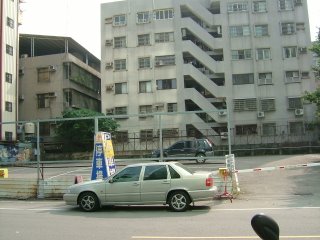
(A parking lot, that is, not a car.) Oh well...
(Note to self: one of these days I ought to standardize my romanizations...)
So from what we could gather, the Japanese-style house that used to be at No. 7 is now this:

(A parking lot, that is, not a car.) Oh well...
(Note to self: one of these days I ought to standardize my romanizations...)
Tuesday, November 14, 2006
CFP: America's Asia, Asia's America
The 2007 Texas Tech Comparative Literature Symposium on "America's Asia, Asia's America"(via CFP list)
April 13-14, 2007 at Texas Tech University in Lubbock, Texas
Texas Tech University houses the largest Vietnam Archive in the United States, and West Texas has been home to thousands of Vietnamese/Asian Americans. Late spring in Lubbock is usually mild and sunny.
Keynote Speakers:
Sheldon Xiao-peng Lu, Comparative Literature Program, UC-Davis;
Rob Wilson, Department of Literature, UC-Santa Cruz;
Sau-ling Cynthia Wong, Asian American Studies Program, UC-Berkeley
Proposal Submission Deadline: January 12, 2007
With great progress in technological innovation and economic development in China, India, and other Asian countries in recent decades, the twenty-first century has increasingly been identified and envisioned as "the Asian-Pacific century" or "the Chinese century" in the global media. What political and cultural implications does this new construction of Asia generate? How will these revitalized Asian nation-states articulate their own desires and reposition themselves in the context of the U.S.-centered global order? How will the United States redefine itself in relation to the rise of this new Asia? What lessons has the United States drawn in its political, economic, cultural, and military encounters with these Asian nation-states since the late nineteenth century?
This symposium looks for papers that will engage these challenging questions and theorize their complexity and historicity in both the Asian and North American contexts. We not only welcome proposals that examine the construction of Asia in terms of space production and reconsider Asian America as a process of racial formation, but we also encourage projects that investigate ways in which information technology, trans-Pacific movements, as well as Asian language communication may impact the futures of both Asia and North America.
Possible topics may include but are not restricted to the following:
--Modernism and the Literary Representation of Asia
--The Cold War and the Cultural Imagination of Asia
--Cold War Legacy and National Division
--Cyberpunk Fiction and the Reinvention of Asia
--Orientalism Revisited
--Postcolonial Asian Literatures and Cultures
--Trash Aesthetics and the Hong Kong Kung Fu Cinema
--Sex, Violence, and Fantasy in the Japanese Manga and Anime
--From Hollywood to Bollywood
--Asians and Asian Americans in Hollywood Cinema and American Popular Culture
--Transnational Asian American Literature
--Globalization and Asian American Popular Culture
--Asian American Studies and Latino/a Studies
--Asian American Studies and African American Studies
--The Discourse of "Human Rights" and the Re-construction of Asia
--SARS, Avian Flu, and the New "Yellow Peril"
--Technology, Espionage, and Asian American Communities
--Blogging and New Asian Nationalisms
--Vietnam War Literature and Culture
--War, Empire, and the Global Market
Please send your one-page proposal and one-page C.V. by January 15, 2007:
Dr. Yuan Shu
Department of English
P.O. Box 43091
Texas Tech University
Lubbock, TX 79409-3091
You may email your inquiry, proposal, and C.V. to Dr. Yuan Shu at (yuan.shu [at] ttu.edu).
Yuan Shu
Associate Professor of English
Director of the Comparative Literature Program
Texas Tech University
Box 43091
Lubbock, TX 79409-3091
E-mail: yuan.shu [at] ttu.edu
V-mail: 806-742-2500x240
Fax: 806-742-0989
Monday, November 13, 2006
Number 7, Lane 237, Min-ch'uan Road
Ever since I bought Ellen Johnston Laing's Photographs of Taiwan During the 1960's, I've been interested in finding the area of Taichung where she lived when she was studying at Tunghai. She mentions having lived in "a pleasant Japanese-style house at number 7, Lane 237, Min-ch'uan Road" (28). This was as close as I could find to that address--I couldn't find a Lane 237 on the map. (Thanks to Kerim for the heads up about UrMap!) I can find a Lane 233 near the intersection of Minquan and Zhonggang Roads, but the next Minquan Road Lane xxx is Lane 359, near the Science Museum. So I guess Lane 237 got renamed or built over at some point. [Update, 11/17/06: I Googled 民權路237巷 and got some results for some companies on that lane, so I guess it still exists! Just doesn't show up on the map. Maybe it's too small. Off to check tomorrow... will bring my trusty camera.]
Monday, November 06, 2006
Did Chen mention Taiwanese independence in his speech?
Edward Cody of the Washington Post writes,
It doesn't surprise me that the Post would misrepresent Chen's speech in this way, though. As Tim mentioned, they got all bent out of shape over Chen's use of Taiwanese. (So did the other Post, which accused Chen of "ignor[ing] the foreign journalists and most TV audience to use mostly the southern Fujianese dialect (prevalent in a southern China district) to cater his remarks to his own supporters in southern Taiwan" (emphasis added). I think the words they use to describe Taiwanese are quite... ummm... interesting. They're really emphasizing the mainland-Chineseness of the Taiwanese language, aren't they? I'll agree, though, that Chen was speaking more to his supporters than to anyone else...)
Acknowledging the damage to his presidency and to the cause of Taiwanese independence from China, as well as the disappointment felt by many of his followers, Chen apologized both to the Democratic Progressive Party and to inhabitants of the self-ruled island in general. (emphasis added)Did I miss something? Did Chen mention the cause of Taiwanese independence from China in his speech? I can't find anything about it in this Chinese transcript, either.
It doesn't surprise me that the Post would misrepresent Chen's speech in this way, though. As Tim mentioned, they got all bent out of shape over Chen's use of Taiwanese. (So did the other Post, which accused Chen of "ignor[ing] the foreign journalists and most TV audience to use mostly the southern Fujianese dialect (prevalent in a southern China district) to cater his remarks to his own supporters in southern Taiwan" (emphasis added). I think the words they use to describe Taiwanese are quite... ummm... interesting. They're really emphasizing the mainland-Chineseness of the Taiwanese language, aren't they? I'll agree, though, that Chen was speaking more to his supporters than to anyone else...)
Wednesday, November 01, 2006
Tunghai turns 51; fns pressed into duty
[Corrected version] In less than 8 hours, I shall be celebrating Tunghai University's 51st year by engaging in the grand ritual of gripping a tennis ball with chopsticks, running 20 meters with them, then dropping the tennis ball into a bucket before passing the chopsticks on to another celebrant. You're not allowed to use your hands--if you drop the tennis ball, you have to pick it up with the chopsticks. When the department chair asked me to take part in this important event, I tried to tell him that I was not worthy, but it was to no avail.
And no, I am up at this hour not because I don't take such an august activity seriously... what would make you say that?
[Update, 11/3/06] Well, I survived the Sports Day activities. I ended up taking part in two events because there weren't enough faculty and staff from the College of Arts (where were you guys?). The first event is too hard to describe, but suffice it to say that Mr. Bean-like, I managed to trip my teammate during that activity...
On the other hand, I received praise from several people after the chopsticks-carrying-tennis-ball event. Unlike a lot of people, I didn't drop the tennis ball at all. (Of course, I was also probably the slowest tennis ball carrier in the event...)
And no, I am up at this hour not because I don't take such an august activity seriously... what would make you say that?
[Update, 11/3/06] Well, I survived the Sports Day activities. I ended up taking part in two events because there weren't enough faculty and staff from the College of Arts (where were you guys?). The first event is too hard to describe, but suffice it to say that Mr. Bean-like, I managed to trip my teammate during that activity...
On the other hand, I received praise from several people after the chopsticks-carrying-tennis-ball event. Unlike a lot of people, I didn't drop the tennis ball at all. (Of course, I was also probably the slowest tennis ball carrier in the event...)
Monday, October 30, 2006
"Formosa Betrayed"--the movie
Not exactly about the 228 Incident that is the focus of George Kerr's account, this upcoming feature film will tell the following story:
Formosa Betrayed is a feature film about the harassment, torture, and murder of Taiwanese-American activists during the 1980s. Inspired by a true story, the film centers on the murder of a Taiwanese-American professor at the University of Kansas. An American detective—who knows nothing about Taiwan—is assigned to the case. Through the investigation of the professor's murder, the detective begins to understand the complex nature of politics, identity, and power in Taiwan-U.S.-China relations.In his search for the murderer and his accomplices, the detective learns that there is a vast Chinese spy network within most major U.S. college campuses which focuses on the political and social activities of Chinese and Taiwanese-American students. The detective turns to the FBI for help, only to realize that the FBI is aware of this spy network but is unwilling to do anything about it in order to protect U.S. spies in Taiwan and elsewhere.
The detective's search for the murderer takes him across the Midwest onto other college campuses and Chinatowns, and finally to Taiwan, where he learns the real reason for the professor's murder—that the professor was an outspoken advocate of Taiwanese independence, and thus he threatened the legitimacy of Chiang Kai-Shek's government on Taiwan. The hit was sanctioned by those at the highest level of power.
The detective takes this information to the de facto U.S. Embassy in Taipei (American Institute of Taiwan), only to be rebuffed because the issue is "too sensitive" for U.S. foreign policy. He returns to the States, frustrated with his knowledge and lack of power to do anything about it—when he is invited to testify before the U.S. Congress in Washington D.C. and finally given the chance to declare the truth.
Will Tiao, a former intern for the Formosa Association for Public Affairs and founder of Formosa Films LLC, is the executive producer.
Thanks to Henk for the link!
Friday, October 27, 2006
Well, at least this goes with the Jane Austen quiz results...
...but I have to admit I'm getting a bit suspicious about the accuracy of these quizzes...
You scored as A classic novel. Almost everyone showers praise upon you for your depth and enduring relevance. According to your acolytes, everything you say is timeless, erudite and meaningful. Of course, none of them actually listens to you. Nobody listens to you at all, but it's fashionable to claim you as a friend. Fond of obscure words, antiquated notions and libraries, you never have a problem finding someone to hang out with. The fact that they end up using you to balance their kitchen tables is an unfortunate side effect, but you're used to being used for others' benefit. Oh the burden of being Great.
Your Literary Personality
created with QuizFarm.com
You scored as A classic novel. Almost everyone showers praise upon you for your depth and enduring relevance. According to your acolytes, everything you say is timeless, erudite and meaningful. Of course, none of them actually listens to you. Nobody listens to you at all, but it's fashionable to claim you as a friend. Fond of obscure words, antiquated notions and libraries, you never have a problem finding someone to hang out with. The fact that they end up using you to balance their kitchen tables is an unfortunate side effect, but you're used to being used for others' benefit. Oh the burden of being Great.
A college textbook | 57% | ||
A classic novel | 57% | ||
An electronics user's manual | 50% | ||
The back of a froot loops box | 46% | ||
A coloring book | 43% | ||
Poetry | 36% | ||
A paperback romance novel | 32% |
Your Literary Personality
created with QuizFarm.com
CFP: Writing Research Across Borders
(I'm posting these partly for my own convenience--it's easier for me to find them this way!)
Open Call for Proposals: Writing Research Across Borders
February 22-24, 2008
University of California Santa BarbaraProposal Deadline: May 1, 2007
Email: writing@education.ucsb.eduRecent decades have seen the growth of writing studies in many nations, focused on all levels of education, and all uses of writing in society, using the resources of many different disciplines. This increased research attention to writing reflects an increased recognition of the importance of writing in modern societies. Yet to a large extent the many emerging traditions of writing research have neither connected fully nor shared their work.
This conference brings together the many writing researchers from around the world, drawing on all disciplines, and focused on all aspects of writing at all levels of development and in all segments of society. This will be an opportunity to learn from different research traditions, share our findings, seek common agendas, and lay the groundwork for future communication and alliances.
As a first step to building this important conversation we have invited some of the leading writing researchers, who have already committed to participating.
We are now issuing an open call for proposals for panels, roundtables, individual presentations, and poster presentations addressing
* current research on writing,
* methodological issues
* reflections on ongoing research programs
* considerations of national or disciplinary trajectories of research
* agendas for further research
We anticipate a program of up to two hundred and fifty presentations.Proposals to present current research should specify research questions, methods, data corpus, and findings, as well as the scope and duration of the research project. Proposals to provide overviews of and reflections on research traditions and agendas should identify clearly the relevant literatures to be considered.
Proposals for individual and poster presentations should be from 250 to 500 words in length and panel and roundtable proposals, 500 to 1000 words. Please indicate your preferred format.
Proposals should be sent by May 1, 2007 via email to writing@education.ucsb.edu. Please include complete contact information.
CFP: Second-language writing in the Pacific Rim
Call for Proposals
Symposium on Second Language Writing 2007
Nagoya Gakuin University, Nagoya, Japan
September 15-17, 2007
2007 Theme: Second Language Writing in the Pacific Rim
We seek proposals for 20-minute presentations that address any aspect of second language writing theory, research, instruction, and assessment as well as teacher education and program administration. Any topic related to second language writing is welcome, but we particularly welcome proposals that address L2 writing issues in the Pacific Rim. We are interested in L2 writing issues in any language and at various levels of education--from emerging literacy to adult literacy education and development. We also encourage proposals that connect L2 writing with other related areas of inquiry, such as computer assisted instruction, corpus analysis, language testing, and world Englishes. We welcome proposals from around the Pacific Rim as well as from other parts of the world. Graduate students are also encouraged to submit proposals. (We do not have a separate graduate student conference this year.)
Each proposal should include: A) contact information for the corresponding author; B) presenter information, including name, institution, email, and 25-word bio statement; C) proposal information, including title, 50-word abstract for the program, and 250-word abstract for blind review; and D) any additional information, such as information about additional presenters. To submit a proposal, please use the online submission form available at:
http://sslw.jslw.org/2007/cfp.html
Proposals must be received by January 31, 2007.
Tony Silva and Paul Kei Matsuda, Chairs
Symposium on Second Language Writing
This looks interesting--and it's nearby... (But right now my research isn't about second-language writing, so I don't know if I'll propose anything...)
Wednesday, October 25, 2006
CFP: "Applied English Education" Conference
The Applied English Department of I-Shou University invites interested presenters and guests for an international symposium on"Applied English Education:
Trends, Issues & Interconnections"
Conference Date: March 9 (Friday), 2007
Venue: I-Shou University, Kaohsiung County(International Conference Room, 10th Floor, Administration Building)
About the symposium:
The concept of ‘applied English’, unlike the one of ‘applied sciences’, is controversial. The successful use of a foreign language in job-related contexts requires a sufficient command of general language skills in order to avoid misunderstandings.
Our symposium focuses on current trends and issues in this field, such as the dis/advantages of teaching applied English for specific purposes, the practical outcome for graduates, and the incorporation of research findings into curricula. As well, our symposium seeks to explore the integration of applied English teaching with other disciplines, and also seeks ways and means to foster and facilitate interconnections among diverse scholars.
In addition, topics related to a broader concept of “applied English” may also be accepted.
Several panels and workshops will be organized for the symposium. Papers will be selected for publication after the conference.
Registration: Free.
Please register on-line at: www.ae.isu.edu.tw/englishsymposium/registration
Accommodation and transport will be facilitated by the organizers.
Important deadlines:
Submission of abstracts: December 31, 2006
Notification of acceptance of abstracts: January 15, 2007
Submission of draft papers: February 15, 2007
Further information: www.ae.isu.edu.tw/englishsymposium
Please email or mail your abstracts (100-200 words) until Dec. 31, 2006 to:
cytsai [at] isu.edu.tw
Applied English Dept.
I-Shou University.
1. Sect. 1. Shiuecheng Rd. Dashu Shuang.
Kaohsiung County. Taiwan. 840. ROC.
Ph: + 886-7-65 777 11 ext 5652
Fax: + 886-7-65 770 56
You will be notified about the acceptance of your paper no later than January 15, 2007.
For further information please check our web site (after October 25, 2006):
www.ae.isu.edu.tw/englishsymposium
Monday, October 23, 2006
I don't know how this happened...


Which Jane Austen Character Are You?

You are Mr. Darcy from Pride and Prejudice. You're pretty arrogant, but that pride stems from the deep-seated knowledge that you are generally the most superior creature in any given room. The good news is that you are deeply loyal to your family, and you have a generous and charitable streak, even though most people don't notice because you are too busy practicing a large vocabulary of stern looks.
Take this quiz!

Quizilla |
Join
| Make A Quiz | More Quizzes | Grab Code
The two things I remember from elementary school
My wife and I were talking this evening about the things we heard classmates and teachers say in elementary school that have managed to stick with us over the years. Here are the two things I remember:
- Ricky Scott's explanation of chocolate milk: "Chocolate milk is actually sour milk, sweetened so much that it tastes like chocolate." (You really have to emphasize the "so much" when you say it.)
- Mr. Beck's (6th grade teacher) punishment for talking in class--we had to write the following sentence 10 times: "It is exceedingly disrespectful to disregard a teacher's request for verbal non-communication."
What are the two quotes that have stuck with you from elementary school?
Wednesday, October 18, 2006
Now they tell me...
| Your Learning Style: Practical and Cooperative |
 You like to test out what you learn, and you excel when you can jump right in and try something. You Should Study: Dentistry Environmental Science Fashion Merchandising Interior Design International Studies Marketing Medicine Music Nursing Criminal Justice Physical Therapy |
Sunday, October 15, 2006
Karen Kingsbury in the news
In case you didn't catch it, Sunday's Taipei Times had an article about our friend and former Tunghai colleague/teacher Karen Kingbury. (As I mentioned a while back, Karen and Michael Jacques and their son Henry moved [back] to the States this summer.) The article is about the publication of Karen's translations of some of Eileen Chang's work. The translations are collected in the book, Love in a Fallen City.
(Thanks to Douglas Jarvie for the link.)
(Thanks to Douglas Jarvie for the link.)
Monday, October 09, 2006
Where my nephew discovers a secret about his uncle
During our Mid-Autumn Festival cookout the other night, my sister-in-law told me that not long ago my 3 1/2 year-old nephew came home from pre-school and asked her, "媽媽, Uncle 是不是一個外國人?" (Mom, is Uncle a foreigner?)
I wondered how long it would be before he had a label that explained my big nose...
I wondered how long it would be before he had a label that explained my big nose...
Friday, September 29, 2006
Kerim Friedman on Freshman Chinese
Kerim, who bravely grades papers written in Chinese (something I don't think I'd ever dare), comments on the need for Freshman Chinese classes in Taiwan's universities to teach research writing rather than (or in addition to?) literature.
At Tunghai, we just finished a four-year freshman language instruction reform project that focused on the first-year English and Chinese classes. The English abstract for the Chinese part of the project (written toward the beginning of the project, I believe), reads as follows:
The goal of Freshman Chinese is aimed at improving student’s language skills. However, the average size of 60 students per class makes it impossible for any teacher to help the students efficiently. Therefore, we decided to reduce the class size down to 30 students in the reading & writing class. For the first two years, we plan to offer 12 classes for the incoming students in the six different colleges, namely, the Colleges of Arts, Management, Social Science, Engineering, Science, and Agriculture. These classes focus on writing, but the theme and reading materials for each class is designed by individual instructor based on his or her specialty. We feel that this arrangement would allow individual instructor to demonstrate his or her teaching skills in a more effective way. Student writing could be creative or expository depending on the nature of the assigned topics. Each student is required to hand in at least 4 short papers and one research paper with substantial length each semester. We hope that we can double the number of such classes in the 3rd and 4th year, i.e., the academic years 2004 and 2005, when the Humanities Building is completed. For the first year of this project, we have published an anthology of Freshman writings in Chinese in June, 2003. In addition, we have finished editing a textbook on literary analysis of short stories and prose of contemporary writers and sent it to the Wheat Field Publisher for publication. We held seminars on teaching with outside speakers and our website provides information on our program and channels for communication. Finally, we have a team of faculty devoted to the teaching of Freshman Chinese reading and writing classes.You can see that this abstract addresses one of the problems that Kerim mentions--the typically large size of Freshman Chinese classes. There does still seem to be an emphasis on creative writing and literary analysis, however. (One comment made at the final meeting on the reform project was that the Chinese department should cooperate with the different colleges to meet their needs and their students' needs--this sounded like a suggestion in the direction of a Chinese WAC [Writing Across the Curriculum] program.) There's more on the Freshman Chinese project here (in Chinese) at the Chinese Department's website. Perhaps I'll take a closer look at this later.
[Update, 6/23/21: I did go back to the Freshman Chinese program in this post, written six and a half years after this first one. (And I'm adding this link almost eight years after writing the post!)]
Monday, September 25, 2006
De/construction
Now that the summer is over and I'm not at home as much, the destruction/construction work in the downstairs apartment that went on for over two noisy and smelly months is also wrapping up. This is the good news. Now that I'm at the office more, though, they've begun ripping out the (concrete) walls in the Chinese Language Center downstairs from me and drilling through what's left. It's like I'm leaving a path of construction in my wake...
Saturday, September 16, 2006
On being "borrowed"
I was going to write some comments about an article I just read on a topic near and dear to me, but as I was reading through the article I found that some of the language and ideas were a little ... too familiar. I saw that the writer cited in the bibliography an essay I had posted on the web several years ago. I made a little comparison between the two and found the following:
I think it's possible that the writer of the article didn't mean to borrow ideas/language without properly citing them. (Which is also why I'm not saying what the article was or who the writer was, though some readers can probably guess what the topic was.) And I am glad that my paper was at least mentioned in the bibliography and in an in-text citation. And I guess I'm not too surprised that the editors and reviewers of a highly-ranked journal like the one that published this article wouldn't be able to catch these problems before publication. But it makes me sad, and it makes me less willing to put more scholarly stuff on the web. I don't have a lot of great ideas (maybe none!), and if my future as an academic depends on getting my ideas published in some scholarly forum, maybe I'd better keep my mouth shut about those ideas before they're published.
I'm sure I'm not the only person this has happened to. What did you do when it happened to you?
- Near the beginning, there are some phrases that are almost exactly the same as my phrasings. The phrases are all part of one sentence in the introduction. (I'm not Shakespeare or anything, but the phrasing is almost word-for-word.)
- The writer also used sources that I had used, which is perhaps not surprising, although we are not in quite the same disciplines. The writer used a couple of quotations I had also used.
- In one case, I had put a long quotation from a secondary source in block quotation format. The writer of this article used the same passage, changed a couple of words, and included the passage in the body of the article without marking it by quotation marks or block quotation format (although there was a parenthetical citation of the source).
- In another case, the writer used the same two short quotations from primary sources that I had also used in my paper. These were not "obvious" quotes (partly because they are from primary sources). Also, the writer didn't cite the source of those quotations in the bibliography. And the writer's translation of one of the quotations is almost identical to mine. (Again, there is no indication given whether or not my paper was the source of these quotations.)
- There were also several references to a key concept/term that I had used, but no definition of that concept (something I had provided) or citation of the source of that concept.
I think it's possible that the writer of the article didn't mean to borrow ideas/language without properly citing them. (Which is also why I'm not saying what the article was or who the writer was, though some readers can probably guess what the topic was.) And I am glad that my paper was at least mentioned in the bibliography and in an in-text citation. And I guess I'm not too surprised that the editors and reviewers of a highly-ranked journal like the one that published this article wouldn't be able to catch these problems before publication. But it makes me sad, and it makes me less willing to put more scholarly stuff on the web. I don't have a lot of great ideas (maybe none!), and if my future as an academic depends on getting my ideas published in some scholarly forum, maybe I'd better keep my mouth shut about those ideas before they're published.
I'm sure I'm not the only person this has happened to. What did you do when it happened to you?
Friday, September 15, 2006
Quotation meme
Seen at CultureCat. She says, "Go here and look through random quotes until you find 5 that you think reflect who you are or what you believe."
- "In three words I can sum up everything I've learned about life: it goes on."--Robert Frost
- "Books to the ceiling,
Books to the sky,
My pile of books are a mile high.
How I love them! How I need them!
I'll have a long beard by the time I read them."--Arnold Lobel [But there's a grammatical error in the third line...] - "One reason I don't drink is that I want to know when I am having a good time."--Nancy Astor
- "No matter how cynical you get, it is impossible to keep up."--Lily Tomlin
- "If you can't have faith in what is held up to you for faith, you must find things to believe in yourself, for a life without faith in something is too narrow a space to live."--George E. Woodberry
Thursday, September 14, 2006
Tell you a secret...
I'm already drinking a Pepsi. And Rain is still on the can. And the semester hasn't even started yet. (Don't tell anyone.)
Tuesday, September 12, 2006
Priceless
This has been circulating around the net--if you haven't seen it yet, take a look! It's hilarious!
(Thanks to Emily for the link to this video...)
(Thanks to Emily for the link to this video...)
Friday, September 08, 2006
New year's resolutions
Susan did this, so I'm going to do it, too: make some resolutions for the new school year (or at least for this semester). The semester is starting soon and I'm not particularly rested for it. (In fact I've got bags under my eyes that you could could put a week's groceries in.) But there's something hopeful about a new semester, so here goes:
- "Write incrementally." (I'm putting this in quotes because Krista at Thinkery and Susan said it first. If you don't know what it means, see Thinkery's explanation here.)
- Finish the dissertation. (This is one of Susan's goals, too. And Heather's, too. And half the world's, it seems. We'll see who manages to get done first. Bet it won't be me! [There's some positive thinking for you...])
- Keep drinking a lot of water. (One thing I've done right this summer is drink tons of water. It's helped me lose some weight and move the "poisons" out of me. Gotta keep up this good habit.)
- Stay away from the Pepsis and other sugary drinks. (Colleagues, students, if you see me with a Pepsi in hand, you have my permission to take it away from me. But don't touch my Dr Pepper...)
- When weather permits (i.e., it's not super-hot and humid and it's not raining), make every effort to walk to school instead of driving. (Don't want to get there stinky and sweaty, but if I can get up early enough maybe I can actually take my time walking there instead of being in a rush.)
- Keep to a schedule enough so that at the end of every day I can look at my daybook and feel satisfied that I accomplished a few important things. (Hope that doesn't sound too ambitious...)
- Spend more quality time with the former native Chinese speaker. (We're both going to be really busy this semester, so our time together should be spent on things other than TV-watching and web-surfing. Ahem--so what is it I'm doing now???)
- Don't make too many resolutions, promises, and/or commitments that I won't be able to keep. (What was that weekend composition class that I just volunteered to teach? Shoot--I guess I've already sort of broken this resolution. Oh well...)
Tuesday, September 05, 2006
The "Spicy Blog" of Fengyuan
 Went to Fengyuan today on some "family business" (
Saturday, September 02, 2006
Favorite motivational line...
From an e-mail from my friend Jon K., who's also dissertating:
Two more weeks until school starts for you. Don't enjoy them, write your dissertation.Heh heh...
Wednesday, August 30, 2006
CFP: Special issue, Asian Journal of Communication
(Hope some folks from Taiwan will submit manuscripts!)Asian Journal of CommunicationCall for PapersSpecial Issue Editors:Chingching Chang, Ph.D., Department of Advertising, National Chengchi University, Taipei, Taiwan
Ven-hwei Lo, Ph.D., Department of Journalism, National Chengchi University, Taipei, TaiwanTitle of the Special Issue:
Internet vs. Traditional Media: Influences on Political Attitudes and Behaviors
Exposure to mass media constructs our view of the world and shapes our political attitudes. Early research has demonstrated the influences of traditional media on different aspects of social and political life. As the Internet penetration rate reaches 50% in many Asian countries, and Internet use displaces time for traditional media, it is important to understand the role that Internet use plays in shaping our world views or political attitudes. The special issue will focus on the influences of the Internet use or compare the influences of the Internet and traditional media in political arenas. Manuscripts submitted for the special issue should compare such influences as (but are not limited to):
- political knowledge
- issue learning in elections
- political attitudes
- political participation
- political efficacy, trust, and alienation
- political mobilization
- social capital
- civic engagement
- public opinions
- agenda setting
Submission Information:Deadline for Submission: 31st December, 2006. Submitted manuscripts should follow the format as indicated in the Submission Guidelines on the Journal website (http://www.tandf.co.uk/journals/authors/rajcauth.asp). The manuscript should be prepared in Microsoft Word format. The names, affiliations, and contact information (i.e., phone, fax, email addresses) of all authors should be provided on the cover page only. The author(s) should not be identified elsewhere in the manuscript. Submitted papers will undergo a double-blind review. Authors may submit completed manuscripts electronically at any time prior to the deadline, 31st December, 2006. Manuscripts and any questions should be directed to:
Chingching Chang, Ph.D.
Department of Advertising
National Chengchi University
e-mail: shenccchang [at] yahoo.com.tw
Tel: + (02) 29393091 ext. 88144
Fax: + (02) 27605662
Ven-hwei Lo, Ph.D.
Department of Journalism
National Chengchi University
e-mail: loven [at] nccu.edu.tw
Tel: + (02) 29393091 ext. 67075
Fax: + (02) 29382063
Saturday, August 26, 2006
Dr Pepper update, and a theory about macaroni and shui jiao
Since, judging from comments, my most popular posts are about either donuts or Dr Pepper, I present this update for your examination.
This morning we took Tim Maddog's advice and headed down (over?) to Mei Chen Siang to get ourselves some Dr Pepper (a.k.a. "nectar of the gods").
Mei Chen Siang is a bakery/import store located in one of the older sections of downtown Taichung. You can see some interesting old architecture in that area. Next time I go down there I'm going to go spelunking down some of those old alleys. And I'll bring a camera with me, of course. (The former native Chinese speaker says I must have lived in Taichung in a past life. Maybe I'm looking for "my" old home?)
Anyway, we got the Dr Pepper. I bought only one six-pack as a way to force myself to enjoy each can (and also so I have an excuse to go back again...). Also bought some other goodies like Pop-Tarts and Kraft Macaroni and Cheese.
Every time I see a box of macaroni and cheese I remember something said by a friend from my days at Feng Chia University. I won't mention her name, but her first name starts with an "H". (hee hee) We used to eat shui jiao (水餃) a lot back then at a place near the university. Then one day after she had eaten some macaroni and cheese that she'd bought at Mei Chen Siang, H made an observation to the effect that although shui jiao and macaroni are both delicious, after you eat shui jiao you tend to want to brush your teeth right away. (Anyone who's ever been stuck in a car with me when I've burped after eating shui jiao will agree with that. [ewwwww...].) But, H continued, after you eat macaroni and cheese you don't want to brush your teeth right away because you want to experience that flavor longer.
I don't know if H still holds to that opinion, but I've found that it pretty accurately matches my experience. But I want to test it again soon.
(If I don't post again, it's probably because H has killed me...)
[Update: I am still alive. Just wanted to mention the joy I just had eating some canned ravioli. And don't try to scare me by telling me what's in that stuff. Remember Homer Simpson's reaction to Marge's comment that the dog's food was "mostly snouts and entrails": "Mmmmmm... snouts..."]
This morning we took Tim Maddog's advice and headed down (over?) to Mei Chen Siang to get ourselves some Dr Pepper (a.k.a. "nectar of the gods").
Mei Chen Siang is a bakery/import store located in one of the older sections of downtown Taichung. You can see some interesting old architecture in that area. Next time I go down there I'm going to go spelunking down some of those old alleys. And I'll bring a camera with me, of course. (The former native Chinese speaker says I must have lived in Taichung in a past life. Maybe I'm looking for "my" old home?)
Anyway, we got the Dr Pepper. I bought only one six-pack as a way to force myself to enjoy each can (and also so I have an excuse to go back again...). Also bought some other goodies like Pop-Tarts and Kraft Macaroni and Cheese.
Every time I see a box of macaroni and cheese I remember something said by a friend from my days at Feng Chia University. I won't mention her name, but her first name starts with an "H". (hee hee) We used to eat shui jiao (水餃) a lot back then at a place near the university. Then one day after she had eaten some macaroni and cheese that she'd bought at Mei Chen Siang, H made an observation to the effect that although shui jiao and macaroni are both delicious, after you eat shui jiao you tend to want to brush your teeth right away. (Anyone who's ever been stuck in a car with me when I've burped after eating shui jiao will agree with that. [ewwwww...].) But, H continued, after you eat macaroni and cheese you don't want to brush your teeth right away because you want to experience that flavor longer.
I don't know if H still holds to that opinion, but I've found that it pretty accurately matches my experience. But I want to test it again soon.
(If I don't post again, it's probably because H has killed me...)
[Update: I am still alive. Just wanted to mention the joy I just had eating some canned ravioli. And don't try to scare me by telling me what's in that stuff. Remember Homer Simpson's reaction to Marge's comment that the dog's food was "mostly snouts and entrails": "Mmmmmm... snouts..."]
Wednesday, August 23, 2006
"What Your Freshmen Don't Know"
Inside Higher Ed has posted Beloit College's annual list of what first-year college students do and don't know about the world. As a public service to faculty members in Taiwan, I'm posting the ones that seem most relevant to our context. Please add more Taiwan-specific items in the comments.
I await your additions (either English or Chinese are fine) with gleeful anticipation.
- The Soviet Union has never existed and therefore is about as scary as the student union. [Do schools in Taiwan even have student unions?]
- They have known only two presidents. [But that could be said about almost any generation of college freshmen in Taiwan...]
- There has always been only one Germany.
- They are wireless, yet always connected.
- They grew up with and have outgrown faxing as a means of communication.
- "Google" has always been a verb. [This one is a stretch... but I liked it.]
- Text messaging is their e-mail. [IM is, too.]
- Young women's fashions have never been concerned with where the waist is. [Actually, I'm not sure about this one...]
- They have rarely mailed anything using a stamp.
- Being techno-savvy has always been inversely proportional to age.
- They have always been able to watch wars and revolutions live on television. [Except that TV news here seems mainly concerned with the scandals of entertainers and presidential families.]
- They have always had access to their own credit cards. [Possibly. And cell phones, too!]
- Acura, Lexus, and Infiniti have always been luxury cars of choice. [At least Lexus.]
- ...
Sunday, August 20, 2006
Things and memories and memories and things
I've been moving to a new office lately, in the process (almost literally) unearthing various pictures, notes, papers that students never came to pick up (ahem!), cards given or sent to me on Teacher's Day or Christmas. I even found one huge card that students gave me on my birthday 11 years ago. (I'm not sure how they knew when my birthday was--it's not like department stores hold sales on that day or anything.)
I don't seem to be willing to throw anything away, for fear of forgetting people or forgetting the feelings associated with those things. I remember when I moved to the US I had to throw away a pair of shoes that one of my FENM classes gave me for Christmas in 1993 (that had to be about the oddest gift I've ever received from students). They bought the shoes after asking me about my shoe size (I figured they were just curious, since I have big "foreigner feet"). Unfortunately, the shoes didn't fit very well and were uncomfortable to wear, so I didn't get much use out of them. I kept them for almost 6 years, though, as if I expected to be able to wear them some day, or as if I were afraid some day I'd run into one of those students and they'd ask about the shoes. Or that by throwing something away, I'd be throwing someone away. (The shoes thing proves it--I don't remember any of those students' names.)
I seem to have inherited this from my parents--my mother, at least. She has boxes and boxes of letters, Christmas cards, birthday cards, etc. that she has saved over the years. Now that my parents are at an age where they're thinking about what they'll leave behind to my brother and me, my mother mentioned that she was thinking of throwing away all those letters. My brother's and my responses (not surprisingly) were "Don't!" So one of these days (if the world doesn't end first) I'll have even more things and memories on my hands.
My research also relies on memories, and things, and memories of things. Using archival documents and interviewing people about events that happened to them 30, 40, 50 years ago involve a lot of work with memories. I'm constantly presenting to someone something they wrote long ago, hoping to get a glimpse of what they remember about how and why they wrote it. I always get answers that are helpful, even when the person says, "I wrote that?!"
But working with those people and materials (whether they're archival documents or the letters my mother has kept) also gives me a sad feeling sometimes--kind of an awareness of mortality and of how lives can go in completely different directions from what people expected when they were younger and perhaps more idealistic. To quote one of my interviewees, "The worst part about time isn't growing old, it's the increasing distance from experiences and emotions that have been so important in shaping one's life. The power and intensity fade, and you're left with so little you can put your finger on." Maybe that's another reason I keep all those old things from my own past. They connect me with that other me.
I don't seem to be willing to throw anything away, for fear of forgetting people or forgetting the feelings associated with those things. I remember when I moved to the US I had to throw away a pair of shoes that one of my FENM classes gave me for Christmas in 1993 (that had to be about the oddest gift I've ever received from students). They bought the shoes after asking me about my shoe size (I figured they were just curious, since I have big "foreigner feet"). Unfortunately, the shoes didn't fit very well and were uncomfortable to wear, so I didn't get much use out of them. I kept them for almost 6 years, though, as if I expected to be able to wear them some day, or as if I were afraid some day I'd run into one of those students and they'd ask about the shoes. Or that by throwing something away, I'd be throwing someone away. (The shoes thing proves it--I don't remember any of those students' names.)
I seem to have inherited this from my parents--my mother, at least. She has boxes and boxes of letters, Christmas cards, birthday cards, etc. that she has saved over the years. Now that my parents are at an age where they're thinking about what they'll leave behind to my brother and me, my mother mentioned that she was thinking of throwing away all those letters. My brother's and my responses (not surprisingly) were "Don't!" So one of these days (if the world doesn't end first) I'll have even more things and memories on my hands.
My research also relies on memories, and things, and memories of things. Using archival documents and interviewing people about events that happened to them 30, 40, 50 years ago involve a lot of work with memories. I'm constantly presenting to someone something they wrote long ago, hoping to get a glimpse of what they remember about how and why they wrote it. I always get answers that are helpful, even when the person says, "I wrote that?!"
But working with those people and materials (whether they're archival documents or the letters my mother has kept) also gives me a sad feeling sometimes--kind of an awareness of mortality and of how lives can go in completely different directions from what people expected when they were younger and perhaps more idealistic. To quote one of my interviewees, "The worst part about time isn't growing old, it's the increasing distance from experiences and emotions that have been so important in shaping one's life. The power and intensity fade, and you're left with so little you can put your finger on." Maybe that's another reason I keep all those old things from my own past. They connect me with that other me.
Wednesday, August 16, 2006
Guess I'll have to stop drinking Pepsi for a while...
...at least until they get these pictures of Rain off the cans. I'm afraid my 渴望 isn't 突破ed by his presence. (Bleah!)
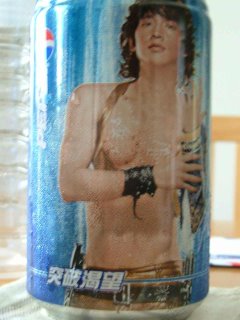
Where'd all the Dr. Pepper in this town go, by the way? Someone at Finga's told me they couldn't import it anymore...
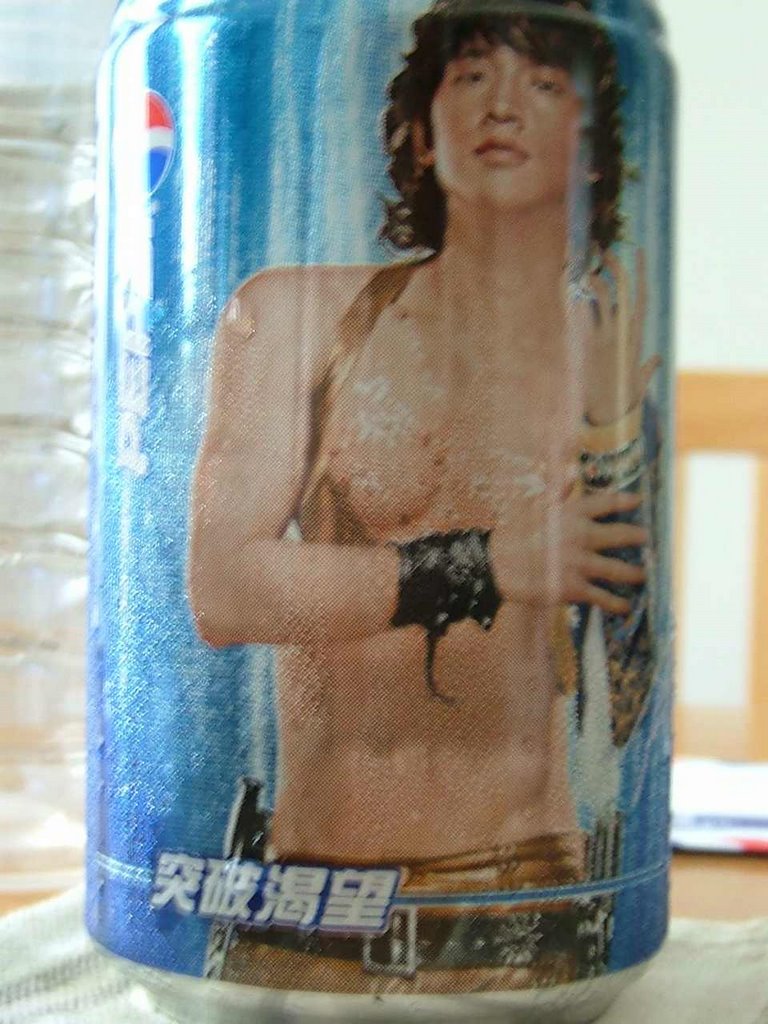
Where'd all the Dr. Pepper in this town go, by the way? Someone at Finga's told me they couldn't import it anymore...
Monday, August 14, 2006
Going crazy...
For the past two weeks, workers in the apartment downstairs have been knocking out walls, drilling into concrete, and doing whatever else they can do to make as much noise as possible. It's not only driving me absolutely insane, but it's also got me worried that some day we're going to wake up in the morning and find ourselves in the basement. Grrrrr...
Oh, and I almost forgot to mention the chemicals they're spraying down there. Paint? Paint remover? I don't know... For some reason, though, it reminds me of "The Cloud Minders" from Star Trek...
[Update, Sep. 5: They're still doing work--hammering, sawing, drilling, shouting, smoking, all as loudly as they can. I hear they'll only be doing it for 10 more days, though...]
Oh, and I almost forgot to mention the chemicals they're spraying down there. Paint? Paint remover? I don't know... For some reason, though, it reminds me of "The Cloud Minders" from Star Trek...
[Update, Sep. 5: They're still doing work--hammering, sawing, drilling, shouting, smoking, all as loudly as they can. I hear they'll only be doing it for 10 more days, though...]
Friday, August 11, 2006
New ICC course blog stimulates thoughts and a request for help
I never took a course is newswriting, so pardon my headline.
I've been working on moving my Intercultural Communication course's website/blog/whatchamacallit to its new home here. In addition, I've been working on lining up new online exchange partners, since my previous partner has moved on. I've ordered the new textbook, Communication Between Cultures, and am working out the course schedule.
In light of recent events in the world, though, I've been having some dark Apocalyptic thoughts that question what possible good a little course like ICC can do in the world. I'm going to resist being overwhelmed by those kinds of thoughts, but suffice it to say that this semester's course will be a darker, leaner ICC--sort of a Spider-Man 3 of ICC courses. (Hmmm... that'll have people scratching their heads...)
Anyway, I'm somewhat happy with the new site (and a prospective student has already pronounced it "more fabulous", so it can't be that bad). But I have been working, in my own low-tech way, on putting the posts on the ICC blog into categories, and I have a couple of questions. I'm not particularly confident with the way in which I'm tagging the posts--the descriptor choices, the number of categories I'm putting each post into, the (growing) total number of categories... So my question is, when you're tagging posts to put them into categories, how do you decide these things (descriptors, number of categories, number of total categories)? Or, is there some sort of website someone can direct me to, kind of a "Tagging for Dummies" that would give me some pointers? Thanks...
I've been working on moving my Intercultural Communication course's website/blog/whatchamacallit to its new home here. In addition, I've been working on lining up new online exchange partners, since my previous partner has moved on. I've ordered the new textbook, Communication Between Cultures, and am working out the course schedule.
In light of recent events in the world, though, I've been having some dark Apocalyptic thoughts that question what possible good a little course like ICC can do in the world. I'm going to resist being overwhelmed by those kinds of thoughts, but suffice it to say that this semester's course will be a darker, leaner ICC--sort of a Spider-Man 3 of ICC courses. (Hmmm... that'll have people scratching their heads...)
Anyway, I'm somewhat happy with the new site (and a prospective student has already pronounced it "more fabulous", so it can't be that bad). But I have been working, in my own low-tech way, on putting the posts on the ICC blog into categories, and I have a couple of questions. I'm not particularly confident with the way in which I'm tagging the posts--the descriptor choices, the number of categories I'm putting each post into, the (growing) total number of categories... So my question is, when you're tagging posts to put them into categories, how do you decide these things (descriptors, number of categories, number of total categories)? Or, is there some sort of website someone can direct me to, kind of a "Tagging for Dummies" that would give me some pointers? Thanks...
Thursday, August 10, 2006
A new book in the former native speaker's library
To get my mind off Mei-mei, let me mention a new book that I just received the other day.
- The Cultural Cold War: The CIA and the World of Arts and Letters, by Frances Stonor Saunders (NY: New Press, 1999).
This was originally published in the UK as Who Paid the Piper? I just started reading it, and so far it's pretty interesting. It traces the history of the CIA's involvement in the ideological war against the Communists during the Cold War. Its focus appears to be mainly on the Cold War in Europe.
Just had to post this...
I was up late last night looking through our pictures of Mei-mei. Every once in a while I'd let out a laugh and tell Mei-mei's "mom" to stop in and check out a particularly funny one.
Here's one from 2004 that we thought was cute--Mei-mei's either giving me a kiss or trying to tell me a secret. (Or maybe she's trying to help me clean my ears.)
I was up until about 3:00 trying to post it, but our Internet connection wasn't being very cooperative. But here it is, finally.
[Update: A friend says this picture reminds her of "Beauty and the Beast", but she's not sure which is which...]
Here's one from 2004 that we thought was cute--Mei-mei's either giving me a kiss or trying to tell me a secret. (Or maybe she's trying to help me clean my ears.)

I was up until about 3:00 trying to post it, but our Internet connection wasn't being very cooperative. But here it is, finally.
[Update: A friend says this picture reminds her of "Beauty and the Beast", but she's not sure which is which...]
Sunday, August 06, 2006
Mei-mei (妹妹), 1994-2006


Mei-mei passed away today at about 3:00 p.m. after complications from diabetes. She taught us a lot about living and dying, and we're sure she's in a better place now.
Sunday, July 30, 2006
愛情故事
Tomorrow is Chinese Lovers' Day, so it seems appropriate to resurrect a story that I wrote--with lots of help from the former native Chinese speaker--for a Chinese class that I took during the summer of 1996. My teacher asked us to write some sentences using Chinese idiomatic phrases (成語) that we had learned in the course, but I decided to write a story instead. Any mistakes in grammar or usage are mine!
每年一到七夕,人們成雙成對上街,情人濃情密意地赴約會,卿卿我我。而我每年七夕有自己的習慣:身上穿著黑衣服,臉上帶著憔悴的表情,晚上七點睡覺。P.S. The former native Chinese speaker wants everyone to know that she never sold papaya milkshakes at the night market. ;-)
今年七夕也不例外:電視新聞的播報員一開始眉開眼笑地報告有關台灣貪官污吏搜刮人民財產的事情,我就生氣的關了電視、關了燈,並上床睡覺。可是,我在床上輾轉反側,無法入眠;千頭萬緒,環繞我心。
想起我的老母常常苦口婆心地對我說:「兒子,我以我這輩子最寶貴的經驗告訴你,你如果覺得煩惱,無法接受世界快速變遷的話,你就去夜市走走,因為,夜市反映了人生百態。千萬記得,可別光說不練!」
母親的啟示讓我怦然心動,所以我就到了夜市。到了夜市之後,我遇到了一位和尚,他手上拿著一個缽。我丟了一個十塊錢的銅板進去。和尚對我說:「祝您多子多孫多福壽,生意昌隆。」我問他這句話有甚麼涵義,他說,就是祝我能有很多的子孫。我告訴他說,世界那麼亂,社會形態瞬息萬變,我不想有孩子。和尚說,我的話是大逆不道的,生孩子就是一件理所當然的事。古人說:「不孝有三,無後為大。」然後,我罵他是個墨守成規的老頭子。之後,我們就吵得天翻地覆,不可開交。最後,我把我的十塊錢從他的缽中拿回來。
其實,我是想用那十塊錢去買隔壁攤子的木瓜牛奶。我問賣木瓜牛奶的小姐說:「妳認識那位和尚嗎?」她說:「認識。他常常來夜市跟市民講道。他非常關心世界大問題,尤其是政府勞民傷財的情況。」我跟她說,他好像要以增加人口數量來救世濟民。她說:「他是個言行合一的人,已經有好幾個孩子了!」
我常常回去夜市幫那位賣木瓜牛奶的小姐,我們分工合作:她賣木瓜,我賣牛奶。雖然生意不是很好,但是我們兩個很談得來。不久之後,我們便結婚了。
Sunday, July 23, 2006
Something of an update
Still working on the diss. Have been working on a chapter that I intended to send to my advisor this weekend. Unfortunately, I haven't been able to (in the words of my high school classmate Dwight) "aggregate my fecal matter". (Dwight is, I imagine, a high-powered lawyer by now. He'll probably sue me for quoting him here.) So the chapter will take a little longer to get together. I can probably focus more on it during this typhoon that will hit us this week.
Wednesday, July 19, 2006
Saying goodbye to friends
Just saw off my friend and colleague Michael Jacques at the bus station. Didn't get mushy or anything, but I hope he and Karen (and Henry!) know that I'll miss them a lot. Although it's easy to stay in touch through e-mail, Skype, etc., their leaving Tunghai/Taiwan still feels so ... permanent.
Best of luck in your new lives (back) in the States! (And by the way, Karen's got a book of translations of Zhang Ailing novellas coming out in October. You can preorder at Amazon ;) ...)
Best of luck in your new lives (back) in the States! (And by the way, Karen's got a book of translations of Zhang Ailing novellas coming out in October. You can preorder at Amazon ;) ...)
Wednesday, July 12, 2006
Bilis coming for a visit... and a weird dream...
Here's how it looks as of midnight 7/13...
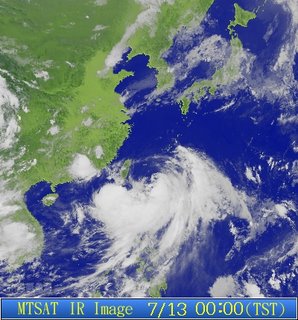
Click here for a more up-to-date satellite image from the Central Weather Bureau.
In other news, I had a disturbing dream last night: Our department received official notification that because of an oversupply of university graduates and a worsening economy, English majors who graduated in the bottom third of their class were to be executed on the athletic field immediately following the graduation ceremony. The most frightening thing about the dream was how calmly everybody (including the graduating students) was taking the news. Students just said, "Wow--I hope it's not me..."

Click here for a more up-to-date satellite image from the Central Weather Bureau.
In other news, I had a disturbing dream last night: Our department received official notification that because of an oversupply of university graduates and a worsening economy, English majors who graduated in the bottom third of their class were to be executed on the athletic field immediately following the graduation ceremony. The most frightening thing about the dream was how calmly everybody (including the graduating students) was taking the news. Students just said, "Wow--I hope it's not me..."
Monday, July 03, 2006
Open Call for Proposals: Writing Research Across Borders
Hoping we can get some representatives from Taiwan to go...
Open Call for Proposals: Writing Research Across Borders
February 22-24, 2008
University of California Santa Barbara
Conference website; http://education.ucsb.edu/netshare/wrconf08/
Proposal Deadline: May 1, 2007
Email: writing@education.ucsb.edu
Recent decades have seen the growth of writing studies in many nations, focused on all levels of education, and all uses of writing in society, using the resources of many different disciplines. This increased research attention to writing reflects an increased recognition of the importance of writing in modern societies. Yet to a large extent the many emerging traditions of writing research have neither connected fully nor shared their work.
This conference brings together the many writing researchers from around the world, drawing on all disciplines, and focused on all aspects of writing at all levels of development and in all segments of society. This will be an opportunity to learn from different research traditions, share our findings, seek common agendas, and lay the groundwork for future communication and alliances.
As a first step to building this important conversation we have invited some of the leading writing researchers, and those listed at the bottom of this call have already committed to participating.
We are now issuing an open call for proposals for panels, roundtables, individual presentations, and poster presentations addressing
* current research on writing,
* methodological issues
* reflections on ongoing research programs
* considerations of national or disciplinary trajectories of research
* agendas for further research
We anticipate a program of up to two hundred and fifty presentations.
Proposals to present current research should specify research questions, methods, data corpus, and findings, as well as the scope and duration of the research project. Proposals to provide overviews of and reflections on research traditions and agendas should identify clearly the relevant literatures to be considered.
Proposals for individual and poster presentations should be from 250 to 500 words in length and panel and roundtable proposals, 500 to 1000 words. Please indicate your preferred format.
Proposals should be sent by May 1, 2007 via email to writing@education.ucsb.edu. Please include complete contact information.
For further information please visit our conference website:
http://education.ucsb.edu/netshare/wrconf08/
If you have any questions contact us at writing@education.ucsb.edu
INVITED SPEAKERS already committed to participating:
Paula Carlino, Argentina, University of Buenos Aires
Caroline Channock, Australia, Latrobe
Rosemary Clerehan, Australia, Monash University
Luuk van Waes, Belgium, University of Antwerp
Angela Dionisio, Brazil, UFP, Recife
Angela Kleiman, Brazil, Unicamp-Sao Paulo
Marilyn Chapman, Canada, University of British Columbia
Graham Smart, Canada, Carleton University
Denis Alamargot, France, University of Poitiers
Michel Fayol, France, University Blaise Pascal
Frederic Francoise, France, Universit� de Paris V
Annie Piolat, France, University de Provence
Sylvie Plane, France, IUF de Paris
Yves Reuter, France, Universit� Lille
Joachim Grabowski, Germany, University of Education, Heidelberg, Germany
Pietro Boscolo, Italy, University of Padua
Emilia Ferreiro, Mexico, National Polytechnic Institute
Gert Rijlarsdam, Netherlands, University of Amsterdam
Lisa Emerson, New Zealand, Massey University
Olga Dysthe, Norway, University of Bergen
Rochelle Kapp, South Africa, University of Cape Town
Liliana Tolchinsky, Spain, University of Barcelona
Linda Allal, Switzerland, Universite de Geneve
Otto Kruse, Switzerland, University of Applied Sciences Erfurt, Switzerland
David Galbraith, UK, University of Staffordshire
Ken Hyland, UK, University of London
Roz Ivanic, UK, Lancaster University
Theresa Lillis, UK, Open University
Brian Street, UK, Kings College- London
Mark Torrance, UK, University of Staffordshire
Arnetha Ball, USA, Stanford University
Charles Bazerman, USA, University of California Santa Barbara
Anne Beaufort, USA, SUNY Stony Brook
Carol Berkenkotter, USA, University of Minnesota
Virginia Berninger, USA, University of Washington
Sheridan Blau, USA, University of California Santa Barbara
Ulla Connor, USA, Indiana University-Purdue University Indianapolis
Christiane Donahue, USA, University of Maine, Farmington
Ann Dyson, USA, University of Illinois Urbana-Champaign
Jill Fitzgerald, USA, University North Carolina Chapel Hill
Steve Graham, USA, Vanderbilt
Kris Gutierrez, USA, University of California Los Angeles
Christina Haas, USA, Kent State University
Richard Haswell, USA, TAMU Corpus Christi
John R. Hayes, USA, Carnegie Mellon University
George Hillocks, USA, University of Chicago
Tom Huckin, USA, University of Utah
Susan Jarratt, USA, University of California Irvine
Ilona Leki, USA, University of Tennessee
Paul LeMahieu, USA, University of California Berkeley
Andrea Lunsford, USA, Stanford University
Karen Lunsford, USA, University of California Santa Barbara
Charles MacArthur, USA, University of Delaware
Paul Matsuda, USA, University of New Hampshire
Debra McCutcheon, USA, University of Washington
Heidi McKee, USA, Miami University
Sandy Murphy, USA, UC Davis
Bill Nagy, USA, Seattle Pacific University
Sondra Perl, USA, CUNY Graduate Center
Jim Porter, USA, Michigan State University
Paul Prior, USA, University of Illinois Urbana-Champaign
David Russell, USA, State University
Rebecca Rickly, USA, Texas Technological University
Tony Silva, USA, Purdue University
Peter Smagorinsky, USA, University of Georgia
Melanie Sperling, USA, University of California Riverside
Clay Spinuzzi, USA, University of Texas Austin
John Swales, USA, University of Michigan
Chris Thaiss, USA, University of California Davis
Gary Troia, USA, Michigan State University
Kathleen Blake Yancey, USA, Florida State University
Subscribe to:
Posts (Atom)