Thursday, October 06, 2005
Watch that language...
From today's Liberty Times (自由電子報) comes the story of PHILIP (his name is in all caps throughout the article), a British businessman who got accused by a former employee of "publicly insulting" (公然侮辱) the employee by using the F-word (also all caps--maybe he was shouting) at a meeting. Fortunately for PHILIP, the judge in Taipei declared him not guilty because PHILIP had used the word to describe the employee's watch (the employee was 20 minutes late) and not the employee. Meanwhile, a guard at an apartment building was fined NT$1500 for using the Chinese version of F--K because the court decided he had used it to insult the other party directly. So if you're going to use the word, be careful how you use it!


Al Gore on democracy, the media, and public discourse
Al Gore spoke on Oct. 5 about the "grave danger" that public discourse in the U.S. is in. The transcript is available here.
[Update: Rebecca MacKinnon summarizes Gore's speech.]
[Update: Rebecca MacKinnon summarizes Gore's speech.]
Monday, October 03, 2005
Discussion about rhetoric and the humanities at the Blogora
The Blogora, a rhetoric blog that doesn't often seem to contain posts about rhetoric (at least as far as I can tell), has an interesting post by James Aune where he tosses around some of his views about the relationship of rhetoric to the humanities and social sciences. He has already received two comments, and hopefully will get more feedback for the position paper he's working on. I'm looking forward to seeing what he finally comes up with.
(By the way, I registered for an account--who knows, one of these days I might be brave enough to post a comment there--and was pleasantly surprised to receive my password in the form of an e-mail from the "World Wide Web Owner". Glad to see the ol' owner of the Web is keeping busy sending out passwords to ordinary folks like me...)
(By the way, I registered for an account--who knows, one of these days I might be brave enough to post a comment there--and was pleasantly surprised to receive my password in the form of an e-mail from the "World Wide Web Owner". Glad to see the ol' owner of the Web is keeping busy sending out passwords to ordinary folks like me...)
Word verification activated
What Rank said. Except as a rhetorician, I'd like to see some words like "bdelygmia", "insinuatio", or "verborum bombus"...
Saturday, October 01, 2005
Big autumn typhoon on its way...
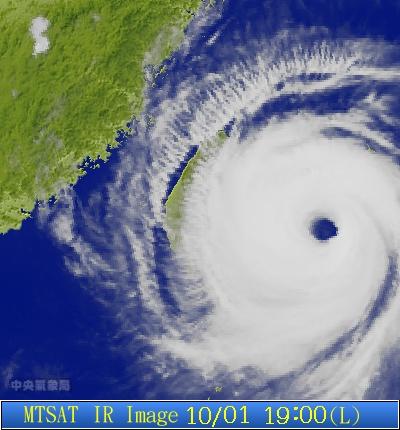 Its name is "Longwang" (龍王) or "Dragon King" and it's got a big ol' dragon eye... It looks like it will be affecting us tomorrow and possibly Monday (which might mean no classes Monday?...)
(picture from the Central Weather Bureau website)
[Update, Oct. 5: Longwang passed through quickly and hardly left any rain in the Taichung area. We had classes on Monday, much to my FENM students' dismay. (We had a quiz that day.)]
Friday, September 30, 2005
Where the former native speaker realizes answering an easy question isn't that easy...
My wife was watching a show where flight attendants were talking about their experiences doing job interviews. When they did the English job interview, one of the applicants--who had practiced a lot for this interview--was asked the simple question, "What's your favorite fruit?"
Not expecting this kind of question, she thought and thought. To help, the interviewer asked again: "What's your favorite fruit? You know, strawberries? Or bananas?"
"Oh yes!" said the interviewee. "I like to eat umbrellas!"
When she told me about this, I laughed and wondered aloud how anyone could say such a thing. My wife said maybe the applicant mixed the words "strawberries" and "bananas" to make "umbrellas". (They sort of sound similar. Sort of.) But I wasn't convinced. "I still don't see how anyone could do such a thing."
So she asked me, in Chinese what my favorite fruit was.
"香草!" (Oops...)
(Little extra credit: what did I mix up to get that result?)
Not expecting this kind of question, she thought and thought. To help, the interviewer asked again: "What's your favorite fruit? You know, strawberries? Or bananas?"
"Oh yes!" said the interviewee. "I like to eat umbrellas!"
When she told me about this, I laughed and wondered aloud how anyone could say such a thing. My wife said maybe the applicant mixed the words "strawberries" and "bananas" to make "umbrellas". (They sort of sound similar. Sort of.) But I wasn't convinced. "I still don't see how anyone could do such a thing."
So she asked me, in Chinese what my favorite fruit was.
"香草!" (Oops...)
(Little extra credit: what did I mix up to get that result?)
Monday, September 26, 2005
Empires of the Mind: a new book in the former native speaker's library
The complete title is Empires of the Mind: I. A. Richards and Basic English in China, 1929-1979 by Rodney Koeneke. I just got it today.
It looks like it will shed some important light on an aspect of I. A. Richards's life that has not been deeply (or widely) discussed--his experiences in China. I don't remember how I first found out that Richards had traveled to China several times, mostly during the Republican era (1911-1949), but that, and mention of him in the preface to Anne Cochran's (the Tunghai FLLD chair in the '50s and '60s, not the singer) Modern Methods of Teaching English As A Foreign Language (a book I briefly mention here), motivated me to take a look at a biography of him by John Paul Russo. Russo discusses Richards's relationship with China in one chapter, and I'll be interested in reading how Koeneke expands on that discussion.
Two things I noticed while skimming the bibliography and index of Koeneke's book, though: 1) he doesn't seem to have used any Chinese-language sources. I wonder, then, if this book will cover more of Richards's perspective toward China than vice-versa. I'll have to see... and 2) a minor quibble--Tseng Yueh-nung (Beauson Tseng), first president of Tunghai, is mentioned (Tseng worked with Richards in China on a Subcommittee on Vocabulary Selection for Middle Schools), but his name is written "Tsing" for some reason. I wonder if that's how Richards wrote his name? (But I remember Tseng mentioned as "Tseng" in Russo's book.) Anyway, as I say, that's a minor criticism. Overall, I'm looking forward to reading this book and adding it to the background for my dissertation.
[Update, 1 Oct. 2005: Having read the first chapter of the book, I need to mention that Koeneke does acknowledge/comment upon his own lack of Chinese and this lack's relationship to his scholarship. He writes,
It looks like it will shed some important light on an aspect of I. A. Richards's life that has not been deeply (or widely) discussed--his experiences in China. I don't remember how I first found out that Richards had traveled to China several times, mostly during the Republican era (1911-1949), but that, and mention of him in the preface to Anne Cochran's (the Tunghai FLLD chair in the '50s and '60s, not the singer) Modern Methods of Teaching English As A Foreign Language (a book I briefly mention here), motivated me to take a look at a biography of him by John Paul Russo. Russo discusses Richards's relationship with China in one chapter, and I'll be interested in reading how Koeneke expands on that discussion.
Two things I noticed while skimming the bibliography and index of Koeneke's book, though: 1) he doesn't seem to have used any Chinese-language sources. I wonder, then, if this book will cover more of Richards's perspective toward China than vice-versa. I'll have to see... and 2) a minor quibble--Tseng Yueh-nung (Beauson Tseng), first president of Tunghai, is mentioned (Tseng worked with Richards in China on a Subcommittee on Vocabulary Selection for Middle Schools), but his name is written "Tsing" for some reason. I wonder if that's how Richards wrote his name? (But I remember Tseng mentioned as "Tseng" in Russo's book.) Anyway, as I say, that's a minor criticism. Overall, I'm looking forward to reading this book and adding it to the background for my dissertation.
[Update, 1 Oct. 2005: Having read the first chapter of the book, I need to mention that Koeneke does acknowledge/comment upon his own lack of Chinese and this lack's relationship to his scholarship. He writes,
To a large extent, the decision to reconstruct the dramatic transformations which occurred in China and the West during the years of Richards's Basic enterprise from the evidence of his diaries, letters and published writings reflects the kinds of questions I asked about the way we narate the history of British imperialism. It also reflects my own limitations. British historians of the future will no doubt read a number of languages in addition to English (many already do) as the history of Britain is increasingly folded into that of the empire which for so long gave it its meaning. I read no Chinese, and speak about as much as my subject did. As a consequence, the enormously important story of Chinese reactions to Richards's efforts, as well as to those of the Rockefeller Foundation and other Western institutions in China during the tumultuous years between the Ching Dynasty and Mao's Revolution, can only be hinted at here. ... (17-18)He also mentions that he has purposely "retained Richards's spelling of Chinese names." He says, "In doing so I hoped to convey something of the air of privileged aloofness which Richards enjoyed as an Englishman abroad" (19).
Friday, September 09, 2005
Another complication for those wanting to do research ethically
Tom Stafford at the University of Sheffield has been conducting an exchange with the people of Reed Elsevier about the academic publisher's involvement in hosting arms trade shows (though a subsidiary, Spearhead Exhibitions). If, like me, you hadn't heard about this before, you can read his exchange with the company here and here and here and here. He also has two other posts about the situation (here and here). Stafford's argument (quoted from his Sept. 8 post) is as follows:
When teaching Research Methods, I talk a lot about research ethics in terms of using sources properly--accurating citing sources, not taking the source's ideas or arguments out of context, using sources that are reliable, ... But this is sure a new twist on research ethics: what do we do when our school's library subscribes to journals and databases whose publishers are involved in business that many of us would consider immoral? And what should we teach our students about this?
(via Crooked Timber)
I believe that the DSEi arms fairs are immoral, geopolitically reckless, sometimes illegal (e.g.) and improperly regulated (e.g.). Beyond this, I resent that a publisher which profits from the hard (and publicly funded) work of academics uses those profits to support the sale to undemocratic & repressive governments of such things as depleted uranium shells, cluster bombs, missile technology and small arms. The arms fairs Spearhead organises (yes, DSEi isn't the only one) are a measly amount of Elsevier's business, but it is a part that makes academics complicit in the deaths of civilians, in torture and in political repression around the world.Reed Elsevier's response to his letters basically claimed that arms trade is "legitimate business" and that "it is your democratic right" to disagree with RE's involvement in arms trading (though it won't affect their business).
When teaching Research Methods, I talk a lot about research ethics in terms of using sources properly--accurating citing sources, not taking the source's ideas or arguments out of context, using sources that are reliable, ... But this is sure a new twist on research ethics: what do we do when our school's library subscribes to journals and databases whose publishers are involved in business that many of us would consider immoral? And what should we teach our students about this?
(via Crooked Timber)
Thursday, September 08, 2005
Two experiments
We're experimenting with keeping the air con off these days. We've got the windows open and some fans on, and there's sometimes a nice breeze that comes in through the balcony window. The view from that window looks like this:
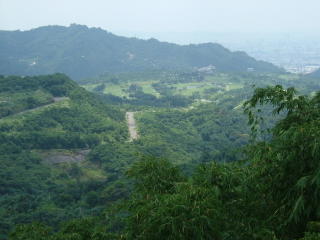
OK, I'm a liar. That picture was from the Chiang Kai-shek Camping Area in Dakeng. Our balcony view actually looks more like this:

Except now we have some creepy vines on the balcony that I pulled off the walls because they were tearing the tiles off the wall of the balcony.
Anyway, that's our first experiment--no air con. It's OK, but it's a litle humid in here.
Second experiment: I was reading Academic Coach today--she has some suggestions regarding writing daily and keeping records of how long you write a day. So I'm going to try that out. Every week I'll report on how much time I spent on my diss. that week. (This will make for exciting reading, I'm sure...)
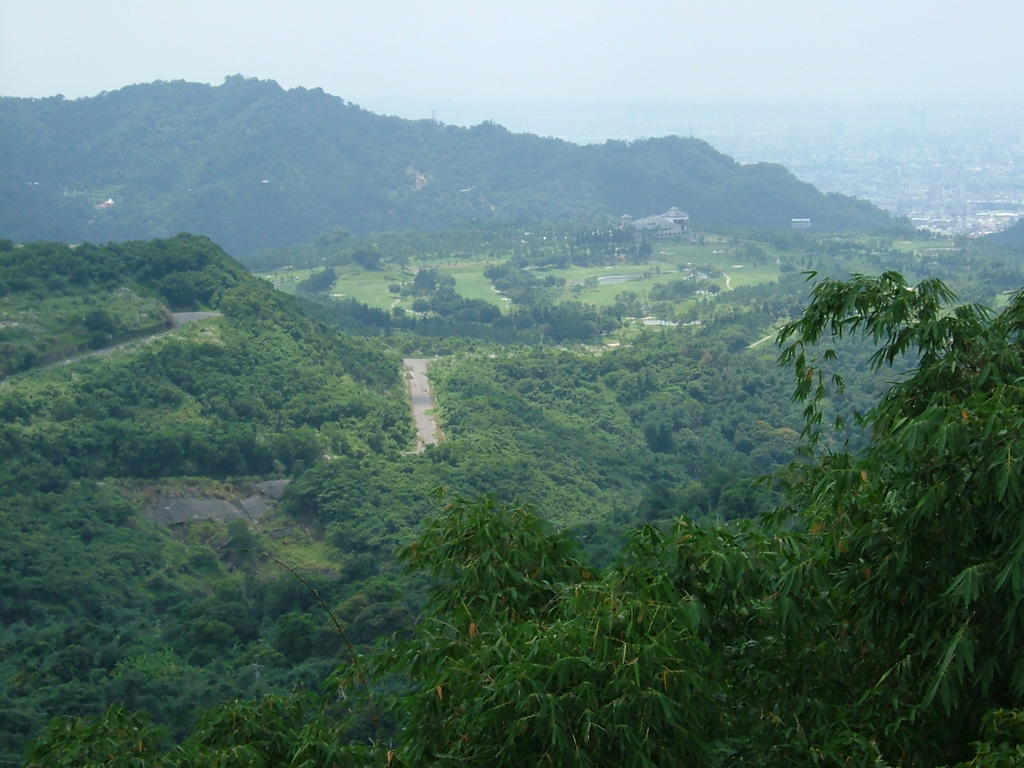
OK, I'm a liar. That picture was from the Chiang Kai-shek Camping Area in Dakeng. Our balcony view actually looks more like this:

Except now we have some creepy vines on the balcony that I pulled off the walls because they were tearing the tiles off the wall of the balcony.
Anyway, that's our first experiment--no air con. It's OK, but it's a litle humid in here.
Second experiment: I was reading Academic Coach today--she has some suggestions regarding writing daily and keeping records of how long you write a day. So I'm going to try that out. Every week I'll report on how much time I spent on my diss. that week. (This will make for exciting reading, I'm sure...)
Wednesday, September 07, 2005
Cites
- Earth Wide Moth on "New London Group, 'A Pedagogy of Multiliteracies'" (wonders, among other things, about "the absence of 'rhetoric'" from NLG's discussion--I wonder if it's b/c NLG doesn't seem to have any rhetoricians participating?)
- Pinyin News on "Hakka and Chinese Characters" (Chinese article--mentions the problems of using Chinese characters to express Hakka words and how Taiwan's government's Council for Hakka Affairs is trying to work them out. Remind me some time to record the Hakka I learned last Saturday that I can use the next time my wife's grandmother asks me why we don't have any kids yet...)
OK. Back to the diss. Classes start next Thursday, so...
Sunday, September 04, 2005
Thursday, September 01, 2005
Typhoon holiday
We just got our power back after a morning without electricity. It's still raining prety hard outside and the wind is blowing the rain in all directions. We still have water, but I filled up the bathtub anyway last night.
According to one report I heard, Talim evidently split in two when it hit the central mountain range. This weakened it--the rain hasn't been as heavy as predicted, but it is still pretty heavy.
I don't have any pictures yet, but Michael Turton has some pics of his neighborhood that he took when he "went out for newspapers this morning in a driving rain and strong winds" this morning. (Guess he's going for the nutty foreigner award. On the other hand, I heard the garbage truck driving around our neighborhood this morning and we saw a someone on a motorcycle almost get blown over outside our window. So I guess he's in good company!)
After hearing reports that there may be "thousands dead" in New Orleans, it's hard to get too uptight about what's happening here.
According to one report I heard, Talim evidently split in two when it hit the central mountain range. This weakened it--the rain hasn't been as heavy as predicted, but it is still pretty heavy.
I don't have any pictures yet, but Michael Turton has some pics of his neighborhood that he took when he "went out for newspapers this morning in a driving rain and strong winds" this morning. (Guess he's going for the nutty foreigner award. On the other hand, I heard the garbage truck driving around our neighborhood this morning and we saw a someone on a motorcycle almost get blown over outside our window. So I guess he's in good company!)
After hearing reports that there may be "thousands dead" in New Orleans, it's hard to get too uptight about what's happening here.
Wednesday, August 31, 2005
Gettin' windy here...
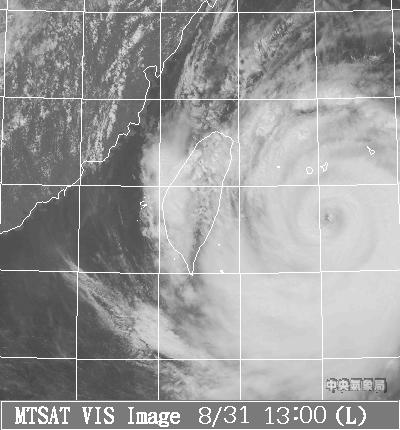
Typhoon Talim is starting to affect us right now, as you can see from the images below from the Central Weather Bureau:
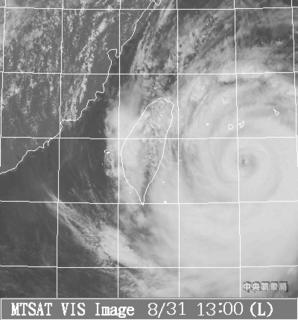
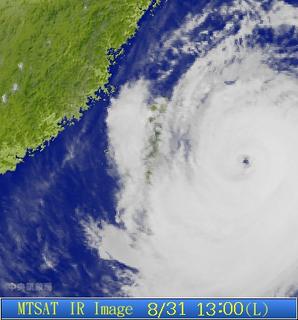
Update, 11:23 p.m.: Still windy (getting windier). And have some rain leaking into the apartment--somehow getting in through the air conditioner.
Here's the latest satellite image from the Central Weather Bureau.
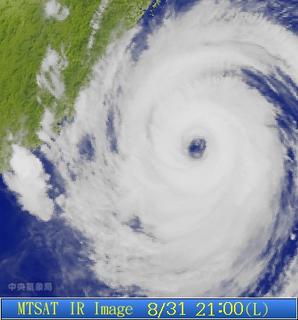
Taiwan's down there somewhere...
I heard Mike Chinoy on CNN earlier, saying that Taiwanese are even more serious about this typhoon because of the coverage of Katrina that has been on the news here. Maybe. But I think it's also because this is such a huge typhoon. One news article mentioned that it has winds up to 184 kmh.
The news has announced that businesses and schools will be closed all over the island tomorrow. We'll probably have to prepare for a water shortage too, I imagine. Hopefully it won't be like last year. Time to fill up the bathtub...

Update, 11:23 p.m.: Still windy (getting windier). And have some rain leaking into the apartment--somehow getting in through the air conditioner.
Here's the latest satellite image from the Central Weather Bureau.

Taiwan's down there somewhere...
I heard Mike Chinoy on CNN earlier, saying that Taiwanese are even more serious about this typhoon because of the coverage of Katrina that has been on the news here. Maybe. But I think it's also because this is such a huge typhoon. One news article mentioned that it has winds up to 184 kmh.
The news has announced that businesses and schools will be closed all over the island tomorrow. We'll probably have to prepare for a water shortage too, I imagine. Hopefully it won't be like last year. Time to fill up the bathtub...
Monday, August 29, 2005
Speaking of Taiwan and rhetoric...
Rhetoric doesn't actually get a mention, but the Taiwan News has an article about a discussion group on deliberative democracy that was held during the Youth National Affairs Conference in Taipei:
The process results in reports that might summarize discussion and/or make recommendations to leaders. According to Zeng Jhao-ming of the National Youth Commission,
I haven't thought much about this youth conference or how (or if) deliberative democracy is being implemented in Taiwan. I'll have to come back to this at some point, though.
Update 8/31/05:
The Taiwan News has an editorial in today's edition: "Deliberation tools can boost quality of Taiwan democracy." The editorial comments on the potential usefulness of deliberative forums to increase citizen understanding of and participation in national and local issues.
In a discussion group on the Youth National Affairs Conference, a panel of National Youth Commission officials and youth representatives shared with international experts how the "deliberative democracy" decision-making process is being implemented locally."Deliberative democracy" refers to a fairly direct form of democracy similar to a political debate and decision-making process found in Swiss cantons, and was the theme of the meetings over the weekend, which focused on the "Impact of Deliberative Democracy on Youth of Taiwan."
The meetings included "Citizen Dialogue Circles", which "are group sessions that use study group methodologies to clarify and discuss issues by means of role-playing, active listening and vision building", and "Citizen Consensus Conferences", which
targeted issues related to educational resource allocation, career development for youth and even prenatal medical tests. Another major discussion stream centered on Taiwan's global role - as a globalized economy, as a global nation and as a global civil society.According to the article, last year's conference included discussion of the presidential election.
The process results in reports that might summarize discussion and/or make recommendations to leaders. According to Zeng Jhao-ming of the National Youth Commission,
"In the Taiwanese case, National Youth Commission is responsible for a view of policy rather than having a direct impact on or being responsible for implementation of policy...we are in a position to send out the recommendation or advice made..."The Youth National Affairs Conference website is here (Chinese only). Sunday's session was also attended by international scholars including James Fishkin of Stanford University's Center for Deliberative Democracy.
I haven't thought much about this youth conference or how (or if) deliberative democracy is being implemented in Taiwan. I'll have to come back to this at some point, though.
Update 8/31/05:
The Taiwan News has an editorial in today's edition: "Deliberation tools can boost quality of Taiwan democracy." The editorial comments on the potential usefulness of deliberative forums to increase citizen understanding of and participation in national and local issues.
As several analysts noted, deliberative forums or polls can provide an important supplement to both indirect representative institutions and to process of direct democracy, such as national citizen referendum, by providing channels for reasonable and informed discussion of urgent or important issues on a community or even national scale.The editorial goes on to point out that two of the basic prerequisites for successful citizen forums or other forms of public deliberation are the people's (and organizers') willingness to keep their minds open and their willingness to see discussion and deliberation as an end rather than a means:
Methods of deliberative democracy, such as citizen forums, "storytelling" among people of various ethnic and social groups and political views, and deliberative polling should be used to explore such critical questions in an open-ended manner instead of being seen as a means to "solve" a predefined problem.As the editorial points out, however, there is a great deal of "political polarization" in Taiwan--particularly in the Legislature--that would make "a bill that would require citizen discussion of proposed laws and programs" hard to pass. They suggest "an independent institution under the Cabinet or under the Research, Development and Evaluation Commission or its proposed replacement National Development Commission" as an alternative.
Sunday, August 28, 2005
Another new book in the former native speaker's library
台籍菁英的搖籃:台中一中 (The Cradle of the Taiwan Elite: Taichung First Secondary School), by 朱珮琪 (Zhu Peiqi).
This book is an extensively revised version of Zhu's master's thesis. It's a history of a school that was the first secondary school established for Taiwanese boys during the period of the Japanese occupation (1895-1945). The school was established through the efforts of Taiwanese elites like Lin Xiantang (林獻堂), Lin Lietang (林烈堂), and Gu Xianrong (辜顯榮). Looks like it'll be a good book! (The school is now a senior high school, by the way.)
This book is an extensively revised version of Zhu's master's thesis. It's a history of a school that was the first secondary school established for Taiwanese boys during the period of the Japanese occupation (1895-1945). The school was established through the efforts of Taiwanese elites like Lin Xiantang (林獻堂), Lin Lietang (林烈堂), and Gu Xianrong (辜顯榮). Looks like it'll be a good book! (The school is now a senior high school, by the way.)
Friday, August 26, 2005
mmmmm... Dr. Pepper....
OK, why didn't anyone tell me that Tesco in Taichung has Dr. Pepper for a mere NT$25 per can? (That's about 77.383 cents US, btw.) Dr. Pepper fans of Taichung, run out there and buy 'em up! Let the folks at Tesco know that they need to keep this stuff in stock! (And maybe devote more shelf space to it. I almost missed it--it's on the far end of the carbonated beverages shelf.)
Oh, and there's some A&W Root Beer too, for fans of that. Ahem.
Oh, and there's some A&W Root Beer too, for fans of that. Ahem.
Thursday, August 25, 2005
Helping out a blogger and her family
Academic Coach has set up a way to help an ABD blogger named "Badger" deal with the medical costs for her terminally ill husband. Check out the link and consider contributing to the "Badger Fund." The family's medical costs are enormous, the U.S. government is no help (of course), and anything we can spare will surely help.
Here's Badger's blog, by the way.
Update, 8/30/05: News from Academic Coach that Badger's husband has passed away. Also this from Badger herself.
Here's Badger's blog, by the way.
Update, 8/30/05: News from Academic Coach that Badger's husband has passed away. Also this from Badger herself.
Disserblogging
I've posted a few article summaries on my "disserblog", Kun zhi ji (困知記) that pertain to intercultural rhetoric. So far the summaries are of
- William J. Starosta, "On Intercultural Rhetoric"
- Mary Garrett and Xiaosui Xiao, "The Rhetorical Situation Revisited"
- Yameng Liu, "Justifying My Position in Your Terms"
Sunday, August 21, 2005
Farewell to the White Terror
This evening I finished reading 走出白色恐怖 (Farewell to the White Terror) by 孫康宜 (Sun Kang-i). As I mentioned earlier, her father was arrested and jailed for 10 years. He was imprisoned in 1950, when Sun was six years old. He spent some time imprisoned on the infamous Green Island and then was moved to a military prison in Xindian (新店) in 1953, where he spent the rest of his 10 years of imprisonment. Sun's father was jailed because of some relatives who were members of an anti-KMT organization (though he was not a part of that--one of Sun's uncles, however, was involved in the Luku Incident [鹿窟事件] of 1952). Sun's father actually got out after 10 years, which was not by any means guaranteed at that time, but his health was affected by the experience (he got tuberculosis).
But Sun's book, as she emphasizes, is not "accusatory literature" (控訴文學) or "scar literature" (傷痕文學, also translated as "literature of the wounded"), but rather a book about gratitude. She thanks family members who took her, her mother, and her brothers in when her father was jailed; she thanks a teacher (Mr. Lan) who helped her family, even taking in her brother when her mother had to stay in the hospital for a while; she even thanks a rickshaw driver who took her family from the Xindian bus station to the military prison and refused to accept her mother's money for the trip because of his sympathy for the family's plight. In fact, most of the essays that make up Farewell (many of which have been previously published in various magazines and newspaper literary supplements) are organized around a person or group of people to whom Sun wants to express gratitude for their help during her family's time of need.
Part of the reason for this "literature of gratitude" comes, I'm sure, from Sun's deeply held religious beliefs. As a Christian, Sun wants to demonstrate how God led her family through the difficult circumstances of their lives during their time of suffering. One of the most difficult issues that many Christians (or any believers in a religious faith, I imagine) are asked about or have to face themselves regards why people suffer. While Sun's book is not a theological treatise on the roles of evil and suffering in the world, one gets the impression that she might view suffering as one way through which people can have the opportunity to help one another (and have the opportunity to be helped by others).
But Sun's book, as she emphasizes, is not "accusatory literature" (控訴文學) or "scar literature" (傷痕文學, also translated as "literature of the wounded"), but rather a book about gratitude. She thanks family members who took her, her mother, and her brothers in when her father was jailed; she thanks a teacher (Mr. Lan) who helped her family, even taking in her brother when her mother had to stay in the hospital for a while; she even thanks a rickshaw driver who took her family from the Xindian bus station to the military prison and refused to accept her mother's money for the trip because of his sympathy for the family's plight. In fact, most of the essays that make up Farewell (many of which have been previously published in various magazines and newspaper literary supplements) are organized around a person or group of people to whom Sun wants to express gratitude for their help during her family's time of need.
Part of the reason for this "literature of gratitude" comes, I'm sure, from Sun's deeply held religious beliefs. As a Christian, Sun wants to demonstrate how God led her family through the difficult circumstances of their lives during their time of suffering. One of the most difficult issues that many Christians (or any believers in a religious faith, I imagine) are asked about or have to face themselves regards why people suffer. While Sun's book is not a theological treatise on the roles of evil and suffering in the world, one gets the impression that she might view suffering as one way through which people can have the opportunity to help one another (and have the opportunity to be helped by others).
So close it's eerie...
My wife just took the Book Quiz... It's quite accurate, except for the part about "Celeste"...
You're Babar the King!
by Jean de Brunhoff
Though your life has been filled with struggle and sadness of late, you're personally doing quite well for yourself. All this success brings responsibility, though, and should not be taken lightly. Life has turned from war to peace, from damage to reconstruction, and this brings a bright new hope for everyone you know. These hopeful people look to you for guidance, and your best advice to them is to watch out for snakes. You're quite fond of the name "Celeste".
Take the Book Quiz
at the Blue Pyramid.

Thursday, August 18, 2005
Composing interview questions
I'm writing interview questions (actually a list of questions to send to a potential interviewee). Lately, my questions have been along the lines of, "Fifty years ago, you said ..... What did you mean by that? How did people respond to it?" etc.
Sometimes I feel like one of Chris Farley's characters on Saturday Night Live--the one who would interview movie stars like Bruce Willis and say, "You know that time when you were in Die Hard and you tied the firehose around your waist and jumped off the building?"
"Yes."
"That was cool."
Sometimes I feel like one of Chris Farley's characters on Saturday Night Live--the one who would interview movie stars like Bruce Willis and say, "You know that time when you were in Die Hard and you tied the firehose around your waist and jumped off the building?"
"Yes."
"That was cool."
Wednesday, August 17, 2005
Well, I should have figured...
You're The Sound and the Fury!
by William Faulkner
Strong-willed but deeply confused, you are trying to come to grips with a major crisis in your life. You can see many different perspectives on the issue, but you're mostly overwhelmed with despair at what you've lost. People often have a hard time understanding you, but they have some vague sense that you must be brilliant anyway. Ultimately, you signify nothing.
Take the Book Quiz
at the Blue Pyramid.

Tuesday, August 16, 2005
Mail call
After a day of working on my dissertation, reading and writing (mostly reading) and struggling in spots with where I want it to go and how I'm going to get it there, I get to settle back and take a look at today's mail.
I got a "big brown envelope" from my parents (as promised in an e-mail from my father). It contains a letter that my mother typed around a photocopy of a "Doonesbury" comic. (It's the one from July 24, in case you're interested--the one where Mike is daydreaming about Bush apologizing for the Iraq war. Dream on, Mike...) Among other things, my mother mentions that one of my uncles has just turned 65. ("I barely remember being that age!" she exclaims.) She also recounts their pastor's children's sermon, where the pastor
The envelope also contains a copy of the "Journal Junction" (from Martinsburg's newspaper The Journal), where some folks have called in to voice their opinions and The Journal has printed some of 'em. One caller's opinion is notable:
Wrapping up this inventory, there's a (mighty late) apology letter and baggage tracing/claim form from United (they lost our luggage for close to a week while we were in the States, but it finally got to us). There are two pictures of my mother's four-foot tall (or is it five feet tall?) teddy bear playing the piano, and there's a copy (actually the original) of a treatise I wrote on "animal sex" when I was 6. (There--that last mention will definitely bring some new readers to this site!)
(And no, I'm not going to make a Technorati tag that says "animal sex"!)
I got a "big brown envelope" from my parents (as promised in an e-mail from my father). It contains a letter that my mother typed around a photocopy of a "Doonesbury" comic. (It's the one from July 24, in case you're interested--the one where Mike is daydreaming about Bush apologizing for the Iraq war. Dream on, Mike...) Among other things, my mother mentions that one of my uncles has just turned 65. ("I barely remember being that age!" she exclaims.) She also recounts their pastor's children's sermon, where the pastor
made the mistake of asking them if they'd ever gone swimming in the ocean, and they proceeded to yell out their experiences in the pool, ocean, bathub, whatever, and she couldn't shut them up to give the sermon. Finally said let's bring an end to this, and dismissed them.The brown envelope also contains an obituary for Richard H. Hart, a gentleman from Morgantown (but born in Martinsburg) who "died unexpectedly on July 20, in the Morgantown Public Library, his place of employment for the last 10 years, surrounded by his beloved books." My parents didn't know him, but they understand his feeling about books...
The envelope also contains a copy of the "Journal Junction" (from Martinsburg's newspaper The Journal), where some folks have called in to voice their opinions and The Journal has printed some of 'em. One caller's opinion is notable:
From my observations of the political scene in the past five years, I have concluded that the real difference between the Democratic and the Republican parties is that the Democrats want to improve the lives of the American people from the cradle to the grave and the Republicans want to control the lives of the American people from before the cradle to beyond the grave.Hmmm... I resonate with that... (Well, I should, considering the caller was my mother!)
Wrapping up this inventory, there's a (mighty late) apology letter and baggage tracing/claim form from United (they lost our luggage for close to a week while we were in the States, but it finally got to us). There are two pictures of my mother's four-foot tall (or is it five feet tall?) teddy bear playing the piano, and there's a copy (actually the original) of a treatise I wrote on "animal sex" when I was 6. (There--that last mention will definitely bring some new readers to this site!)
(And no, I'm not going to make a Technorati tag that says "animal sex"!)
Saturday, August 13, 2005
New books in the former native speaker's library
Went to 7-Eleven this evening and picked up 3 books I had ordered from 博客來網路書店 (which translates "Berkeley Internet Bookstore", although they don't call themselves Berkeley in English). They're owned by the same company, President (統一) that owns 7-Eleven (and Starbucks, among other businesses) in Taiwan, so you can order books through the website, have them delivered to your neighborhood 7-Eleven (in Taiwan only, natch), and pay for the books there. (And you don't have to pay postage.) Anyway, that's a long preface to listing the books I bought--sorry! Here's what I got:
*I made up the English translation for Cai's book's title... was thinking about Harry Franck's books of the first half of the 20th century, like A Vagabond Journey Around the World (1910), Roaming Through the West Indies (1920) (both of which I have copies of), and Glimpses of Japan and Formosa (1924) (which I'd love to get a copy of sometime...). Anyway, guess I could have translated Cai's book "Vagabonding in LA", too...
- 走出白色恐怖 (Farewell to the White Terror) by 孫康宜 (Sun Kang-i), a Tunghai graduate (FLLD, 1966) who teaches in the East Asian Languages and Literatures Department at Yale. Her father (a mainlander) was arrested during the White Terror period in Taiwan and jailed as a political prisoner for 10 years. The book was recommended to me by a Tunghai Chinese department professor, Hung Mingshui. I've gotten through the first 40 pages so far.
- 野火集 (Wildfire Collection) by 龍應台 (Long Yingtai). Republished in 2005, this is a 20th anniversary edition that includes her reflections on the essays she wrote and the reactions to those essays. I found out about this book from the post "Unpolitical Political Statements" on the EastSouthWestNorth blog. Interestingly, the first essay in the collection, 〈中國人,你為什麼不生氣〉("Chinese person, why aren't you angry?") is the first Long Yingtai essay that I read--years ago, in a collection of the R.O.C.'s best essays of 1984. At the time I read the essay, though, I had no idea who Long Yingtai was/is. (I don't mention this to show how well-read I am; rather, I think it demonstrates the huge role serendipity plays in my reading habits...)
- LA流浪記 (Roaming about in LA)*, by 蔡康永 (Cai Kangyong). Cai is a writer and a host of several kinds of shows on TV here (including interview shows about literature/the arts, shows about relationships, shows that interview celebrities, and even the recent Golden Horse Awards show). He also happens to be a Tunghai graduate (FLLD, 1985), which I didn't know until I saw this on the Tunghai website. Hmmm... Wonder if he'd be interested in doing an interview about his experiences as an FLLD student?
*I made up the English translation for Cai's book's title... was thinking about Harry Franck's books of the first half of the 20th century, like A Vagabond Journey Around the World (1910), Roaming Through the West Indies (1920) (both of which I have copies of), and Glimpses of Japan and Formosa (1924) (which I'd love to get a copy of sometime...). Anyway, guess I could have translated Cai's book "Vagabonding in LA", too...
Thursday, August 11, 2005
Links (before I lose 'em)
- "Locally-Scaled Rhetorics" ("What changes when we rename/reframe what formerly went by the name 'public rhetoric' as 'locally-scaled rhetorics'?"--from Working Blue)
- "Is Anthropology Global?" (discussion from Savage Minds)
- "Unpolitical Political Statements (Michel Foucault and Long Yingtai--from ESWN)
- "Seediq Bale" (a movie being planned about the Wushe incident--from Keywords)
- "Why Civil Rights Organizations Ignore Interracial Couples" (asks why concerns of interracial couples aren't "taken seriously as a civil rights issue"--from Mixed Media Watch)
- "The base line" (about "anti-illegal immigration activists" in the U.S.--from Orcinus)
- "Chocolate Proletariat" (on class, labor, and race in Tim Burton's Charlie and the Chocolate Factory [which we just got back from watching]--from Vitia)
Tuesday, July 12, 2005
According to Academic Splat!, getting the book published is only half the battle...
According to Professor Camicao, even getting that book published and getting tenure doesn't help you if you really care about the idea of people reading your work.
Whatever its faults, I did archival research that uncovered some important facts, and provided a synthesis and overview of a large, important subject that --surprisingly-- had not been examined before through an interdisciplinary lens. And thanks to my editor at Respectable U Press, I wrote it clearly (with minimal jargon) so that non-academics and academics in disciplines outside of literature could read it without being annoyed.And that wasn't all: then he got a lousy review by someone who evidently didn't read the book very carefully. *sigh* A depressing tale it is...
But Respectable U Press only did a library edition that costs and arm and a leg. While my pals got their feet in at Bigshot Press and had astonishingly beautiful and affordable paperbacks produced, my gentle creation, dressed in quiet blue, marched anonymously into libraries across the nation. He did not get a viewing at the MLA book-fair, and missed several of the other interdisciplinary book fairs where he might have been seen. When he was displayed, he cost too much for anyone to take home with him. He got no posters. He got no cover jacket. He was dressed in gentle blue and he went gently into the good libraries of this nation.
Sunday, July 10, 2005
Interesting "Frog in a Well" entry on a Chinese wartime dictionary
I love to hear about old dictionaries or encyclopedias that people come across, so was interested to read this entry by Konrad Lawson about a dictionary published during the War of Japanese Resistance. (The title of the dictionary, 《抗戰建國實用百科辭典》, translates as Practical Encyclopedic Dictionary of the War of Resistance and National Reconstruction--quite a mouthful...)
Lawson notes that the dictionary has a lot of censored entries, though many of the blacked-out entries are still readable "because of the slight indentation that the printed characters make on the poor quality paper." Though a lot of the censored entries are blacked out for obvious reasons (they sound pro-Communist or sympathetic to Communist ideas), some seem to be censored just because they appear to "reflect badly on the performance of the Nationalist government in some way." This reminds me of some of the odd things I saw blacked out of English-language encyclopedias from the late 70s that you can (still) find in Tunghai's library. It appeared to be unacceptable, for instance, to suggest that the Nationalists had ever tried to cooperate with the Communists during the war. (Kind of like it's unacceptable to some to suggest the U.S. cooperated with Saddam Hussein a few years ago...?)
Lawson notes that the dictionary has a lot of censored entries, though many of the blacked-out entries are still readable "because of the slight indentation that the printed characters make on the poor quality paper." Though a lot of the censored entries are blacked out for obvious reasons (they sound pro-Communist or sympathetic to Communist ideas), some seem to be censored just because they appear to "reflect badly on the performance of the Nationalist government in some way." This reminds me of some of the odd things I saw blacked out of English-language encyclopedias from the late 70s that you can (still) find in Tunghai's library. It appeared to be unacceptable, for instance, to suggest that the Nationalists had ever tried to cooperate with the Communists during the war. (Kind of like it's unacceptable to some to suggest the U.S. cooperated with Saddam Hussein a few years ago...?)
Wednesday, July 06, 2005
Still preparing for that conference...
Mentioned a couple of weeks ago that I was at work preparing a presentation for the ISHR conference in LA. I'm still at it and the conference is (ack!) next week! As usual, my paper is about 3 times too long for the 20 minutes I'll have to talk. And I still haven't mastered the art of talking quickly (never managed to go to the SusanSinclairSchool of SpeedSpeech, unfortunately). So have no choice but to continue hacking away at the paper. I'm trying to paraphrase all the things I had quoted (hate saying "According to Burke, Quote ... Endquote"). Then I have to figure out how much of the theory I should toss and how many stories I should cut. I don't know about others, but I always prefer to hear stories in conference presentations. Any other suggestions? (ERG will say, "Finish it!")
Tuesday, July 05, 2005
The grass is roughly the same shade of green over here
In the latest Chronicle of Higher Education, Donald Hall writes about faculty life in U.S. and European universities. Some of what he mentions about European universities (heavy teaching loads and comparatively low pay, in particular) sound quite familiar to me. On the other hand, the cost of living isn't quite as high here as it is in European cities, I don't think. Probably not even as high as in major U.S. cities, I would guess. And then there's what he says about academic administration in European universities, which may or may not be similar to the situation here. ("May or may not," that is...)
Security threat for PHP-based blogging
Netcraft reports that PHP-based blogging programs have been found to have a security hole:
Many popular PHP-based blogging, wiki and content management programs can be exploited through a security hole in the way PHP programs handle XML commands. The flaw allows an attacker to compromise a web server, and is found in programs including PostNuke, WordPress, Drupal, Serendipity, phpAdsNew, phpWiki and phpMyFAQ, among others.(via Michael Jacques)
English articles on aftermath of chemical plant fire

Image of run-off from the scene of Sunday's fire
(from Yahoo!-Kimo News)
Here are a couple of articles in the English-language newspapers about Sunday's fire at the chemical plant:
- Taichung air safe despite smoke, officials say, from the Taiwan News
"The major reason for the water (from the scene of Sunday's fire) turning yellow was because of the 30 percent of hydrolysis protein found in the chemical fire-fighting foam," the Cabinet-level Environmental Protection Administration explained in a statement released later yesterday.
The statement acknowledged that the concentration of sodium nitrite and nitrate nitrogen in the creek was on the high side but did not exceed levels considered safe.
- Pollution from blaze at 'acceptable levels:' EPA, from the Taipei Times
Yesterday, two filtering systems in nearby rivers were established. Seven trucks collected sludge from the rivers and sent them to sewage plants for treatment. EPA officials said that the yellow color in the rivers is normal because decomposition of nitrate released from the factory had been processed in water.
The pH level of river water also remained at "acceptable levels," the EPA said. Since the river water is not source for drinking water, the public should remain calm, officials added. However, agricultural agencies in charge of irrigation management will be closely monitoring the river in the near future.
- New fire at Taichung plants under control, from the China Post
Sunday, July 03, 2005
Industrial park fire in Taichung
Turned on the news earlier this afternoon to hear that a big fire was going on at a chemical plant in the industrial park near Tunghai. Thick black smoke could be seen pouring out of the burning plant. Evidently some sodium nitrite was in danger of spreading over the city as well. According to a recent report on Yahoo!-Kimo's news site (in Chinese), the fire is under control now and there wasn't any evidence of dangerous chemicals in the air.
[Update, 9:25 p.m.: Now Zhongtian news is reporting that chemicals have leaked into the Fazi River. From what I know, the Fazi is the only major river left in Taichung City that still had fish swimming in it (although I imagine the new "Science Park" they're building in Xitun will take care of that sooner or later). No news yet on how they plan to clean up the river, but the news was showing a lot of a thick foamy substance in it.]
[Update, 7/5/05: 12:10 a.m.: A lot of the fish that I mentioned above are turning up dead now.]
[Update, 9:25 p.m.: Now Zhongtian news is reporting that chemicals have leaked into the Fazi River. From what I know, the Fazi is the only major river left in Taichung City that still had fish swimming in it (although I imagine the new "Science Park" they're building in Xitun will take care of that sooner or later). No news yet on how they plan to clean up the river, but the news was showing a lot of a thick foamy substance in it.]
[Update, 7/5/05: 12:10 a.m.: A lot of the fish that I mentioned above are turning up dead now.]
Saturday, July 02, 2005
Taiwan's indigenous channel
Among other news sources, the BBC reports on Taiwan's new cable network--ITV (Indigenous Television Network), which will broadcast programs focusing on aboriginal groups here.
Aboriginal groups, who account for less than 2% of Taiwan's population, have long complained the mainstream media either neglects or misrepresents them.
They see the new channel as a historic chance for their own voices to be heard, not just in Taiwan but around the world through collaboration with other indigenous television programmes.
The 12 aboriginal tribes in Taiwan, who trace their roots back 6,000 years, have their own traditions and languages, although the new station will mainly broadcast in Mandarin Chinese.
Friday, July 01, 2005
CiteILike...
After reading through Kerim's very helpful CiteULike tutorial on Savage Minds, I now have my own library of citations. It even has its own RSS feed! Cool!
Wednesday, June 29, 2005
125% slang, all the time...
Your Slanguage Profile |
| British Slang: 25% |
| Canadian Slang: 25% |
| Prison Slang: 25% |
| Southern Slang: 25% |
| Victorian Slang: 25% |
| Aussie Slang: 0% |
| New England Slang: 0% |
Monday, June 27, 2005
Areté has an inspiring post on taking a meeting with oneself--I think I'll follow her (and S.'s) example...

Sunday, June 26, 2005
It must have been "Foreigner Day" at the Taichung Harbor fish market today...
Michael Turton went to the fish market with his family and friends this morning and posted his pictures while we were at the fish market with my sister-in-law, brother-in-law, and their son. He's got some beautiful shots, and I'll try not to post "repeats" of his pictures...
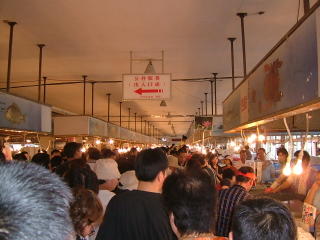 When Michael and his family went, there weren't many people there. But by the time we got there...
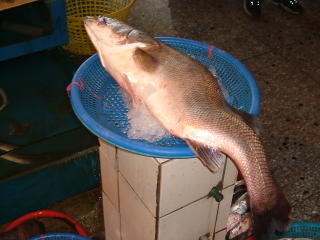
This fish was just taking a rest--I think it had heat stroke, like I had.
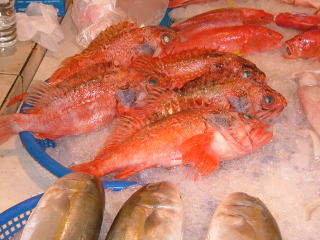
These fellas look kind of prehistoric... From what I could find on the web, they're called "Chikamekintoki" in Japanese...
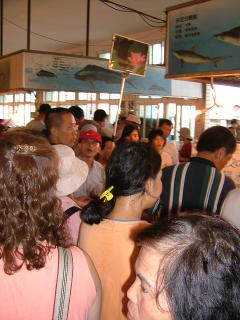
There were some devout Buddhists at the fish market today, buying (and asking other people to buy) live fish so they could release them back into the water. They didn't appear particularly successful... (They're the people in the back holding up the red sign with a picture of a lotus on it.)
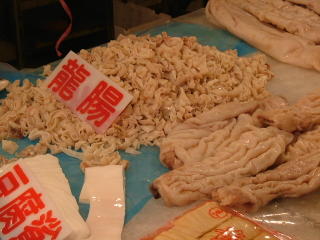
"Dragon's Intestines"--actually the intestines of mambo fish.
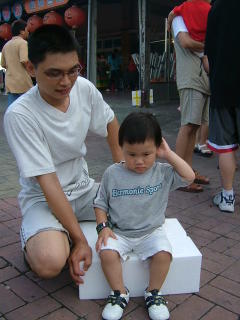
Our nephew found another use for the styrofoam coolers Michael mentions...
OK. What's our next outing gonna be, Michael? (heh)
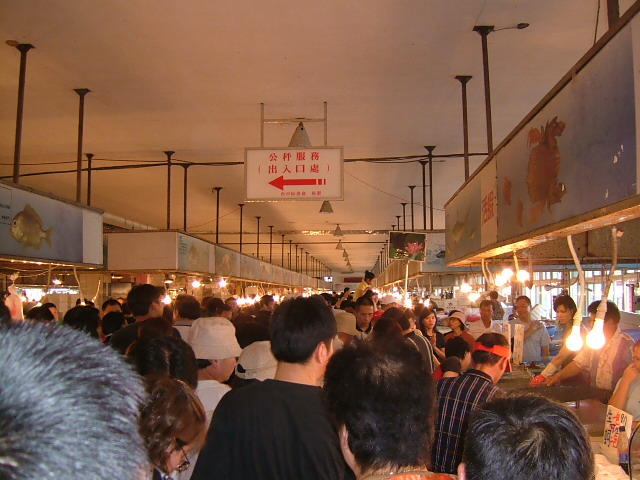 When Michael and his family went, there weren't many people there. But by the time we got there...
This fish was just taking a rest--I think it had heat stroke, like I had.

These fellas look kind of prehistoric... From what I could find on the web, they're called "Chikamekintoki" in Japanese...
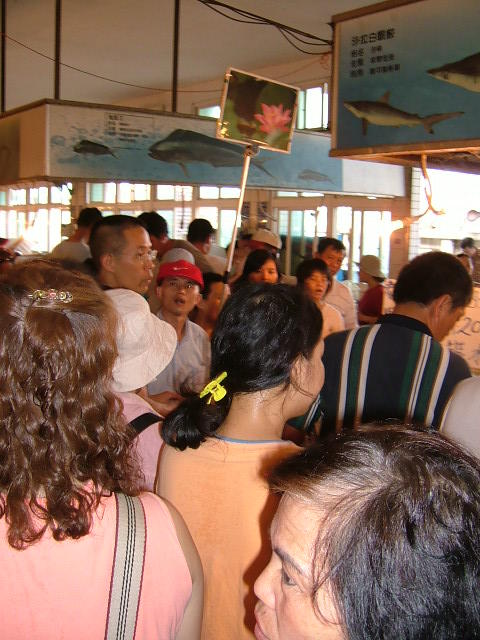
There were some devout Buddhists at the fish market today, buying (and asking other people to buy) live fish so they could release them back into the water. They didn't appear particularly successful... (They're the people in the back holding up the red sign with a picture of a lotus on it.)

"Dragon's Intestines"--actually the intestines of mambo fish.
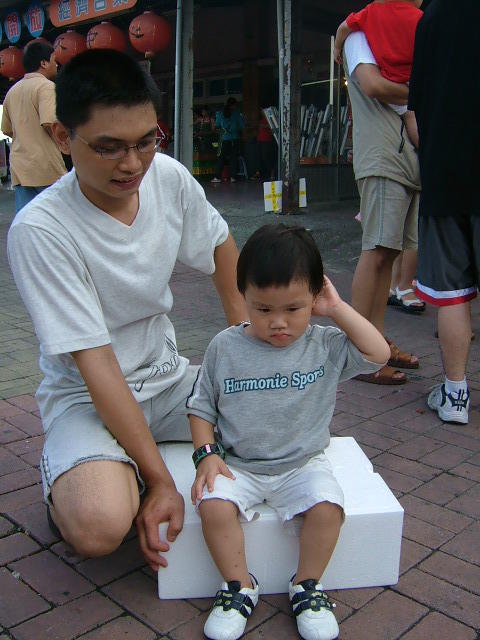
Our nephew found another use for the styrofoam coolers Michael mentions...
OK. What's our next outing gonna be, Michael? (heh)
Saturday, June 25, 2005
Another interview about Taiwan
Konrad Lawson, on his blog Muninn, relates a chat he had with an elderly Taiwanese couple at a coffee shop in Taipei. They talked mostly in Japanese. It's an interesting read. Here's one paragraph to pique your interest:
When the war ended and Taiwan reverted to the control of Nationalist Chinese forces, he finished his high school education in Taipei though all of his classes switching suddenly from Japanese to Chinese. The couple said that the switch was particularly difficult for elementary school teachers who had to study Chinese via the radio and change their materials from Japanese to Chinese, while junior and high school teachers came largely from China. After graduating the husband was accepted to and went to Zhongyang University in Nanjing after turning down an offer from Taiwan National University. The year was 1948 and within only a few months of starting college, he would be fleeing Nanjing with the rest of the Nationalist government and his fellow students as the Nationalist forces started crumbling in the face of Communist advances.
Link to the former native speaker's abode
I found our apartment complex (or "community," as they often call it here) using Google's satellite images: here it is, in case you're interested. We're in the building in the middle of the picture. Tunghai University is here, with the FLLD building in the middle (the big building to the far left that looks like a rectangular donut is the university library).
By the way, I heard on the news that Taiwan's government is worried about the easy availability of satellite images of the island. They're worried that our enemies will be able to get free images of Taiwan's military bases through Google Maps.
[Update, 10:06 p.m.: Also took a trip to China--I think this is the Forbidden City, right?]
By the way, I heard on the news that Taiwan's government is worried about the easy availability of satellite images of the island. They're worried that our enemies will be able to get free images of Taiwan's military bases through Google Maps.
[Update, 10:06 p.m.: Also took a trip to China--I think this is the Forbidden City, right?]
Friday, June 24, 2005
Amazing!
Am listening to an interview I did yesterday, using my MP3 player for the first time. It is SO clear! I'll never go back to bulky cassette recorders...
And the interview went quite well, too--the interviewee was able to take a lot of my "yes-no" questions (note: don't ask so many yes-no questions next time!) and talk for quite a while on them. I got a lot of good stories, too, that will make my dissertation not so dry. He was definitely better at being interviewed than I was at interviewing!
And the interview went quite well, too--the interviewee was able to take a lot of my "yes-no" questions (note: don't ask so many yes-no questions next time!) and talk for quite a while on them. I got a lot of good stories, too, that will make my dissertation not so dry. He was definitely better at being interviewed than I was at interviewing!
Preparing for ISHR
I found out Tuesday afternoon that Tunghai has accepted my proposal for a travel grant to present a paper at the conference of the International Society for the History of Rhetoric. I was a little worried I wouldn't get the grant because, as you can see from my abstract, I'm not going to be talking about English teaching. (Actually, I could probably make a decent argument that it relates to the work we do in the intercultural communication class I teach here.) So I'm grateful to Tunghai for agreeing to help foot the bill for my trip to LA in July.
I'm shortening the paper to focus mainly on post-war Taiwan because I don't think I could cover both colonial and post-war Taiwan adequately in a 20-minute presentation. (I found out in April how hard it was to cover to any depth a few presidential inaugurals in 20 minutes!) The paper explores some issues pertaining to how the KMT government defined the Chineseness that it encouraged (or perhaps "coerced" is a better word in some cases) the people of Taiwan to identify with--specifically, "Chinese" as equal to "citizen of the Republic of China, temporarily exiled to the island of Taiwan but diligently at work on recovering the nation from the Russian Communists and their puppet Mao Zedong" (or something along those lines). I'm arguing that in order to have an understanding of the complexities of 20th-century Chinese rhetoric, it's necessary to look at competing notions of Chineseness rather than focusing only on rhetoric that is considered Chinese simply because it is produced on the Chinese mainland--though admittedly, the mainland figures prominently into the notions of Chineseness that the KMT on Taiwan emphasized. I argue that it's important to pay attention both to the claims the KMT government made about how it represented the last bastion of true Chineseness in the world, and to the "contents" of the Chineseness that the R.O.C. on Taiwan represented. (Why, for instance, some Republican era Chinese writers and thinkers were acceptable and others, such as Lu Xun, weren't. Or why some aspects of language simplification were acceptable and others weren't.) The main angle on this that I will take is how what I call "the rhetoric of Chineseness" was fundamental to educational theory and practice in early martial-law Taiwan, particularly in terms of learning to use language/rhetoric. Learning was in large part, as Richard Wilson wrote 35 years ago, "learning to be [a particular kind of] Chinese" or learning to speak and write as a particular kind of Chinese.
Most of what I will have to say would probably be no surprise to anyone who has lived in Taiwan for a while (and hasn't been asleep the whole time) or has read about Taiwan. (In fact, there's some interesting material at--of course!--Scott's blog about some of this.) But Taiwan hasn't had much representation, to my knowledge, at international rhetoric conferences, though there have been some good articles on Taiwan in NCA/Sage's Intercultural and International Communication Annual (see here for links to tables of contents). In fact, while there are about half a dozen scholars from the mainland who will be at ISHR, I'm the only one I know of who is coming from Taiwan. (A-chin Hsiau of the Academia Sinica was going to present what looked like an interesting paper, but won't be there.) So again I'm in the odd position of being the "foreigner" representing Taiwan at an international conference. Hope that's not always the case...
I'm shortening the paper to focus mainly on post-war Taiwan because I don't think I could cover both colonial and post-war Taiwan adequately in a 20-minute presentation. (I found out in April how hard it was to cover to any depth a few presidential inaugurals in 20 minutes!) The paper explores some issues pertaining to how the KMT government defined the Chineseness that it encouraged (or perhaps "coerced" is a better word in some cases) the people of Taiwan to identify with--specifically, "Chinese" as equal to "citizen of the Republic of China, temporarily exiled to the island of Taiwan but diligently at work on recovering the nation from the Russian Communists and their puppet Mao Zedong" (or something along those lines). I'm arguing that in order to have an understanding of the complexities of 20th-century Chinese rhetoric, it's necessary to look at competing notions of Chineseness rather than focusing only on rhetoric that is considered Chinese simply because it is produced on the Chinese mainland--though admittedly, the mainland figures prominently into the notions of Chineseness that the KMT on Taiwan emphasized. I argue that it's important to pay attention both to the claims the KMT government made about how it represented the last bastion of true Chineseness in the world, and to the "contents" of the Chineseness that the R.O.C. on Taiwan represented. (Why, for instance, some Republican era Chinese writers and thinkers were acceptable and others, such as Lu Xun, weren't. Or why some aspects of language simplification were acceptable and others weren't.) The main angle on this that I will take is how what I call "the rhetoric of Chineseness" was fundamental to educational theory and practice in early martial-law Taiwan, particularly in terms of learning to use language/rhetoric. Learning was in large part, as Richard Wilson wrote 35 years ago, "learning to be [a particular kind of] Chinese" or learning to speak and write as a particular kind of Chinese.
Most of what I will have to say would probably be no surprise to anyone who has lived in Taiwan for a while (and hasn't been asleep the whole time) or has read about Taiwan. (In fact, there's some interesting material at--of course!--Scott's blog about some of this.) But Taiwan hasn't had much representation, to my knowledge, at international rhetoric conferences, though there have been some good articles on Taiwan in NCA/Sage's Intercultural and International Communication Annual (see here for links to tables of contents). In fact, while there are about half a dozen scholars from the mainland who will be at ISHR, I'm the only one I know of who is coming from Taiwan. (A-chin Hsiau of the Academia Sinica was going to present what looked like an interesting paper, but won't be there.) So again I'm in the odd position of being the "foreigner" representing Taiwan at an international conference. Hope that's not always the case...
Tuesday, June 21, 2005

Friday, June 17, 2005
Link smorgasbord, with a picture of my dog thrown in for good measure
I've been playing around with Technorati tags for my posts, but I have a feeling this is going to defy any tag besides "miscellany"...
First the links--they're from my Bloglines feeds (which I'll make public one of these days, when I get around to it), so I want to post them here for future reference. In no particular order:
And now for Mei-mei:

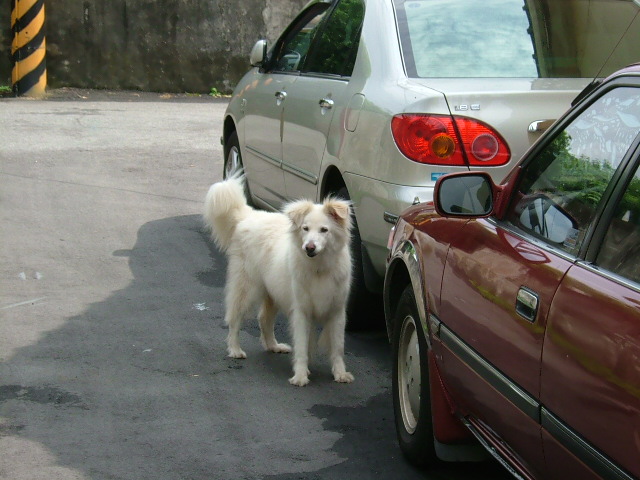
Mei-mei, who lives with her "grandparents" in Hsin-she, likes to hang out around our car when we visit. She always looks forward to going on rides with us, even though those rides usually end up at the vet's where she gets her blood sugar checked...
First the links--they're from my Bloglines feeds (which I'll make public one of these days, when I get around to it), so I want to post them here for future reference. In no particular order:
- Alan Baumler discusses "[t]he question of China's existence or non-existence in the eyes of foreigners" on 井底之蛙, The China History Group Blog
- Shannon Parker of tonari no shibafu summarizes his sensei's advice on how to be a Japanese intellectual history scholar
- Clancy Ratliff of CultureCat browses MIT's OpenCourseWare and find some cool things on writing, feminism, new media studies, etc.
- Issues in Scholarly Communication notes Yahoo!'s new deep Web searching services, and
- ISC also excerpts an editorial from Library & Information Science Research on open access to research
And now for Mei-mei:
Mei-mei, who lives with her "grandparents" in Hsin-she, likes to hang out around our car when we visit. She always looks forward to going on rides with us, even though those rides usually end up at the vet's where she gets her blood sugar checked...

Alex Reid on assessment at SUNY
Came across a post by Alex Reid on "SUNYwide assessment and the failure of composition" that critiques the school's rubric for assessing the teaching of writing. Interesting...
Monday, June 13, 2005
A pile of grading to do + a temperamental online faculty information system =
teeth-grinding frustration + a brief hiatus from blogdom.
Friday, June 10, 2005
Don't know why I have time to do these things...
| Your IQ Is 120 |
 Your Logical Intelligence is Above Average Your Verbal Intelligence is Genius Your Mathematical Intelligence is Exceptional Your General Knowledge is Exceptional |
Some blog entries on mentoring
There are a couple of interesting posts about mentoring over at the blog of the Synecdochic Prof (not to be confused with Schenectady Synecdoche--hmmm... wonder if they know each other?).
I'm particularly interested in this subject because I tried (unsuccessfully) to get a mentoring program started in my department. One of the reasons it failed was that a lot of people (including junior faculty) didn't feel a formal program was necessary--enough mentoring is done informally, I guess.
I'm particularly interested in this subject because I tried (unsuccessfully) to get a mentoring program started in my department. One of the reasons it failed was that a lot of people (including junior faculty) didn't feel a formal program was necessary--enough mentoring is done informally, I guess.
Thursday, June 09, 2005
Study on scientific misconduct
Issues in Scholarly Communication links to a study reported in the Chronicle of Higher Education that found that a third of respondents to a survey about scientific misconduct in the U.S. admitted to having "engaged in actions such as overlooking others' use of flawed data, failing to present data contradicting one's own work, and circumventing minor requirements of human-subject research."
The original article from Nature, entitled "One in three scientists confesses to having sinned" (written by Meredith Wadman), is available online (for how long, I don't know). It quotes Brian Martinson, who conducted the survey with colleagues at the HealthPartners Research Foundation, as saying that "'[t]he majority of misbehaviours reported to us are more corrosive than explosive,'" but also that they are still a serious matter.
Martinson, according to Nature,
The original article from Nature, entitled "One in three scientists confesses to having sinned" (written by Meredith Wadman), is available online (for how long, I don't know). It quotes Brian Martinson, who conducted the survey with colleagues at the HealthPartners Research Foundation, as saying that "'[t]he majority of misbehaviours reported to us are more corrosive than explosive,'" but also that they are still a serious matter.
Martinson, according to Nature,
thinks the main cause of all the questionable behaviour is the increasing pressure that scientists are under as they compete to publish papers and win grants. "We need to think about the working conditions in science that can be addressed," he says, suggesting better salaries and employment conditions for young scientists, and a more transparent peer-review process.The U.S. government, evidently, has a policy of only policing "fabrication, falsification and plagiarism" and does not concern itself with other types of misconduct like the ones mentioned above. The article concludes,
Martinson and his colleagues say their study is the first attempt to quantify such activities. They hope their results will persuade scientists to stop ignoring the wider range of misbehaviour.
Tuesday, June 07, 2005
More on research in the UK (and, by extension, Taiwan)
Chris Bertram at Crooked Timber cites an article by Jonathan Wolff about "the distorting effects" of the funding of humanities research on the research itself. The original article, from the Guardian, is here and the Crooked Timber discussion is here.
One paragraph from Wolff's article that I think is quotable concerns how the AHRC (the Arts and Humanities Research Board), which gives out the grants and evaluates the research results,
One paragraph from Wolff's article that I think is quotable concerns how the AHRC (the Arts and Humanities Research Board), which gives out the grants and evaluates the research results,
wants to reassure itself that it is funding work of the highest international standards. How can you demonstrate this? Not easily. Citation rates rely on quickfire take-up of ideas in the peer-reviewed literature; fine in the sciences but poor in the humanities, where response time is more measured. And anyway, published citation rates ignore mentions in monographs and book chapters, which remain central to the humanities.This reminds me of the situation in the humanities in Taiwan.
Monday, June 06, 2005
Ranking publications
At the Valve, Matt Greenfield muses about how research is evaluated in Britain and (in at least one school) in the U.S.
Sunday, June 05, 2005
Grumble grumble
Tunghai's computer center picked the dumbest of all possible times to make major changes to the school's web and e-mail service. So now my "official" website is offline until I can find time to figure out what they've done.
[Update at 6:19 p.m.: I've moved the my official homepage over to the new server, but have to do some editing to get it all looking the way it should be. But I don't have time to do that right now, so it'll have to stay ugly for a while...]
[Update at 6:19 p.m.: I've moved the my official homepage over to the new server, but have to do some editing to get it all looking the way it should be. But I don't have time to do that right now, so it'll have to stay ugly for a while...]
Saturday, June 04, 2005
Wednesday, June 01, 2005
The Peking Duck on Singlish
There's a nice discussion going on at the Peking Duck on Singapore English, the bane of Lee Hsien Loong's existence, evidently (Singapore English, that is, not the Peking Duck).
Monday, May 30, 2005
'Nother useful blog entry I have no time to comment on
Earth Wide Moth's notes on readings from the genre theory class he's taking this summer. Hope to see more of these, since I can't be there in person (*sniff*).
[Update: here's a link to Derek's genre studies category.]
['Nother Update: Baron Miguel Secluna is also blogging the course. Way to go, Baron... er... sir?]
[Update: here's a link to Derek's genre studies category.]
['Nother Update: Baron Miguel Secluna is also blogging the course. Way to go, Baron... er... sir?]
Sunday, May 22, 2005
Taking a break
I've got a couple of projects to get done between now and the end of June, so my blogging will be light-to-nonexistent until then. (If I can control myself!)
Saturday, May 21, 2005
Bookmarks--no time for comments
- Areté on "non-western authorship"
- EastSouthWestNorth on "The Lies That The Elders Told"
- Rhetorica: Press-Politics Journal on "Unremarkable illogic..."
Friday, May 20, 2005
Teaching vs. research universities revisited
In blog-time, this is slightly old news, but I'll post it anyway:
Does this relate in some way to the issue of classifying Taiwan's universities into research universities and teaching universities? It seems to--judging from this May 8 China Times article that mentions that some schools had already received grants from a plan to promote research universities (「推動研究型大學整合計畫」), so they were disqualified from competition for the grants that Tunghai and the other 12 universities got.
Interestingly, the same article concludes,
[Update, 2:42 p.m.: Perhaps that last question doesn't get at the real issue, which is the role the MOE should or shouldn't have in promoting universities as places of high-quality (undergraduate) education as well as institutes of high-quality research. Direct injections of money to support innovative teaching plans are one approach, but not the only one.]
MOE Grants 90M to THU
May 7, 2005
90 million NT dollars was granted to Tunghai University by the Ministry of Education. THU ranked no. 3 after the MOE reviewed the Teaching and Learning Plans from 54 universities. Twelve other universities benefited from the 1 billion NTD subsidy.
THU President Haydn Chen thanked Dr. Cheng-Tung Lin, Dean of Academic Affairs, as well as, all faculty and staff for the work and effort that was put into producing the Teaching and Learning Plan. President Chen said, "Education is an ongoing affair. At present universities are putting too much emphasis on research, leaving the teaching and learning facet as secondary. Our school cares for general education emphasizing on holistic education for the development of the ideal student."
(Source: Tunghai's website)
Does this relate in some way to the issue of classifying Taiwan's universities into research universities and teaching universities? It seems to--judging from this May 8 China Times article that mentions that some schools had already received grants from a plan to promote research universities (「推動研究型大學整合計畫」), so they were disqualified from competition for the grants that Tunghai and the other 12 universities got.
Interestingly, the same article concludes,
教育部指出,近年國內大學普遍「重研究、輕教學」,對高等教育發展不利。「獎勵大學卓越計畫」是要幫助大學提升教學,如果成效不錯,明年經費將擴增為五十億元,更多教學型大學可以受惠。The MOE complains about the overemphasis on research at the expense of teaching, but it seems to be talking out of both sides of its mouth here, considering its hand in encouraging the heavy emphasis on research. (As Scott has mentioned, the MOE plays a major role in the promotion of faculty members of Taiwan's universities.) It's nice to see an attempt at establishing a balance, though. On the other hand, I'm a little worried that the balance will be between research universities (with their more easily quantifiable results) and teaching universities (with their less quantifiable, potentially more subjective results). In the long run, where will more of the money go?
[Update, 2:42 p.m.: Perhaps that last question doesn't get at the real issue, which is the role the MOE should or shouldn't have in promoting universities as places of high-quality (undergraduate) education as well as institutes of high-quality research. Direct injections of money to support innovative teaching plans are one approach, but not the only one.]
More fun with SSCI
Clyde and I have been having a nice chat over on Scott's blog about the uses of the SSCI in Taiwan, and Scott himself has thrown his two cents' in, too (well, it's his blog--of course he has!).
The line that I got the biggest kick out of is the beginning of the third paragraph: "No one would deny, not even Jonathan Benda, that publication in an SSCI journal is a major accomplishment in a research career." I don't know if I'm supposed to take this as a sign that I'm becoming infamous for disagreeableness, but if so, well, I'll try to take it as a compliment.
At any rate, I do agree that publication in an SSCI journal (or, say an A&HCI journal, etc.--depending on your field) is a big achievement in a researcher's career. But... well, check out Scott's blog for more of my crazy comments.
The line that I got the biggest kick out of is the beginning of the third paragraph: "No one would deny, not even Jonathan Benda, that publication in an SSCI journal is a major accomplishment in a research career." I don't know if I'm supposed to take this as a sign that I'm becoming infamous for disagreeableness, but if so, well, I'll try to take it as a compliment.
At any rate, I do agree that publication in an SSCI journal (or, say an A&HCI journal, etc.--depending on your field) is a big achievement in a researcher's career. But... well, check out Scott's blog for more of my crazy comments.
Monday, May 16, 2005
A cultural *what*??!!
You scored as Cultural Creative. Cultural Creatives are probably the newest group to enter this realm. You are a modern thinker who tends to shy away from organized religion but still feels as if there is something greater than ourselves. You are very spiritual, even if you are not religious. Life has a meaning outside of the rational.
What is Your World View? (corrected...hopefully) created with QuizFarm.com |
Saturday, May 14, 2005
More pictures from Ghent
I've got a lot of pics, but it has taken me forever to get around to posting them. And most of them are of old buildings... (Duh!) But here are some pictures.
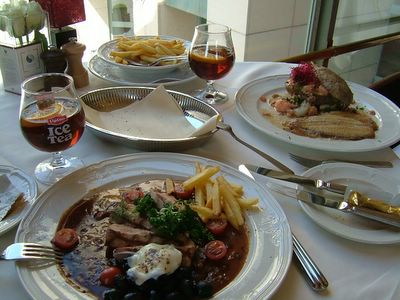
This fortified me for presenting my paper... (No pics of me--I ate too much.)

Guess what's special about these shoes...
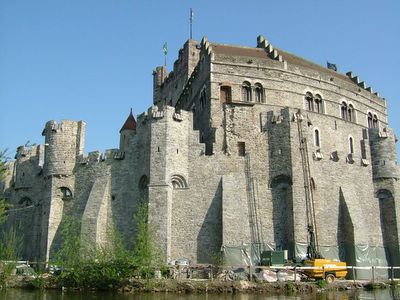
Gravensteen, a 12th-century castle in the middle of Ghent. Taken from a tour boat on the Leie River. Gravensteen has an (ahem) interesting collection of torture instruments on display. There was one where they'd strap someone to a wooden bed and put his meals on a table, just slightly out of reach. (Someone should have done that to me while I was there...)

This fortified me for presenting my paper... (No pics of me--I ate too much.)

Guess what's special about these shoes...

Gravensteen, a 12th-century castle in the middle of Ghent. Taken from a tour boat on the Leie River. Gravensteen has an (ahem) interesting collection of torture instruments on display. There was one where they'd strap someone to a wooden bed and put his meals on a table, just slightly out of reach. (Someone should have done that to me while I was there...)
Friday, May 13, 2005
Enough with the rain already!
Nine o'clock in the evening. It's been raining HARD since yesterday. Living at the top of Dadu Hill (I'm refusing to call it a mountain) helps keep our home dry, but some folks in other parts of Taiwan (Hsinchu, Miaoli, Yunlin, for instance) aren't quite as lucky.

This shot, from the United Daily News, is from Hsinchu.
This shot, from the United Daily News, is from Hsinchu.
Thursday, May 12, 2005
Guóyǔ (國語) as prerequisite to citizenship
Mark Swofford's Pinyin News reflects on a Taipei Times report regarding a proposed language requirement for foreign nationals wishing to become Taiwan (R.O.C.--so far) citizens. The Times article refers to "a basic grasp of Mandarin," but when Swofford checked with the Ministry of the Interior, he was told other Taiwan languages (Hakka, Minnan, and possibly Aboriginal languages) would be acceptable alternatives. Swofford comments,
I suspect some of the ambiguity may lie in how Guóyǔ (國語) is translated. Most of the time the word refers to Mandarin. Recently, however, the government has occasionally chosen to translate Guóyǔ not as "national language" (i.e. Mandarin) but "national languages" (i.e. the more than one dozen languages of Taiwan: Mandarin, Taiwanese, Hakka, and the languages of Taiwan's tribes).
Tuesday, May 10, 2005
Boston--a land of contradictions
a better tomorrow has a nice post about the use of the phrase "land of contradictions" in much (too much) travel writing. His parody of a travel article is worth quoting (check out the whole thing here):
Boston is indeed a land of contrasts and contradictions. Meander along any of its cobblestone streets and you can feel the deep Puritan spirituality of the people. But walk through the bustling business district, and you can feel the vibrant pulse of one of America's oldest cities trying to adapt to its status as a newfound economic powerhouse. ...Unfortunately, this is unlikely to happen in any English-language travel guide. But I haven't checked out any Chinese travel guides lately. Maybe they have their own version of this.
Sunday, May 08, 2005
How to distinguish foreigners from Americans
Some little kids noticed me when I got out of my brother-in-law's car near my in-laws' house Sunday afternoon. One of the kids yelled, "Foreigner! Foreigner!" in Chinese to his siblings and parents. Another kid said to him, "He's not a foreigner, he's an American. The ones with long noses are Americans."
Monday, May 02, 2005
On defining rhetoric at family reunions and other awkward occasions
This is not quite in response to a request by Paul Stob at the Blogora for a "quick" definition of rhetoric for use at family-type gatherings:
When I went to my first Rhetoric Society of America conference in 1998 they were selling a cool T-shirt with the heading "What is rhetoric, anyway?", followed by a bunch of definitions on the back, including Aristotle's "the faculty of discovering in any given case the available means of persuasion", I. A. Richards's "the study of misunderstanding and its remedies", George Campbell's "that art or talent by which discourse is adapted to its end", and Kenneth Burke's "[t]he use of language as a symbolic means of inducing cooperation in beings that by nature respond to symbols", among others. I wore this T-shirt with pride and would point to the back of it whenever someone asked me what I was studying. (To be honest, it also helped me define for myself exactly what it was I was supposed to be studying. And to be honest, I think the definitions helped me a lot more than they helped those asking me what rhetoric is.)
Unfortunately, after many washings, the definitions of rhetoric faded away and in the end, I was left with a T-shirt that only asked, "What is rhetoric, anyway?" Oddly appropriate that all the definitions of rhetoric would self-destruct like that, leaving me again to my own devices.
[Cross-posted as a comment to the Blogora]
When I went to my first Rhetoric Society of America conference in 1998 they were selling a cool T-shirt with the heading "What is rhetoric, anyway?", followed by a bunch of definitions on the back, including Aristotle's "the faculty of discovering in any given case the available means of persuasion", I. A. Richards's "the study of misunderstanding and its remedies", George Campbell's "that art or talent by which discourse is adapted to its end", and Kenneth Burke's "[t]he use of language as a symbolic means of inducing cooperation in beings that by nature respond to symbols", among others. I wore this T-shirt with pride and would point to the back of it whenever someone asked me what I was studying. (To be honest, it also helped me define for myself exactly what it was I was supposed to be studying. And to be honest, I think the definitions helped me a lot more than they helped those asking me what rhetoric is.)
Unfortunately, after many washings, the definitions of rhetoric faded away and in the end, I was left with a T-shirt that only asked, "What is rhetoric, anyway?" Oddly appropriate that all the definitions of rhetoric would self-destruct like that, leaving me again to my own devices.
[Cross-posted as a comment to the Blogora]
Sunday, May 01, 2005
The dreaded reading meme
I've been avoiding responding to the 9th grade Tuba Player's mention of me in her response to the reading meme. But I figure I'll need to respond sooner or later...
You're stuck inside Fahrenheit 451. What book do you want to be?
To be honest, I've never read Fahrenheit 451, but I did look up the book on (*gasp*) SparkNotes (don't tell anyone). Sounds like an interesting book that I'll probably not be able to read for a good long time. So maybe I'd like to be Fahrenheit 451 if I were stuck in Fahrenheit 451...
Have you ever had a crush on a fictional character?
Princess Leia--not Carrie Fisher, mind you, but Princess Leia from the Star Wars book. (When Star Wars came out, I was only 9 and I wasn't allowed to see it, so I read the book. Actually, when I got to see the movie years later, I was very disappointed. The book was better...)
The last book you bought is?
The Content of the Form: Narrative Discourse and Historical Representation by Hayden White.
What are you currently reading?
The Content of the Form, Is Taiwan Chinese? by Melissa J. Brown, Between Assimilation and Independence by Stephen Phillips, and a bunch of Research Methods proposals.
Five books you would take to a desert island:
I like 9th Grade's choice of the U.S. Army Survival Manual. In addition to that, I would take the Bible (maybe I'd finally be able to read the whole thing, something that 30 years of church-going hasn't been able to get me to do), Black Athena volumes 1 and 2 by Martin Bernal (another work I've been trying to read for years), The English Patient by Michael Ondaatje (I read it every summer), and (heh heh) a blank diary (hope that's not cheating!).
Who are you going to pass this stick to and why?
1. last updated, because he probably read Fahrenheit 451 during his science fiction phase
2. ERG, 'cause he's judicious and even-tempered (though he doesn't have a blog--use the comments function!)
3. Clyde Warden, who also doesn't have a blog (probably because, unlike me, he has a life!), because he's such an eclectic reader
You're stuck inside Fahrenheit 451. What book do you want to be?
To be honest, I've never read Fahrenheit 451, but I did look up the book on (*gasp*) SparkNotes (don't tell anyone). Sounds like an interesting book that I'll probably not be able to read for a good long time. So maybe I'd like to be Fahrenheit 451 if I were stuck in Fahrenheit 451...
Have you ever had a crush on a fictional character?
Princess Leia--not Carrie Fisher, mind you, but Princess Leia from the Star Wars book. (When Star Wars came out, I was only 9 and I wasn't allowed to see it, so I read the book. Actually, when I got to see the movie years later, I was very disappointed. The book was better...)
The last book you bought is?
The Content of the Form: Narrative Discourse and Historical Representation by Hayden White.
What are you currently reading?
The Content of the Form, Is Taiwan Chinese? by Melissa J. Brown, Between Assimilation and Independence by Stephen Phillips, and a bunch of Research Methods proposals.
Five books you would take to a desert island:
I like 9th Grade's choice of the U.S. Army Survival Manual. In addition to that, I would take the Bible (maybe I'd finally be able to read the whole thing, something that 30 years of church-going hasn't been able to get me to do), Black Athena volumes 1 and 2 by Martin Bernal (another work I've been trying to read for years), The English Patient by Michael Ondaatje (I read it every summer), and (heh heh) a blank diary (hope that's not cheating!).
Who are you going to pass this stick to and why?
1. last updated, because he probably read Fahrenheit 451 during his science fiction phase
2. ERG, 'cause he's judicious and even-tempered (though he doesn't have a blog--use the comments function!)
3. Clyde Warden, who also doesn't have a blog (probably because, unlike me, he has a life!), because he's such an eclectic reader

Friday, April 29, 2005
Some of my notes from Hayden White's 4/21 talk in Ghent
The title of White's plenary at the Rhetoric, Politics, Ethics conference was "Historicality as a Trope of Political Discourse." I wrote down a few, probably not very helpful, notes about what he had to say:
White said that rhetoric "used to be the theory of the political uses of language." He felt that the separation of history from rhetoric [or rhetoric from history?], which was meant to make history into a science, "deprived it [history] of sources of invention and of literary sensibility" (rough quote). History as science separated history from philosophy and detaching history from rhetoric "deprived it of a theory of composition", which gave rise to the myth that history is found in materials, not the writing of it. White also spoke of the "domestication of historical sensibility" and of the current belief that historical empirical details give rise to the form as well as the content of history. [Some of these ideas remind me of White's The Content of the Form, which I've been reading lately.]
White cited Hume's Essays Moral and Political, where Hume argued that the relationship between ethics and politics couldn't be dealt with conceptually because of the separation of "is" from "ought" [that you can't get from statements about what is to ethical statements about what ought to be]. But, said White, Hume didn't see that rhetoric "is precisely the discourse that examines the anomolies [? can't read my handwriting] of trying" to bring together "is" and "ought." White described rhetoric as a "theory of trope" or "tropology", which he characterized as how "turns" are used to move "from statements of fact to statements of 'ought'" (and not just from the literal to the figurative).
White characterized rhetoric, ethics, and politics in a humorous formula:
White said that rhetoric "used to be the theory of the political uses of language." He felt that the separation of history from rhetoric [or rhetoric from history?], which was meant to make history into a science, "deprived it [history] of sources of invention and of literary sensibility" (rough quote). History as science separated history from philosophy and detaching history from rhetoric "deprived it of a theory of composition", which gave rise to the myth that history is found in materials, not the writing of it. White also spoke of the "domestication of historical sensibility" and of the current belief that historical empirical details give rise to the form as well as the content of history. [Some of these ideas remind me of White's The Content of the Form, which I've been reading lately.]
White cited Hume's Essays Moral and Political, where Hume argued that the relationship between ethics and politics couldn't be dealt with conceptually because of the separation of "is" from "ought" [that you can't get from statements about what is to ethical statements about what ought to be]. But, said White, Hume didn't see that rhetoric "is precisely the discourse that examines the anomolies [? can't read my handwriting] of trying" to bring together "is" and "ought." White described rhetoric as a "theory of trope" or "tropology", which he characterized as how "turns" are used to move "from statements of fact to statements of 'ought'" (and not just from the literal to the figurative).
White characterized rhetoric, ethics, and politics in a humorous formula:
- rhetoric=what can I say?
- ethics=what should I do?
- politics=what can I get away with?
Lien Chan's speech at Beijing University
My wife and I just finished watching a rebroadcast of Lien Chan's "historic" speech at Beida and came to the conclusion that one of his main points ran along the lines of "what a great man I am to have come to the mainland and to Beida". His speech was full of quotes from the leaders of different countries (Churchill, for instance, and Reagan's [ugh] "If not us, then who? If not now, then when?") that would make you think, if you didn't know better, that Lien was a national leader himself. (The Reagan quote came near the end of the speech, and Lien connected it to his reasons for being in China.)
He also got some shots in on the DPP and TSU, criticizing their ideas as still being in the 20th century. (Which is kind of ironic--I thought half the 20th century in Taiwan was dominated by a political party that spent a lot of its time thinking about how it would retake the mainland...) Altogether it looked like it was lapped up by the Beida audience (even though Lien did imply at one point that a lot of the intellectual giants of Beida, like Hu Shih and Fu Ssu-nien, escaped to Taiwan after 1949... ahem...).
He also got some shots in on the DPP and TSU, criticizing their ideas as still being in the 20th century. (Which is kind of ironic--I thought half the 20th century in Taiwan was dominated by a political party that spent a lot of its time thinking about how it would retake the mainland...) Altogether it looked like it was lapped up by the Beida audience (even though Lien did imply at one point that a lot of the intellectual giants of Beida, like Hu Shih and Fu Ssu-nien, escaped to Taiwan after 1949... ahem...).
Subscribe to:
Posts (Atom)