Showing posts with label postwar Japan. Show all posts

Thursday, June 18, 2020

Driving in Postwar Japan

I started watching The Warped Ones on Turner Classic Movies tonight. I couldn't sit through the whole thing, but I did get curious about where it was filmed in Japan. A scene early on shows the two released criminals Akira and Masaru stealing a car, and I noticed that the steering wheel was on the left-hand side and they were driving on the right-hand side of the road (as was everyone else). Here's one scene of the guy (Masaru?) breaking into the car:


So my question is, I thought that in Japan, steering wheels were on the right-hand side and they drove on the left. I did a little Googling research and found that while Okinawa was still under US military rule, people there were required to drive on the right, but I didn't see anything about whether that was the case in the rest of Japan, especially around 1960 when the movie was made. Does anyone have any ideas about this? Does this movie take place in Okinawa?

[Update, 6/20/20: I forced myself to watch the rest of this, and there's a bit of dialogue where someone says, "The steering wheel's on the other side." The response to that: "It's a foreign car." So my question is sort of answered there. I also read somewhere that the movie was filmed in Tokyo. But I'm still confused by what I thought I saw was other people driving on the right-hand side fo the road... Maybe I was wrong about the whole thing--just saw people driving on the left-hand side. guess this blog post was much ado about nothing!]

Sunday, February 09, 2020

Grajdanzev's publications available online

Here together are links to the books by Grajdanzev that are available online, since print versions are usually expensive (or undependable if you buy facsimile editions):

Grajdanzev, Andrew J. Formosa Today: An Analysis of the Economic Development and Strategic Importance of Japan's Tropical Colony. International Secretariat, Institute of Pacific Relations, 1942. (limited to search-only)

Grajdanzev, Andrew J. Korea Looks Ahead. IPR Pamphlets No. 15, American Council, Institute of Pacific Relations, 1944. (pdf)

Grajdanzev, Andrew J. Modern Korea. John Day, 1944. (See below)

Grad, Andrew J. Land and Peasant in Japan: An Introductory Survey. International Secretariat, Institute of Pacific Relations, 1952. (See below)


Still not found online (links are to WorldCat):
Grajdanzev, Andrew J. The External Trade of Manchuria, 1928-1935: An Analysis. N.p., 1936.

Grajdanzev, Andrew J. (comp.). Statistics of Japanese Agriculture, with Introductory Notes. International Secretariat, Institute of Pacific Relations, 1941.

Grajdanzev, Andrew J. The Economic Development of Formosa. Shanghai: Kelly and Walsh, 1941.

Grajdanzev, Andrew J. Memorandum on Politics and Government in Korea. International Secretariat, Institute of Pacific Relations, 1942.

Grajdanzev, Andrew J. Economic Planning in India. Institute of Pacific Relations, 1945.


Saturday, February 08, 2020

A little more about Andrew Grajdanzev in Occupied Japan

Came across a couple of references to Andrew Grajdanzev in Eiji TAKEMAE's The Allied Occupation of Japan (translated and adapted from the Japanese by Robert Ricketts and Sebastian Swann), Continuum, 2002.

In regard to McArthur's SCAP special staff sections:
Lieutenant Colonel Cecil G. Tilton, Chief of Local Government Division, made a singular contribution to the reform of local administration. Holding a BS and MSc from the University of California (Berkeley) and an MBA from Harvard, he had taught at the Universities of Hawai'i and Connecticut before entering the Army. After training at the University of Virginia School of Military Government, he was recruited to teach at the University of Chicago CATS [Civil Affairs Training School]. Tilton was assisted initially by John W. Maseland of Dartmouth College and Andrew J. Grajdanzev, an ardent advocate of decentralization and home rule. Grajdanzev later played a role in drafting SCAP's land-reform programme. Tilton followed Local Government Division to Eighth Army headquarters when it was transferred there in mid-1948. (158-159)
 In regard to Grajdanzev's participation in SCAP decisions on land reform:
By mid-October 1945, SCAP, too, had begun to mull the merits of land reform. When Natural Resources Section failed to move quickly on the issue, MacArthur assigned this task to Civil Information and Education Section. On 9 November, General Headquarters issued SCAPIN-257 ('Agricultural Programme') directing the government to submit a plan on its long-range food-production goals by the end of December. The plan did not concern land reform per se but was to include counter-measures for the problem of tenancy, credit, ground rents and taxes. (340)
Takemae discusses how SCAPIN-411 ("Rural Land Reform") was written based on the view that "egalitarian land reallotment" would "not only prevent a resurgence of militarism but nip radical Socialist and Communist ambitions in the bud" (341). SCAPIN-411 directed that "the government would buy up land from non-operating owners, sell it to the tillers and eliminate absentee landlordism by transferring their property to landless tenants" (341).
CI&E had drawn up SCAPINs 257 and 411, but now Government Section and Economic and Scientific Section also became involved. Work got under way in February 1946 and, in March, primary responsibility for the reform shifted from CI&E back to Natural Resources Section. The drafting committee included William T. Gilmartin and Ladejinsky of NRS (the latter [a "Russian-born agrarian specialist" who supported land redistribution] having transferred to Japan in December for that purpose); Lieutenant W. Hicks of CI&E; and Thomas Bisson and Dr Andrew J. Grajdanzev of GS. On 9 May, Ladejinsky completed a staff study borrowing heavily from ideas that ["radical Japanese agronomist"] Yagi Yoshinosuke had advanced in 1936: national expropriation of tenanted land and its sale to the tillers, compensation for landlords and entrenched tenancy rights. (341-2)
Takemae goes on to describe all the political maneuvering among the delegates of the Allied Council for Japan to nail down the details of the land reform program. There was a lot of haggling over the upper limits of land that landlords could keep--some calling for 5 hectare limits, some calling for 3, and some for 1 hectare. The bill that had to be approved by the Japanese Diet was based on a proposal that "the government fix the amount of tenant-cultivated property a landlord could retain at 1 hectare, impose an absolute limit of 3 hectares (12 in Hokkaido) on all holdings and make the acquisition programme compulsory" (342).
The bill was submitted to the Diet on 7 September 1946, but opposition surfaced from an unexpected quarter. Andrew Grajdanzev of Government Section's Local Government Division protested that the programme was too extreme; what was needed, he said, was 'reform, not revolution.' Grajdanzev convinced GS Chief Whitney to back his demand to clarify exceptions to the 3-hectare upper limit on holdings in a way that would benefit large landowners. Whitney also agreed to modify the composition of the land commissions to favour landlords. [Japanese Agriculture Minister] Wada, however, dug in his heels and refused to budge on the issue, and Schenck threw his full support to the plucky Agriculture Minister, embroiling NRS in a battle royal with the more powerful GS, which won the day. Whitney accused Schenck, in effect, of kowtowing to the Japanese and ultimately browbeat the NRS chief into compliance. Government Section obliged Wada to make exceptions to the 3-hectare limit and impose a land-price ceiling. As Diet deliberations on the amended bill proceeded, NRS abandoned its earlier strategy of secrecy. Schenck warned a Liberal Party delegation of "dire consequences" should Parliament fail to carry the legislation. In that case, he said, the Supreme Commander would have no alternative but to issue a formal directive. The law was enacted without incident on 21 October. (343)
Wow. Lots of quoting there. I don't know much about the agrarian reforms in Occupied Japan besides what I quoted here, but this does give me a little more information on what Grajdanzev was up to in Japan after the war.

[Update, 2/12: This might be useful at some point:

331.42 Records of the SCAP Government Section 
1945-52 
291 lin. ft.
Textual Records: Decimal correspondence, 1945-52. SCAP instructions to the Japanese Government ("SCAPINS"), 1945-51. Issuances of the Joint Chiefs of Staff, 1945-51, and of General Headquarters Far East Command, 1947-51. Records relating to the Far Eastern Commission, 1945-51. Records concerning the Japanese Diet, 1946-52. Records relating to elections, 1945-51. Records relating to the removal or exclusion from office of individuals considered undesirable as public officials ("Purge Files"), 1945- 51. Records concerning the Japanese Civil Service ("National Personnel Authority File"), 1945-51. Records concerning the economic decentralization program ("Zaibatsu File"), 1945-50. Records relating to religious, cultural, economic, and other organizations in Japan, 1945-52. File containing information on Japanese individuals involved in legal cases under U.S. jurisdiction ("Biographical File"), ca. 1945-52.

Sunday, May 26, 2019

The slightly less mysterious Andrew J. Grajdanzev

When I was working on the previous post about Andrew Grad/Grajdanzev, I also wrote to Frank Joseph Shulman of the University of Maryland who (as I mentioned) had sent out an inquiry about Grad about 12 years ago. I also wrote an email to Mark Caprio of Rikkyo University, who had given a presentation on Grad at the University of Hawai'i' about 5 years ago. Both of them wrote back to me with some interesting information on this mysterious figure. I also talked with my brother, Chris Benda, who is a librarian at Vanderbilt University and master of figuring out ways to find information.

Chris and I talked about what I already knew and he gave me some ideas to find out what I didn't know. For instance, we found out a bit more about Grad's career (up to 1944) from the author bio in Korea Looks Ahead:
ANDREW J. GRAJDANZEV is on the international research staff of the Institute of Pacific Relations. Born in Siberia in 1899, he lived in the Far East for thirteen years, studying and teaching in Harbin, Manchuria, and in Tientsin, China. He has traveled in China, Mongolia, Korea, Japan, Australia and other countries. Dr. Grajdanzev received his Ph.D. from Columbia University and has taught economics at Oregon State College and Far Eastern politics at Hunter College. His published works include Formosa Today, Statistics of Japanese Agriculture, Modern Korea, and numerous magazine articles.
Alfred Christian Oppler's 2015 book, Legal Reform in Occupied Japan: A Participant Looks Back, includes brief information about Grad. Oppler and Grad both worked as part of SCAP, so they met when Oppler arrived in Tokyo. Oppler briefly describes Grad:
Grajdanzev turned out to be a fanatic of decentralization and home rule. As a human being, he was a pleasant combination of kindness and intellectual sophistication. (16)
Oppler also mentions a meeting with Grad and some other people on Jan. 24, 1947, regarding the division of farmland, which was being affected by land reform.

Chris and I also found a folder of correspondence from 1942-1947 between Grad and the Nation. Chris also found this information about Grad from the Library of Congress Authorities database. We found several news articles from the Washington Post and the New York Times that mention the "adverse reports" and accusations of Communist leanings about Gradjanzev. (I suppose someone would have to do a FOIA request to find out more about that.)

But we hadn't found a death date for him (no obituaries as far as I can tell), so I couldn't test my hypothesis (a very weak one, admittedly) about Grad's death.Then Chris suggested using Find a Grave, which I think he had used earlier. Lo and Behold, there was the grave stone for Andrew J. Grajdanzev Grad, 1899-1960. He's buried at the Flushing Cemetery in NY. On the grave stone inscriptions, he's described as a "scholar," "author," and "humanist."

So that appears to disprove my thought that Grad had died in 1952, halting the publication of his book on postwar Japan. It still leaves some questions, though, like what he did between losing his job at the UN and his death.

Friday, May 24, 2019

The mysterious Andrew J. Grajdanzev, author of Formosa Today (1942)

I've been skimming through William L. Holland's Remembering the Institute of Pacific Relations: The Memoirs of William L. Holland for a project I'm working on. The book doesn't mention George H. Kerr, but it does mention one point of interest.

Holland mentions Andrew Grajdanzev (aka Andrew Grad), author of Formosa Today: An Analysis of the Economic Development and Strategic Importance of Japan's Tropical Colony (1942), which was published by the Institute of Pacific Relations (Kerr and Holland discussed his book in letters that were included in the McCarran hearings). Holland notes that Grajdanzev was working under the Supreme Commander for the Allied Powers (SCAP) after the war, but also doing research on "a personal research project involving a social survey of the Japanese town of Fukaya, located some sixty miles northwest of Tokyo" (51). Holland goes on to describe something that got Grajdanzev kicked out of Japan:
In order to obtain funds to pay his research assistants, he bought liquor at the PX and then sold it on the black market. This activity was soon discovered by the military police, and he was summoned to explain himself. He did so quite candidly but was told that what he was doing was illegal. The upshot was that he was dismissed and sent back to the United States. Later I was able to get the Rockefeller Foundation to provide a substantial research grant for him to continue his work, and it eventually was completed. However, due to his untimely death, it was never fully revised and thus became one of the IPR's few unfinished projects. (51)
The bit about Grajdanzev's "untimely death" seems to add to the mystery of this already-mysterious figure. I've done some googling about him, but haven't really come up with anything besides citations of his writings and an unanswered request for information from 12 years ago on the Korean Studies email list. (I have written to Frank Shulman to see if he ever found out more about Grajdanzev--Grad--even the business of his last name is a bit mysterious.)

One thing to add, upon reading more in Holland's memoirs: an appendix listing the IPR's publications includes "Land and Peasant in Japan, by Andrew J. Grajdanzev. 1952. 275pp. Mimeo. IR." I'm assuming this is the research that he didn't have time to revise before his death--this places his death somewhere around 1952. (Nope. See my new post on Grad about this. See also this post on Grad and the McCarran committee in which I cite a review of Land and Peasant in Japan.)

[Update, May 25, 2019] Looking through my old email correspondence with my fellow Kerrologists, I see that we had broached this topic before. An article in the January 2, 1953 issue of the Chicago Daily Tribune entitled "List of Accused U.S. Employes [sic] on U.N. Payroll" discusses "38 past and present employes [sic, at least they're consistent] of the United Nations as persons 'believed to be Communists or under communist discipline.'" The list includes
Andrew Grad, hired Oct. 5, 1949, adverse comment Jan. 20, 1951; terminated June 30, 1952.
One wonders if his "untimely death" had anything to do with these accusations...

Wednesday, May 17, 2017

George H. Kerr, Ryukyu: Kingdom and Province Before 1945 on Archive.org

In their introduction to Islands of Protest: Japanese Literature from Okinawa, editors Davinder L. Bhowmik and Steve Rabson argue that in the 1950s and 60s, Okinawans' preference for Japanese control over U.S. occupation "grew extremely popular, with greater than 70 percent of the Okinawan electorate supporting reunification with Japan at a time when, in one of history's repetitions, U.S. occupation forces encouraged the flourishing of Ryukyuan culture in an effort to distance Okinawans from their mainland cousins" (4).

George H. Kerr took some role in this U.S. effort. Kerr had conducted research with SIRI (The Scientific Investigations of the Ryukyu Islands), a joint academic-military effort. Kerr expressed concern about the Okinawan desire to "revert" to Japanese control. Hidekazu Sensui quotes from a 1952 SIRI progress report in which Kerr worries that this movement "constitutes a threat to our position in political warfare" (qtd in 40). As part of the U.S. occupiers' efforts to distance Okinawans from the Japanese, Kerr was asked to write a history of the Ryukyus that would be translated into Japanese.

The English book was written, as Kerr notes in a foreword, "at the request of Brigadier General James M. Lewis, Civil Administrator for the Ryukyu Islands, who desired a text suitable for translation into the Japanese language for use at the University of the Ryukyus" (ii). Kerr's 1953 book, Ryukyu: Kingdom and Province Before 1945 (available on archive.org) became the basis for Ryukyu no Rekishi.


In his short biographical essay about George H. Kerr (pdf), Tony Jenkins notes that
Okinawans of a certain generation variously celebrate or scorn George Kerr's Ryukyu no Rekishi (1956), which they were required or encouraged to read in their college days. It was, and still is, seen either as welcome international recognition of Okinawa's place in history, or as American propaganda, occasionally erroneous, that sought to divorce the 1950s Okinawan collective mentality from Japan. (3)
It would perhaps be understandable if the history of the Ryukyus that Kerr was writing was meant only for American civil administration. The fact that the U.S. Civil Administrator saw a need to have an American write a history of Ryukyu to be translated into Japanese was cause for suspicion among Okinawan academics, as Jenkins notes.

But Jenkins also argues that Kerr was at least somewhat aware of the complicated nature of Okinawan-Japanese relations--Kerr saw the Okinawans as needing to emphasize a more equal status with the Japanese mainland so that when Japan retook control of the islands, they wouldn't be treated as second-class citizens. This theme is also evident in the foreword to Ryukyu, where Kerr argues that "the people of Ryukyu are much more eager to be recognized and accepted as 'Japanese', than the people of Japan are ready or eager to claim them without reservation." He concludes,
Okinawa and its people have sometimes been likened to Texas and the Texans. They are proud of their tradition of former independence, and cherish special cultural characteristics which set them apart and give them self-respect. But like the Texans whose pride and patriotism as citizens of the United States should not be challenged, the people of Ryukyu consider themselves patriotic and true citizens of the larger unit, Japan. The attitude of the sophisticated Japanese of Tokyo toward the farmers and fishermen of Okinawa Province finds its parallel in the attitude of the native New Yorker toward the drawling, ranch-born cowhand on the most distant border ranges. With great reluctance the Okinawan will admit that the record shows Japan's discrimination in economics, politics, and social advantage. Nevertheless, the ties of race, common language, education, political and administrative institutions, and economy were and may be assumed to be permanent. (ii)
It would be interesting to know if any of these thoughts made it into the Japanese translation, though. Here's an interesting case where any changes between the English and Japanese versions would be a result of the U.S. civil administration's censors rather than "cultural" differences or censorship by the Japanese themselves.

[Update: Prof. Sensui noted on Facebook that the Japanese translation of the book included the foreword, which was "often quoted by Okinawan writers and politicians (Prof. Ota's was one of the earliest cases), though they usually skipped the part in which GHK drew comparison with Texans."]

Thursday, February 16, 2017

Taiwanese in Post WWII Korea?

I've been thinking about the author's note for Vern Sneider's 1950 short story, "A Pail of Oysters," that was published in the Antioch Review. It notes that Sneider first met Taiwanese in Korea:
In early 1945 he served as area supervisor of Tobaru, a village of 5,000, on Okinawa, and later went to Korea where he was given charge of the education and welfare sections of Kyongi Province, which contains Seoul. It was on the last job that he first came to know well the various Chinese groups from whom he gathered the material for the present story.  “Whether they were Fukien, Hakka, or Pepohuan,” says Mr. Sneider, “their grievances against the soldiery were always the same.” Afterward, he and a group of Chinese intended to create a fishing fleet, build food processing plants on the Pescadores Islands off Formosa, and distribute their products through the East. The situation became too “chaotic,” and he came home where for the past three years he has been trying to “bring the desperate plight of Asia to light through fiction.”
My question is about what these "Chinese groups" were doing in Korea? Were they former soldiers for the Japanese empire? POWs?

Wednesday, August 03, 2016

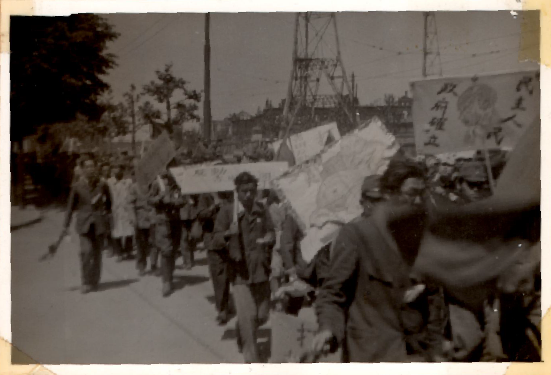
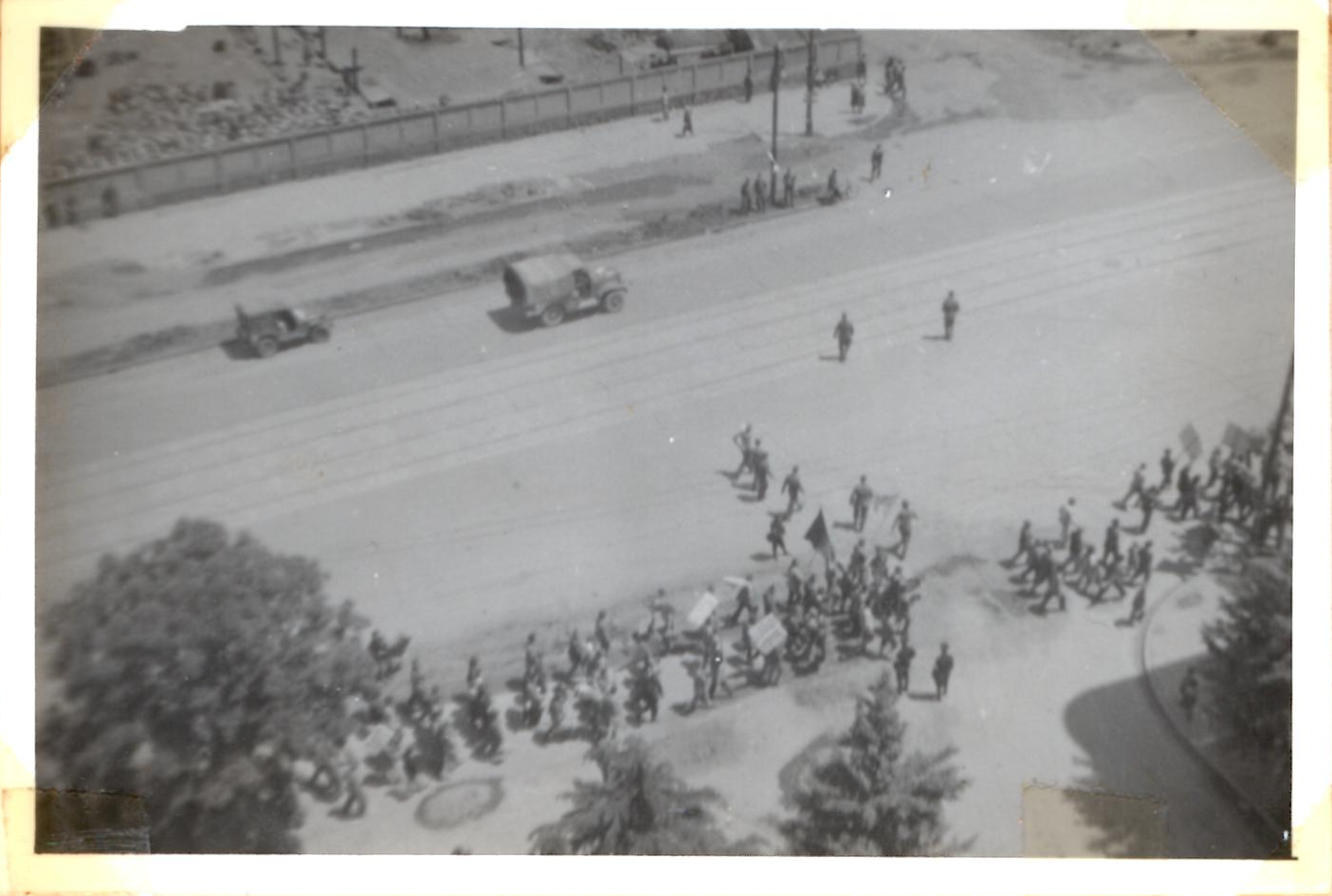
Brush with history: My father's photos of the May 19, 1946 Tokyo food demonstrations

My late father went to Tokyo as a member of the MacArthur Honor Guard at the beginning of the U.S. Occupation. He was, as I recall, experimenting with photography at the time and took many pictures. My wife and I are scanning some of photo albums, and I thought I'd share some pictures that might interest my reader(s).

Here are a few he took of a protest march from 1946.

The sign reads, I believe, "Establish Democratic People's Government"


A diary excerpt by Mark Gayn (collected in The Cold War: A History in Documents and Eyewitness Accounts, edited by Jussi M. Hanhimäki and Odd Arne Westad) describes the demonstrations as follows:
The political pot is boiling madly. [Prime Minister] Yoshida is still struggling to form a new cabinet. As fast as he picks his ministers, it is discovered that they are war criminals subject to purge. Meanwhile, the food rationing machinery has bogged down. In the far north the distribution of food is thirty days behind schedule; in Tokyo, twelve. There are street-corner rallies, parades, mass meetings of protest. On Tuesday, eight hundred people demonstrated before the palace, demanding to know what the emperor was eating. On Friday, there were eight "food demonstrations" in front of rationing stations. Yesterday, twenty. There is a steady stream of marching men past the Diet and the premier's residence.
The climax came today with a "Give Us Rice" mass meeting. By ten o'clock on this bright, warm morning, there were at least 60,000 people at the imperial plaza. They had put three trucks together, and mounted tables on them for the speakers' platform. The chairman was the head of the Transport Workers' Union. But the meeting was actually run by a hard-looking man in corduroy knickers and a sports jacket. This was Katsumi Kikunami, an editorial writer for the Asahi, head of the Newspaper Union, and founder of the huge Congress of Industrial Unions. Grimly, he introduced a succession of speakers--union leaders, political workers, and just plain people.
One of these was a housewife of thirty-five, slim and plain-looking and obviously undernourished. She came from a ward in which there has been no rice distribution in two weeks. She had a child strapped to her back, and as she denounced the police and the rationing officials, the child's wailing came clear and loud over the loudspeaker.
But most of the speakers talked of politics. They demanded Yoshida's resignation, a Popular Front, a new cabinet including workers and farmers. "We must use the privileges we've gained since the war," cried Suzuki, editor of the Yomiuri, "One of them is the right to make revolutionary changes that will produce a democratic government. A one-day general strike will force Yoshida out!"
Tokuda was the last to speak. He wheeled around on the table top, pointed at the palace, and shouted: "We're starving. Is he?" He denounced Yoshida and the war criminals in the Diet, but he saved his sharpest barbs for the emperor. "Last week," he said, "we went to the palace and asked to see the emperor. We were chased away. Is it because of the emperor can say nothing but 'Ah, so. Ah, so?'" He mimicked the emperor. The crowd cheered wildly (...)
There's more in the book, including General MacArthur's response to the protests, which, as Gayn's diary suggests, were attended by ordinary people, labor leaders, and more radical left-wing elements. In Embracing Defeat: Japan in the Wake of World War II, John Dower argues that the Americans occupying Japan after the war "contributed unwittingly to the circumstances in which such radical activities flourished by deciding to promote political freedom and social reform without taking an active role in rehabilitating the economy." MacArthur's response to the demonstrations "chilled the popular movement," writes Dower, although "it certainly did not freeze it." Later on, Dower writes that eventually,
[i]n the summer of 1948, MacArthur reversed occupation labor policy by withdrawing the right to strike from public employees, who commonly were in the vanguard where miserable pay, layoffs, and radical unionism were concerned. Simultaneously, occupation authorities worked diligently behind the scenes to promote the emergence of a virulently anticommunist "democratization" (mindo) movement within organized labor.
By that time, however, my father, having been honorably discharged, was back in the U.S. and beginning the next chapter of his life. (Which also involved photography!)

My wife and I are scanning and organizing some of my late father's pictures from when he was in the MacArthur Honor Guard in postwar Japan. I'm not sure what camera he was using, but some of the pictures might be a bit out of focus.