Saturday, December 30, 2006

Anniversary wandering around Dadu

One way that the former native speaker family likes to spend its wedding anniversary is by randomly driving around and looking at historical sites. (Actually, we don't need the excuse of a wedding anniversary to do this.) One year, when we were visiting my parents during winter vacation, we went to Shepherdstown, WV to eat lunch at a German restaurant, then found ourselves crossing the Potomac River into Sharpsburg and visiting Civil War battlefields. (Don't read too much into that particular way of spending a wedding anniversary.)

This year we were both working on our anniversary, so we saved the random driving for today. We started out searching for a new housing development we wanted to take a look at, but ended up taking a winding road down Dadushan and into the town of Dadu.

We drove around a little there. Then I saw a sign that said "Huangsi Academy" (磺溪書院) and we decided to drive there to take a look. It turned out that the Huangsi Academy ("Huangxi" in pinyin) is a "3rd class historical site" in Taiwan. I'm going to quote the English part of sign in front of the school (without correcting the grammar which, comparatively speaking, isn't that bad):
Huangsi School, commonly known as Wunchang Temple [文昌祠], was the culture and education center of the Dadu area in the past. During the fourth year of the reign of Emperor Jiacing [Jiaqing, 嘉慶] in the Cing [Qing, 清] Dynasty, (1799 A.D.), for the purpose of encouraging literacy, an aristocrat from Dadu, Jhao, Shun-Fang [趙順芳] and a Wurih aristocrat, Yang, Jhan-Ao [楊占鰲], cofounded Si Yong Society, later converted to Wunchang Temple. Later, Huangsi School was established on the site of Wunchang Temple in the thirteenth year of Emperor Guangsyu [Guangxu, 光緒] in the Cing Dynasty (1887 A.D.).

Huangsi School, positioned north faced south and leaned toward east, is a Chinese Quadrangle [四合院], with the width of seven rooms (seven Kaijian [開間]), two units of buildings (two Jin [進]), two wings of chambers (two Hulong [護龍]), a joint worship pavilion, and a grand front court. In the first unit, at the center of three Kaijian is the main gate, on which the swallowtail eaves cascade at the both sides, to allow the seven-Kaijian facade to spread evenly. The lecture room of three Kaijian situates at the second unit, where Wunchang God is worshiped at the center. Right in the front, a joint worship pavilian with eight-pillar and the Sieshan [歇山] style roof is decorated with characteristic eaves and vivid ceramic encrusted adornments. The passing corridors which spread two sides of the lecture room are connected to the dormitory at the wings. The exterior walls of the corridors are embellished with delicate brick carving. The architecture is vastly adorned with engraved brick carvings, from the wall panels, to the door and window frames, to the windowsills, to the semicircular-shaped dadoes, and to vase-shape corridor doors. These features make the architecture stand out from the rest in Taiwan during the Cing Dynasty.

November 27, 1985, Ministry of the Interior declared "Huang S Academy" a 3rd class national historical site.

Cultural Affairs Bureau, Taichung County
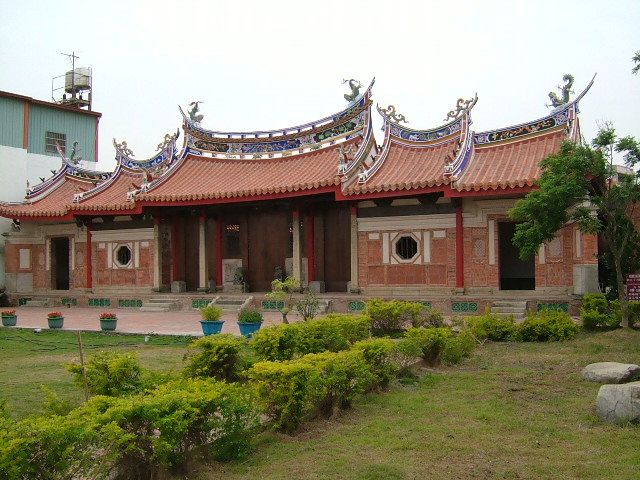
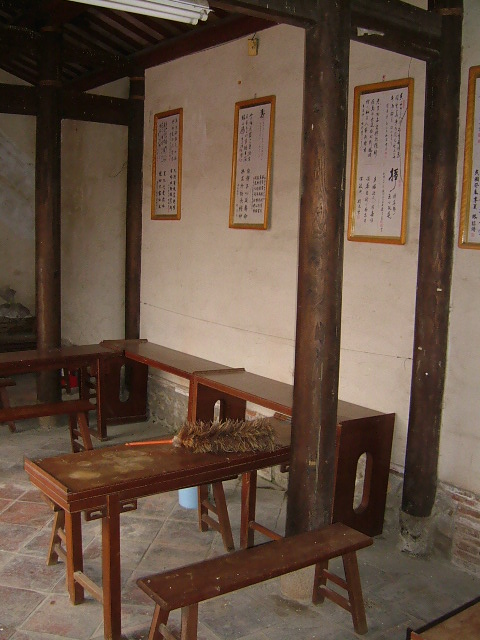
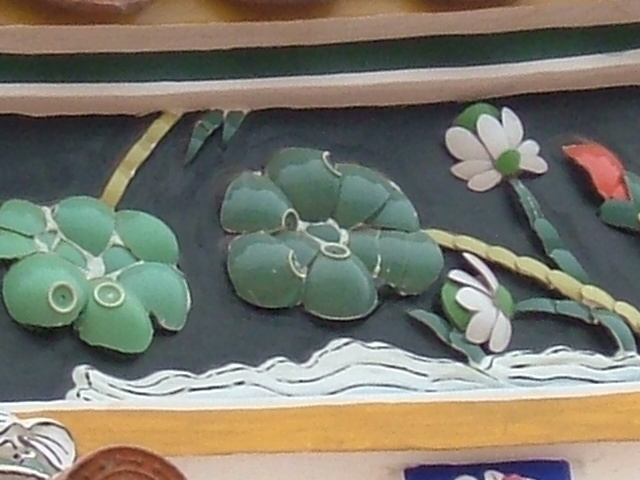
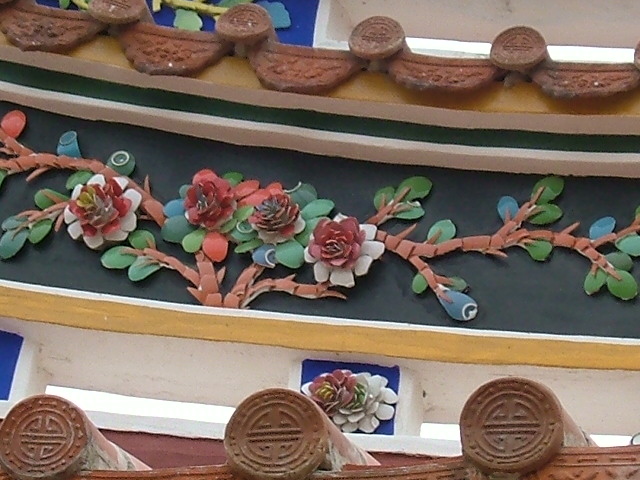
Let me provide a few pictures of what they're talking about.
Huangsi School

Lecture room

Vase-shaped door

Ceramic adornments

More ceramic adornments

A ceramic elephant

The interesting thing about these ceramic adornments is, if you look carefully, you can see that they're actually bowls that have been broken, cut, and shaped into these decorations. (The former native Chinese speaker saw a TV show that described how this is done.)

The main door to the temple
A plaque that says "Huangsi School" but, for some reason, identifies the founding year as the twelfth year of the Guanxu Emperor's reign. Wonder who's right...

Some of the carving they mentioned

This last picture is a palanquin (轎子) used to carry someone who had passed the civil service examinations and become a jinshi (進士). The phrase on the side refers to someone who had come in in first place in all of the 3 levels of the civil service examinations.

The former native Chinese speaker is convinced that in a previous life, I was a "fragile scholar" (文弱書生) who probably died young of T.B. I don't know about that, but I'm hoping being near that palanquin will help me as a scholar... (*cough*)

[Update, 8/19/16: Here's a picture of a round portal in the temple, taken more recently by Alexander Synaptic.]

Tuesday, December 26, 2006

Movin' and shakin'

[Updated, 11:10 p.m] Not in relation to James Brown (r.i.p.). Just had a 'little' earthquake. About 3 or 4 tremors, actually. [As Amanda says, though, it wasn't that little down south! And I just heard on the news (11:00 p.m.) that it was the biggest in the Pingtung area in about 100 years.] Here's some basic information.

[Slightly sarcastic aside: The CNN article I linked to below is notable for being one of the few CNN articles about Taiwan that does not contain the line, "China considers Taiwan a renegade province." Where were their copy editors?]

[12/27/06 update] The BBC News' website notes that communications have been affected by last night's quake:
Taiwan's largest telephone company, Chunghwa Telecom Co, said damage to an undersea cable had disrupted 98% of Taiwan's communications with Malaysia, Singapore, Thailand and Hong Kong.
And Mabel Liao writes in the comments (below) from "the center of the earthquake" in Hengchun, where she teaches. She says her school was closed today because of rockslides.

Son of Frankenscheduling

We just got our schedules for the spring semester. Because this semester everyone so enjoyed the long weekend of Oct. 6-10 and the Saturday make-up on Oct. 14, it has been decided that we'll have not one, not two, not three, but FOUR make-up classes on the Saturdays of March 3, March 10, April 14, and June 9 (to make up for days off on Feb. 26, Feb. 27, April 6, and June 18, respectively). Joy joy joy.

The reasons for this are, first, to give people a longer winter break--beginning classes on March 1 rather than Feb. 26 (too bad I already bought my plane tickets). And April 6 is the day after Tomb-Sweeping Festival, so they had to give that Friday off. (But why make it up? What happened to Spring Break?) And then June 18 is the day before Dragon Boat Festival (a Tuesday), which is a day off.

So is this going to be a trend? Every semester we'll be getting these bizarre schedules? I've been around long enough to remember teaching on Saturdays, but at least it was a regular thing back then. Maybe we should just get rid of the 5-day week here and go back to the good old days...

Anybody else's schedule for spring looking like this, or are we the only ones?

Thursday, December 21, 2006

Something Mei-mei would appreciate

Rosa Eberly at the Blogora asks,
What is "joyous afterstool"??
or, better
What do you have to say about "joyous afterstool"?
Well, Mei-mei always used to have joyous afterstools...

[Update: I was thinking of what A Christmas Carol would sound like if Fred's greeting to his uncle were changed (apologies to the Ghost of Charles Dickens):

'A joyous afterstool, uncle! God save you!' cried a cheerful voice. It was the voice of Scrooge's nephew, who came upon him so quickly that this was the first intimation he had of his approach.

'Bah!' said Scrooge, 'Humbug!' ...

'Afterstool a humbug, uncle!' said Scrooge's nephew. 'You don't mean that, I am sure?'...

'Don't be cross, uncle.' said the nephew.

'What else can I be,' returned the uncle, 'when I live in such a world of fools as this? Joyous afterstool! ... If I could work my will,' said Scrooge indignantly,'every idiot who goes about with 'Joyous afterstool' on his lips, should be boiled with his own...'

And at this point, I think I'd better stop...]

Saturday, December 16, 2006

Another new book in the former native speaker's library

Today was a pretty miserable day--cold (by Taiwan standards), windy, and rainy. But the former native speaker family still had to venture out to Bookman Books on some "family business". ("Stella!"--well, got the right actor this time, at least.)

But before we get to the new book, I feel it my duty to post several photos that are only vaguely related to the content of this post, a la a certain other Taiwan blogger (his pictures are better than mine, though, I admit [as my aunt would say, he has a better camera {and I've got more parenthetical comments, so there!}]).

I've been trying for weeks to get a decent picture of the mountains east of Taichung from my Tunghai vantage point. The closest I came to accomplishing this was this morning around 9:00 when I took some pictures from the top floor and a stairwell in the new Humanities building.


In this picture, you can see the "Central Park" luxury apartment building that is going up across from Tunghai on Taichung Harbor Rd.

No photo-taking trip to Tunghai is complete without a shot of Luce Chapel:


And for lunch (actually these were taken last month):

And would you like some bland coffee to go with something from the Snake bar?

Hmmm... seems like I'm forgetting something here. Anyway...

Friday, December 15, 2006

CFP: The Journal of Diplomatic Language

From the H-Rhetor list:
JOURNAL OF DIPLOMATIC LANGUAGE - CALL FOR PAPERS

http://www.jdlonline.org/about.html

The study of diplomatic language lies at the crossroads of the social sciences--combining aspects of international relations, communication, linguistics, psychology, anthropology, history, law and political science. Its analysis employs methodologies, both qualitative and quantitative, that are rapidly evolving. The Journal of Diplomatic Language aims to provide an Internet-based forum for timely publication of academic-quality manuscripts that will foster development of more sophisticated conceptual frameworks and methodological techniques within this inherently interdisciplinary field.

We are currently inviting submissions from prospective authors, for the January 2007 issue, of relatively short conceptual papers that critically analyze some aspect of diplomatic language in a systematic and innovative manner. We are open to contributions spanning the entire range of topics relevant to studies of political language and diplomacy. Research reports or that cut across traditional disciplinary boundaries are especially encouraged. As with any refereed academic journal, submitted papers will be evaluated through a process of peer review on the basis of quality, theoretical importance, originality, relevance to a broad cross-disciplinary audience, and clarity of presentation. Papers may present results from completed research, as well as report on current research, with an emphasis on novel approaches, methods, ideas, and perspectives.

Please forward your papers to DrHaroldBashor [at] aol.com with a short biographical sketch and abstract/summary.


--------------------
Dr. Harold W. Bashor, Ph.D.
Editor-in-Chief
Sounds interesting...

Monday, December 04, 2006

Good news...

You paid attention during 97% of high school!

85-100% You must be an autodidact, because American high schools don't get scores that high! Good show, old chap!

Do you deserve your high school diploma?
Create a Quiz

Now if only the nightmares would stop...

Local donut shop closes

The former native Chinese speaker and I drove by our nearest Waili's Donuts (on the corner of Chaoma and Liming Roads) this evening, only to find it closed down and the building for rent.

Hey, you saw the prediction first here--Clyde Warden, pastry prognisticator, predictor of Taiwan donuts futures wrote,
I tend to be with the sceptics on the future of any doughnut chain in Taiwan. Foods that are not core to chinese consumption tend to be very fadish, and doughnuts are a great example. Doughnuts are not at all new to Taiwan, and they are generally of medium popularity, but the market for the raised dough, which is very chewy, is not so large. Also, with so many breakfast shops/stands, is there a need for a breakfast chain? Can people take the time to sit down and eat in the morning (which is one of the big success markets for Mister donut in Japan. Lastly, local bread stores are so numerous and very competitive, soon people will feel there is nothing special, and the idea of paying a 60K NT$ rent a month and only selling doughnuts will be like the Scotch Tape store in Saturday Night Live (too narrow a product line).
(Who says we don't track the important trends here?)

Saturday, December 02, 2006

Yet another name for the former native speaker

The latest in a series:

Yesterday we were in Carrefour (which, despite having a collection of kitchy Christmas decorations that rivals Wal-Mart's, still doesn't sell dirt cookies) when a cute little kid saw me, ran to his mother, and said, "英文人! 英文人!" (Roughly, "English language person.") His mom wasn't so cute, though: "Bah! Humbug!" she spat. "What's a 英文人? He's a 外國人!"* Way to stifle your kid's language play, Mom...

*OK, so she said it all in Chinese. Without the "Bah! Humbug!" part. Anyway...

Poem on someone's birthday

(Before you criticize this, think of Rhymin' Hyman Pressman...)

Today is someone's birthday
But, you probably ask, whose?
In this poem I won't say
But I'll try to drop some clues.

When he counted his comic books on the hallway floor, he
Probably never counted on so quickly turning forty.

When he got his first glasses, which made him look kind of funny,
He didn't think that one day he'd be seeing twenty-twenty.

When he sat in his chair in the dorm and said, "Enter",
He didn't consider the day he'd be thirty and ten, or

When he went with my future sis-in-law on their first date, he
Probably didn't think about the date he'd be half-eighty.

He's now an XL but he's not that big a guy;
Now he fits just fine between XXXIX and XLI.

Friday, November 24, 2006

Cross-cultural kinship terms

In Thursday's Intercultural Communication class, we discussed the different functions of language covered in our textbook. One part of the discussion that was particularly interesting to me was when we compared Chinese and English kinship terms and saw how the use of kinship terms in Chinese affects how English kinship terms are interpreted.

We found, for instance, that if I said, "My uncle is a farmer", students felt a need to specify in their minds whether that uncle was on my father's side or mother's side, and whether the uncle was older or younger than my parent. (Some students automatically thought in terms of a father's brother, but one student said she was closer to her mother's side of the family, so thought in terms of a mother's brother.) Students were also a bit surprised when I suggested that if I said the same sentence to a native speaker of English, that person might (but probably wouldn't) ask if I meant my father's or my mother's brother, and most likely wouldn't wonder about whether or not the uncle was older or younger than my parent.

The powerful role of kinship terms is also discussed in "The Cultural Connotations and Communicative Functions of Chinese Kinship Terms" (American Communication Journal 3.3 [2000]). Shaorong Huang and Wenshan Jia argue that there are three main communicative functions served by kinship terms in Chinese:

  1. They serve a "linking function," in that they serve as a way of connecting individuals to their social groups. Huang and Jia point out--as we did in class--that kinship terms are not just used among family members, but are also used to address non-family members.
  2. They serve a "mentation function"--meaning that they are involved in stimulating "the development of higher mental processes."
    For instance, when a child addresses her maternal grandfather by the kinship term of [外祖父] "wai zu fu," she may at least understand, or try to understand, the following: 1) she has a family relation with the old man, but the old man does not live in her family; 2) as a senior member, the old man has certain power over her, and she must respect and obey him; and 3) comparing with her paternal grandfather, this man is less powerful and less strict with her behavior. The single kinship term works as a stimulus in the child's mind to help the child go through a complicated cognitive process.
  3. They serve a "regulatory function" because use of kinship terms "helps individuals regulate their personal behavior in speech communication."

I'm not sure I agree with everything they say in this article (for instance, they imply a uniqueness for the Chinese family system that I'm not sure about--our textbook suggests that Indian kinship terms are also quite complicated). But the points I cited above extend what we were discussing on Thursday about how kinship terms fit into both the naming and the interactional functions of language.

(cross-posted, with slight adjustments, to the ICC course blog)

Saturday, November 18, 2006

No. 7, Minquan Road, Lane 237?

Looks like Minquan Road, Lane 237 (民權路237巷) is now Dahe Road (大和路). Anyway, that's what the clerk at the check-in desk at the Yadian Commercial Hotel (雅典商務旅館) on 3 Dahe Rd. told us. (She was very helpful even though we didn't want a room.)

So from what we could gather, the Japanese-style house that used to be at No. 7 is now this:


(A parking lot, that is, not a car.) Oh well...

(Note to self: one of these days I ought to standardize my romanizations...)

Tuesday, November 14, 2006

CFP: America's Asia, Asia's America

The 2007 Texas Tech Comparative Literature Symposium on "America's Asia, Asia's America"

April 13-14, 2007 at Texas Tech University in Lubbock, Texas

Texas Tech University houses the largest Vietnam Archive in the United States, and West Texas has been home to thousands of Vietnamese/Asian Americans. Late spring in Lubbock is usually mild and sunny.

Keynote Speakers:

Sheldon Xiao-peng Lu, Comparative Literature Program, UC-Davis;
Rob Wilson, Department of Literature, UC-Santa Cruz;
Sau-ling Cynthia Wong, Asian American Studies Program, UC-Berkeley

Proposal Submission Deadline: January 12, 2007

With great progress in technological innovation and economic development in China, India, and other Asian countries in recent decades, the twenty-first century has increasingly been identified and envisioned as "the Asian-Pacific century" or "the Chinese century" in the global media. What political and cultural implications does this new construction of Asia generate? How will these revitalized Asian nation-states articulate their own desires and reposition themselves in the context of the U.S.-centered global order? How will the United States redefine itself in relation to the rise of this new Asia? What lessons has the United States drawn in its political, economic, cultural, and military encounters with these Asian nation-states since the late nineteenth century?

This symposium looks for papers that will engage these challenging questions and theorize their complexity and historicity in both the Asian and North American contexts. We not only welcome proposals that examine the construction of Asia in terms of space production and reconsider Asian America as a process of racial formation, but we also encourage projects that investigate ways in which information technology, trans-Pacific movements, as well as Asian language communication may impact the futures of both Asia and North America.

Possible topics may include but are not restricted to the following:

--Modernism and the Literary Representation of Asia

--The Cold War and the Cultural Imagination of Asia

--Cold War Legacy and National Division

--Cyberpunk Fiction and the Reinvention of Asia

--Orientalism Revisited

--Postcolonial Asian Literatures and Cultures

--Trash Aesthetics and the Hong Kong Kung Fu Cinema

--Sex, Violence, and Fantasy in the Japanese Manga and Anime

--From Hollywood to Bollywood

--Asians and Asian Americans in Hollywood Cinema and American Popular Culture

--Transnational Asian American Literature

--Globalization and Asian American Popular Culture

--Asian American Studies and Latino/a Studies

--Asian American Studies and African American Studies

--The Discourse of "Human Rights" and the Re-construction of Asia

--SARS, Avian Flu, and the New "Yellow Peril"

--Technology, Espionage, and Asian American Communities

--Blogging and New Asian Nationalisms

--Vietnam War Literature and Culture

--War, Empire, and the Global Market

Please send your one-page proposal and one-page C.V. by January 15, 2007:

Dr. Yuan Shu
Department of English
P.O. Box 43091
Texas Tech University
Lubbock, TX 79409-3091

You may email your inquiry, proposal, and C.V. to Dr. Yuan Shu at (yuan.shu [at] ttu.edu).

Yuan Shu
Associate Professor of English
Director of the Comparative Literature Program
Texas Tech University
Box 43091
Lubbock, TX 79409-3091
E-mail: yuan.shu [at] ttu.edu
V-mail: 806-742-2500x240
Fax: 806-742-0989
(via CFP list)

Monday, November 13, 2006

Number 7, Lane 237, Min-ch'uan Road

Ever since I bought Ellen Johnston Laing's Photographs of Taiwan During the 1960's, I've been interested in finding the area of Taichung where she lived when she was studying at Tunghai. She mentions having lived in "a pleasant Japanese-style house at number 7, Lane 237, Min-ch'uan Road" (28). This was as close as I could find to that address--I couldn't find a Lane 237 on the map. (Thanks to Kerim for the heads up about UrMap!) I can find a Lane 233 near the intersection of Minquan and Zhonggang Roads, but the next Minquan Road Lane xxx is Lane 359, near the Science Museum. So I guess Lane 237 got renamed or built over at some point. [Update, 11/17/06: I Googled 民權路237巷 and got some results for some companies on that lane, so I guess it still exists! Just doesn't show up on the map. Maybe it's too small. Off to check tomorrow... will bring my trusty camera.]

Monday, November 06, 2006

Did Chen mention Taiwanese independence in his speech?

Edward Cody of the Washington Post writes,
Acknowledging the damage to his presidency and to the cause of Taiwanese independence from China, as well as the disappointment felt by many of his followers, Chen apologized both to the Democratic Progressive Party and to inhabitants of the self-ruled island in general. (emphasis added)
Did I miss something? Did Chen mention the cause of Taiwanese independence from China in his speech? I can't find anything about it in this Chinese transcript, either.

It doesn't surprise me that the Post would misrepresent Chen's speech in this way, though. As Tim mentioned, they got all bent out of shape over Chen's use of Taiwanese. (So did the other Post, which accused Chen of "ignor[ing] the foreign journalists and most TV audience to use mostly the southern Fujianese dialect (prevalent in a southern China district) to cater his remarks to his own supporters in southern Taiwan" (emphasis added). I think the words they use to describe Taiwanese are quite... ummm... interesting. They're really emphasizing the mainland-Chineseness of the Taiwanese language, aren't they? I'll agree, though, that Chen was speaking more to his supporters than to anyone else...)

Wednesday, November 01, 2006

Tunghai turns 51; fns pressed into duty

[Corrected version] In less than 8 hours, I shall be celebrating Tunghai University's 51st year by engaging in the grand ritual of gripping a tennis ball with chopsticks, running 20 meters with them, then dropping the tennis ball into a bucket before passing the chopsticks on to another celebrant. You're not allowed to use your hands--if you drop the tennis ball, you have to pick it up with the chopsticks. When the department chair asked me to take part in this important event, I tried to tell him that I was not worthy, but it was to no avail.

And no, I am up at this hour not because I don't take such an august activity seriously... what would make you say that?

[Update, 11/3/06] Well, I survived the Sports Day activities. I ended up taking part in two events because there weren't enough faculty and staff from the College of Arts (where were you guys?). The first event is too hard to describe, but suffice it to say that Mr. Bean-like, I managed to trip my teammate during that activity...

On the other hand, I received praise from several people after the chopsticks-carrying-tennis-ball event. Unlike a lot of people, I didn't drop the tennis ball at all. (Of course, I was also probably the slowest tennis ball carrier in the event...)

Monday, October 30, 2006

"Formosa Betrayed"--the movie

Not exactly about the 228 Incident that is the focus of George Kerr's account, this upcoming feature film will tell the following story:
Formosa Betrayed is a feature film about the harassment, torture, and murder of Taiwanese-American activists during the 1980s. Inspired by a true story, the film centers on the murder of a Taiwanese-American professor at the University of Kansas. An American detective—who knows nothing about Taiwan—is assigned to the case. Through the investigation of the professor's murder, the detective begins to understand the complex nature of politics, identity, and power in Taiwan-U.S.-China relations.

In his search for the murderer and his accomplices, the detective learns that there is a vast Chinese spy network within most major U.S. college campuses which focuses on the political and social activities of Chinese and Taiwanese-American students. The detective turns to the FBI for help, only to realize that the FBI is aware of this spy network but is unwilling to do anything about it in order to protect U.S. spies in Taiwan and elsewhere.

The detective's search for the murderer takes him across the Midwest onto other college campuses and Chinatowns, and finally to Taiwan, where he learns the real reason for the professor's murder—that the professor was an outspoken advocate of Taiwanese independence, and thus he threatened the legitimacy of Chiang Kai-Shek's government on Taiwan. The hit was sanctioned by those at the highest level of power.

The detective takes this information to the de facto U.S. Embassy in Taipei (American Institute of Taiwan), only to be rebuffed because the issue is "too sensitive" for U.S. foreign policy. He returns to the States, frustrated with his knowledge and lack of power to do anything about it—when he is invited to testify before the U.S. Congress in Washington D.C. and finally given the chance to declare the truth.

Will Tiao, a former intern for the Formosa Association for Public Affairs and founder of Formosa Films LLC, is the executive producer.

Thanks to Henk for the link!

Friday, October 27, 2006

Well, at least this goes with the Jane Austen quiz results...

...but I have to admit I'm getting a bit suspicious about the accuracy of these quizzes...

You scored as A classic novel. Almost everyone showers praise upon you for your depth and enduring relevance. According to your acolytes, everything you say is timeless, erudite and meaningful. Of course, none of them actually listens to you. Nobody listens to you at all, but it's fashionable to claim you as a friend. Fond of obscure words, antiquated notions and libraries, you never have a problem finding someone to hang out with. The fact that they end up using you to balance their kitchen tables is an unfortunate side effect, but you're used to being used for others' benefit. Oh the burden of being Great.

A college textbook


57%

A classic novel


57%

An electronics user's manual


50%

The back of a froot loops box


46%

A coloring book


43%

Poetry


36%

A paperback romance novel


32%

Your Literary Personality
created with QuizFarm.com

CFP: Writing Research Across Borders

(I'm posting these partly for my own convenience--it's easier for me to find them this way!)

Open Call for Proposals: Writing Research Across Borders
February 22-24, 2008
University of California Santa Barbara

Proposal Deadline: May 1, 2007
Email: writing@education.ucsb.edu

Recent decades have seen the growth of writing studies in many nations, focused on all levels of education, and all uses of writing in society, using the resources of many different disciplines. This increased research attention to writing reflects an increased recognition of the importance of writing in modern societies. Yet to a large extent the many emerging traditions of writing research have neither connected fully nor shared their work.

This conference brings together the many writing researchers from around the world, drawing on all disciplines, and focused on all aspects of writing at all levels of development and in all segments of society. This will be an opportunity to learn from different research traditions, share our findings, seek common agendas, and lay the groundwork for future communication and alliances.

As a first step to building this important conversation we have invited some of the leading writing researchers, who have already committed to participating.

We are now issuing an open call for proposals for panels, roundtables, individual presentations, and poster presentations addressing
* current research on writing,
* methodological issues
* reflections on ongoing research programs
* considerations of national or disciplinary trajectories of research
* agendas for further research
We anticipate a program of up to two hundred and fifty presentations.

Proposals to present current research should specify research questions, methods, data corpus, and findings, as well as the scope and duration of the research project. Proposals to provide overviews of and reflections on research traditions and agendas should identify clearly the relevant literatures to be considered.

Proposals for individual and poster presentations should be from 250 to 500 words in length and panel and roundtable proposals, 500 to 1000 words. Please indicate your preferred format.

Proposals should be sent by May 1, 2007 via email to writing@education.ucsb.edu. Please include complete contact information.