Showing posts with label Taichung. Show all posts

Friday, July 31, 2026

Four new books in the former native speaker's library

I got a collection of four small illustrated books about old Taichung, 《臺中舊城》, which includes 

  • 「宮原武熊的一天」(about Miyahara Takekuma, a Japanese ophthalmologist who ran an eye clinic in Taichung),  
  • 「和平日報:二七部隊」(about the Taichung-based newspaper I've been combing through for my research on 蔡鐵城),
  • 「臺中公園-前世今生」(about Taichung Park), and 
  • 「1960's 綠川點點滴滴的日子」(about the cleaning up of the Lü Chuan [Green River] in downtown Taichung).
These books also have maps of old Taichung that I guess you can use to find the places discussed. Wish I had time this trip to visit Taichung and take a look at those historical sites.
 
From their website, 臺中舊城生活博物館, it appears that they've published other books about Taichung, too. 

Monday, January 20, 2025

Thoughts on Taiwan Travelogue

I finished reading Lin King's translation of Yáng Shuāng-zǐ's Taiwan Travelogue this morning. I enjoyed the novel a lot, including its postmodern framing, where the English translation I read is supposed to be a translation of Yáng's Mandarin translation of Aoyama Chizuko's original novel, a novel that went through several Japanese, English, and Mandarin editions. (If memory serves me correctly!) 

I also enjoyed getting a picture of Taiwan--and particularly Taichung--during the period of Japanese colonialism. The descriptions of the Taichū Train Station and its environs, the markets, the streets and countryside were fascinating to me. King's translation also cleverly creates the point of view of the Japanese travel writer/novelist by using Japanese names for most of the cities and sites in Taiwan (which she often calls "the Southern Country" or "the Island" in contrast to "the Mainland," which refers to Japan). For example, Taichung's Lü Chuan River (or Lyu-Chuan Canal) is called the "Midori River." 

Lü Chuan River (Midori River) during the Japanese Period, from Wikimedia Commons

Much of the book is focused on discussions of food, particularly Taiwanese cuisine (Aoyama-san describes herself as having an always-hungry "monster" in her belly as the result of unfortunate events during her childhood). While there were a lot of dishes, snacks, beverages, etc., that I was familiar with, there were also quite a few that I don't recall ever trying or even hearing of, particularly because their names are written in romanized Taiwanese (though the Mandarin names are often added in footnotes). Reading this book made me hunger for Taiwanese food, both familiar and strange. 

Perhaps my unfamiliarity with the food mentioned in the book and with some of the places they visited should be a warning to me. Without giving away the plot of the novel, the ending made me question my own relationship to Taiwan and Taiwanese people, and what my role should be (if any) in representing Taiwan (and Taiwan's rhetoric) to others. Maybe it's not my place to speak but rather to continue to learn. 

Speaking of which, what should be my fifth book for 2025?

P.S. This interview with Lin King gives more information about the novel. And here is a more complete review of the book (spoilers!).

P.P.S. Next book on my reading list: Dominic Meng-Hsuan Yang's The Great Exodus from China: Trauma, Memory, and Identity in Modern Taiwan. 

P.P.P.S Here's another nice review of the book. I find myself hoping a movie version of this comes out one of these days...

Monday, September 18, 2023

【台灣演義】episode about Taichung

This is from almost a year ago--somehow I missed it. But I'll post it here mainly to remind myself to watch it when I get a chance...

Tuesday, August 30, 2022

Some notes on bookstores in Taiwan during the Japanese colonial period

In a previous post about Lien Heng's biography, I mentioned interest in the history of bookstores in Japanese-governed Taiwan. Here I want to get down some notes on the odds and ends I have come across in the process of trying to learn more about this fascinating topic. 

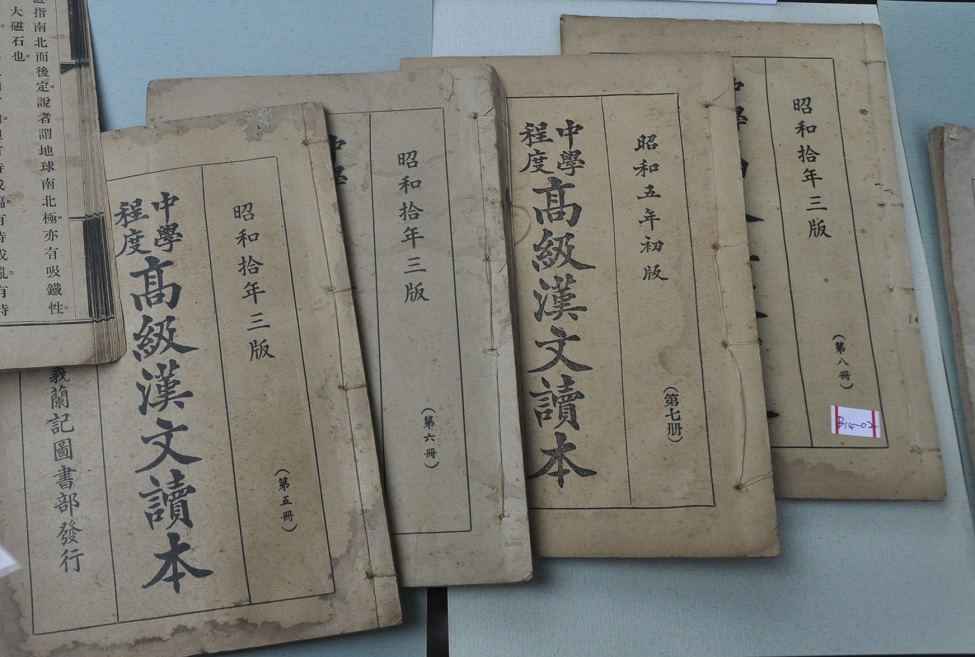
I mentioned in the previous post that according to a website about independent bookstores in Taiwan, in 1927 there were only about 30 bookstores in Taiwan. Central Bookstore (中央書局) opened in Taichung in 1927, Lien Heng's Yatang Bookstore (雅堂書局) in Taipei the same year. (Lien's bookstore only ran for two years before it had to close down.) Chiang Wei-shui's Culture Bookstore (文化書局) had opened a year before in Taipei. Huang Mao-sheng's Lan-chi Bookstore (蘭記書局) opened in Chia-I in 1917. These bookstores focused mainly on selling (and in some cases publishing) Chinese-language books. As Chen Hsiang-lan writes in an article about the 100th anniversary of the Lan-chi Bookstore, owner Huang Mao-sheng took considerable risks to publish and sell Chinese-language books during the Japanese period. As with the bookstores run by Lien Heng and Chiang Wei-shui, Huang's bookstore/publishing venture was primarily concerned with passing on knowledge of Chinese culture and language, as can be seen from the picture below of some of the  Chinese textbooks published by Lan-chi Bookstore. Another article published in 2017 recommends a book about the history of the store: 《記憶裡的幽香——嘉義蘭記書局史料文集百年紀念版》.

Chinese language textbooks published by Lan-chi Bookstore

Somewhat confusingly, a 2020 Taiwan News article describes the reopening of "Taiwan's oldest bookstore," but that bookstore isn't Lan-chi or the Japanese bookstore I'll discuss below. It's the Regent Store (瑞成書局), which the authors say opened in 1912 and is the oldest bookstore in Taiwan that is still operating. The store's website has a video (in Taiwanese and Mandarin) telling the store's story.

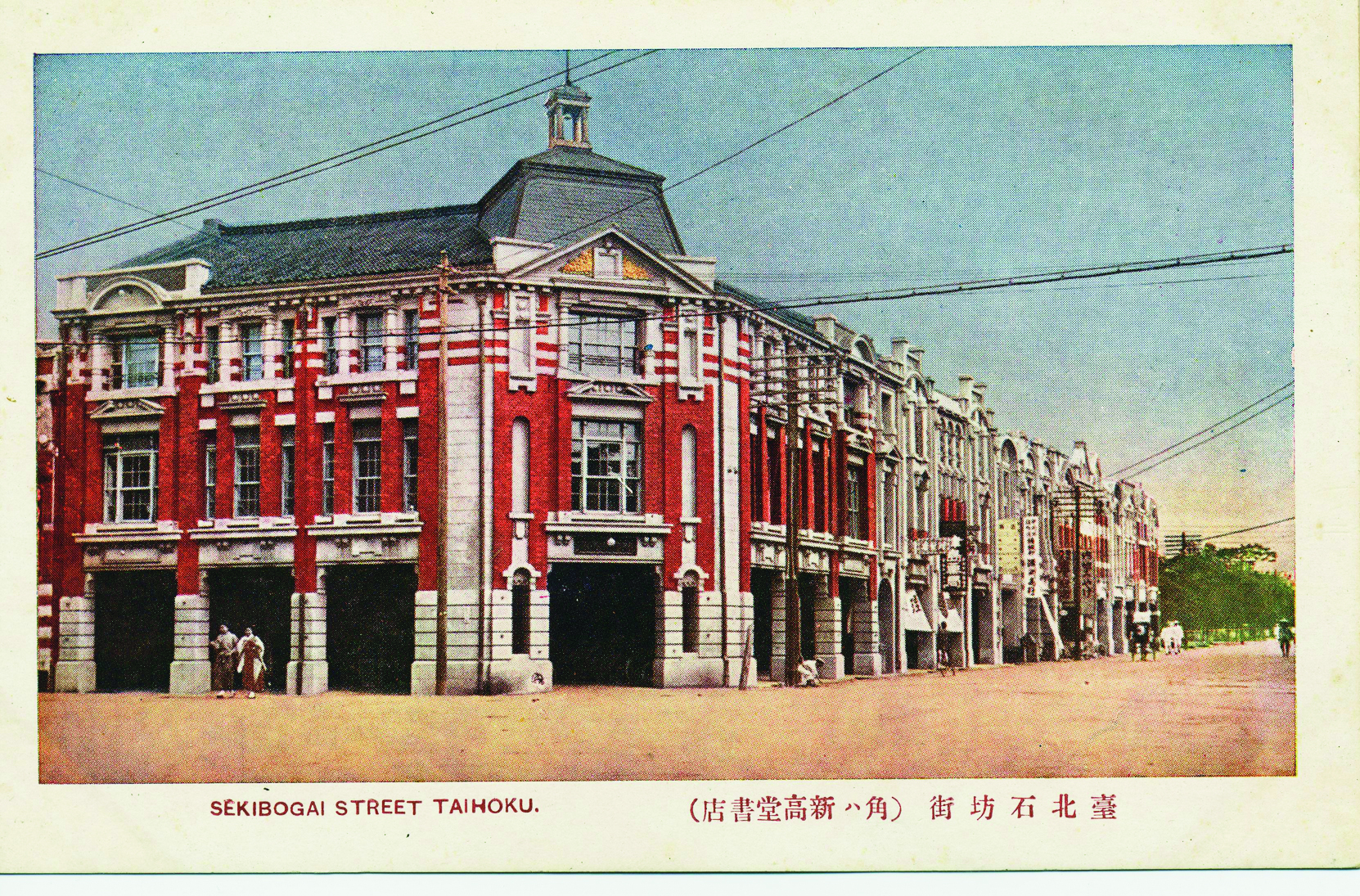
This is what I've found (so far) about five of the Chinese language bookstores in colonial Taiwan. There were also of course Japanese bookstores. Hui-yu Caroline Ts'ai's 2013 article "Diaries and Everyday Life in Colonial Taiwan" in part describes colonial bureaucrat Utsumi Chūji's (內海忠司) preference for a bookstore in Taipei called Niitakadō Bookstore (新高堂), which she describes as "the largest bookstore in Taiwan" (p. 152). 

Niitakadō Bookstore (新高堂)

According to Ts'ai, 
Niitakadō was also well known for issuing textbooks, reference tools, photograph collections, postcards, maps, and many other items. His [Utsumi's] taste for books also reflected an aspect of the marketing strategy of books, which was developed to cater to the growing needs of Japanese communities in Taiwan. An expanding readership on the island - across race and generation - was constructing "Taiwan" as a subject of Japan's empire. (p. 152)
Ts'ai writes that Niitakadō was built in 1912, but this article claims it was founded in 1898 by Murasaki Chōei (村崎長昶). This article by Su Shuo-bin (蘇碩斌) and Lin Yueh-hsien (林月先) agrees, explaining that the original stationery store became a bookstore (renamed 新高堂書店) in 1900. According to Su and Lin, what instigated the explosive growth of Murasaki's business was the excitement in Taiwan (presumably among the Japanese residents, but possibly also among the Taiwanese) about the Russian-Japanese war. The sale of magazines about the war led to the sale of books, and Murasaki's bookstore grew more and more profitable. 

Su and Lin mention three other bookstores that opened around 1898 in the same area of Taipei: the Namiki Bookstore (並木書店), the Taiyōdō Bookstore (太陽堂書店), and the Shirotani Bookstore (城谷書店).* All three of these stores went out of business, though, for various reasons, though other stores moved in. Su and Lin note that Murasaki was fairly conservative in his selection of what kinds of books to sell; he didn't want to get on the bad side of the government. Niitakadō took over the business of supplying elementary school textbooks and also took over the book purchasing for Taipei Imperial University, Taipei University, and Medical College, and dominated the textbook market in Taiwan. (Su and Lin's article is an interesting read, and I highly recommend it. It's an excerpt from a history of Taipei: 《臺北城中故事:重慶南路街區歷史散步》.)

I also found pictures of the 太陽號書店 [Taiyōgo] bookstore, pictured below. According to an article from 2015, it later became the Taiwan Commercial Press (臺灣商務印書館), but that has moved away from its original location. 


Here is a picture of the interior of the store:


I'm going to end this here. I hope the links to the other sources are useful! My apologies if I didn't mention your favorite bookstore from the Japanese colonial era! Let me know about it in the comments!

*Please correct my romanization of the Japanese names of these stores if they're wrong. 

Sunday, August 28, 2022

Notes on Lien Heng (1878-1936): Taiwan's Search for Identity and Tradition

Wu, Shu-hui. Lien Heng (1878-1936): Taiwan's Search for Identity and Tradition. Research Institute for Inner Asian Studies, Indiana University, 2005.

This isn't going to be a formal review of Wu's biography of Lien Heng. There are two published reviews that I have found:

  • Harrison, Mark. Review of Lien Heng (1878-1836): Taiwan's Search for Identity and Tradition, by Shu-hui Wu. The China Quarterly, vol. 187, 2006, pp. 800-802.  https://doi.org/10.1017/S030574100639042X
  • Salát, Gergely. Review of Lien Heng (1878-1836): Taiwan's Search for Identity and Tradition, by Shu-hui Wu. Acta Orientalia Academiae Scientiarum Hungaricae, vol. 66, no. 3, 2013, pp. 488-489. https://www.jstor.org/stable/43282533
My own thoughts about the book are mixed but generally good. I appreciated how Wu put Lien's life in the context of his times in Taiwan and China. For instance, her discussion of Lien's attitude toward vernacularization of writing relates his perspectives toward both the issue as it was being debated in China (by such people as Hu Shih, Liu Shih-p'ei, and Huang K'an) and how it was being taken up in Taiwan, considering Taiwan's status as a Japanese colony at the time. Lien appears to have viewed pai-hua-wen (白話文, vernacular writing, or "Plain language," as Wu translates it) in Taiwan as combining with the Japanese Kokugo policy to cut off Taiwanese people from their roots. As Wu writes, "Lin Shu and others [in China] promoted classical Chinese to counter the New Culture Movement; Lien Heng called for its preservation to save the Chinese identity in Taiwan" (p. 198). 

Wu also gives a good sense of the social and intellectual circles in which Lien Heng moved. Having lived in Taichung for 16 years, I was particularly interested to read about Lien's trips there. He stayed at Lai Yuan (萊園), Lin Hsien-t'ang's (林獻堂) mansion in Wufeng, during treatment for a stomach problem. Lien and his family also stayed in Taichung for 4 years at Lin Tzu-piao's* mansion, Juei-hsüan (瑞軒), near/at Taichung Park. (The Lins eventually donated it to become Taichung Park, according to Wikipedia.) 

I was also interested in Wu's description of Liang Ch'i-ch'ao's (梁啟超)'s visit to Taiwan in 1911, particularly in how Liang and Lien communicated with each other. According to Wu, the two (and others who were present during Liang's visit) couldn't communicate with each other orally because they spoke different languages (she doesn't use the term "language" to describe Liang's Kwangtungese and Lien's Taiwanese). They didn't even try to use Japanese to communicate, even though Lien had taught himself the language (though I'm not sure if he taught himself spoken Japanese or just written Japanese). Wu writes, curiously, that "[o]bviously, Liang had not learned to speak Japanese, although he had lived in Japan for more than ten years" (p. 109). I'm not sure why that's "obvious," but maybe their lack of interest in speaking Japanese had something to do with nationalism--not wanting to communicate in the colonizer's language.** They communicated with each other by writing notes (and lots of poems!) in classical Chinese. I wonder what that might have looked like... 

The number and topics of poems that Wu mentions Lien and others writing was also interesting to me; it reminded me of something Ron Scollon wrote in a 1997 TESOL Quarterly article on contrastive rhetoric. Discussing the need for a "contrastive poetics" that would take into account genres and the history of genres, Scollon cited Jonathan Spence's comment that some poems from the Tang Dynasty might be comparable to British memos from the twentieth century 
as in each case the functional placement of the text is as an officially placed critique of the policies of authorities in higher positions. Such a comparison would depend on first making a linguistic, cultural, epoch-internal contrast among information, critical, and expressive genres in government and official social contexts. (p. 354)
While the poems of Lien Heng and others mentioned in Wu's book weren't necessarily comparable to governmental memos, they do arguably function in broader ways than people in the US might think of if we generally think of poems in terms of creative literary expression. 

Wu also discusses Lien's bookstore in Taipei in the context of bookstores in Taiwan during the Japanese period. I had not known about the challenges that Taiwanese had importing books from China during that period. To quote some detail from Wu:
The colonial administrators had an extensive network designed to control Taiwanese thought and they exercised this without consulting the constitution of their home government. Especially onerous was the rigid control of the sale of books. When books arrived from China, they were subjected to censorship at the customs house. Those books belonging to restricted categories (chin-shu) were removed from their packages and confiscated. Usually, the loss from each order was around thirty to sixty percent. Worse was that the restriction standards changed constantly. Very often books became illegal after the bookstores had sent in their orders and it was too late to inform the publishers in China because the goods had already been shipped. It took months for the books to travel to Taiwan. Sometimes customs would pull only one or two volumes from a multi-volume set and make the entire collection impossible to sell. The biggest threat to a bookstore owner was the unexpected inspections conducted by the police. The owner would be fined and imprisoned for several days or weeks if he violated the law, even if his store just held books in storage that were on the new banned list. Chiang Wei-shui's store was often monitored by the secret police because of his political and social activities. (pp. 254-255)

A webpage about bookstores in Taiwan mentions that during the Japanese period, there were only about 30 bookstores in colonial Taiwan. Taichung's Central Bookstore (中央書局) was one of those; the Wikipedia article about the store, which opened up in 1927 (around the same time Lien's store opened), says that at that time, it was the first bookstore in Central Taiwan specializing in importing Chinese and Japanese books and magazines and was also the largest Chinese bookstore in Taiwan. It ran into trouble after the Mukden Incident of 1931.

A couple of critiques: Harrison and Salát fault Wu's book for not discussing some personal aspects of Lien's life in more detail--they both comment on his extramarital affairs that Wu only briefly mentions: Salát, to suggest that Wu could present a more well-rounded (and critical) perspective on Lien; Harrison, to suggest that Lien's relationship with a Taiwanese geisha would open more than "a glimpse into Taiwan's rich social world of the period" (p. 802). I agree with both of these points. 

The final section of the book, which summarizes and analyzes Lien's most famous work, The General History of Taiwan (台灣通史), is sometimes hard to follow. While Wu brings in other sources to supplement (and sometimes correct) the narrative that Lien wrote, I found it difficult sometimes to distinguish between Wu's summary of Lien and the additions/corrections she was providing. The section has extensive citations, but it was still not always clear. 

Finally, I have to mention that the book could have used some copyediting; the frequent grammatical issues generally don't cause confusion in terms of meaning, but combined with the many typographical issues  that a copy editor should have caught, they are very distracting. (In one instance, in what might have been an "autocorrect" error, the book mentions the Ch'ing government's "energetic policy of 'signification'" [p. 355], which should read "sinification"--quite a different meaning!) 

Overall, though, I am glad I read this book. Not only did I learn a lot from it, but it has given me some directions for future reading and investigation (such as the history of bookstores and publishing in Taiwan). 

*I admit I cannot find reference to Lin Tzu-piao online, so I'm not sure what character "piao" would be here.

** [Update, 11/4/22: Judging from Joshua Fogel's essay about Liang Qichao and Japan, Liang was able to read Japanese and translated Japanese works (themselves translations of works in Western languages) into Chinese. Fogel writes, intriguingly, that 
For Liang, the Japanese language was little different from Cantonese. Both were rooted, he believed, in an ancient literary language, wenyan, which had served both countries (and Korea and Vietnam, it should be added) for many centuries. The Hewen Han dufa (Reading Japanese the Chinese way), a contemporary work offering easy access to Japanese for readers of Chinese, was an all-important text for Liang. It not only enabled him to gain quick entry into contemporary Japanese writings and translations; it also substantiated the notion that Japanese could be read as if it were a topolect of Chinese. (249-250)

From Joshua A. Fogel, "Introduction: Liang Qichao and Japan." Between China and Japan: The Writings of Joshua Fogel, Brill, 2015. 242-252. DOI: https://doi.org/10.1163/9789004285309_017 

Monday, April 06, 2020

How Tunghai University ended up in Taichung instead of Hsinchu

I'm supposed to be working on my never-ending (never-beginning?) Kerr paper right now, but I'm going to take a break to transcribe an April 29, 1954 letter to George H. Kerr concerning Tunghai University. The letter is from Re-lin Su (蘇瑞麟), a former student of Kerr's (a little about him here). According to an article in the Bradford County Telegraph, Su was the "principal of the Chu Tung County High School in Shin-chu, Formosa." He was in the US at the time of this letter, under the auspices of the Foreign Operations Administration of the US government.

Here's the letter:
April 29, 1954 
Dear Kerr Sensei: 
I'm glad to hear from you. This is my third week here, and I have a very light program. There is nothing to do except to attend conferences, all kinds, whether it concerns my program or not. I'm sure I can't learn much, but it is good for me to read some books and prepare my monthly, quarter, predeparture and final reports. 
I've not met Mr. Kabura yet. He is living at dormitory. It is my pleasure to hear he is here, I'm going to try to see him. 
Before I left Formosa I've heard about a new college. My hometown was one of the two prearranged campuses, but because of county governor of my county was not interested in it, so the new college was decided to be established at Taichu. And last January when I was in Berea College, Ky, I've heard something about it. I was told it was going to follow Berea College--labor system. But at that time it was not decided what and how many departments the new college should have. There is one agricultural college in Taichu already. As for social science, our government does not like it any more. I think you are still remember there was an evening college for social science in Taihoku before the February war. I'm sure you know why our government does not like to open social science college.  
This new college is a mission college. I think it will be good for Formosa. At least some more high school graduates can attend college and receive college level education. You might not be able to imagine how hard to attend college in Formosa, even secondary school.  
We've around three hundred secondary schools--senior high and junior high--and yet only about half of elementary graduates who want to attend junior high school can go to junior high school. The circumstance is not better at all since the Japanese control. 
Do you have any concern about the college? I've ever talk to one of professor in Berea College. I want to put up some relation between my high school and the college. Not only to send students to the college, but to get their help and cooperation to my school's extension service to the communities.  
I've written a few lines before, the county governor was not interested in a new college. In fact, he was not he was interested in it. There will be a election of county governor in May, he wanted to be as candidate again. When two years ago there was the first election for county governor in Formosa, I was the most hopeful one. He came to talk with me let him try, and this time--this May 2--he would help me. Because of I had not so much money to forward as candidate, and he is older than me, so I agreed to let him try.  
And last May before I came the States because he wished to forward as candidate again, so he was afraid of me very much. If the college was established at my home town if I would forward as candidate he was sure he would fail. So, so long as the college concerns he did not show any interest and guide those people who came to see the prearranged campus, he let one of supervisor of schools led to a place where there are two Buddist Temples.  
On the contrary Taichu offered a large land for campus, in fact Taichu is much better than the place where the county governor had shown in my county. 
And this time only one candidate for county governor. Of course I'm not interested in that job I am enjoying my present job more.  
But still is the strongest enemy for him, and many people wanted to put me as candidate this time while I am here and know nothing about their election. 
This democratic way does not profit our democracy at all so long as this election concerns. 
Sincerely yours, 
RL. Su
Su, Yao-tsung, ed. Correspondence by and about George H. Kerr (II), pp 593-596. (Errors in original.)

Thursday, November 05, 2009

Tremor...

That was a long one--seemed to go for at least 30 seconds (but I'm not sure). [The TV news said it lasted a minute, but they're also saying it was 7.0 at its epicenter, so I don't know...] I was just starting to read the preface to Vicki Tolar Burton's Spiritual Literacy in John Wesley's Methodism (see, I keep up with what's going on at SU) and I'd gotten to the part where she's describing an engraving of John Wesley's deathbed scene, and... boom! Now I'm afraid to open the book again!

[Update:] According to the Central Weather Bureau, it was two tremors--one at 5:32 and one at 5:38 p.m. I must have felt the first one because I started writing this post at 5:35 p.m.--that was a 6.0, centered in Nantou. (The USGS says it was a 5.7.)

[7:36 p.m.update:] Yet another one just hit. A very short one, though. I saw on the news that someone from the Central Weather Bureau was saying these were adjustments (aftershocks?) related to the 921 earthquake that happened 10 years ago. (!)

Dead pigeons

No, this isn't the name of a new punk band--I'm just noting the fact that I have seen two dead pigeons today. This morning we saw one lying outside the KFC on the corner of Taichung Harbor Rd. & Huichung Rd. At the time, I thought maybe it had flown into the plate glass window and died.

Later, when I was walking to my classroom an hour ago, I saw another dead pigeon lying next to a tree. They were both about average size, probably adults (though I don't know for sure). Just surprised to see two dead pigeons in one day. Hopefully it's a coincidence...

Tuesday, June 17, 2008

More pictures taken on Sunday

Here are some pictures we took of the Central Mountain Range on Sunday. They were taken from the fifth floor of the Humanities building at Tunghai. We had a good view of the mountains after the rain cleaned up the air.

tunghai1

tunghai2

tunghai3
The construction on the left is of "Moon River," a new apartment building (like we need any more around here...)

tunghai5

tunghai6
The tall tower is a building called, simply, "Hotel ONE".

The following two are "stitched" shots...

mountain

mountain2

Wednesday, December 12, 2007

American food in Taichung, circa 1960?

Just taking a break from working on the diss.--specifically, from harassing would-be interviewees with pages of detailed questions about things that they probably don't remember writing. (I mean, I don't remember what I wrote 10 years ago--why should they remember what they wrote 30 or 50 years ago?)

Had a nice bagel and coffee for breakfast (at Bagels 'n Beans), which has got me thinking about Western food in Taichung around the time that I'm covering in my dissertation. A few mentions in letters of having Thanksgiving turkeys (or Christmas turkeys) at Tunghai. Where'd they come from? Were they locally raised? I also recall mentions of the U.S. Officer's Club where people sometimes went to eat. Anyone have an address on that? I seem to vaguely remember seeing it somewhere a long time ago, but I don't remember where.

Friday, March 23, 2007

A big piece of real estate

The Taichung City Government's website reports here that a Hong Kong investor, Richard Li, is interested in developing the old Shuinan Airport. We heard about this on the TV news earlier (though they focused more on how a city councilwoman was trying to act as a matchmaker between Li and the mayor's daughter Hu Ting-Ting).

Shuinan Airport

The TV news was suggesting that the redevelopment might result in a rise in the cost of housing in Taichung. But the story on the website mentions some problems with the Ministry of National Defense that might slow down the redevelopment of the airport. Anyone heard anything more about this?