Classes ended last week, and I'm still rushing to get grading done before doing some holiday traveling. But I didn't want to miss posting in December because this will be the first year since 2007 that I managed to post something every month.
Well, now I've done it, so I can get back to grading.
Tuesday, December 13, 2016


Tuesday, November 29, 2016
So much for reading month...
...unless you include reading student work. Learned a lot from their writing, though! Some really interesting work being done in my first-year writing classes on topics like diversity in the university, experiential learning, university students and mental health, study abroad, and a bunch of more topics. If I could just read what they write and not worry about grading it...
The semester is going to be over soon. Classes end on Dec. 7. I hope to spend some time doing some reading and writing, though first I have to recover from this cold I picked up during our trip home for Thanksgiving...
Oh, I should note that I never finished Rose, Rose, I Love You. (In fact, I can't even find my copy of it!) Somehow I feel that it must be a better read in the original language(s). In English, it's rather dull. (Apologies to the translator!)
The semester is going to be over soon. Classes end on Dec. 7. I hope to spend some time doing some reading and writing, though first I have to recover from this cold I picked up during our trip home for Thanksgiving...
Oh, I should note that I never finished Rose, Rose, I Love You. (In fact, I can't even find my copy of it!) Somehow I feel that it must be a better read in the original language(s). In English, it's rather dull. (Apologies to the translator!)
Tuesday, November 01, 2016
National Academic Reading Month?
So November is usually National Academic Writing Month, which got its inspiration from National Novel Writing Month. I tried participating in this three years ago, with mixed results. I might have tried it more recently, I'm not sure, but I'm beginning to be more and more suspicious about it. Or maybe it's depressed.
I don't think November is a good month to do this, at least not for me. I'm typically overwhelmed in November--behind in grading (like now), and then there's the long trip home for Thanksgiving at the end of the month. So I don't plan on participating in this activity this year. In fact, I'm going to cut back on the writing that I do every day for this month. I've been doing a lot of journaling on the train, for instance forcing myself to write at least 750 words during each 20-minute trip. I'm not going to do as much anymore, at least not for this month. I want to do some reading instead. I have stacks of books that I want to read. I once commented to a reader that I had a dream that I'd be able to read all my unread books once I had finished my dissertation. That hasn't happened (though that hasn't stopped me from buying even more books). Maybe now it's time to get going on that dream/plan. Maybe I should declare November Reading Month (for me, anyway, though you're welcome to join me). Now I just have to decide what I want to read in November...
I've decided to start with Wang Chen-ho's Rose, Rose, I Love You, which I mentioned in a previous post. Hopefully starting with a novel will help me build momentum. (If I started off with some dusty academic treatise, I'd probably lose momentum very quickly!) I am also currently reading Rick Perlstein's The Invisible Bridge (I loved his Nixonland), but I've got the hardback copy and I'm not going to lug it around on the train every day. I'll save it for reading at home.
I've decided to start with Wang Chen-ho's Rose, Rose, I Love You, which I mentioned in a previous post. Hopefully starting with a novel will help me build momentum. (If I started off with some dusty academic treatise, I'd probably lose momentum very quickly!) I am also currently reading Rick Perlstein's The Invisible Bridge (I loved his Nixonland), but I've got the hardback copy and I'm not going to lug it around on the train every day. I'll save it for reading at home.
Monday, October 24, 2016
Upcoming Academic Plan meeting
I volunteered (?) to go to a "Town Hall" meeting this coming Wednesday on the Academic Plan. We'll see how that goes. They're expecting "a robust discussion." I don't know if I'll say anything, but I'll try to take notes on the discussion. Not sure if I'll post them here or just make them available to my colleagues.
I think the last time I posted notes here on a university-related meeting was back in 2006! It wasn't exactly the same thing, but it was a meeting that led to the development of Tunghai's English Language Center.
More on this later...?
In the meantime, I just reread a note that I posted back in 2004 about Applied English departments in Taiwan. It looks as though back then I was also wondering about the relationship between humanities education and the marketplace. This was from the perspective, though, of someone who was more involved in the English major than I am here. Anyway, it was an interesting trip down memory lane...
[Update, 11/1/16: Here's a link to a news story about the town hall meeting. It didn't go as I had expected/hoped. There wasn't really a chance to ask about what some faculty (like me) had questions about: What would the curriculum look like in 10 years? What kinds of new responsibilities would faculty members have? Will we still be teaching classes or will our job descriptions be very different? The Academic Plan refers to "'Just-for you' learning with curated content and resources matched to individual learning goals. Learning modules and 'stackable' credentialing will add customization." What will that look like in practice? So far I haven't heard anything specific about this.]
I think the last time I posted notes here on a university-related meeting was back in 2006! It wasn't exactly the same thing, but it was a meeting that led to the development of Tunghai's English Language Center.
More on this later...?
In the meantime, I just reread a note that I posted back in 2004 about Applied English departments in Taiwan. It looks as though back then I was also wondering about the relationship between humanities education and the marketplace. This was from the perspective, though, of someone who was more involved in the English major than I am here. Anyway, it was an interesting trip down memory lane...
[Update, 11/1/16: Here's a link to a news story about the town hall meeting. It didn't go as I had expected/hoped. There wasn't really a chance to ask about what some faculty (like me) had questions about: What would the curriculum look like in 10 years? What kinds of new responsibilities would faculty members have? Will we still be teaching classes or will our job descriptions be very different? The Academic Plan refers to "'Just-for you' learning with curated content and resources matched to individual learning goals. Learning modules and 'stackable' credentialing will add customization." What will that look like in practice? So far I haven't heard anything specific about this.]
Friday, October 14, 2016
Two new books in the former native speaker's library
Not sure why I'm still calling myself "the former native speaker." The way my Chinese ability is going, I should call myself "the former non-native speaker." No, that's not right. Maybe "the former Chinese speaker..."
Anyway, I've gotten something of an urge to read some fiction from Taiwan (in translation, of course--and I don't even have time to read that, much less read a novel in Chinese). I'm currently reading Rose, Rose, I Love You by Wang Chen-ho, which I bought a while back but never got around to reading. Then I decided to pick up a couple more books from that series, so I bought
Anyway, I've gotten something of an urge to read some fiction from Taiwan (in translation, of course--and I don't even have time to read that, much less read a novel in Chinese). I'm currently reading Rose, Rose, I Love You by Wang Chen-ho, which I bought a while back but never got around to reading. Then I decided to pick up a couple more books from that series, so I bought
- Huang Fan's Zero and other Fictions and
- Li Ang's The Lost Garden
Who knows when I'll actually get around to reading them. These are all from the Columbia UP series, "Modern Chinese Literature from Taiwan." Interestingly, it appears that this series was originally called "Modern Literature from Taiwan" (at least I think so). I've read Wu Zhuoliu's Orphan of Asia, which is also in that series, and I have to wonder about its place in the series "Modern Chinese Literature from Taiwan" when it was originally written in Japanese. Anyway, it looks like an interesting series, and I might use it to introduce me to some literature that I can then read in Chinese (probably when I retire...).
Wednesday, October 12, 2016
New writing group begins its work
As my faithful reader(s?) might remember, I joined a writing group at my school last year that had its ups and downs. And (tentative) ups again. Well, I've joined a new writing group for this semester. As with the last year's group, we had a bit of a rocky start, partly because of differing ideas about what we'd do at the meetings. So we ended up meeting today with three people (including me). I am going to do my best to go to the meetings this semester, but I guess I'll have to see how my workload goes.
I've continued to think about what I was writing about last year regarding the kinds of writing I should be doing. As I mentioned before, as a non-tenure track person, I don't have to limit myself to writing things that will contribute to getting me tenure. So I'm trying to work on something that I can pitch to a more popular publication. My partners, who are more experienced than I am in writing for more general audiences, are helping me a lot with the process. (Including how to use words like "pitch" properly!) My first project for myself is to start writing a pitch for an article idea I have. We'll see how that goes. It's pretty exciting to be learning something new about writing!
[Update, 11/29/16: Well, that didn't go very far. I only made it to that first meeting, and then it seemed that life conspired to prevent me from attending any other meetings. So... not much success this time with the writing group. Maybe it's not meant to be for me.]
I've continued to think about what I was writing about last year regarding the kinds of writing I should be doing. As I mentioned before, as a non-tenure track person, I don't have to limit myself to writing things that will contribute to getting me tenure. So I'm trying to work on something that I can pitch to a more popular publication. My partners, who are more experienced than I am in writing for more general audiences, are helping me a lot with the process. (Including how to use words like "pitch" properly!) My first project for myself is to start writing a pitch for an article idea I have. We'll see how that goes. It's pretty exciting to be learning something new about writing!
[Update, 11/29/16: Well, that didn't go very far. I only made it to that first meeting, and then it seemed that life conspired to prevent me from attending any other meetings. So... not much success this time with the writing group. Maybe it's not meant to be for me.]
Saturday, October 01, 2016
A couple of posts related to Yang Kui
I don't have time to think about this right now, but here are two links I want to think about at some point:
- "Reviewing the Zhao Gang Controversy" by Brian Hioe (
note: not a big deal, but I think he writes Yang Cui's name wrong--her grandfather is Yang Kui--fixed) - "楊逵東海花園,和平宣言(1949)" by 陳凱劭 (about Yang Kui--gotta check out that 東海花園 next time we're in Taiwan!)
Wednesday, September 28, 2016
My "idea" paper on the academic plan
This is a draft of the paper I wrote. Perhaps I'll get some feedback from students tomorrow! Perhaps I'll get a pink slip tomorrow!
"Experiential Liberal Arts" in "Northeastern 2025"
In its draft statement, the Academic Plan working group on “The Essence of Northeastern” (James Hackney, Lori Lefkovitz, and Joanne Miller) call Northeastern “a leader in experiential liberal arts and sciences, entrepreneurship, and innovation.” The use of the term “experiential liberal arts” generated several comments on the discussion board set up to allow the Northeastern community to give feedback on the draft statement. One comment from a faculty member, from February 12, 2016, argues that the sentence needs to add “reference to technology [and] engineering” or risk “leav[ing] out a significant component of Northeastern.” That faculty member’s suggested rewrite removes the word “experiential liberal arts,” replacing it with “experiential education that integrates liberal arts across the humanities, sciences and technology to be entrepreneurial and to innovate.” Another faculty member, writing on February 14, argues that the term “experiential liberal arts” needs to be defined so that “technology and engineering” are not “excluded.” Kathleen M. Vranos, a graduate student, agrees with the questioning of the term “experiential liberal arts.” Posting on March 8, she suggests that “the college is ‘running away’ from its niche” by using the term. Observing that “[t]he literature refers to ‘liberal professional education,’” she suggests that the statement should use the term “experiential, liberal, professional education” rather than “experiential liberal arts.” “This means,” she concludes, “liberal education outcomes are integrated into professional programs and visible and measurable in an applied manner.”
This questioning and critique of the term “experiential liberal arts” is countered by the March 24 post by an NU alum, who quotes Harvard president Drew Faust to argue that “Northeastern is trying to revolutionize liberal arts into uniquely its own form and into a new form of higher education – experiential liberal arts.” The alum provides Faust’s description of liberal arts as “[t]he art of the possible” that is characterized by “improvisation,” “flexibility,” and “contingency” and draws from fields such as philosophy, history, anthropology, math, science, and literature. The alum argues that “experiential liberal arts” is important and revolutionary enough that it deserves “its own section in the academic plan.” The alum’s post is the closest anyone comes on the page to defining what the contested term “experiential liberal arts” is supposed to mean. It also displays the most enthusiastic support of the concept.
Another supporter of the concept of "experiential liberal arts" is, not suprisingy, Northeastern University president Joseph Aoun. In an essay published in 2015, Aoun argues that "the marriage of liberal arts skills with experiential learning yields advanced survival skills for the modern era: creative, critical and analytical thinking, deft communication, and the ability to deal with complexity and ambiguity, applying knowledge in unexpected situations." Aoun's examples of how this marriage might work in practice involve an English major who does a co-op with a magazine and a philosophy major doing a co-op at the UN Human Rights Council and doing a research project based on that experience.
Despite Aoun's support for the concept, the term "experiential liberal arts" does not appear in the final version of the "Essence of Northeastern" statement. It has been replaced by a characterization of Northeastern as "a world leader in experiential learning and a thought leader on the frontier of learning science." Without going into an etymological analysis of the words "art" and "science," I would point out the obvious shift in phrasing from emphasizing "liberal arts" to stressing "learning science." I am not entirely sure of the origins of the term "learning science," but a quick check on Wikipedia (I know, I know) reveals that it is a relatively new term; the replacement suggests a nervousness about using an ancient (out of date?) term like "liberal arts" (even with the more fashionable word "experiential" tacked on) and a preference for a more modern and "scientific" sounding characterization of the school's identity.
Furthermore, the only reference to the liberal arts in the final Academic Plan is found in a section entitled "Learning tailored by enhancements in technology":
Northeastern 2025 will take advantage of technology to connect more quickly with professional networks across industries in real time. This will enable the university to make education, including our liberal arts curriculum, more responsive, with classroom and experiential learning tailored to the demands of an ever-evolving world, a requisite for professional resilience.
The liberal arts curriculum is singled out as being in need of "enhancement" through technology that will make it more able to 'keep in step' with the demands of modern (post-modern? post-post-modern?) life.
Curiously (or perhaps not so curiosly), the implication that the liberal arts curriculum in particular is in need of being "tailored to the demands of an ever-evolving world" is in sharp contrast with Harvard President Faust's depiction of the liberal arts (quoted earlier) as "[t]he art of the possible." Faust seems to be arguing that the liberal arts are always already able to perpare students for "professional resilience."
So the revision of the "Essence" statement has given me new directions for inquiry, both in terms of the immediate context of Northeastern and in a more general "boundary-less" context of twenty-first century higher education. In lieu of a conclusion, I'll raise three points that might be worth considering or investigating further in the future:
- The role of the humanities at a career- or professional-oriented university. If the “liberal arts” are not part of the school’s professed identity (essence), where do they belong? (I confess that right now I’m equating the liberal arts with the humanities, which is not exactly right. But I’ll try to figure that out in a future project.) In what way are they necessary, and (going back to something I was writing before the Great Essence Deletion of 9/27/16) in what way are actual departments of English, languages, philosophy, etc., necessary as independent academic units in such a university? Perhaps one thing that we could imagine is that the school could combine them into some sort of interdisciplinary “department” or teaching and research unit. Removins such disciplinary divisions would also be in tune with the academic plan's theme of "boundaryless-ness." I have my concerns about such an idea from an institutional and political (institutional political) standpoint because I’ve had experience with working in teaching units that are underfunded and overworked and generally made second-class citizens of the institution. However, there might also be something to be said for, say, a humanities unit or a liberal arts unit that would be properly funded and respected and would not necessarily depend for its existence on educating majors or graduate students in its program. I wonder how that might work and what the practical effects of that would be. Where might we find positive and inspiring models of such programs?
- Related to this is the fact that I don’t really know what the “liberal arts curriculum” at NU is. I know there’s an NU Core (CORE?) of courses that students can choose from for what I’m guessing is basically a gen. ed. requirement. First Year Writing is one of those courses, of course (which places me in the liberal arts curriculum?). I need to find out more about what this CORE is and how it might be characterized as a liberal arts curriculum. I also could find out more about how it is taught to see if there is a reason it is singled out as being in need to the kind of attention it is given in terms of keeping up-to-date with our fast-moving global society.
- In all this, I would need to move beyond anecdotal evidence. I know from my own experience, for instance, that I haven’t had that many liberal arts majors in either my FYW courses or my AWD courses (depending on how you define “liberal arts,” of course). I also know that a colleague of mine taught the “Advanced Writing for the Humanities” course last year that is supposed to cater to the needs of majors in the humanities. If I remember correctly, not one of the students in the class was a humanities major. What that means, I don’t know—that students pick courses based on the schedule? That there aren’t that many humanities majors at NU? That humanities majors take courses other than that course for whatever reason? So anecdotes only take you so far in trying to figure out something as complex as this.
Works Cited
"Academic Plan: Northeastern 2025." Northeastern 2025. www.northeastern.edu/academic-plan/plan/. Accessed 28 Sept. 2016.
Aoun, Joseph E. "A Complete Education." Inside Higher Ed. 20 Apr. 2015. www.insidehighered.com/views/2015/04/20/essay-calls-ending-divide-between-liberal-arts-and-practical-education. Accessed 28 Sept. 2016.
"Essence of Northeastern." Northeastern 2025. www.northeastern.edu/academic-plan/essence-of-northeastern/. Accessed 28 Sept. 2016.
"Essence of Northeastern (Draft)." Northeastern 2025. www.northeastern.edu/academic-plan/essence/. Accessed 27 Sept. 2016 (no longer available).
Faculty Member. Comment on "Essence of Northeastern (Draft)." Northeastern 2025. 12 Feb. 2016. www.northeastern.edu/academic-plan/essence/#discussion. Accessed 27 Sept. 2016 (no longer available).
Faculty Member. Comment on "Essence of Northeastern (Draft)." Northeastern 2025. 14 Feb. 2016. www.northeastern.edu/academic-plan/essence/#discussion. Accessed 27 Sept. 2016 (no longer available).
"Learning Sciences." Wikipedia. 26 Sept. 2016. en.wikipedia.org/wiki/Learning_sciences. Accessed 27 Sept. 2016.
"Liberal Arts Education." Wikipedia. 19 Sept. 2016. en.wikipedia.org/wiki/Liberal_arts_education. Accessed 27 Sept. 2016.
NU Alum. Comment on "Essence of Northeastern (Draft)." Northeastern 2025. 24 March 2016. www.northeastern.edu/academic-plan/essence/#discussion. Accessed 27 Sept. 2016 (no longer available).
Vranos, Kathleen M. Comment on "Essence of Northeastern (Draft)." Northeastern 2025. 8 March 2016. www.northeastern.edu/academic-plan/essence/#discussion. Accessed 27 Sept. 2016 (no longer available).
"Idea" paper assignment from my two First Year Writing courses
As I've mentioned before, I've been trying some new/old things with the FYW courses I'm teaching this semester. One thing we're working on is a semester-long project that will be based on a topic of student interest that grows out of our class's reading of my university's new ten-year academic plan. Last semester, as my faithful follower(s) know, I asked students to contribute to the development of the academic plan by adding their thoughts to discussion boards set up to collect opinions about various aspects of the proposed plan. This time we're going to develop research projects based on the materials on the plan's website.
I've divided the project into three parts: portfolio one, portfolio two, and portfolio three. I planned for the students to start doing research for the second portfolio and finish it up for the third. Originally I was thinking of having students write a more-or-less formal proposal for the project for portfolio one, but then I read a quote from Benedict Anderson (in his memoirs, A Life Beyond Boundaries) that got me thinking about how students might approach the project:
I've divided the project into three parts: portfolio one, portfolio two, and portfolio three. I planned for the students to start doing research for the second portfolio and finish it up for the third. Originally I was thinking of having students write a more-or-less formal proposal for the project for portfolio one, but then I read a quote from Benedict Anderson (in his memoirs, A Life Beyond Boundaries) that got me thinking about how students might approach the project:
The ideal way to start interesting research, at least in my view, is to depart from a problem or question to which you do not know the answer. Then you have to decide on the kind of intellectual tools (discourse analysis, theory of nationalism, surveys, etc.) that may or may not be a help to you. But you have also to seek the help of friends who do not necessarily work in your discipline or program, in order to try to have as broad an intellectual culture as possible. Often you also need luck. Finally, you need time for your ideas to cohere and develop.So instead of a formal proposal, I decided to adapt an assignment given to me in graduate school back in 1999 by my professor, Louise Wetherbee Phelps. Here's the adapted assignment I gave the students:
Portfolio One Project
Explore an idea related to your responses so far about the academic plan; relate it as much as you can/need to the reading, writing, and discussion you've been doing. As genre, this is an informal global structure and can be meandering and even digressive as long as we can follow the train of thought. But to say that is not to say it can be sloppy or slap-dash--it's not a journal or quick response. It needs to be as rigorously thoughtful as you can make it, and what I would call "textualized" (rather than "formalized"). What that means is that it is acquiring the features of text including intelligible full sentences, explicit connections and order, surface control--enough so that a reader can respond as a fellow writer. It's an effort to externalize nonlinear, rather undifferentiated thought and move it toward sustained reflection. It does not require a traditional thesis statement; you won't necessarily be making an argument (although your essay might contain some argumentative elements). While you can use "I" in this, the focus should be on putting your experiences and thoughts to use in exploring an idea rather than writing an autobiographical piece.
If you're having trouble imagining this, here are some examples of the kinds of topics or ideas you might write about:
- What is a "global university?" How does the idea of a global university get expressed and discussed in the academic plan, and how does that relate to what the term might mean to you? What do you think about the concept being discussed there? (Why) Is the concept of a "global university" important to you?
- What is an academic plan, according to what you see in the NU academic plan? How might it be developed and function for a university?
- Explore the concept of "lifelong experiential learning"--what does it mean and how would a university support that? (Should a university support it?)
Of course, don't feel limited to these topics. In fact, I hope you pursue some angle I hadn't thought of.
- Based on your reading and writing about the academic plan, explore your thoughts about the purpose(s) of higher education in 2016 (and 2025?).
In this "idea" paper, you can reuse what you've written before, but I imagine it will be refined and put to use in service of whatever new points you're making.
If you feel the need to go to outside sources to help you think about your topic, you can do some "light" research, but don't overwhelm your text with quotes, paraphrases, or summaries. If you cite or quote (including from the academic plan website), give me references at the end.
Length? While I'm tempted to say, "As long as it has to be," let's go with a number of around 1000 words, more if necessary.
I'll be conferencing with you next week (9/26-28) to check in with you about your process on this. Go to this form to sign up for your conference.
*The idea for this assignment (and some of the wording of the assignment) was adapted from an assignment given to me by Dr. Louise Wetherbee Phelps back in 1999.We're still in the process of writing and revising these "idea" papers--I'll post my draft next, for your reading pleasure...
Sunday, September 11, 2016
A couple of links about expressivism
Might need these next spring when I have to spring to the defense of how I'm running this semester's first-year writing classes:
- Bronwyn Williams. 2011. "Dancing with Don: Or, Waltzing with 'Expressivism.'" Enculturation.
The other possibility is that Murray doesn’t get read anymore because what he advocates, particularly in terms of who generates knowledge in the writing classroom, remains too radical for rhetoric and composition. With so many first-year composition programs still focused on “academic writing” and the teaching of argument, often through themed courses or standardized syllabi in which students have limited choice about what they write, there is little sense of classrooms that are truly “student-centered.” More than a few composition teachers talk in the hallways about the need for student-centered classrooms, but run courses in which there is no doubt that authority and expertise remain with the instructor. Frankly, I have been and can be as guilty of this inconsistency as anyone. I like being in charge and I often push students toward writing about subjects that I think will be more beneficial to them. Of course Murray isn’t saying that teachers shouldn’t know what they are doing; just that students have knowledge and expertise too that we need to bring into the classroom.
- James Zebroski. 1999. “The Expressivist Menace.” History, Reflection, and Narrative: The Professionalization of Composition, 1963-1983. Ed. Mary Rosner, Beth Boehm, and Debra Journet. Stamford, CT: Ablex. 99-114.
Friday, September 09, 2016
Even lighter blogging ahead
I don't want to give up on this blog, but I feel I should warn my reader(s?) that since classes have started here (just finished week one), I don't think I'm going to have a great deal of time to post things here. I will try my best, however. I'm joining a faculty writing group again that will meet once every other week. It sounds like we'll be just sitting together writing. Maybe I'll do some blogging during that time (if I can get away with it!).
I see that I posted something about the first week of classes about two years ago. This time, I'm teaching different classes (except for the business writing class). But it was still a hot week!
As I mentioned in some previous posts that I'm too lazy right now to link to, I'm teaching first-year writing this semester and I'm asking students to do some journaling. In addition to that, they're going to be developing semester-long research/writing projects growing out of their readings of our school's academic plan. (Hope that link works until the end of the semester!) I don't know what they'll come up with yet for topics, but it will be interesting, I'm sure.
More later?
I see that I posted something about the first week of classes about two years ago. This time, I'm teaching different classes (except for the business writing class). But it was still a hot week!
As I mentioned in some previous posts that I'm too lazy right now to link to, I'm teaching first-year writing this semester and I'm asking students to do some journaling. In addition to that, they're going to be developing semester-long research/writing projects growing out of their readings of our school's academic plan. (Hope that link works until the end of the semester!) I don't know what they'll come up with yet for topics, but it will be interesting, I'm sure.
More later?
Saturday, September 03, 2016
Thoughts and questions about George H. Kerr, Edward Paine, and Formosa Betrayed (Updated, 9/27/18)
Recently I came across a post by Stephen O. Murray that has me thinking again about Edward Paine's role in the authorship of Formosa Betrayed. The post is a revision (update) of a chapter in Looking through Taiwan: American Anthropologists' Collusion with Ethnic Domination (U of Nebraska P, 2005), co-authored by Murray and Keelung Hong. For those who don't know Edward Paine, he worked in Taiwan for the United Nations Relief and Rehabilitation Agency (UNRRA) after WWII and witnessed the corruption and incompetence of the Chen Yi government that climaxed with the March Massacres in 1947.
Murray writes that after the 228 Incident, Paine and Kerr worked together on a book about what had happened. Murray continues,
In an article introducing the George H. Kerr collection at the Okinawa Prefectural Archives (Chinese; pdf), historian Su Yao-tsung (蘇瑤崇) also cites the WUFI story that has circulated about Paine's role in the composition of what became, almost 20 years later, Formosa Betrayed (see my 2010 notes for details of that story). Su argues that although Kerr used materials that Paine had provided him for book (and thanked him in the acknowledgements), most of the book was based on Kerr's own experience, so Kerr "was without a doubt the first author" (p. 247, my translation).
There are some interesting (and frustratingly confusing) twists to this whole tale, though. In no particular order:
Murray writes that after the 228 Incident, Paine and Kerr worked together on a book about what had happened. Murray continues,
Although they had received an advance from a publisher, Kerr stopped work on the book without giving Paine any satisfying explanation, and only much later (1965) published Formosa Betrayed. That book is very critical of Chiang and his subordinates. It would have had a greater impact, however, closer to the time of the events (and closer to the time when it appears to have been written). I wrote to Kerr asking about the sequence of writing and publication of Formosa Betrayed, but in two letters Kerr avoided the direct (and repeated) question of why a book about his observations did not appear much earlier. (My guess is that the virulent attack on American experts for “losing China” in part for reporting the unpopularity of Chiang Kaishek had traumatized and/or deterred him, but this is a surmise for which I have no evidence.)As I wrote in a comment to Murray's post, I posted some notes a few years ago about the publication history of Formosa Betrayed based on research I conducted in the Okinawa Prefectural Archives. In those notes, I quoted from some 1965 correspondence between Kerr and editors at Houghton Mifflin in which Kerr blames the failure to publish earlier on the McCarthy era. In fact, he implies that it would not have been possible to publish at that time. He does not mention Paine in those letters, however.
In an article introducing the George H. Kerr collection at the Okinawa Prefectural Archives (Chinese; pdf), historian Su Yao-tsung (蘇瑤崇) also cites the WUFI story that has circulated about Paine's role in the composition of what became, almost 20 years later, Formosa Betrayed (see my 2010 notes for details of that story). Su argues that although Kerr used materials that Paine had provided him for book (and thanked him in the acknowledgements), most of the book was based on Kerr's own experience, so Kerr "was without a doubt the first author" (p. 247, my translation).
There are some interesting (and frustratingly confusing) twists to this whole tale, though. In no particular order:
- Articles in two issues of Pacific Affairs, published in Dec. 1949 and Dec. 1951, include references to a book project by Kerr entitled The Development of Modern Formosa as a project sponsored by the Institute of Pacific Relations (the publisher of Pacific Affairs). The article in the Dec. 1949 issue describes The Development of Modern Formosa as an "extensive report, with particular emphasis on wartime and postwar developments, [that] has now been completed and is scheduled for publication under the auspices of the IPR International Secretariat early in 1950" (p. 410). The 1951 article mentions that the book was supposed to come out in 1952 (p. 421). Neither of the notes about the project mentions Paine as a co-author; this suggests that whatever Paine thought (in 1986) about the book as a co-authored project, Kerr had gone ahead with a book about "modern Formosa" by himself.
- Su Yao-tsung notes in his article that according to archival documents, Kerr wrote in 1948 that he had a manuscript "in preparation" entitled "Seeds of Rebellion: Formosa under Kuomintang Rule, 1945-1947." What is the relationship between "Seeds of Rebellion" and The Development of Modern Formosa? (Thanks to Prof. Hidekazu Sensui for first raising this question in an email.)
- In Volume Two of Correspondence by and about George Kerr (Taipei: 228 Museum, 2000), there are several letters to Paine that imply that Kerr and Paine were working on a book together. Evidently Paine had written to several people who had been in Taiwan before and during 228, asking them for information about their experiences and observations. For instance, there's one letter to Paine from Allan Shackleton (author of Formosa Calling) that mentions "your book" (Vol. 2, p. 848), and there's a letter from Muriel Graham (pp. 855ff) in which she writes, "I do wish I could help you and Mr. Kerr more..."
- Kerr and Paine did evidently work together on a memorandum about Taiwan's situation that they sent to several media outlets. It was entitled "Can Formosa Be Used in Solving Our Dilemma in China?" and a draft of it (not the final version) can be found on pp. 166ff. in the Collected Papers (Taipei: 228 Museum, 2000). Interestingly, although it appears to have been a collaborative effort (see Correspondence vol. 1, p. 435), Kerr writes on the draft found in Collected Papers, "I prepared this to distribute..." Several questions related to this: Who's the audience for this note? Why does Kerr leave out Paine? (He could have written "Ed Paine and I prepared this...") (Update, 9/27/18, updated 6/12/19: After further digging in the 228 Museum Kerr archives and Kerr's inventory of the materials that he sold to Cheng-mei Shaw, I found that this was labeled "the Kerr-Paine Memo" and was one of the memos that Kerr and Paine distributed to media outlets and others. The other document that Kerr and Paine wrote together is a five-page brief entitled, “Will America Face a ‘Formosa Problem’?” It's dated December 15, 1948. Headed with a hand-drawn map of Asia and the Western Pacific, the brief gives an overview of the US situation regarding Taiwan—that at Cairo, Roosevelt had “promised” Chiang Kai-shek to return Taiwan to China, but that not only was the KMT rule of Taiwan corrupt, but the Nationalists were likely to lose the mainland. Kerr and Paine go on to outline some basic facts about Taiwan: its strategic potential to the US, area and population, development, economic potential, post-surrender events, “What do the Formosans want?”, “What would be the significance of a plebiscite?”, and “What if the Communists are successful on the mainland?”)
- Finally (?), there's the question of the phrasing of Kerr's reason (given in 1965) for not publishing: "it was not possible to get a hearing" by the time he got the manuscript back. What exactly did Kerr mean by that? Was it impossible to publish it, or was Kerr "deterred" (as Murray puts it) from publishing it? (This isn't directly related to the authorship issue, but it's related to Kerr's reasons for postponing the publication of the book for close to 20 years.)
Thursday, September 01, 2016
New year's resolutions, Fall 2016
Tried this 10 years ago. The idea was that the more meaningful unit of measurement for us academic-y types (at least those of us in the U.S. and some other parts of the world) starts in September and goes until May (or December, if you want to do "new semester resolutions"). So it seems reasonable to make resolutions at the beginning of the school year instead of in January.
Anyway, the idea was nice, but I pretty much failed on all of my resolutions, with the possible exception of #7 (though you'd have to ask her about that). But I'm 10 years old now, so maybe I'm mature enough by now both to make achievable resolutions and to successfully carry out those achievable resolutions. (?) So here goes:
Anyway, the idea was nice, but I pretty much failed on all of my resolutions, with the possible exception of #7 (though you'd have to ask her about that). But I'm 10 years old now, so maybe I'm mature enough by now both to make achievable resolutions and to successfully carry out those achievable resolutions. (?) So here goes:
- Write regularly. (I forget what "write incrementally" meant and the link to Krista's blog is broken.) Keep a journal in which I write at least 750 words a day.
- Exercise more--at least do some more walking.
- Drink more water and fewer sugary drinks. (Including iced coffee and iced tea.)
- Send a polished draft of my GHK paper to a journal. (At least I need to get some feedback on it.)
- Spend quality time with the family. (Hopefully this can be combined with #2.)
- Spend less time on the internet, particularly Facebook.
- "Keep to a schedule enough so that at the end of every day I can look at my daybook and feel satisfied that I accomplished a few important things." (That sounded good 10 years ago, and it still applies.)
- "Don't make too many resolutions, promises, and/or commitments that I won't be able to keep." (That's also from 10 years ago. It still seems reasonable.)
[Update, 8/25/21: Although some people would agree that in 2016 I acted like a 10-year-old, I meant to write "ten years older"...]
Tuesday, August 30, 2016
Summer winding up (down?)
Today we went to the New England Aquarium since this is the last week of summer vacation. The little guy had a good time, I think--he seemed to enjoy looking at the fish; he even touched some in the shark petting tank (!). Unfortunately, we didn't get any pictures because it was too hard to manage. Guess this is something we'll have to learn to do--my dad managed to take pictures of my brother and me when we were little.
I managed to get some things written this summer--mostly on this blog, but I also contributed a post about A Pail of Oysters to the Asian Books Blog. In addition, I was interviewed for an article in the Monroe News about the republication of Oysters. I would have liked to get more done on an article about George Kerr that I've been working on for about three years, but I'm still not sure where it's going. I've sort of written myself into a corner with it. I might post a blog entry at some point in the near future about some issues related to the authorship of Formosa Betrayed and the chronology of its publication, updating this post I wrote about 6 1/2 years ago (!). But right now I have more questions than answers on that front.
My main goal for the semester (besides to teach well) is to maintain my own writing schedule so that I can maintain some momentum in the midst of everything else in life. Wish me luck!
I managed to get some things written this summer--mostly on this blog, but I also contributed a post about A Pail of Oysters to the Asian Books Blog. In addition, I was interviewed for an article in the Monroe News about the republication of Oysters. I would have liked to get more done on an article about George Kerr that I've been working on for about three years, but I'm still not sure where it's going. I've sort of written myself into a corner with it. I might post a blog entry at some point in the near future about some issues related to the authorship of Formosa Betrayed and the chronology of its publication, updating this post I wrote about 6 1/2 years ago (!). But right now I have more questions than answers on that front.
My main goal for the semester (besides to teach well) is to maintain my own writing schedule so that I can maintain some momentum in the midst of everything else in life. Wish me luck!
Friday, August 26, 2016
New book in the former native speaker's library
I already had Harry A. Franck's A Vagabond Journey around the World (1910) and Roaming through the West Indies (1920), but I've been wanting to get Glimpses of Japan and Formosa (1924) for awhile.

I did a littleGoogling research about the book and found a few reviews that came out around the time the book was published. The reviews were mixed. A couple were relatively positive:
I did find some more recent scholarship that made use of Glimpses, though. Rachel Snow, in a 2006 dissertation on "vernacular photo-travel books," uses some images from the book although it appears that the bulk of her discussion of Franck is based on Roaming through the West Indies. Paul Barclay, in his 2010 article on "image-making in Taiwan under Japanese colonial rule," cites Franck in a couple of places, but he doesn't analyze the book in depth.
Finally, I'd note that Franck's descendants have developed their own website about the travel author. It shares some information about his biography and his service in the Second World War.
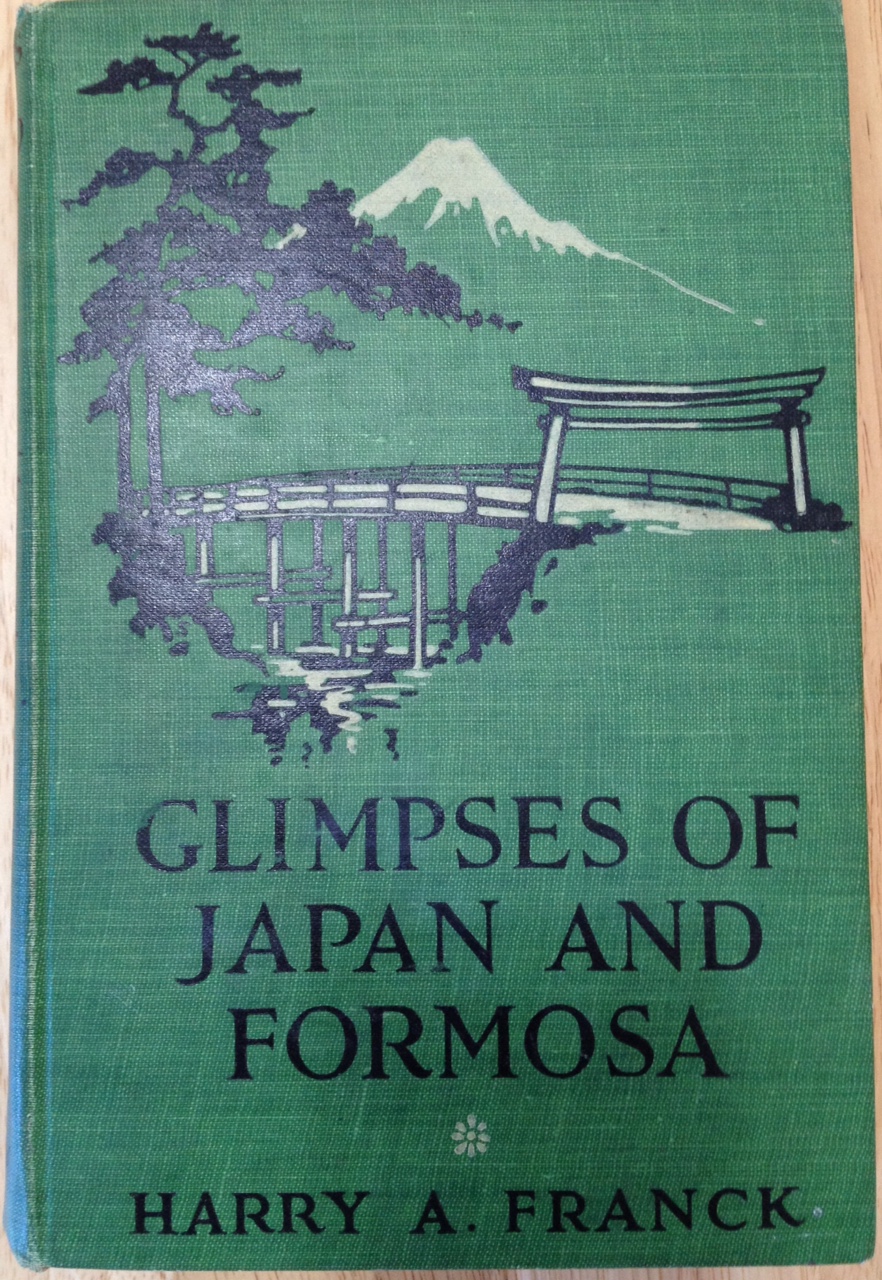
I did a little
- A February, 1925 review in The Bookman; A Review of Books and Life praised the book: "Here are no stilted observations, but lively human snapshots of life as lived by the Joneses and Smiths and Browns of Japan and Formosa. Exit the intriguing politician and the fanatical high priest, and enter the bourgeoisie, with the homely eccentricities as common to every people as the provincialisms of the national tongue. It can be truly said of 'Glimpses of Japan and Formosa' (Century) that its glimpses ring true and, in so far as the lay mind can tell, are faithful reproductions of Far Eastern life."
- A February 13, 1925 review in Journal of the Royal Society of Arts says that Franck "has a quick eye for noticing things of interest and a bright, pleasant way of telling them." The reviewer notes that Franck appears to have been able to see "a good deal" of Taiwan, as well.
- A May, 1925 review in The Geographical Journal argues that Franck "needs a longer residence in the Island Empire before he can fill the gap [in observations of the "New Japan"] with much success." "Mr. Franck," the reviewer continues, "says little enough that has not been said before, and he is not always well informed when he makes original remarks--as, for instance, when he states that independence is regarded as 'not even worth thinking about' by the Chinese-Formosans."
- A note in the September, 1925 issue of Political Science Quarterly calls the book "interesting" and "human and humorous," but concludes that it is "the utterance of a stranger describing strange things rather than a comprehending analysis by one who through years of association has become an understanding friend."
I did find some more recent scholarship that made use of Glimpses, though. Rachel Snow, in a 2006 dissertation on "vernacular photo-travel books," uses some images from the book although it appears that the bulk of her discussion of Franck is based on Roaming through the West Indies. Paul Barclay, in his 2010 article on "image-making in Taiwan under Japanese colonial rule," cites Franck in a couple of places, but he doesn't analyze the book in depth.
Finally, I'd note that Franck's descendants have developed their own website about the travel author. It shares some information about his biography and his service in the Second World War.
Wednesday, August 03, 2016
Brush with history: My father's photos of the May 19, 1946 Tokyo food demonstrations
Here are a few he took of a protest march from 1946.

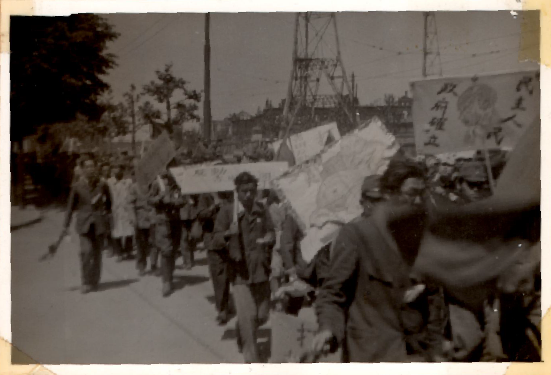 |
| The sign reads, I believe, "Establish Democratic People's Government" |
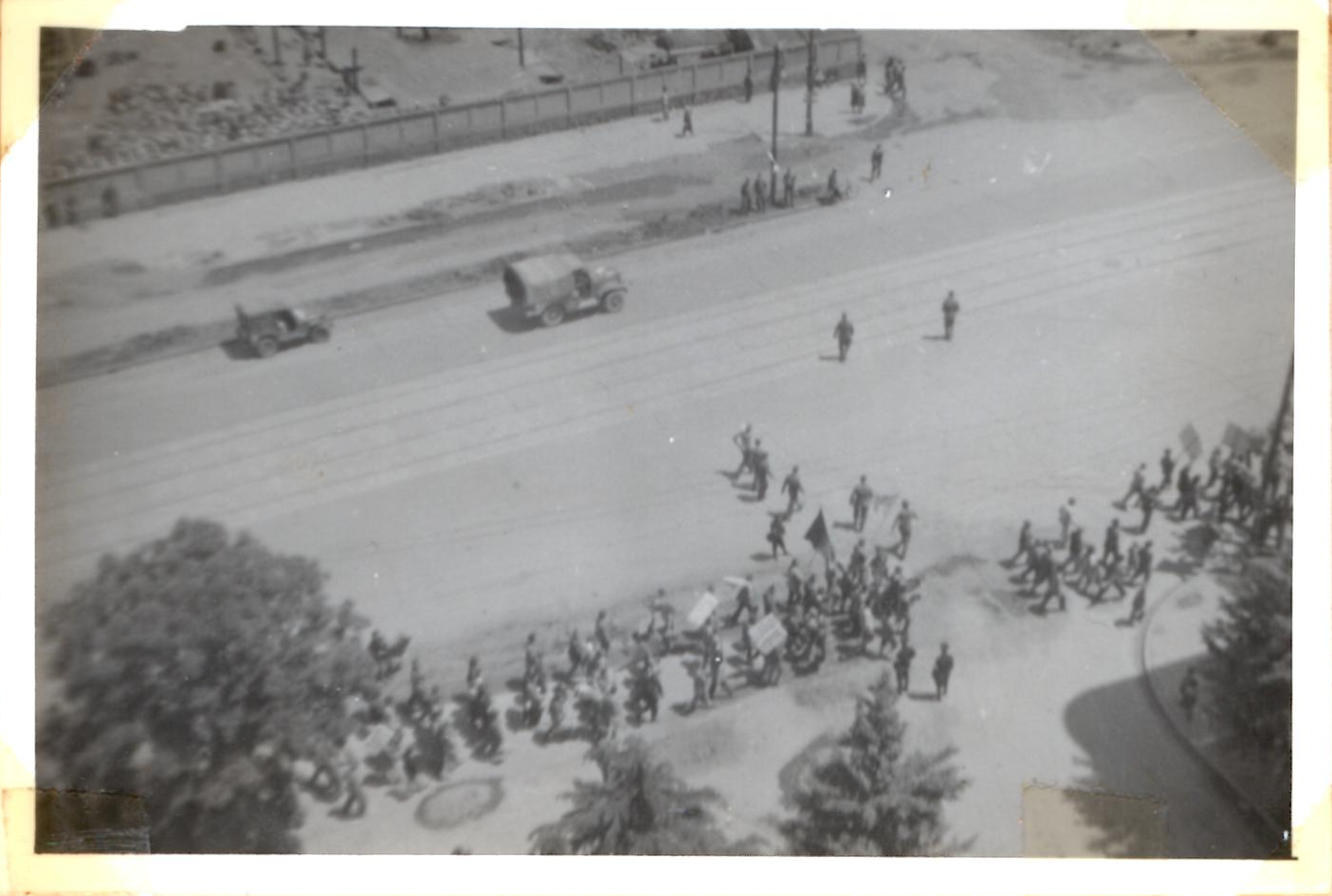
A diary excerpt by Mark Gayn (collected in The Cold War: A History in Documents and Eyewitness Accounts, edited by Jussi M. Hanhimäki and Odd Arne Westad) describes the demonstrations as follows:
The political pot is boiling madly. [Prime Minister] Yoshida is still struggling to form a new cabinet. As fast as he picks his ministers, it is discovered that they are war criminals subject to purge. Meanwhile, the food rationing machinery has bogged down. In the far north the distribution of food is thirty days behind schedule; in Tokyo, twelve. There are street-corner rallies, parades, mass meetings of protest. On Tuesday, eight hundred people demonstrated before the palace, demanding to know what the emperor was eating. On Friday, there were eight "food demonstrations" in front of rationing stations. Yesterday, twenty. There is a steady stream of marching men past the Diet and the premier's residence.
The climax came today with a "Give Us Rice" mass meeting. By ten o'clock on this bright, warm morning, there were at least 60,000 people at the imperial plaza. They had put three trucks together, and mounted tables on them for the speakers' platform. The chairman was the head of the Transport Workers' Union. But the meeting was actually run by a hard-looking man in corduroy knickers and a sports jacket. This was Katsumi Kikunami, an editorial writer for the Asahi, head of the Newspaper Union, and founder of the huge Congress of Industrial Unions. Grimly, he introduced a succession of speakers--union leaders, political workers, and just plain people.
One of these was a housewife of thirty-five, slim and plain-looking and obviously undernourished. She came from a ward in which there has been no rice distribution in two weeks. She had a child strapped to her back, and as she denounced the police and the rationing officials, the child's wailing came clear and loud over the loudspeaker.
But most of the speakers talked of politics. They demanded Yoshida's resignation, a Popular Front, a new cabinet including workers and farmers. "We must use the privileges we've gained since the war," cried Suzuki, editor of the Yomiuri, "One of them is the right to make revolutionary changes that will produce a democratic government. A one-day general strike will force Yoshida out!"
Tokuda was the last to speak. He wheeled around on the table top, pointed at the palace, and shouted: "We're starving. Is he?" He denounced Yoshida and the war criminals in the Diet, but he saved his sharpest barbs for the emperor. "Last week," he said, "we went to the palace and asked to see the emperor. We were chased away. Is it because of the emperor can say nothing but 'Ah, so. Ah, so?'" He mimicked the emperor. The crowd cheered wildly (...)There's more in the book, including General MacArthur's response to the protests, which, as Gayn's diary suggests, were attended by ordinary people, labor leaders, and more radical left-wing elements. In Embracing Defeat: Japan in the Wake of World War II, John Dower argues that the Americans occupying Japan after the war "contributed unwittingly to the circumstances in which such radical activities flourished by deciding to promote political freedom and social reform without taking an active role in rehabilitating the economy." MacArthur's response to the demonstrations "chilled the popular movement," writes Dower, although "it certainly did not freeze it." Later on, Dower writes that eventually,
[i]n the summer of 1948, MacArthur reversed occupation labor policy by withdrawing the right to strike from public employees, who commonly were in the vanguard where miserable pay, layoffs, and radical unionism were concerned. Simultaneously, occupation authorities worked diligently behind the scenes to promote the emergence of a virulently anticommunist "democratization" (mindo) movement within organized labor.By that time, however, my father, having been honorably discharged, was back in the U.S. and beginning the next chapter of his life. (Which also involved photography!)
My wife and I are scanning and organizing some of my late father's pictures from when he was in the MacArthur Honor Guard in postwar Japan. I'm not sure what camera he was using, but some of the pictures might be a bit out of focus.
Friday, July 22, 2016
A few comments on Hsiao-ting Lin's depiction of the White Terror
I wrote briefly a couple of months ago about Hsiao-ting Lin's book, Accidental State: Chiang Kai-shek, the United States, and the Making of Taiwan (Harvard, 2016)--see the bottom of this post. I'm closer to finishing the book now, and it has given some fascinating information about U.S.-Taiwan-China relations in the early postwar years. It also gave me some new information about how Thomas Liao tried to get the Supreme Commander of the Allied Powers (SCAP), MacArthur, to take over Taiwan at least temporarily before Chiang Kai-shek's retreat in 1949.
I do have an issue, however, with how Lin represents the White Terror, or the "white terror," as he calls it. A minor point is the use of lower case and quotation marks, which in my view seems to be an attempt to lessen its importance or seriousness. More importantly, he redefines the “White Terror” at one point, writing that in 1950, “secret police action was undertaken throughout the island against those who were potentially opposed to the Nationalist rule, generally labeled as ‘communist spies.’ … This marked the beginning of a decade-long “white terror” on the island” (p. 185, emphasis mine). (In an endnote to an earlier part, he suggests that the "white terror" lasted "from the 1950s to the 1970s" [p. 284, n. 84].) Every source I've seen about the period describes the White Terror as lasting for much, if not all, of the martial law period that ended officially in 1987. (I know some people who even disagree with the 1987 date and put it back into the 90s.)
Speaking of sources, Lin recommends two books in that aforementioned endnote, including (oddly) Kang-yi Sun’s Journey through the White Terror, a book that, though emotionally moving, as I wrote in a review of the Chinese-language original, is more of a memoir of her family's experiences during the White Terror than a comprehensive history of the period. Interestingly, as I mentioned in a comment to that earlier review, Sun seems to excuse higher-ups like Chiang Ching-kuo for their role in the White Terror (or at least her experience of the White Terror) more readily than many other victims might. I have not read the other source that Lin cites, Lan Bozhou's (藍博洲) 1993 book, White Terror (白色恐怖), so I can't speak to that book, though I wonder if there isn't anything more recent he could have cited.
These are perhaps minor issues, as are, perhaps, my issues with Lin's depiction of 228. Perhaps they add up to something more, and perhaps not. (Lots of "perhaps".) I do think Accidental State is a valuable and informative book, though, and it has given me some other perspectives on George Kerr's role in postwar U.S.-Taiwan relations.
I do have an issue, however, with how Lin represents the White Terror, or the "white terror," as he calls it. A minor point is the use of lower case and quotation marks, which in my view seems to be an attempt to lessen its importance or seriousness. More importantly, he redefines the “White Terror” at one point, writing that in 1950, “secret police action was undertaken throughout the island against those who were potentially opposed to the Nationalist rule, generally labeled as ‘communist spies.’ … This marked the beginning of a decade-long “white terror” on the island” (p. 185, emphasis mine). (In an endnote to an earlier part, he suggests that the "white terror" lasted "from the 1950s to the 1970s" [p. 284, n. 84].) Every source I've seen about the period describes the White Terror as lasting for much, if not all, of the martial law period that ended officially in 1987. (I know some people who even disagree with the 1987 date and put it back into the 90s.)
Speaking of sources, Lin recommends two books in that aforementioned endnote, including (oddly) Kang-yi Sun’s Journey through the White Terror, a book that, though emotionally moving, as I wrote in a review of the Chinese-language original, is more of a memoir of her family's experiences during the White Terror than a comprehensive history of the period. Interestingly, as I mentioned in a comment to that earlier review, Sun seems to excuse higher-ups like Chiang Ching-kuo for their role in the White Terror (or at least her experience of the White Terror) more readily than many other victims might. I have not read the other source that Lin cites, Lan Bozhou's (藍博洲) 1993 book, White Terror (白色恐怖), so I can't speak to that book, though I wonder if there isn't anything more recent he could have cited.
These are perhaps minor issues, as are, perhaps, my issues with Lin's depiction of 228. Perhaps they add up to something more, and perhaps not. (Lots of "perhaps".) I do think Accidental State is a valuable and informative book, though, and it has given me some other perspectives on George Kerr's role in postwar U.S.-Taiwan relations.
Thursday, July 21, 2016

Tuesday, July 05, 2016
"The Story of The United States Government..." in Taiwan and Bahrain
In honor (?) of July 4, I thought I'd post a publication from the U.S. Office of War Information--a booklet that George H. Kerr refers to in Formosa Betrayed. I found a copy of this pamphlet in in the GHK collection at the Taipei 228 Memorial Museum last summer and scanned it. The booklet is entitled, The Story of The United States Government ... How It Started ... And How It Works. It describes the U.S. system of government through the eyes of "John," a 21-year-old American citizen who reflects on what he has learned in school about the government, participates in electoral politics, and fulfills his obligations, such as performing jury duty. By presenting an idealized image of the American political system, the pamphlet encourages readers to admire that system.
Kerr writes about this booklet in chapter 10 of Formosa Betrayed, arguing that this kind of propaganda encouraged young unsophisticated Taiwanese to imagine that the U.S. would support them if they took action against the unjust Chen Yi administration. As Kerr puts it,
The pamphlet - like many others - took the form of a pictorial appeal to young people of middle and high school age, that age of political unsophistication when all things seem possible to achieve through direct action. Formosans reading it could see the parallel distinctly - their ancestors, too, had left mainland China for an open frontier, and they, too, had tried again and again to protest taxation without representation. (The taxation of tea was a very familiar issue.) For a quarter century their fathers and elder brothers had struggled under the Japanese to achieve local self-government through elective assemblies; now it was their turn to take up the self-sacrificing struggle.Actually, this particular pamphlet says little about the American Revolution. It notes that John had "learned how the people of the early American colonies fought and won their independence and freedom to govern themselves," and that "the American colonists, after winning their independence, recognized the need for a strong union among the colonies for their mutual protection and welfare." It's of course hard to say how much emphasis Taiwanese readers of this booklet would put on the idea of winning independence; possibly if they were reading it in the context of other pro-democracy rhetoric, they might mix together the messages of these various texts. Probably the most powerful or encouraging part of the pamphlet is at the end:
It is through experiences such as those described in this booklet that citizen John participates in the operation of his government. And it is as a result of these experiences that John's form of government has become precious to him --a government which permits freedom of religion, freedom of speech, freedom of the press, freedom of assembly, and freedom to choose those who govern. Today John and millions like him all over the world are fighting to keep these freedoms alive.As Kerr says, after quoting this paragraph, such a message "was construed to mean that the United States Government and the American people were standing by ready to support a 'fighting effort' to make democracy come true in Formosa." He concludes:
The United States Information Service Director realized that propaganda headquarters in Washington was paying not the slightest heed to our consular reports. These had been grave enough in early 1946, but as the year drew to a close they carried warning that a sense of crisis filled the island. November brought many new reports of conflict between the Formosans and the mainland Chinese, and some of these incidents - in retrospect - were to take on special significance. ... The possibility of violence was present; the ill-considered propaganda was inflammatory, but the Consulate continued to distribute it.As readers of Formosa Betrayed find out, in reality, the official response of the U.S. Consulate to Taiwanese requests for support in their struggle against the KMT, and in the aftermath of the February 28, 1947 Incident (and subsequent massacre), was "This is China now."
As readers can see, the pamphlet was published in English, which suggests a desire to appeal to more educated people in Taiwan. (Interestingly, it doesn't describe the electoral system when explaining how leaders are elected.) Publishing in English was probably also more economical, since the booklet could also be sent to other countries. I came across another reference to this pamphlet in a post on the British Library's American Collections blog. This post, by Louis Allday, focuses on how the U.S. sent this and other pamphlets to the chief of the Bahrain Police Force in 1946 (the same year it was sent to Taiwan). Allday discusses three pamphlets, two of which (including The Story of the United States Government...) were in English, and one of which was in Arabic. At the time, Bahrain was controlled by the British, who were none too happy to see such American propaganda sent there.
Subscribe to:
Comments (Atom)