Monday, April 16, 2007
Not again...
I remember checking CNN's website 8 years ago (almost to the day) and feeling sick when I read about the shootings at Columbine. Now this happens at Virginia Tech...


What sixth graders were reading about fifty years ago
I'm almost finished a revision of what has felt like an interminable chapter--and for part of that translated the following lesson from the sixth grade, second semester Guoyu textbook published in late 1956. Thought I'd post it to give a sense of what sixth-graders in Taiwan were reading in their Chinese classes about 50 years ago.
This textbook includes another martyr tale--a two-part story about Wu Feng, who was said to have sacrificed himself in order to persuade Aborigines to stop headhunting. That the Guoyu textbook of that time contains violent tales of martyrs isn't particularly surprising, considering the government's project of trying to condition young people to be willing to sacrifice themselves for the cause of retaking the mainland. I was surprised, however, by the composition exercise that asks students to write about bombing an enemy country. I'd really be interested in seeing what sixth-graders came up with in response to that kind of prompt. (Doubt I'll ever run across anything like that, though.)
I'm also curious about how long this story of Yan Haiwen was used in elementary school language textbooks. I haven't seen any earlier Guoyu textbooks from Republican China, so I'm not sure if this story was retained from that time. And it would be interesting to see when it went "out of fashion", too.
(Source: Guomin xuexiao Guoyu keben gaoji disi ce 國民學校國語課本高級第四冊--this was the textbook for second-semester sixth-graders, published in December 1956)
The story of Yan Haiwen has shown up in at least one movie (1977's 筧橋英烈傳 "Heroes of the Eastern Skies"), which I haven't yet seen.Air Force Martyr Yan Haiwen
On the morning of August 17, 1937, in the blue and cloudless skies above the Jiangsu-Shanghai area, a Chinese bomber was surrounded by the enemy's antiaircraft shells and was clearly in great danger. Because of the concentration of the enemy’s antiaircraft guns, countless shells burst around this plane, bringing heavy smoke and blocking its movement. Suddenly, black smoke burst from the plane's tail; then a tiny dot jumped from the plane's cockpit, becoming a beautiful parachute, perfectly round and white, which floated down.
There was immediate commotion among the enemy, and the enemy soldiers climbed from their trenches; a clamor coming from their mouths, they headed over to where the parachute landed.
A Chinese pilot appeared in front of them.
Young--not much more than twenty--he stood on a piece of high ground.
Dozens of enemy soldiers began to surround him. Although he was only one man, he showed not a trace of fear, and in his hand he held a handgun, raising it imposingly.
An enemy officer ran over to him, trying to persuade him to surrender. He used his gun to reply to this great insult: bang, bang, bang--the gun sounded three times, and that officer and two enemy soldiers fell. There was a clamor among the rest of the enemy soldiers, and they dropped back. From behind, a Type 38 rifle sounded, and hundreds of enemy soldiers holding weapons once again surrounded him.
At this point, he only had one bullet left. He looked around him--the enemy was everywhere, a turbulent yellow wave. Above was the fatherland's beautiful blue sky; underneath, the fragrant grass of the fatherland. This young soldier's heart felt great pain; his hot blood rushed upwards, and when the enemy was no more than fifty meters away, standing on the field of the fatherland he raised his gun to his temple and fired, a young warrior who finally died for the fatherland.
The enemy, honoring his bravery, buried him and set up a memorial for him that said: "The Grave of Yan Haiwen, a Brave Soldier for China."
Exercises:
Speaking: How did China's Air Force defeat the enemy? Why did the martyr Yan Haiwen have to jump out in a parachute? How did he appear to the enemy? How did he treat the enemy? Why did the enemy bury him and set up a memorial for him? Who was China's enemy at that time? Now what enemies do we have?
Writing Characters: Listen and write the following words and phrases:
轟炸機 (bomber), 高射礮 (antiaircraft gun), 渾圓 (perfectly round), 騷動 (commotion), 亂嚷 (clamor), 威風凜凜 (imposing, or awe-inspiring), 洶湧 (turbulent), 殉職 (die at one’s post)
Composition: Write a narrative about bombing the enemy country.
This textbook includes another martyr tale--a two-part story about Wu Feng, who was said to have sacrificed himself in order to persuade Aborigines to stop headhunting. That the Guoyu textbook of that time contains violent tales of martyrs isn't particularly surprising, considering the government's project of trying to condition young people to be willing to sacrifice themselves for the cause of retaking the mainland. I was surprised, however, by the composition exercise that asks students to write about bombing an enemy country. I'd really be interested in seeing what sixth-graders came up with in response to that kind of prompt. (Doubt I'll ever run across anything like that, though.)
I'm also curious about how long this story of Yan Haiwen was used in elementary school language textbooks. I haven't seen any earlier Guoyu textbooks from Republican China, so I'm not sure if this story was retained from that time. And it would be interesting to see when it went "out of fashion", too.
(Source: Guomin xuexiao Guoyu keben gaoji disi ce 國民學校國語課本高級第四冊--this was the textbook for second-semester sixth-graders, published in December 1956)
Monday, April 09, 2007
Another reason I gotta get this diss. done
I woke up early this morning, then fell asleep again and dreamed that I was at a used book sale at a university in the States. I got the idea to look through some old hymnals from the late nineteenth and early twentieth centuries to see if I could find the tune to the Shansi Hymn that used to be sung on Shansi Day at Oberlin College. (That was the day they would announce which Oberlin graduates would be representatives to China.) The hymn, written by Herbert A. Youtz, was sung to the tune of "No. 541" in some mysterious hymnal which I haven't yet found. So I was looking through old hymnals for "No. 541" to see if the tune would fit the lyrics.
Meanwhile, Nicolas Cage was standing a few yards away looking at an old art book and talking to the seller about an oddity in something that the book said about an artist's life. I was going through hymnals, some of which didn't go up to 541, some of which skipped 541 (went from 540 to 542), then I came to one that had 541. I was having trouble singing the Shansi Hymn to the tune of 541 because I'm not very good at sight-reading, and Nicolas Cage said to me, "I didn't know you were interested in old hymnals, Jon."
"Oh, I'm trying to find the tune that fits a hymn that they used to sing on Shansi Day in the early 1900s, Nic."
"Oh," he said.
"But I'm not very good at sight reading, so I can't tell if this hymn fits the words."
"Oh, well give me a few lines and I'll try," he said. (He's quite the Renaissance man, you know.)
So I reeled off a few lines to the hymn:
"But I want to stay asleep and see if Nicolas Cage and I find the right hymn," I said.
"Give it up, Jon," I said. "It's just a dream. Even if you find the hymnal, it might not be real."
"Oh--yeah. I guess so." So I woke up.
[Update, 6/26/07: Nic Cage never got back to me on this, but the amazing team of Ken Grossi (of the Oberlin Archives) and Mary Louise Van Dyke (Oberlin Library's resident hymnologist) solved the mystery of Tune No. 541 for me. From Ken's e-mail to me:
[Update 2, same date: That was quick! The tune turns out to be by Haydn; Hymn 541, "Glorious Things of Thee are Spoken". Here's the tune (sorry, it's not a link to my singing...)]
Meanwhile, Nicolas Cage was standing a few yards away looking at an old art book and talking to the seller about an oddity in something that the book said about an artist's life. I was going through hymnals, some of which didn't go up to 541, some of which skipped 541 (went from 540 to 542), then I came to one that had 541. I was having trouble singing the Shansi Hymn to the tune of 541 because I'm not very good at sight-reading, and Nicolas Cage said to me, "I didn't know you were interested in old hymnals, Jon."
"Oh, I'm trying to find the tune that fits a hymn that they used to sing on Shansi Day in the early 1900s, Nic."
"Oh," he said.
"But I'm not very good at sight reading, so I can't tell if this hymn fits the words."
"Oh, well give me a few lines and I'll try," he said. (He's quite the Renaissance man, you know.)
So I reeled off a few lines to the hymn:
Founded on the blood of martyrs,So there Nicolas Cage and I were, digging through old hymnals, trying to find a hymn that would fit the lyrics to the Shansi Hymn. Then I suddenly felt I should wake up.
See the walls of Shansi stand
Witness to a great devotion,
Tomb of an heroic band.
From the death of her slain Master,
Grows the Living Church today;
Through self-sacrifice of heroes
Comes the power of God alway.
"But I want to stay asleep and see if Nicolas Cage and I find the right hymn," I said.
"Give it up, Jon," I said. "It's just a dream. Even if you find the hymnal, it might not be real."
"Oh--yeah. I guess so." So I woke up.
[Update, 6/26/07: Nic Cage never got back to me on this, but the amazing team of Ken Grossi (of the Oberlin Archives) and Mary Louise Van Dyke (Oberlin Library's resident hymnologist) solved the mystery of Tune No. 541 for me. From Ken's e-mail to me:
The title of the hymnal is "Church Hymns and Tunes," edited by Rev. Herbert B. Turner, D.D. and William F. Biddle (New York: A.S. Barnes and Company, 1909). The book contains an Austrian Hymn 8.7.8.7.D. with the Tune No. 541 at the top of the page. Mary Louise concluded that the tune for this song was also used for the words of the song on the Shansi Day Program (by Herbert Alden Youtz).There you have it. I should be getting a copy of the tune in a few days, after which I'll let all you who are waiting with bated breath know what exactly "Austrian Hymn 8.7.8.7.D is. Oh! the supsense!]
[Update 2, same date: That was quick! The tune turns out to be by Haydn; Hymn 541, "Glorious Things of Thee are Spoken". Here's the tune (sorry, it's not a link to my singing...)]
Friday, March 23, 2007
A big piece of real estate
The Taichung City Government's website reports here that a Hong Kong investor, Richard Li, is interested in developing the old Shuinan Airport. We heard about this on the TV news earlier (though they focused more on how a city councilwoman was trying to act as a matchmaker between Li and the mayor's daughter Hu Ting-Ting).
 Shuinan Airport
The TV news was suggesting that the redevelopment might result in a rise in the cost of housing in Taichung. But the story on the website mentions some problems with the Ministry of National Defense that might slow down the redevelopment of the airport. Anyone heard anything more about this?
Thursday, March 22, 2007
Oysters coming home to roost
(Don't ask me what that title's supposed to mean--I have no idea!)
My colleague and fellow disser-commiserator John just sent me a copy of the original short story "A Pail of Oysters" that Vern Sneider published in the Antioch Review in 1950. (The novel, about which I've written three posts, was published in 1953.)
I haven't had time to read the story yet--I'm too busy fighting my way through a dissertation chapter that I want to finish before the end of the month--but I notice it seems a lot more focused on Li Liu and his family. There doesn't appear to be any Didi, Precious Jade, or Ralph Barton in this story. Hmmm... (More later...)
And thanks, John!
Sunday, February 25, 2007
Back from Oberlin
Had a nice time in Oberlin, despite all the warnings we got prior to going about the terrible weather in the Cleveland area.
 (Saw this igloo on Oberlin's campus on Tuesday. By Wednesday it had mostly melted away.)
Got some good productive time in at Oberlin's Archives, thanks to the kind help of Roland Baumann, Ken Grossi, and Tammy Martin (and their assistants). Thanks, all!
We had dinner Monday night with our friend ERG, who came to Oberlin to visit. Had a great time with him!
We also got some needed shopping in. (It's nice to be able to buy shoes in a place where the clerks don't keep reminding you that you have big feet...)
I read three books on the flight there and back. On the way over, I read From Evangelicalism to Progressivism at Oberlin College, 1866-1917 by John Barnard (available for free online at OSU's Knowledge Bank). On the way back, helped by a 3-hour delay on the runway due to a heavy crosswind, I read The Kite Runner by Khaled Hosseini and Ordeal by Slander by Owen Lattimore. Good books! (See, I don't just buy 'em...)
But now it's back to work. Classes begin March 1, so I have syllabi to write and a few days to get some quality dissertating time in. So... talk to y'all later...
[Update: And now I can see what we just missed, weather-wise...]
Wednesday, February 07, 2007
Sunday, February 04, 2007
"And you know, I don't even feel any withdrawal symptoms..." (he said, his lips trembling...)
Our home has been without Internet service for the past few days (lousy phone company), but we haven't had time to call them to find out what's wrong. And we don't miss it that much, either. So the former native Chinese speaker and I decided tonight that we're going to cancel our ADSL service at home. And I feel pretty good about it, actually. (But I wonder if I'll start to gain weight...)
Thursday, January 25, 2007
Friday, January 19, 2007
I would be remiss not to mention this...
Dunkin' Donuts has arrived in Taiwan. (And I just went to Mr. Mister Donut for the first time last Sunday. I'm so out of style.)
It sounds like the Taiwan stores will also offer the ham, egg, and cheese breakfast bagels that helped me face those awful Syracuse winters...
Update: Thanks to Heather's comment and the wonder that is YouTube, I now present...
It sounds like the Taiwan stores will also offer the ham, egg, and cheese breakfast bagels that helped me face those awful Syracuse winters...
Update: Thanks to Heather's comment and the wonder that is YouTube, I now present...
Monday, January 15, 2007
Weekend trip
We had some time off yesterday, so we took the High-Speed Rail (HSR) to Taipei yesterday. We could only get a one-way trip, and we could only get seats on the 7 o'clock train. But that turned out to be OK.

People like to take pictures when the train is coming. Here's one guy trying to fit in his family and the train. I love that photographer's pose. Looks like he's in training for the next Matrix movie....
The trip was smooth and quick--we left right at 7:00 and arrived in Banqiao (or "Banciao", as they write it) 53 minutes and 25 seconds later. (In contrast, the bus we took from Taipei to Taichung last night took about 2 hours--and I think the driver was speeding the whole way.)
We spent the morning at the Taipei 228 Memorial Museum. Quite a sobering experience. (There's also a "virtual museum" that contains a lot of the pictures that are on display at the museum. Unfortunately, it's only available in Chinese.)
Coming back to Taichung, we felt kind of jealous of Taipei's MRT system, though we know how much people in Taipei suffered during the construction of the subway. But we're hoping to see something like it in Taichung one of these days...
Thursday, January 11, 2007
Goal
To finish my dissertation before my fortieth birthday. (Let's see, that gives me about 31,449,600 seconds, give or take.)
Four new books in the former native speaker's library
It was almost like a birthday present (except that I paid for them...). This afternoon I got a box from Labyrinth Books, containing the four books that I ordered in November. They are all hardbound books, but only one (the Luce book) has a dust jacket. But three of them were less than US$10 each, and the last book was only $15. Not a bad deal...
- Henry R. Luce, Time, and the American Crusade in Asia by Robert E. Herzstein (Cambridge UP, 2005)
- Renaissance Debates on Rhetoric edited and translated by Wayne A. Rebhorn (Cornell UP, 2000)
- A Tragic Beginning: The Taiwan Uprising of February 28, 1947 by Lai Tse-han, Ramon H. Myers, and Wei Wou (Stanford UP, 1991)
This has been characterized as a "case study of pseudo-objectivity" written by KMT apologists at the Hoover Institution, but it's still important to read, I think. - The United States in the Asia-Pacific since 1945 by Roger Buckley (Cambridge UP, 2002)
Wednesday, January 10, 2007
"Draco dormiens nunquam titillandus"
It's the week that all the first-year students take their English oral final exams here. Walking around the building, you can see students standing all over, holding papers and mumbling strange words to themselves. It's times like these that I begin to think I'm actually teaching at Hogwarts.
One of my first-year students just used "vouchsafe" in her oral test, and another used "artifice." Either I'm doing something right, or their electronic dictionaries are working overtime...
One of my first-year students just used "vouchsafe" in her oral test, and another used "artifice." Either I'm doing something right, or their electronic dictionaries are working overtime...
Back to the archives
(I gotta work on writing better titles...)
I just read Christopher Phelps's (or is it Christopher Phelps'?) column in the Chronicle about his dream archive. Some points to remember before I dig around in the Oberlin archives this winter break (or that I wish I had thought of last time I was there, so I wouldn't have to dig around in the archives this winter break):
[Update, 1/12/07: OK--got the donation box up and running (on the upper right-hand side of the page. I don't expect much, but it's worth a try...]
I just read Christopher Phelps's (or is it Christopher Phelps'?) column in the Chronicle about his dream archive. Some points to remember before I dig around in the Oberlin archives this winter break (or that I wish I had thought of last time I was there, so I wouldn't have to dig around in the archives this winter break):
- "Archival copy rates vary a great deal. The top end often seems usurious at 50 cents or more a page. Nevertheless, price cannot deter a scholar. Should I order $319 worth of copies? Answer: of course. It's cheaper than a plane ticket or gasoline, room, and board should I have to return for a second trip."
[Update, 1/12/07: OK--got the donation box up and running (on the upper right-hand side of the page. I don't expect much, but it's worth a try...]
Tuesday, January 09, 2007
TaichungPAWS
My colleague Douglas informed us about an organization he's involved with called Taichung People Animals Welfare Society (Taichung PAWS) that has begun recently. Here's an introduction from the organization's website:
We are a group of concerned people from various countries who have joined together to care for homeless animals in the Taichung area. Each of us has different motivations and ideas about homeless animals in Taiwan, but we have one thing in common: that we all care deeply about animals. We want to see some changes in our local society. We hope that there will no more homeless animals in Taiwan. We hope that more people will adopt and care for animals. We hope that people will stop killing animals and choose TNR (trap/neuter/release) to control homeless animal populations. We hope that the next generation of Taiwanese will be more educated about animals and that they will have concern for animals as we do. We hope to solve the problems of homeless animals in the Taichung area through Adoption/fostering, TNR, and education.They're holding an event from 1 to 5 p.m. on Saturday 1/13 at the Our Home Cafe near World Gym. (Here's a map.) More details here.
Monday, January 08, 2007
Three books the former native speaker wishes were in his library, but is content (for now) to borrow from someone else's library
During an online search this past weekend for materials related to Vern Sneider's A Pail of Oysters, I came across a reference to some letters that he exchanged with George Kerr, author of Formosa Betrayed. Some images of those letters are available online via the National Repository of Cultural Heritage, but I also found out that the 228 Museum in Taipei published a 3-volume set related to Kerr:
- Collected Papers by George H. Kerr
- Correspondence by and about George H. Kerr (I)
- Correspondence by and about George H. Kerr (II)


Saturday, January 06, 2007
Didn't realize they were so healthy...
BBC News reports that Momofuku Ando, the Taiwan-born Japanese inventor of instant noodles and founder of Nissin Food Products, has died at the ripe old age of 96. Notable is the fact that, according to the BBC, Ando "often ate his company's instant noodles." Guess Nissin really produces "long-life noodles"...
Hegemony
It's windy this evening, so I wore my favorite baseball cap when I went out for a quick walk:
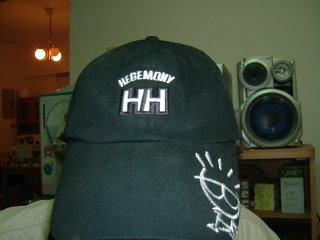
I get a strange feeling of power whenever I wear it. (Unfortunately, it didn't stop the guy in the SUV from almost running me over. Guess that's another example of the material world trumping language.)
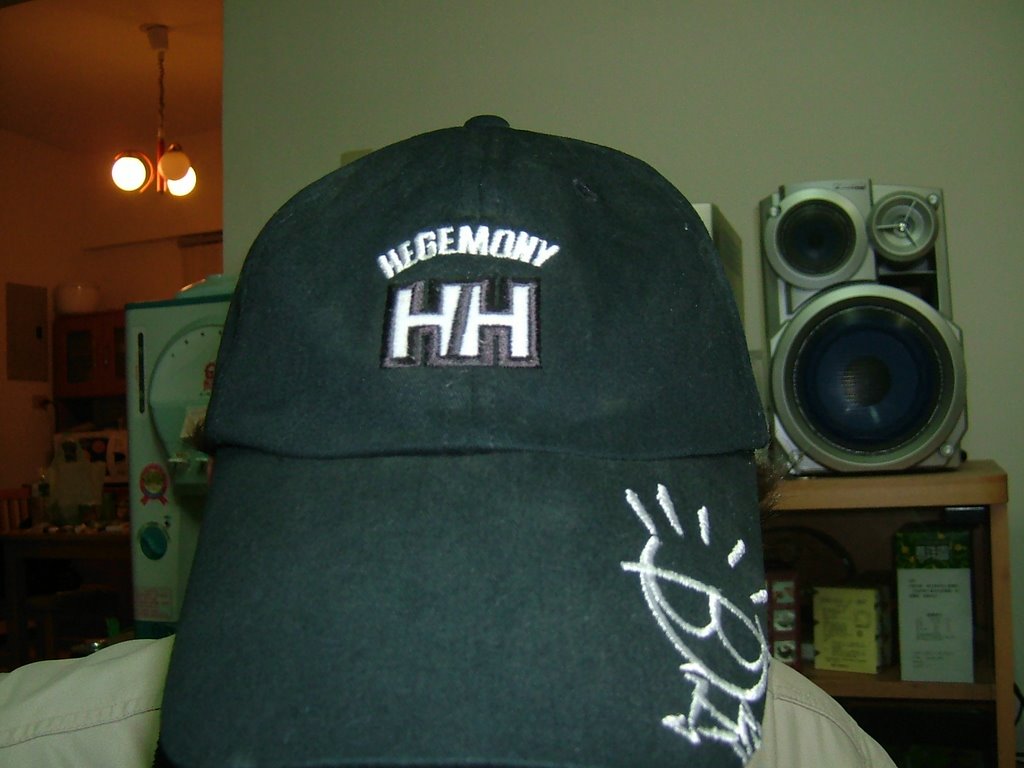
I get a strange feeling of power whenever I wear it. (Unfortunately, it didn't stop the guy in the SUV from almost running me over. Guess that's another example of the material world trumping language.)
Thursday, January 04, 2007
I'm starting off 2007 with this?!
We've been going to a certain restaurant in Taichung for a couple of years, and I always found amusing a sign that is stuck on the door of a stall in the men's restroom. It's in the stall where the "squatter" toilet is located. Well, this time I happened to have my camera with me, so I took a picture of the sign:
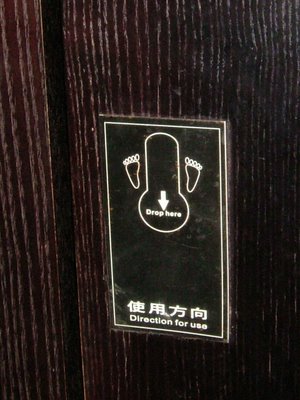 Now I don't teach technical writing, but it would be interesting to do some usability testing on these instructions. (Would people think that they had to take off their shoes before "dropping"?...)
I had a little trouble getting a clear shot because the sign kept reflecting the light of the flash, so I tried a couple of times until I found that standing at an angle and using red-eye reduction made for a pretty clear picture.
It was at about this point that I also realized that if anyone had come into the restroom and seen multiple flashes coming from inside one of the stalls, I'd have had a bit of explaining to do... Guess I could have told them I was 閃電俠 (the Flash)...
(Remind me to get a picture of the other sign--the one that contains the words "Memento excrementi"*--some time.)
*Sounds like a great title for a blog, doesn't it?
 Now I don't teach technical writing, but it would be interesting to do some usability testing on these instructions. (Would people think that they had to take off their shoes before "dropping"?...)
I had a little trouble getting a clear shot because the sign kept reflecting the light of the flash, so I tried a couple of times until I found that standing at an angle and using red-eye reduction made for a pretty clear picture.
It was at about this point that I also realized that if anyone had come into the restroom and seen multiple flashes coming from inside one of the stalls, I'd have had a bit of explaining to do... Guess I could have told them I was 閃電俠 (the Flash)...
(Remind me to get a picture of the other sign--the one that contains the words "Memento excrementi"*--some time.)
*Sounds like a great title for a blog, doesn't it?
Subscribe to:
Posts (Atom)